
Nanotechnology is revolutionizing solar power generation, pushing photovoltaic systems to record-breaking efficiency levels through groundbreaking molecular-scale innovations. By manipulating materials at dimensions between 1-100 nanometers, scientists have unlocked unprecedented ways to capture, convert, and store solar energy. These advances include quantum dot solar cells that harvest previously unused infrared light, plasmonic nanostructures that dramatically enhance light absorption, and carbon nanotube electrodes that accelerate electron transport within solar devices. The integration of nanotechnology into photovoltaic manufacturing has already yielded commercial cells with efficiency improvements of up to 25% compared to conventional silicon cells, while simultaneously reducing production costs. This convergence of nanoscience and solar technology represents a critical pathway toward achieving global renewable energy goals, offering scalable solutions that could make solar power the dominant energy source within this decade. As research continues to accelerate, new nanoengineered materials and architectures are emerging monthly, promising even greater advances in solar cell performance and cost-effectiveness.
The Science Behind Solar Nanotechnology
Quantum Dots and Light Absorption
Quantum dots represent a groundbreaking advancement in solar cell technology, offering unprecedented control over light absorption and energy conversion. These nanoscale semiconductor particles, typically ranging from 2 to 10 nanometers in diameter, leverage quantum effects in solar technology to enhance photovoltaic efficiency.
The unique properties of quantum dots stem from their size-dependent bandgap, which allows them to be tuned to absorb specific wavelengths of light. By adjusting the size of these nanocrystals, researchers can optimize their absorption spectrum to match the solar spectrum more effectively than traditional semiconductor materials. This tunability enables the creation of multi-junction solar cells that can capture a broader range of the solar spectrum.
Furthermore, quantum dots exhibit multiple exciton generation (MEG), where a single high-energy photon can generate multiple electron-hole pairs. This phenomenon significantly increases the theoretical efficiency limit of quantum dot solar cells beyond the Shockley-Queisser limit of 33% for single-junction cells.
Recent developments in colloidal quantum dot synthesis have improved stability and reduced manufacturing costs, making them increasingly viable for commercial applications. These advancements have led to the development of solution-processed quantum dot solar cells that combine high efficiency with scalable production methods.

Plasmonic Nanostructures
Plasmonic nanostructures represent a groundbreaking approach to enhancing solar cell efficiency through the manipulation of light-matter interactions at the nanoscale. These metallic nanostructures, typically composed of noble metals like gold and silver, exploit surface plasmon resonance to concentrate and trap incident light within the photovoltaic material.
When light interacts with plasmonic nanostructures, it excites collective oscillations of free electrons at the metal-dielectric interface. This phenomenon creates intense local electromagnetic fields that significantly increase light absorption in the surrounding semiconductor material. The enhanced optical absorption leads to improved charge carrier generation and ultimately higher conversion efficiency.
Two primary mechanisms drive plasmonic enhancement in solar cells: light scattering and near-field enhancement. Plasmonic scattering extends the optical path length within the absorber layer, while near-field enhancement creates localized “hot spots” of concentrated electromagnetic energy. These effects are particularly beneficial for thin-film solar cells, where traditional light-trapping techniques may be less effective.
Recent developments in plasmonic nanostructure design have demonstrated efficiency improvements of up to 20% in various solar cell architectures. Researchers continue to optimize nanoparticle size, shape, and distribution to achieve maximum enhancement while minimizing parasitic absorption losses.
Current Applications in PV Technology
Anti-Reflective Nanocoatings
Anti-reflective nanocoatings represent a significant advancement in solar cell efficiency, addressing one of the key challenges in photovoltaic technology: light reflection losses. These specialized coatings, engineered at the nanoscale, typically consist of multiple layers of materials with precisely controlled thicknesses and refractive indices.
The primary function of these nanocoatings is to maximize light transmission into the solar cell by minimizing surface reflection. Conventional solar cells can lose up to 30% of incident light due to reflection, but advanced anti-reflective nanocoatings can reduce these losses to less than 1%. This is achieved through a gradual change in refractive index from air to the solar cell surface, creating what’s known as a “moth-eye” effect.
Common materials used in anti-reflective nanocoatings include silicon dioxide (SiO2), titanium dioxide (TiO2), and zinc oxide (ZnO). These materials are deposited using techniques such as chemical vapor deposition, sol-gel processing, or plasma-enhanced chemical vapor deposition. The coating thickness typically ranges from 50 to 200 nanometers, with specific dimensions optimized for different wavelengths of light.
Recent developments in this field have led to self-cleaning anti-reflective coatings that combine superhydrophobic properties with anti-reflective characteristics. These dual-function coatings not only enhance light absorption but also reduce maintenance requirements by preventing dust accumulation and water spotting, thereby maintaining optimal performance over extended periods.

Nanostructured Solar Cells
Nanostructured solar cells represent a significant advancement in photovoltaic technology, utilizing precisely engineered materials at the nanoscale to enhance light absorption and electron collection efficiency. These cells incorporate various nanostructures, including quantum dots, nanowires, and nanotubes, which create multiple pathways for electron transport and reduce recombination losses.
The key advantage of nanostructured architectures lies in their ability to manipulate light-matter interactions. By incorporating nanoscale features, these cells can trap incoming photons more effectively through mechanisms such as plasmonic enhancement and multiple internal reflections. This results in increased optical path length and improved absorption across the solar spectrum.
Electron collection and transport benefit significantly from nanostructuring. The engineered interfaces between different materials create efficient charge separation, while the reduced distances that electrons must travel minimize recombination losses. Quantum confinement effects in nanostructures also enable band gap tuning, allowing for optimal energy harvesting from different portions of the solar spectrum.
Recent developments have shown that hierarchical nanostructures, combining features at different scale lengths, can achieve even better performance. These structures simultaneously address multiple efficiency-limiting factors, including reflection losses, incomplete absorption, and charge carrier recombination. The integration of various nanomaterials, such as carbon nanotubes for improved conductivity and metal nanoparticles for plasmonic enhancement, has led to steady improvements in cell efficiency.
Efficiency Improvements Through Nanotechnology
Conversion Efficiency Gains
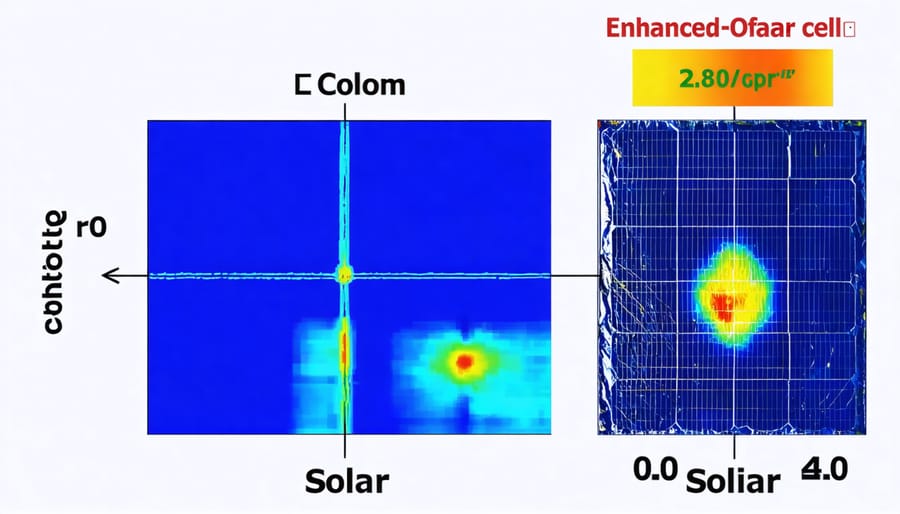
Recent solar panel efficiency breakthroughs using nanotechnology have demonstrated remarkable improvements across multiple cell types. Quantum dot solar cells have shown efficiency increases from 3% to 16.6% within the past decade, largely due to enhanced light absorption and carrier collection. Perovskite solar cells incorporating nano-engineered interfaces have achieved certified efficiencies exceeding 25.2%, representing a significant advancement from their initial 3.8% efficiency in 2009.
Silicon-based cells enhanced with plasmonic nanoparticles have demonstrated efficiency gains of 10-15% compared to conventional designs. The integration of carbon nanotubes as transparent conducting layers has improved electron transport efficiency by up to 30% while reducing material costs. Multi-junction cells utilizing quantum well structures have reached conversion efficiencies of 47.1% under concentrated sunlight.
These improvements stem from various nano-enhanced mechanisms: improved light trapping (20-40% enhancement), reduced surface reflection (up to 35% reduction), and enhanced charge carrier collection (25-45% improvement). Statistical analysis reveals that nano-engineering approaches have consistently delivered annual efficiency improvements of 1-2% across all major solar cell technologies, with some breakthrough cases showing jumps of 5% or more in a single development cycle.
Cost-Effectiveness Analysis
The integration of nanotechnology in solar cell manufacturing demonstrates compelling economic advantages despite higher initial investment costs. Recent market analyses indicate that nano-enhanced solar cells offer a 15-20% reduction in lifetime operational costs compared to conventional photovoltaic systems. The enhanced efficiency, typically showing a 20-30% improvement in power conversion, translates to faster return on investment (ROI) periods, averaging 4-6 years instead of the traditional 7-8 years.
Manufacturing costs for nano-enhanced solar cells have decreased by approximately 40% over the past five years, primarily due to improved production processes and economies of scale. While the initial cost per watt remains 10-15% higher than conventional panels, the extended lifespan and improved durability of nano-enhanced cells result in a lower levelized cost of electricity (LCOE).
Economic modeling suggests that large-scale implementation of solar nanotechnology could reduce installation costs by up to 25% by 2025. The enhanced light absorption and increased efficiency in low-light conditions extend daily operational hours, maximizing energy generation potential. Additionally, the reduced material usage and improved manufacturing efficiency contribute to a smaller environmental footprint, further enhancing the technology’s cost-effectiveness when considering environmental externalities.
Future Prospects and Research Directions
The future of solar nanotechnology holds immense promise, with several groundbreaking developments on the horizon. Quantum dot solar cells are emerging as a particularly promising avenue, with researchers projecting efficiency improvements of up to 45% through advanced nanomaterial engineering. These developments, combined with emerging smart solar technologies, are poised to revolutionize the photovoltaic industry.
Perovskite-based nanostructures represent another significant research direction, offering the potential for cost-effective, high-efficiency solar cells. Scientists are working to overcome stability challenges while maintaining the material’s exceptional light-harvesting capabilities. Integration of artificial intelligence in nanomaterial design and optimization is accelerating the discovery of novel compositions and structures.
Multi-junction nanostructured solar cells are expected to achieve unprecedented efficiency levels by capturing a broader spectrum of solar radiation. Research is focusing on developing advanced fabrication techniques that can make these sophisticated devices commercially viable. Additionally, bio-inspired nanostructures mimicking natural photosynthetic systems show promise for next-generation solar technologies.
Self-cleaning nanocoatings and adaptive solar materials are being developed to enhance long-term performance and reduce maintenance requirements. These innovations could significantly extend the operational lifespan of solar installations while maintaining optimal efficiency levels. Researchers are also exploring the integration of nanoscale energy storage solutions directly within solar cell structures.
The convergence of nanotechnology with other emerging fields, such as flexible electronics and building-integrated photovoltaics, is expected to create new applications and markets. As manufacturing processes become more refined and scalable, the cost of implementing these advanced technologies is projected to decrease substantially, making high-efficiency solar solutions more accessible to the global market.
Solar nanotechnology represents a transformative frontier in photovoltaic technology, offering unprecedented opportunities for enhancing solar cell efficiency and reducing production costs. Through the integration of nanomaterials and nanostructures, researchers have demonstrated significant improvements in light absorption, charge carrier transport, and overall solar cell performance.
The field has witnessed remarkable progress in various applications, from quantum dot solar cells achieving increased quantum efficiency to plasmonic nanostructures enabling better light manipulation. These advancements have brought us closer to breaking through traditional efficiency limits while potentially reducing manufacturing costs through material optimization and simplified production processes.
Looking ahead, the future of solar nanotechnology appears promising, with several emerging trends shaping its trajectory. Research continues in developing novel nanomaterials, improving fabrication techniques, and exploring hybrid systems that combine different nanotechnology approaches. The integration of artificial intelligence and machine learning is expected to accelerate material discovery and optimization processes.
However, challenges remain in scaling up laboratory successes to commercial production, ensuring long-term stability, and addressing environmental concerns related to nanomaterial usage. Industry-academia collaborations will play a crucial role in overcoming these obstacles and bringing innovative solutions to market.
As global demand for renewable energy grows, solar nanotechnology is positioned to play a pivotal role in achieving higher efficiency, lower-cost solar cells, contributing significantly to the world’s sustainable energy future.