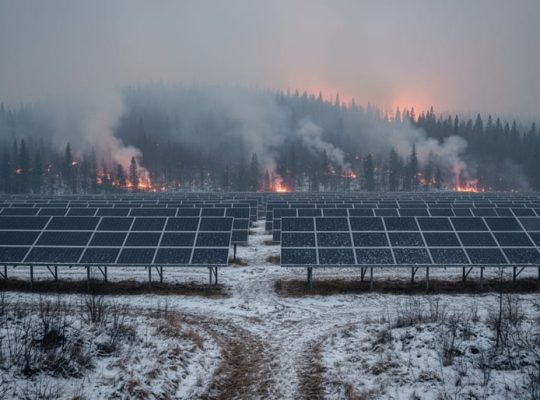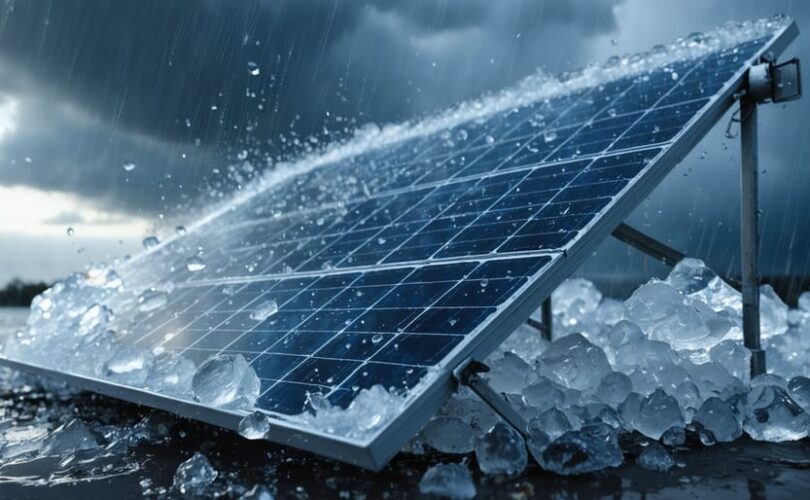
Solar panel impact resistance stands at the forefront of modern photovoltaic system design, determining how effectively installations can survive extreme weather conditions and potential physical threats. Recent advancements in tempered glass technology and multi-layer lamination have elevated impact resistance standards, enabling panels to withstand hailstones up to 25mm in diameter at terminal velocities of 23 meters per second. Industry-standard testing protocols, including the rigorous IEC 61215 certification, now demand solar panels demonstrate resilience against multiple impact scenarios, from wind-borne debris to severe hail events. This enhanced durability directly translates to extended system longevity, reduced maintenance costs, and improved return on investment for both residential and utility-scale installations. As climate patterns become increasingly unpredictable, understanding and implementing robust impact resistance measures has evolved from a mere safety consideration to a critical factor in sustainable energy infrastructure development.
Understanding Solar Panel Impact Standards
IEC and UL Testing Requirements
Solar panels must meet rigorous international testing standards to ensure their resilience against impact damage. The International Electrotechnical Commission (IEC) 61215 standard serves as the primary certification requirement, specifically outlining impact resistance testing procedures. During certification, panels undergo standardized hail impact tests where ice balls of 25mm diameter are projected at specific velocities to simulate real-world conditions.
UL 1703, established by Underwriters Laboratories, provides complementary testing requirements for the North American market. This standard requires panels to withstand impacts from steel balls dropped from various heights, ensuring durability against falling objects and severe weather events.
Both standards mandate multiple impact points across the panel surface, with particular attention to corners, edges, and center areas. Panels must maintain their structural integrity and electrical performance after testing, with no visible damage that could compromise functionality. Maximum power output degradation is limited to 5% post-impact testing to achieve certification.
Manufacturers must obtain these certifications before bringing products to market, ensuring consistent quality and reliability across the industry. Regular updates to these standards reflect evolving environmental challenges and technological capabilities.
Hail Impact Test Procedures
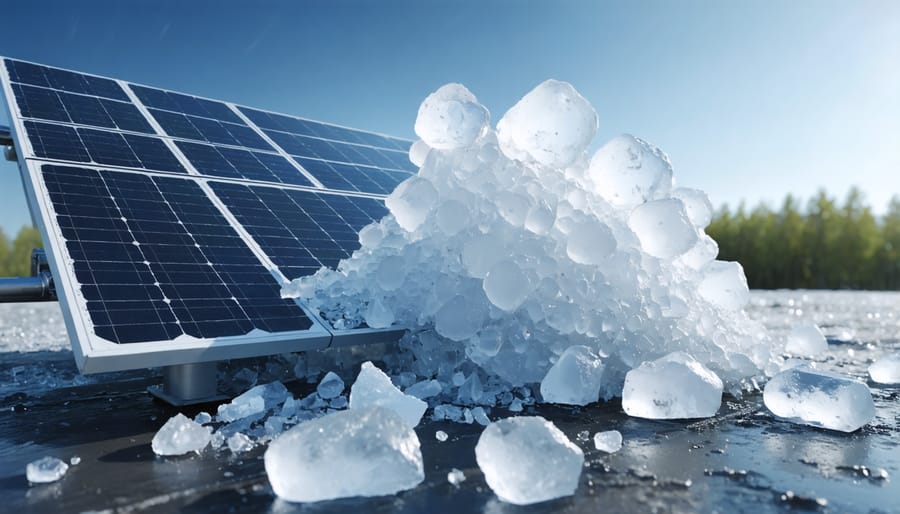
Hail impact testing for solar panels follows rigorous standardized procedures outlined in IEC 61215 and ASTM E1038-10 standards. The primary test involves launching artificial hail stones of specified diameters, typically ranging from 25mm to 75mm, at solar panels using pneumatic launchers or specialized impact testing equipment.
During testing, ice balls are propelled at velocities between 20-30 meters per second, simulating real-world hail conditions. Impact points are carefully selected to target potentially vulnerable areas, including corners, edges, and the center of the panel. Multiple impacts are conducted at each designated location to ensure comprehensive evaluation.
The panels undergo thorough inspection before and after testing, including visual examination, electrical performance measurements, and insulation resistance checks. To pass certification, panels must maintain their structural integrity, show no visible damage affecting performance, and retain at least 95% of their initial power output capacity.
Temperature control during testing is crucial, with ice balls maintained at -4°C to ensure consistent density and hardness. The entire procedure is documented with high-speed cameras for detailed analysis of impact behavior and material response.
Impact-Resistant Design Features
Glass Technology Advancements
Recent solar panel durability innovations have significantly enhanced the protective capabilities of photovoltaic glass. Advanced tempering processes now create glass that can withstand impacts up to four times stronger than traditional panels, while maintaining optimal light transmission for maximum energy generation.
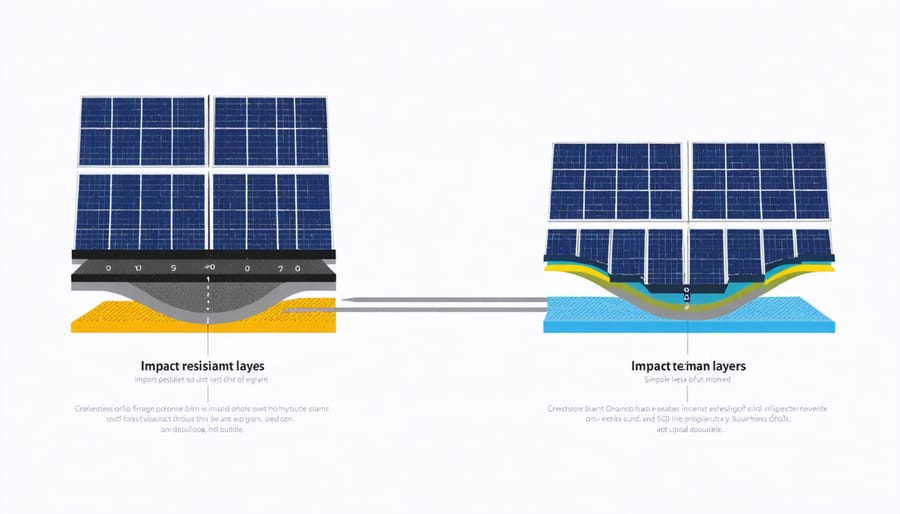
The integration of multi-layer laminated glass technology has revolutionized panel protection. These systems typically combine a tempered glass outer layer with specialized polymer interlayers, creating a robust barrier against environmental threats. When impacted, the laminated structure holds broken pieces together, preventing catastrophic failure and maintaining structural integrity.
Modern manufacturing techniques have also introduced nano-coating treatments that enhance both impact resistance and self-cleaning properties. These coatings form an additional protective layer while reducing maintenance requirements and ensuring consistent performance over time.
Glass thickness optimization has evolved through computational modeling and real-world testing. Manufacturers now achieve an ideal balance between structural strength and light transmission, typically utilizing glass between 3.2mm and 4mm thick. This optimization ensures panels meet international testing standards while maximizing energy conversion efficiency.
The development of specialized edge treatments and frame integration methods has further enhanced overall panel durability. These improvements distribute impact forces more effectively across the entire panel structure, reducing stress concentrations and potential failure points.
Frame and Mounting Systems
The frame and mounting system of a solar panel plays a crucial role in its impact resistance capabilities. Aluminum frames, the industry standard, provide structural integrity while maintaining a favorable strength-to-weight ratio. These frames act as a protective barrier, absorbing and distributing impact forces across the panel surface, thereby reducing the risk of cell damage.
Mounting systems significantly influence a panel’s ability to withstand impact forces. Fixed-tilt mounting systems typically offer superior impact resistance compared to tracking systems due to their rigid construction and fewer moving parts. The mounting rail configuration, particularly the spacing and number of attachment points, directly affects the panel’s structural stability during impact events.
Advanced mounting solutions incorporate shock-absorbing elements and flexible components that help dissipate impact energy. Some systems feature specialized clamps with rubber inserts that provide additional cushioning against sudden forces while maintaining secure panel attachment.
The integration between frame and mounting system creates a unified defensive barrier. Key considerations include:
– Proper torque specifications for mounting hardware
– Sufficient clearance between panels to prevent contact during movement
– Strategic placement of support rails to maximize load distribution
– Use of compatible materials to prevent galvanic corrosion
Engineers must carefully balance these elements while adhering to local building codes and wind load requirements. Recent innovations in frame design include reinforced corners and deeper frame profiles that enhance overall impact resistance without significantly increasing weight or cost.
Real-World Performance Data
Hailstorm Survival Statistics
Recent studies analyzing solar panel performance during severe hailstorms have revealed encouraging statistics regarding their durability. According to data collected from major hailstorm events between 2015 and 2023, modern solar installations demonstrate a remarkable survival rate of approximately 96% when exposed to hailstones up to 1 inch (25mm) in diameter.
A comprehensive study conducted across five major U.S. solar farms affected by significant hailstorms showed that only 0.1% of installed panels required replacement due to hail damage. The most extensive documented case occurred during a 2017 Colorado hailstorm, where a 2.5-million-panel installation experienced impact from hailstones reaching 2.75 inches in diameter. Despite the severity, less than 0.76% of panels suffered damage requiring replacement.
Statistical analysis from insurance claims reveals that solar panels installed after 2016 demonstrate significantly improved impact resistance compared to earlier installations. This improvement is attributed to enhanced testing standards and advanced materials technology. Current data indicates:
– 99.8% survival rate for hailstones under 1 inch
– 98.3% survival rate for hailstones 1-1.5 inches
– 95.7% survival rate for hailstones 1.5-2 inches
– 86.4% survival rate for hailstones exceeding 2 inches
Laboratory testing correlates with these real-world findings, showing that contemporary solar panels can withstand multiple impacts from simulated hailstones at terminal velocity without significant performance degradation. Financial analysis indicates that the cost of potential hail damage adds only 0.1% to 0.3% to the total lifetime operational costs of solar installations in hail-prone regions.
Wind-Driven Debris Response
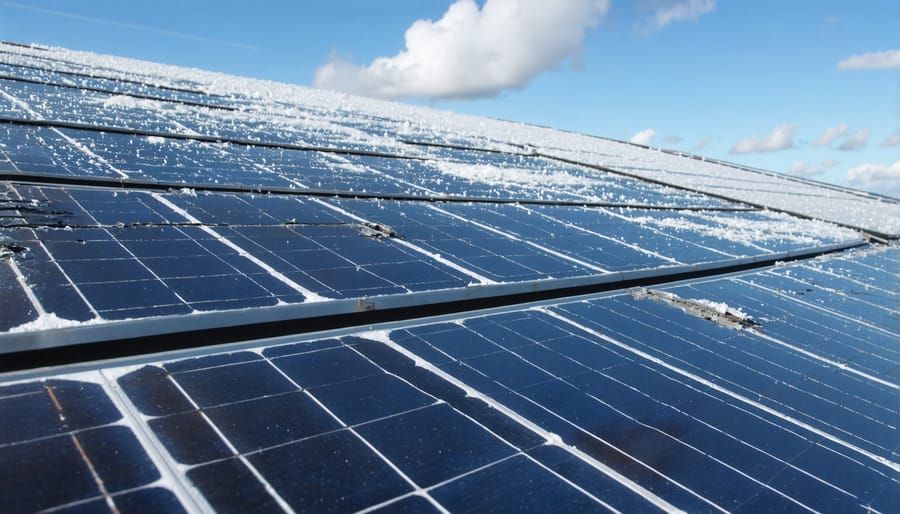
Wind-driven debris poses a significant challenge to solar panel installations, particularly during severe weather events such as hurricanes, tornados, and intense storms. Modern solar panels undergo rigorous testing to evaluate their resilience against various types of wind-propelled objects, from small gravel to larger debris like tree branches and roof tiles.
Industry standards require solar panels to withstand impact from projectiles traveling at velocities up to 50 mph (80 km/h), though many manufacturers exceed these requirements. Testing protocols typically involve launching steel balls of varying sizes at panels using pneumatic cannons under controlled conditions to simulate real-world scenarios.
Research conducted by leading certification laboratories has demonstrated that high-quality solar panels with tempered glass surfaces can withstand impacts from:
– Small stones and hail (up to 1 inch in diameter)
– Wind-borne sand and debris
– Small branches and vegetation
– Light construction materials
The structural integrity of solar panels during wind-driven debris events depends heavily on several factors:
– Glass thickness and tempering quality
– Frame construction and mounting system stability
– Impact angle and debris characteristics
– Panel installation angle and positioning
To enhance wind-driven debris resistance, manufacturers employ various design features including:
– Reinforced corner protection
– Multi-layer laminate construction
– Enhanced edge sealing
– Specialized protective coatings
Documentation from field studies in high-wind regions shows that properly installed solar panels with current impact resistance standards maintain functionality even after exposure to moderate debris impacts, though regular inspection is recommended following severe weather events.
Future-Proofing Solar Installations
Installation Best Practices
Proper installation techniques significantly enhance a solar panel’s impact resistance capabilities. Begin by conducting a thorough site assessment, paying particular attention to local weather patterns and potential impact hazards. Implementation of hurricane-resistant installation methods is crucial, especially in regions prone to severe weather events.
Install panels at an optimal angle of 30-45 degrees to minimize direct impact from hail and falling debris while maintaining efficiency. Use reinforced mounting systems with additional support points, spacing them at intervals no greater than 1.5 meters to distribute impact forces evenly across the array.
Select high-grade stainless steel mounting hardware rated for extreme conditions, and ensure all components meet or exceed local building codes. Implementation of micro-inverter systems can help isolate potential damage to individual panels rather than affecting the entire array.
Install protective barriers or deflectors where appropriate, particularly in areas with high debris risk. Regular inspection of mounting hardware and immediate replacement of any compromised components is essential for maintaining impact resistance integrity.
Consider incorporating shock-absorbing materials between mounting rails and panel frames, and always maintain proper torque specifications during installation to prevent stress points that could compromise impact resistance.
Maintenance and Inspection Protocols
Regular inspection and maintenance are crucial for preserving the impact resistance capabilities of solar panels throughout their operational lifetime. Implementing comprehensive maintenance strategies for resilience should include quarterly visual inspections of panel surfaces, mounting hardware, and frame integrity.
Key maintenance protocols include:
– Documenting and photographing any visible damage or deterioration
– Checking for loose mounting brackets or frame components
– Evaluating the condition of protective coatings and encapsulation materials
– Inspecting edge seals and junction boxes for water ingress
– Testing electrical connections for proper functionality
Professional technicians should conduct annual comprehensive assessments using specialized equipment to detect micro-cracks or internal delamination that may compromise impact resistance. These assessments typically employ thermal imaging and electroluminescence testing to identify potential weaknesses before they develop into critical failures.
Post-extreme weather events require immediate inspection, particularly following hailstorms or debris impacts. Facility managers should maintain detailed maintenance logs, including impact event documentation, repair history, and performance data. This information proves invaluable for warranty claims and helps optimize future maintenance scheduling.
Preventive measures, such as protective covers during severe weather warnings and regular cleaning to prevent debris accumulation, can significantly extend the impact resistance longevity of solar installations.
The impact resistance of solar panels represents a critical factor in the long-term success and sustainability of photovoltaic installations worldwide. Through comprehensive testing standards, advanced materials science, and innovative design approaches, the industry continues to develop increasingly resilient solar panels that can withstand diverse environmental challenges. Understanding and implementing proper impact resistance measures not only protects substantial investments in solar infrastructure but also ensures consistent energy production and system longevity.
The evolution of impact-resistant technologies has significantly enhanced the reliability of solar installations in regions prone to extreme weather events, making solar energy a more viable option for a broader range of applications and locations. From specialized glass treatments to reinforced frame designs, these advancements have contributed to reduced maintenance costs and improved performance metrics across the industry.
As the global transition to renewable energy accelerates, the importance of impact resistance in solar panel design cannot be overstated. It plays a vital role in ensuring the technology’s widespread adoption and long-term viability. For stakeholders at all levels – from manufacturers to installers and end-users – prioritizing impact resistance standards and certifications remains essential for maximizing return on investment and maintaining system efficiency throughout the expected lifecycle of solar installations.
Moving forward, continued research and development in impact resistance technology will be crucial in advancing the solar industry’s ability to meet growing energy demands while withstanding increasingly challenging environmental conditions.