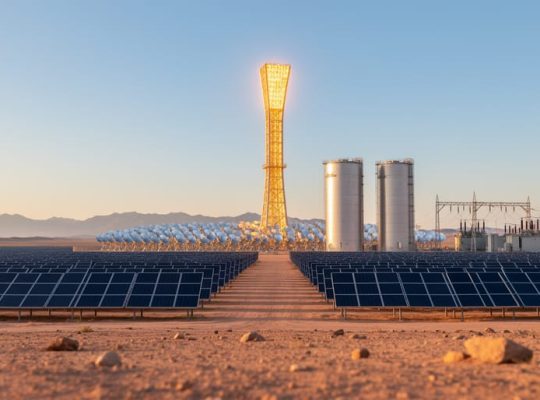
Breakthrough innovations in photovoltaic technology are revolutionizing the solar energy landscape, pushing the boundaries of what’s possible in renewable power generation. Recent solar efficiency advancements have achieved conversion rates exceeding 47% in multi-junction cells, marking a significant leap forward in solar cell performance. These developments, coupled with emerging perovskite-silicon tandem technologies and advanced manufacturing processes, are rapidly transforming solar from an alternative energy source into a mainstream power generation solution.
Cutting-edge research in bifacial solar panels, quantum dot integration, and transparent solar cells is opening new applications in building-integrated photovoltaics and mobile devices. Scientists and engineers are simultaneously tackling efficiency limitations and cost barriers through innovative materials science and automated production techniques. As these technologies mature, they promise to accelerate the global transition to sustainable energy while dramatically reducing the levelized cost of solar electricity.
This technical evolution represents more than incremental improvement; it signals a fundamental shift in how we harness solar energy, making it increasingly competitive with traditional power sources across diverse geographical and economic contexts.
Next-Generation Solar Cell Materials
Perovskite Solar Cells
Perovskite solar cells represent one of the most promising emerging solar materials, demonstrating remarkable progress in efficiency improvements over the past decade. These crystalline materials have achieved power conversion efficiencies exceeding 25% in laboratory settings, approaching the performance levels of traditional silicon cells while offering potential cost advantages in manufacturing.
The key advantage of perovskite technology lies in its solution-processable nature, allowing for simple and cost-effective fabrication methods such as roll-to-roll printing. This characteristic makes perovskite cells particularly attractive for large-scale commercial production. Additionally, their bandgap tunability enables optimal solar spectrum absorption and creates opportunities for tandem cell applications.
However, several challenges must be addressed before widespread commercialization becomes viable. Stability remains a primary concern, as perovskite materials can degrade when exposed to moisture, heat, and prolonged sunlight. Research efforts are focused on developing enhanced encapsulation techniques and more stable perovskite compositions to extend operational lifetimes.
Recent developments in hybrid perovskite formulations and advanced manufacturing processes have shown promising results in addressing these stability issues while maintaining high efficiency levels. Multiple companies and research institutions are now scaling up production capabilities, suggesting that commercial perovskite solar products could reach the market within the next few years, potentially revolutionizing the photovoltaic industry through reduced costs and improved performance.

Tandem Solar Cells
Tandem solar cells represent a significant breakthrough in photovoltaic technology by stacking multiple semiconductor layers to capture a broader spectrum of sunlight. Unlike traditional single-junction cells, these multi-junction devices combine different materials with varying bandgaps, enabling them to harvest energy from multiple wavelengths of light simultaneously.
The most common configuration involves a top cell made from high-bandgap material to absorb shorter wavelengths, while lower layers capture longer wavelengths that pass through the upper layers. This strategic arrangement allows tandem cells to achieve theoretical efficiency limits above 45%, substantially surpassing the 33% Shockley-Queisser limit of single-junction cells.
Recent developments have focused on perovskite-silicon tandem cells, which combine the low cost and stability of silicon with the exceptional light-absorbing properties of perovskite materials. These hybrid devices have already demonstrated laboratory efficiencies exceeding 29%, with researchers projecting potential increases to 35% in the near future.
Manufacturing challenges include ensuring precise layer alignment, managing interface defects, and maintaining cost-effectiveness at scale. However, ongoing innovations in deposition techniques and materials engineering continue to address these obstacles. As production processes mature, tandem cells are expected to play a crucial role in next-generation solar installations, particularly in applications where maximum efficiency per surface area is paramount.
Advanced Manufacturing Techniques
Heterojunction Technology
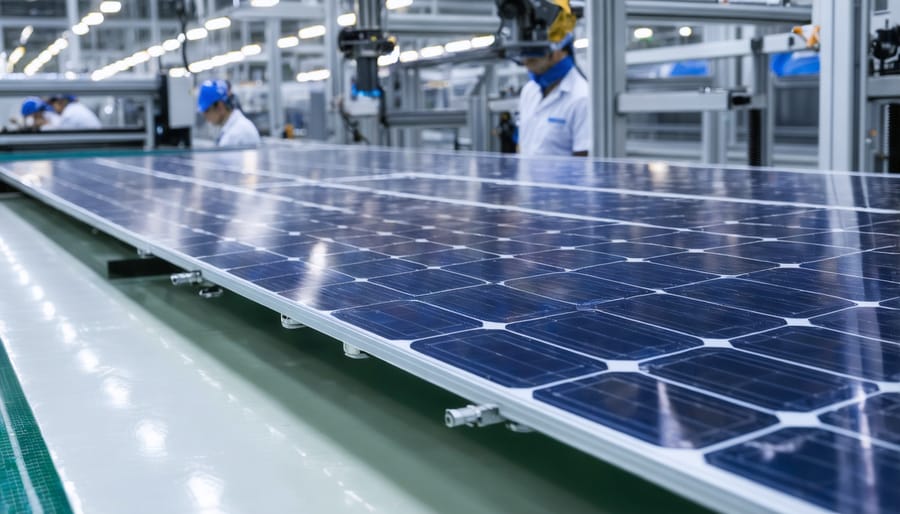
Heterojunction technology (HJT) represents a significant advancement in solar cell manufacturing, combining the best features of crystalline silicon and thin-film technologies. This innovative approach creates a junction between crystalline silicon and amorphous silicon layers, resulting in exceptional cell efficiency rates typically exceeding 24%. The unique structure allows for superior light absorption and better performance across varying temperature conditions.
The manufacturing process involves depositing thin layers of amorphous silicon on both sides of a crystalline silicon wafer, creating a double-sided passivation effect. This structure significantly reduces electron recombination losses and helps to optimize solar PV performance even in challenging environmental conditions.
Key benefits of HJT include lower temperature coefficient (-0.26%/°C compared to -0.35%/°C for conventional cells), superior low-light performance, and enhanced bifacial capabilities. The technology requires fewer production steps compared to traditional PERC cells, potentially reducing manufacturing costs while maintaining higher efficiency rates.
Recent developments in HJT manufacturing have focused on reducing silver paste consumption and implementing advanced interconnection technologies. These improvements, combined with the technology’s inherent advantages, position HJT as a promising solution for next-generation solar panels, offering both improved performance and cost-effective production methods.
TOPCon Technology
TOPCon (Tunnel Oxide Passivated Contact) technology represents a significant advancement in solar cell architecture, offering substantial improvements over traditional PERC cells. This innovative approach incorporates a thin tunnel oxide layer and highly-doped polysilicon film on the cell’s rear surface, creating an efficient passivated contact structure that minimizes electron recombination losses.
The technology’s key advantage lies in its ability to achieve higher conversion efficiencies by addressing two critical challenges: surface passivation and carrier selectivity. The ultra-thin oxide layer (typically 1-2 nanometers) allows electrons to tunnel through while blocking holes, resulting in reduced recombination rates and improved carrier collection.
In commercial applications, TOPCon solar cells consistently demonstrate efficiency rates exceeding 24%, with laboratory specimens reaching beyond 26%. This marked improvement over conventional technologies translates to enhanced power output per panel and better performance in real-world conditions, particularly at higher temperatures.
Manufacturing integration of TOPCon technology has proven relatively straightforward, as it builds upon existing production lines with minimal modification requirements. This compatibility with current manufacturing processes has accelerated its adoption across the industry, making it a commercially viable option for next-generation solar panels.
The technology’s superior temperature coefficient and bifacial capability further contribute to its appeal, offering improved performance in hot climates and increased energy yield through rear-side power generation. These characteristics make TOPCon particularly attractive for utility-scale solar installations seeking to maximize power output per installed area.
Smart Integration Solutions
Bifacial Solar Modules
Bifacial solar modules represent a significant advancement in photovoltaic technology, capable of harvesting solar energy from both their front and rear surfaces. These innovative panels capture direct sunlight on their front side while simultaneously collecting reflected light (albedo) on their rear side, substantially increasing their overall energy yield compared to traditional monofacial modules.
The energy gain from bifacial modules typically ranges from 5% to 30%, depending on various environmental factors including ground reflectivity, installation height, and tilt angle. White surfaces or light-colored ground covers can significantly enhance the rear-side performance, with snow offering particularly high albedo values during winter months.
These modules employ specialized solar cells, typically using either PERC (Passivated Emitter and Rear Cell) or n-type technology, with transparent back sheets or glass-glass construction. The dual-sided design eliminates the traditional aluminum back sheet, reducing material costs while improving durability and extending the module’s lifetime.
Installation considerations for bifacial modules require careful optimization of mounting height and row spacing to maximize ground-reflected light capture. Elevated mounting systems, often used in agricultural settings or over light-colored surfaces, have demonstrated particularly promising results in field testing.
The technology has proven especially effective in large-scale solar installations, where careful site planning can optimize ground reflectivity and module positioning to achieve maximum bifacial gain, making these modules increasingly popular in utility-scale solar projects worldwide.
AI-Powered Optimization
Artificial intelligence is revolutionizing solar energy systems through advanced optimization and predictive capabilities. AI-driven solar management systems are enhancing performance across the entire solar energy value chain, from design and deployment to maintenance and grid integration.
Machine learning algorithms analyze vast amounts of environmental data, including weather patterns, solar irradiance, and historical performance metrics, to optimize panel positioning and energy production in real-time. These systems can predict maintenance requirements before failures occur, reducing downtime and extending equipment lifespan.
Deep learning models are particularly effective in managing solar arrays, utilizing computer vision to detect panel defects and soiling issues that impact efficiency. The AI systems can automatically adjust inverter settings and power flow to maximize energy yield under varying conditions, resulting in efficiency improvements of up to 20% compared to traditional management methods.
Grid integration has become more sophisticated through AI applications that balance supply and demand, forecast production capacity, and optimize energy storage decisions. These intelligent systems enable better coordination with utilities and help maintain grid stability while maximizing the economic value of solar installations.
The implementation of AI in solar technology also facilitates preventive maintenance scheduling, reduces operational costs, and provides detailed performance analytics that help system operators make data-driven decisions for continuous improvement.
Advanced Tracking Systems
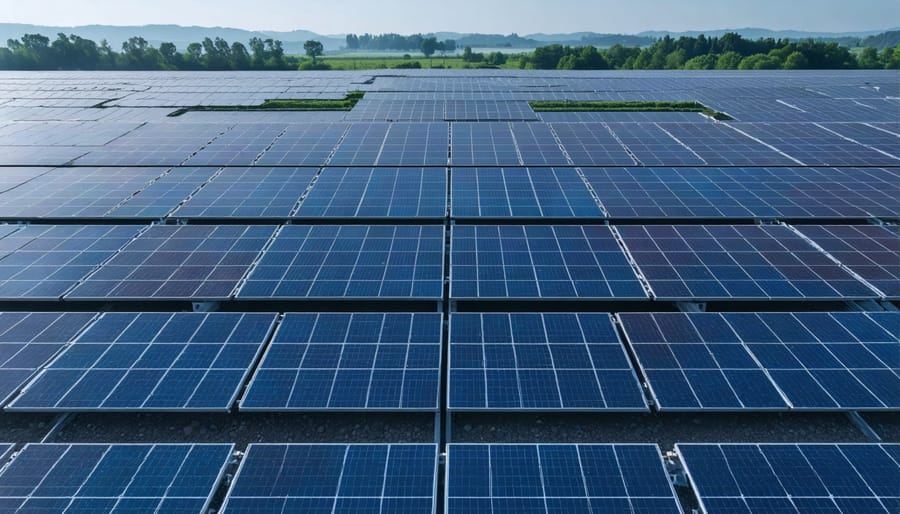
Advanced solar tracking systems have revolutionized the efficiency of photovoltaic installations by optimizing the angle and position of solar panels throughout the day. Modern dual-axis tracking systems can increase energy yield by 35-45% compared to fixed installations, making them increasingly attractive for utility-scale projects.
Recent innovations in tracking technology incorporate artificial intelligence and machine learning algorithms to predict weather patterns and adjust panel positioning proactively. These smart systems analyze historical weather data, real-time conditions, and performance metrics to maximize energy capture while minimizing mechanical wear.
Breakthrough developments in distributed control architecture allow individual tracker rows to operate independently, enhancing system reliability and reducing maintenance requirements. Modern tracking systems utilize robust sensors and precision motors that can withstand harsh environmental conditions while maintaining accuracy within 0.1 degrees.
Enhanced backtracking algorithms prevent inter-row shading and optimize performance during diffuse light conditions. This advancement is particularly valuable in regions with variable weather patterns or installations on challenging terrain.
Cost reductions in tracking hardware, coupled with improved reliability, have significantly decreased the lifetime operational expenses of tracking systems. The integration of wireless communication protocols and remote monitoring capabilities enables real-time performance optimization and predictive maintenance, further improving the return on investment for large-scale solar installations.
The rapid evolution of solar energy technologies represents a pivotal moment in our transition towards sustainable energy systems. These innovations are fundamentally reshaping the photovoltaic landscape, promising unprecedented levels of efficiency and accessibility. From perovskite-silicon tandems achieving record-breaking conversion rates to advanced manufacturing processes reducing production costs, the industry is witnessing transformative developments that extend far beyond traditional silicon-based technologies.
Looking ahead, the integration of artificial intelligence in solar cell design and production, combined with emerging materials science breakthroughs, suggests an even more promising future. Industry projections indicate that solar efficiency could exceed 40% in commercial applications within the next decade, while manufacturing costs continue to decline. This convergence of improved performance and reduced costs will likely accelerate global solar adoption across both residential and industrial sectors.
The impact of these technological advances extends beyond pure energy generation. Enhanced energy storage solutions, smart grid integration, and building-integrated photovoltaics are creating a more resilient and flexible energy infrastructure. As research institutions and industry leaders continue to collaborate on pushing the boundaries of solar technology, we can anticipate further breakthroughs in efficiency, durability, and application versatility.
For professionals and stakeholders in the solar industry, staying informed about these technological developments is crucial for making informed decisions and contributing to the advancement of sustainable energy solutions.