
Rhode Island established the nation’s first offshore wind farm in 2016, positioning itself as the vanguard of American offshore wind policy development and creating a replicable regulatory blueprint for coastal states pursuing ocean-based renewable energy infrastructure. The Block Island Wind Farm’s successful deployment demonstrated that comprehensive policy frameworks integrating environmental protection, stakeholder engagement, and economic development incentives could transform offshore wind from theoretical potential into operational reality.
Understanding Rhode Island’s offshore wind policy architecture provides essential insights for renewable energy professionals navigating the complex intersection of maritime law, environmental regulation, and clean energy mandates. The state’s approach encompasses strategic legislative mechanisms, including the Distributed Generation Standardized Contracts and Long-Term Contracting for Renewable Energy statutes, which created procurement certainty for offshore wind developers while protecting ratepayer interests through competitive bidding processes.
Rhode Island’s regulatory evolution offers practical lessons for integrating multiple renewable energy sources within diversified clean energy portfolios. The state’s Renewable Energy Growth Program and Renewable Energy Standard established complementary policy instruments that simultaneously advanced offshore wind development and distributed solar photovoltaic deployment, demonstrating how coordinated renewable energy policies create synergistic market conditions.
This analysis examines the specific legislative acts, regulatory decisions, and implementation strategies that enabled Rhode Island’s offshore wind success, providing actionable intelligence for policy analysts, industry stakeholders, and renewable energy professionals seeking to understand or replicate effective offshore wind policy frameworks in other jurisdictions.
Rhode Island’s Historic Position in Offshore Wind Development
The Block Island Wind Farm: America’s Offshore Wind Pioneer
The Block Island Wind Farm achieved a historic milestone in December 2016 when it became the first operational offshore wind facility in the United States. Located approximately three miles southeast of Block Island, the 30-megawatt project consists of five Haliade 150-6MW turbines manufactured by GE Renewable Energy, generating sufficient electricity to power approximately 17,000 homes annually.
The project’s development timeline began in 2008 when Deepwater Wind, now part of Ørsted, secured approval from the Rhode Island Public Utilities Commission. This nine-year journey from concept to operation established critical precedents for regulatory approval processes, environmental impact assessments, and stakeholder engagement protocols that subsequent offshore wind projects would follow.
Several policy frameworks proved instrumental in enabling the project’s success. The Rhode Island Renewable Energy Standard mandated increasing percentages of renewable energy in the state’s electricity mix, creating market demand for offshore wind power. Additionally, the Long-Term Contracting Standard for Renewable Energy required National Grid to enter into a 20-year power purchase agreement with Deepwater Wind, providing the financial certainty necessary for project financing. Federal support through the Bureau of Ocean Energy Management’s regulatory framework streamlined permitting processes while ensuring environmental compliance.
The project yielded valuable lessons for the broader offshore wind industry. Construction challenges, including vessel availability and weather-dependent installation windows, highlighted the need for specialized infrastructure and equipment. Environmental monitoring confirmed minimal impacts on marine ecosystems and fishing activities, addressing stakeholder concerns with empirical data. Economic benefits extended beyond electricity generation, creating local employment opportunities and attracting supply chain investments to Rhode Island’s ports.
Academic institutions, including the University of Rhode Island, partnered with project developers to conduct ongoing research on turbine performance, marine habitat effects, and grid integration strategies. These collaborative efforts have produced educational programs training the next generation of offshore wind professionals, establishing Rhode Island as a knowledge hub for renewable energy innovation.

State Energy Goals Driving Policy Innovation
Rhode Island has established itself as a national leader in renewable energy policy through aggressive, legally binding targets that directly influence offshore wind development. The state’s Renewable Energy Standard mandates that 100% of electricity sales come from renewable sources by 2033, creating substantial market demand for offshore wind generation. This ambitious timeline positions Rhode Island ahead of many states and necessitates rapid policy innovation to achieve compliance.
The state’s procurement approach reflects strategic planning rather than ad hoc development. Rhode Island has committed to contracting over 1,000 megawatts of offshore wind capacity through multiple procurement rounds, building progressively on lessons learned from the Block Island Wind Farm. These targets translate into specific Request for Proposals that outline technical requirements, economic development expectations, and environmental standards that developers must meet.
Legislative mandates drive policy creation by establishing clear accountability mechanisms. The Office of Energy Resources operates under statutory requirements to conduct regular procurement cycles, ensuring continuous project pipeline development. These mandates also compel interagency coordination between environmental regulators, coastal management authorities, and economic development offices.
Academic partnerships with institutions like the University of Rhode Island have strengthened policy development through research on marine spatial planning, fisheries impacts, and grid integration challenges. This collaboration between government and educational institutions ensures evidence-based policymaking while creating workforce development opportunities for aspiring renewable energy professionals. The state’s policy framework demonstrates how binding renewable energy goals catalyze comprehensive regulatory innovation, providing valuable insights for other jurisdictions developing offshore wind programs and complementary renewable energy initiatives including solar photovoltaic deployment.
Key Policy Frameworks Enabling Offshore Wind in Rhode Island
Legislative Mandates and Renewable Energy Standards
Rhode Island’s offshore wind sector operates within a robust legislative framework anchored by the state’s Renewable Energy Standard (RES), which mandates that electricity providers procure increasing percentages of their power from renewable sources. This standard, progressively escalating to 38.5% by 2035, creates sustained demand for clean energy projects and provides the market certainty necessary for significant infrastructure investments in offshore wind development.
The 2016 Offshore Wind Act represented a watershed moment, authorizing the procurement of up to 400 megawatts of offshore wind capacity through long-term contracts. This legislation empowered utility companies to enter into power purchase agreements extending 20 years or more, addressing the fundamental challenge of project financing by guaranteeing revenue streams that justify the substantial capital requirements of offshore wind farms. The Act’s passage directly enabled the Block Island Wind Farm and subsequent larger-scale projects.
Further strengthening this framework, the 2020 amendment to offshore wind procurement legislation expanded the state’s commitment by authorizing an additional 600 megawatts of capacity, with provisions for up to 1,000 megawatts contingent upon federal approvals and favorable economic assessments. These statutory requirements establish clear procurement timelines and evaluation criteria, reducing regulatory uncertainty for developers and investors.
The integration of these mandates with the RES creates compounding policy effects. Utilities must simultaneously meet renewable energy targets while fulfilling offshore wind procurement obligations, effectively guaranteeing market absorption for new projects. This legislative certainty has positioned Rhode Island as an attractive jurisdiction for offshore wind investment, demonstrating how coordinated statutory frameworks can accelerate renewable energy deployment across complementary technologies including solar photovoltaic systems.
Power Purchase Agreements and Financial Mechanisms
Rhode Island’s offshore wind development relies heavily on structured Power Purchase Agreements that provide the financial certainty necessary to attract investment in these capital-intensive projects. The state’s approach employs long-term PPAs, typically spanning 20 years, which guarantee revenue streams for developers while managing ratepayer exposure to cost fluctuations.
The Block Island Wind Farm established the precedent through a PPA with National Grid, setting a fixed price per megawatt-hour that enabled project financing despite the project’s relatively small scale. This agreement demonstrated how contractual certainty could overcome financial barriers in nascent offshore wind markets. For the larger Revolution Wind project, state regulators approved a PPA structure that incorporates declining price schedules, reflecting anticipated cost reductions as the offshore wind industry matures.
Rhode Island’s Public Utilities Commission plays a central role in reviewing and approving these agreements, balancing developer needs for bankable contracts against consumer protection considerations. The cost recovery mechanism distributes project costs across the utility customer base through small surcharges on electricity bills, ensuring no single ratepayer category bears disproportionate burden.
Academic institutions, including partnerships with the University of Rhode Island, contribute economic analyses that inform PPA negotiations and regulatory decisions. These collaborations provide independent assessments of cost-benefit ratios and long-term economic impacts, strengthening the evidence base for policy decisions.
The state’s PPA framework offers valuable lessons for photovoltaic professionals examining how structured agreements can support renewable energy deployment across technologies, demonstrating how financial mechanisms directly influence project viability and market development.
Permitting and Regulatory Coordination
Rhode Island’s offshore wind development operates within a complex regulatory framework requiring coordination between multiple governmental bodies. The permitting process involves both federal and state oversight, with the Bureau of Ocean Energy Management (BOEM) managing federal waters permits while Rhode Island maintains jurisdiction over state waters and coastal zone consistency determinations.
The Rhode Island Coastal Resources Management Council (CRMC) plays a pivotal role as the lead state agency for offshore renewable energy permitting. CRMC reviews project proposals for consistency with the state’s coastal management program, evaluating potential impacts on marine ecosystems, commercial fishing operations, and coastal resources. The agency has developed specialized expertise in offshore wind assessment through collaboration with universities and research institutions, enhancing technical review capacity.
Recognizing the need for efficient project approval, Rhode Island has implemented streamlining measures including coordinated federal-state review processes and clear application guidelines. The state established the Ocean Special Area Management Plan, which provides pre-identified suitable areas for offshore wind development, reducing uncertainty for developers. This framework has positioned Rhode Island as a model for regulatory efficiency, demonstrating how comprehensive planning can accelerate renewable energy deployment while maintaining environmental protections and stakeholder engagement.
Current Offshore Wind Projects and Policy Evolution
Revolution Wind Project and Policy Adaptations
The Revolution Wind project represents Rhode Island’s second major offshore wind development, building upon lessons learned from the Block Island Wind Farm. This 704-megawatt initiative, jointly developed to serve both Rhode Island and Connecticut, demonstrates the state’s commitment to expanding clean energy capacity while refining its procurement methodology.
Revolution Wind emerged from Rhode Island’s 2016 authorization allowing National Grid to contract for an additional 400 megawatts of offshore wind capacity. The procurement process reflected significant policy maturation, incorporating more sophisticated evaluation criteria that balanced cost considerations with economic development benefits, environmental impacts, and grid integration capabilities. This multi-dimensional assessment framework established a replicable model for future renewable energy procurements.
The project’s development timeline revealed important policy adaptations, particularly regarding interconnection planning and transmission infrastructure coordination. Rhode Island’s Public Utilities Commission implemented enhanced review procedures that streamlined approval processes while maintaining rigorous environmental and technical standards. These procedural improvements reduced regulatory uncertainty for developers and accelerated project timelines.
Significantly, Revolution Wind’s procurement included provisions for workforce development and supply chain integration, reflecting Rhode Island’s strategic approach to maximizing local economic benefits. The state partnered with the University of Rhode Island and Rhode Island College to develop specialized training programs, ensuring a qualified workforce for construction and operational phases. These educational initiatives created pathways for aspiring renewable energy professionals to enter the offshore wind sector, establishing connections between policy implementation and career development that strengthen Rhode Island’s position as a regional offshore wind leader.

Supply Chain and Workforce Development Policies
Rhode Island has strategically positioned itself to capture substantial economic benefits from offshore wind through comprehensive supply chain and workforce development initiatives. The state’s approach recognizes that offshore wind infrastructure represents a generational economic opportunity, with policies specifically designed to maximize local job creation and industrial capacity building.
Central to this strategy is the development of ProvPort, Rhode Island’s specialized offshore wind port facility in Providence. This $35 million infrastructure investment, supported by state and federal funding, provides staging and assembly capabilities for offshore wind components. The facility positions Rhode Island as a regional hub for offshore wind construction and maintenance activities, creating sustained employment opportunities in manufacturing, marine operations, and logistics sectors.
The state’s workforce development policies mirror successful renewable energy training frameworks established in the solar sector. Rhode Island established partnerships between the Governor’s Workforce Board, community colleges, and industry stakeholders to create targeted training programs addressing offshore wind-specific skills. These initiatives include marine trades training, electrical systems certification, and safety credential programs required for offshore operations.
The Rhode Island Commerce Corporation administers supply chain development programs that incentivize local businesses to enter the offshore wind market through technical assistance and competitive grants. This comprehensive approach ensures Rhode Island residents and businesses benefit directly from the state’s offshore wind expansion, creating a replicable model for integrating local economic development objectives with renewable energy infrastructure deployment across complementary sectors including solar photovoltaics.
Integration Challenges: Connecting Offshore Wind to the Grid
Transmission Infrastructure Policy and Planning
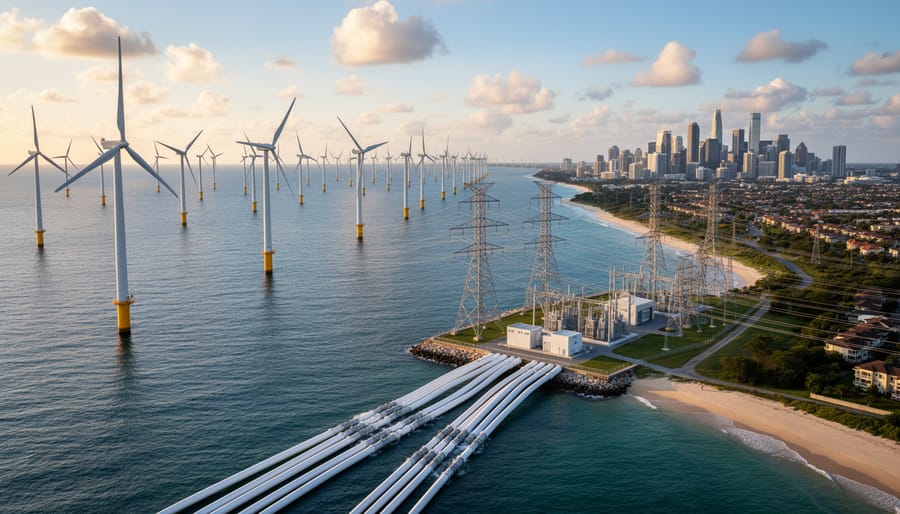
Rhode Island’s offshore wind development has required substantial transmission infrastructure investments to connect projects to the onshore grid. The state addresses these challenges through a coordinated planning approach involving National Grid, the primary transmission operator, and state regulatory agencies. The Rhode Island Public Utilities Commission oversees transmission upgrade requirements and ensures adequate capacity exists to deliver offshore wind power to load centers.
Cost allocation represents a critical policy consideration. Rhode Island employs a socialized cost recovery model where transmission expenses are distributed across the ratepayer base, recognizing that offshore wind provides system-wide benefits including emissions reductions and energy security. For the Revolution Wind project, National Grid estimated approximately $65 million in onshore transmission upgrades, costs incorporated into long-term power purchase agreements approved by state regulators.
The state’s transmission planning process includes stakeholder engagement with utilities, project developers, and environmental advocates. Rhode Island participates in ISO New England regional transmission planning to coordinate offshore wind integration across the broader New England grid. This collaborative framework ensures technical feasibility while managing financial impacts.
Academic institutions including the University of Rhode Island contribute research on grid integration challenges and optimal interconnection strategies. These partnerships inform policy decisions and workforce training programs, preparing professionals to manage increasingly complex renewable energy transmission systems as offshore wind capacity expands throughout the northeastern United States.
Interconnection Standards and Grid Modernization
Rhode Island’s offshore wind development necessitates substantial grid infrastructure upgrades to accommodate large-scale variable renewable generation. The state has established comprehensive interconnection standards through collaborative efforts between National Grid, the Federal Energy Regulatory Commission, and state regulators to ensure seamless integration of offshore wind power.
Technical requirements mandate that offshore wind facilities comply with IEEE 1547 standards for distributed generation interconnection, addressing voltage regulation, frequency response, and power quality parameters. The Revolution Wind project requires underwater transmission cables connecting to the Davisville substation in North Kingstown, representing significant investment in transmission infrastructure modernization.
Grid modernization initiatives include advanced forecasting systems, enhanced monitoring capabilities, and automated switching technologies to manage renewable energy variability. These upgrades complement energy storage integration strategies essential for grid stability.
Rhode Island’s collaboration with the University of Rhode Island’s Grid Modernization Laboratory provides valuable research on optimal integration strategies. The state’s Power Sector Transformation initiative allocates resources for distribution system upgrades, smart grid technologies, and demand response programs. These modernization efforts create a resilient infrastructure capable of accommodating increasing renewable penetration while maintaining reliability standards, offering lessons applicable to photovoltaic interconnection challenges nationwide.
Environmental and Community Engagement Policies
Environmental Impact Assessment Requirements
Rhode Island’s offshore wind projects undergo rigorous environmental impact assessment processes mandated by both federal and state regulations. The Bureau of Ocean Energy Management (BOEM) requires comprehensive Environmental Impact Statements that evaluate potential effects on marine ecosystems, fisheries, avian species, and cultural resources. These assessments examine impacts to essential fish habitats, migratory bird corridors, and endangered species like the North Atlantic right whale.
The state’s Coastal Resources Management Council oversees additional environmental reviews under the Rhode Island Coastal Zone Management Program, ensuring compliance with state conservation standards. Key requirements include baseline surveys of benthic habitats, acoustic monitoring protocols during construction to protect marine mammals, and seasonal restrictions on pile-driving activities during critical spawning periods.
Developers must implement mitigation strategies including fisheries compensation programs, marine mammal observer protocols, and adaptive management plans based on ongoing monitoring data. Rhode Island has collaborated with the University of Rhode Island’s Graduate School of Oceanography to establish long-term environmental monitoring frameworks that track ecosystem changes throughout project lifecycles. These collaborative research initiatives provide valuable data for refining environmental protection standards while advancing scientific understanding of offshore wind interactions with marine environments.
Fisheries Coordination and Community Benefits
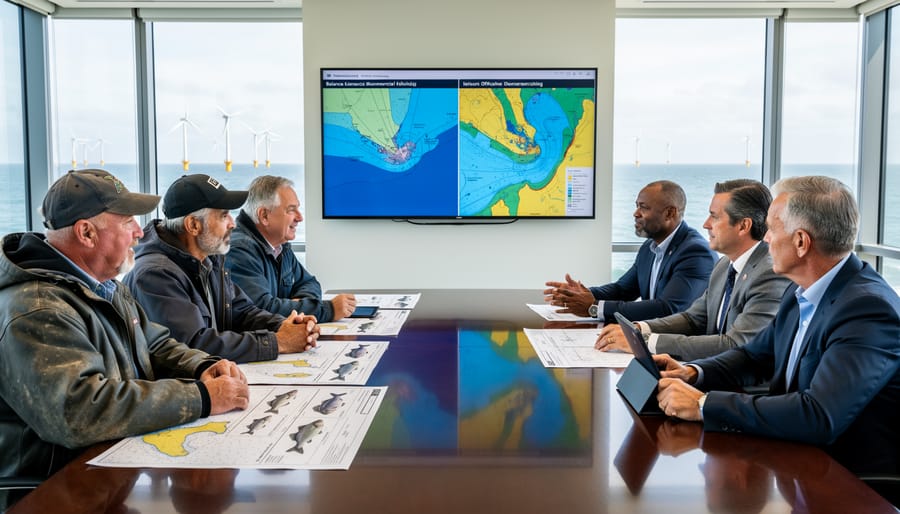
Rhode Island’s offshore wind development has prioritized collaborative stakeholder engagement, particularly with the commercial fishing industry. The state established the Fisheries Advisory Board in 2010, creating a formal mechanism for fishermen to participate in project planning and site selection. This framework requires developers to conduct extensive consultations with fishing communities, document traditional fishing grounds, and implement mitigation strategies to minimize operational impacts.
The Rhode Island Coastal Resources Management Council mandates comprehensive community benefit agreements that extend beyond environmental compliance. These agreements typically include funding for port improvements, workforce training programs, and economic development initiatives in coastal communities. For the Block Island Wind Farm, developers committed to annual fisheries compensation funds and established cable burial protocols to protect bottom-fishing operations.
Academic partnerships with the University of Rhode Island have strengthened stakeholder engagement through independent monitoring programs and collaborative research initiatives. These programs provide transparent data on fishing impacts and marine ecosystems, building trust among stakeholder groups. The framework demonstrates how renewable energy development can address legitimate industry concerns while advancing clean energy goals through structured dialogue and equitable benefit distribution.
Lessons for Renewable Energy Policy Development
Transferable Policy Mechanisms for Renewable Energy
Rhode Island’s offshore wind policy framework offers valuable lessons for advancing solar photovoltaics and other renewable technologies. The state’s competitive procurement model, established through legislative mandates requiring utilities to solicit long-term contracts, provides a replicable template for large-scale solar deployments. This approach creates market certainty while enabling developers to secure project financing through predictable revenue streams.
The power purchase agreement structure pioneered in Rhode Island’s Block Island Wind Farm demonstrates how fixed-price, long-term contracts can reduce investment risk for renewable projects. Solar developers can adapt these contractual frameworks, particularly the escalation clauses and performance guarantees that balance utility and developer interests. State regulatory agencies have refined these mechanisms through successive procurement rounds, developing standardized evaluation criteria that assess technical capability, economic impact, and environmental stewardship.
Rhode Island’s innovative financing mechanisms include credit enhancement tools and green bonds that lower capital costs for renewable infrastructure. These financial instruments, combined with streamlined permitting processes established for offshore wind, offer blueprints for accelerating solar project development timelines. The state’s emphasis on workforce development partnerships with universities creates educational pathways applicable across renewable sectors, ensuring adequate skilled labor for project construction and maintenance.
Additionally, Rhode Island’s stakeholder engagement protocols, which brought together environmental advocates, fishing communities, and industry representatives, provide frameworks for navigating complex renewable energy siting decisions that solar developers increasingly face in land-constrained regions.
Challenges and Policy Gaps Requiring Innovation
Despite Rhode Island’s pioneering efforts, several policy gaps require attention for next-generation offshore wind development. Grid integration remains a critical challenge, as transmission infrastructure must evolve to accommodate increasing renewable capacity from both offshore wind and distributed solar photovoltaic systems. The state lacks comprehensive long-term planning frameworks that coordinate offshore wind expansion with onshore renewable portfolio targets, creating potential bottlenecks in achieving decarbonization goals.
Supply chain development presents another unresolved issue. While Rhode Island established the Port of Providence as a staging area, policies supporting domestic manufacturing of turbine components and specialized vessels remain underdeveloped compared to European standards. This dependency on international supply chains introduces cost uncertainties and project delays.
Environmental monitoring protocols also require refinement. Current regulations focus primarily on pre-construction assessments, but adaptive management strategies for operational impacts on marine ecosystems need strengthening. Collaboration with universities conducting marine research could enhance evidence-based policy adjustments.
Additionally, workforce development policies have not kept pace with industry expansion. Educational program offerings in offshore wind technology remain limited, creating skills gaps that could constrain future growth. Addressing these challenges through innovative policy solutions will be essential for Rhode Island to maintain its leadership position in offshore wind deployment.
Rhode Island’s offshore wind policy development represents a significant achievement in renewable energy governance, establishing a comprehensive regulatory framework that has influenced implementation strategies across the United States. The state’s pioneering approach, from the Block Island Wind Farm through current expansions, demonstrates how coordinated policy development between state agencies, utilities, and research institutions creates pathways for successful renewable energy deployment. The evolution of Rhode Island’s framework, encompassing refined permitting processes, enhanced environmental review standards, and workforce development initiatives, provides valuable lessons for renewable energy professionals working across all sectors of the clean energy transition.
For photovoltaic professionals and renewable energy stakeholders, understanding Rhode Island’s cross-sector policy development offers essential insights into regulatory mechanisms that apply beyond offshore wind. The integration of environmental protection standards, economic development goals, and technical implementation requirements exemplifies comprehensive energy policy design. Academic researchers and industry professionals benefit from examining how Rhode Island’s collaborative approach, including partnerships with universities and structured educational programs, addresses both immediate deployment challenges and long-term workforce needs.
As offshore wind policies continue evolving alongside complementary renewable technologies, Rhode Island’s regulatory framework remains a critical case study. The state’s ongoing refinement of environmental monitoring protocols, grid integration standards, and stakeholder engagement processes demonstrates that effective energy transition policies require continuous adaptation. Renewable energy professionals who grasp these interconnected policy developments position themselves to contribute meaningfully to the expanding clean energy sector, recognizing that solar, wind, and other renewable technologies advance through shared regulatory innovations and coordinated implementation strategies.