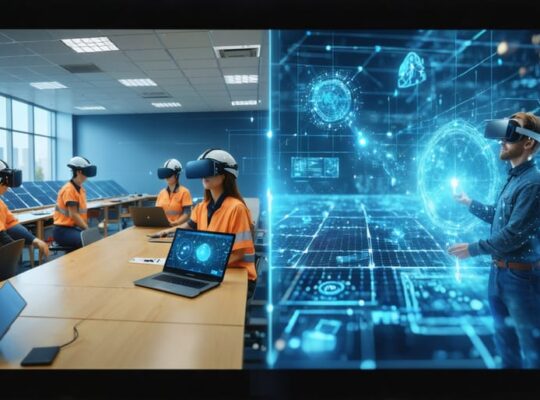
The photovoltaic industry faces a critical parallel between how solar panels convert sunlight into electricity and how experienced professionals must transfer knowledge to emerging talent. Just as photons striking semiconductor materials initiate a cascade of energy transformations—from radiant to electrical energy with quantifiable efficiency losses at each stage—the solar workforce experiences similar transfer dynamics when seasoned engineers pass technical expertise to new hires.
Understanding energy transfers in solar systems reveals three fundamental conversion stages: photon absorption in the active layer, electron-hole pair generation, and current extraction through electrical contacts. Each transition point represents potential energy loss through heat dissipation, reflection, or recombination. Modern photovoltaic systems achieve 15-22% conversion efficiency in commercial applications, with research-grade cells reaching beyond 26%. These numbers matter because they directly inform system design, performance projections, and economic viability calculations.
The same principles apply to workforce knowledge transfer. When senior solar engineers retire or transition roles without structured mentorship programs, organizations lose accumulated expertise at rates comparable to energy losses in poorly designed PV systems. Companies implementing systematic knowledge transfer protocols—including documentation standards, cross-generational project teams, and formalized training pathways—preserve institutional knowledge with measurably higher retention rates.
This article examines both physical energy transformations within solar cells and the strategic frameworks for transferring technical knowledge across professional generations. By understanding quantum efficiency, spectral response curves, and thermal management principles alongside mentorship best practices and competency mapping, solar industry stakeholders can optimize both technological performance and human capital development. The intersection of these concepts provides actionable strategies for building resilient, knowledgeable teams capable of advancing photovoltaic innovation.
The Dual Meaning of Energy Transfer in Solar: From Photons to People
How Energy Moves Through Solar Systems
Solar energy systems operate through a precise sequence of energy transformations that convert sunlight into usable electricity. Understanding this fundamental process is essential for anyone working in or studying the photovoltaic industry.
The energy transfer chain begins when photons from sunlight strike the surface of a photovoltaic cell. These light particles carry electromagnetic energy that initiates the conversion process. Upon contact with the semiconductor material, typically silicon, photons transfer their energy to electrons within the atomic structure.
This energy absorption causes electron excitation, where electrons break free from their atomic bonds and enter an excited state. The semiconductor’s specially engineered structure, featuring positive and negative layers, creates an electric field that directs these freed electrons in a specific direction, establishing electron flow.
As electrons move through the material, they generate direct current electricity. This movement represents the transformation of light energy into electrical energy at the cellular level. Individual photovoltaic cells are connected in series and parallel configurations within modules to increase voltage and current output to practical levels.
The final stage involves power conversion, where inverters transform the direct current produced by PV modules into alternating current suitable for grid integration or immediate consumption. This complete energy transfer chain operates continuously during daylight hours, with efficiency determined by factors including material quality, temperature, and irradiance levels.
Just as effective energy transfer requires each component to function optimally, successful solar organizations depend on seamless knowledge transfer between experienced professionals and emerging talent to maintain industry advancement.

How Knowledge Moves Through Solar Teams
Just as photons transfer energy through solar cells with varying degrees of efficiency, knowledge flows from experienced solar professionals to newcomers through deliberate pathways that determine organizational effectiveness. This parallel reveals critical insights for workforce development in the renewable energy sector.
In photovoltaic systems, energy transfer efficiency depends on material quality, proper connections, and minimal resistance. Similarly, knowledge transfer in solar companies requires structured mentorship programs, clear communication channels, and reduced organizational barriers. When seasoned engineers and technicians share expertise with junior staff, the quality of information transmitted directly impacts the receiving professional’s ability to apply that knowledge effectively.
Energy losses occur at every junction in a solar array, whether through resistance, heat dissipation, or reflection. Knowledge transfer experiences comparable losses through miscommunication, inadequate documentation, and insufficient training time. Research indicates that organizations lose between 30-40 percent of institutional knowledge when experienced workers retire without formal succession planning, mirroring the efficiency gaps found in poorly optimized solar installations.
Optimization strategies prove essential in both domains. Maximum power point tracking ensures solar systems operate at peak efficiency under varying conditions. Likewise, adaptive training programs that incorporate hands-on experience, collaborative university partnerships, and digital knowledge repositories maximize knowledge retention among new professionals. Companies that invest in educational program offerings and structured mentorship see measurably higher rates of skill acquisition and innovation, creating sustainable pathways for expertise transfer across generations of solar industry professionals.
The Critical Knowledge Gaps Emerging in Solar Workforce
Technical Expertise at Risk
The solar industry faces a critical challenge in preserving specialized technical knowledge accumulated over decades of photovoltaic innovation. Manufacturing expertise with monocrystalline silicon technology, for instance, encompasses intricate understanding of ingot pulling processes, wafer slicing precision, and quality control methods that veteran technicians have refined through years of hands-on experience. This tacit knowledge often exists outside formal documentation, residing instead in the problem-solving instincts and troubleshooting methodologies of senior personnel.
Multi-crystalline technology presents its own unique knowledge repository. Experienced professionals possess deep insights into polysilicon casting techniques, grain boundary management, and efficiency optimization strategies specific to this cell type. Their ability to identify production anomalies, adjust manufacturing parameters in real-time, and maintain consistent output quality represents invaluable expertise that cannot be easily codified in training manuals alone.
The transition to Passivated Emitter and Rear Cell (PERC) technology has introduced additional complexity requiring specialized competencies. Field technicians and engineers have developed sophisticated diagnostic skills for identifying performance issues related to rear-side passivation, understanding light-induced degradation patterns, and implementing corrective measures. These advanced troubleshooting capabilities stem from countless hours observing system behavior under varied environmental conditions.
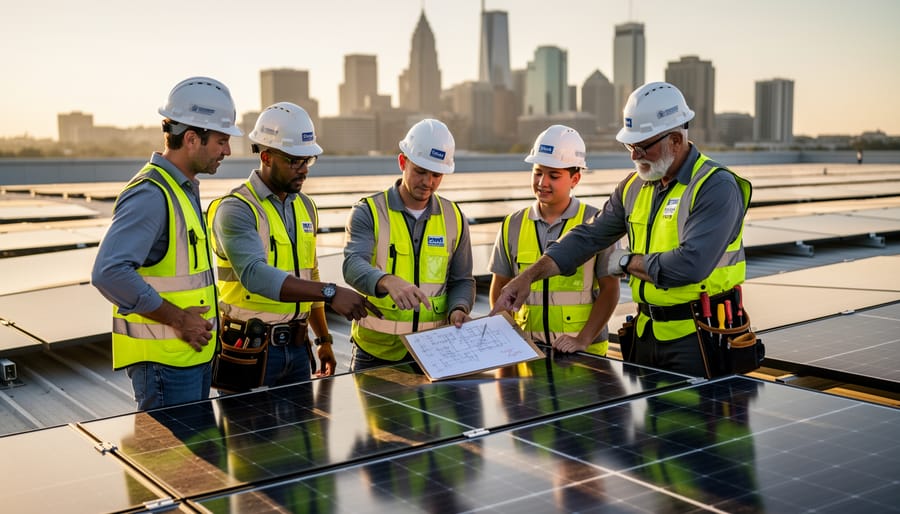
Without structured knowledge transfer mechanisms, retiring professionals take this practical wisdom with them, creating significant operational vulnerabilities. New technicians may struggle with uncommon failure modes, lack historical context for equipment modifications, or miss subtle indicators of emerging problems. Universities and industry organizations increasingly recognize this gap, developing collaborative educational programs that combine theoretical foundations with mentorship opportunities. These initiatives aim to bridge generational divides by creating structured pathways for experiential learning, ensuring that critical technical expertise remains accessible to the next generation of photovoltaic professionals.
Installation and Optimization Wisdom
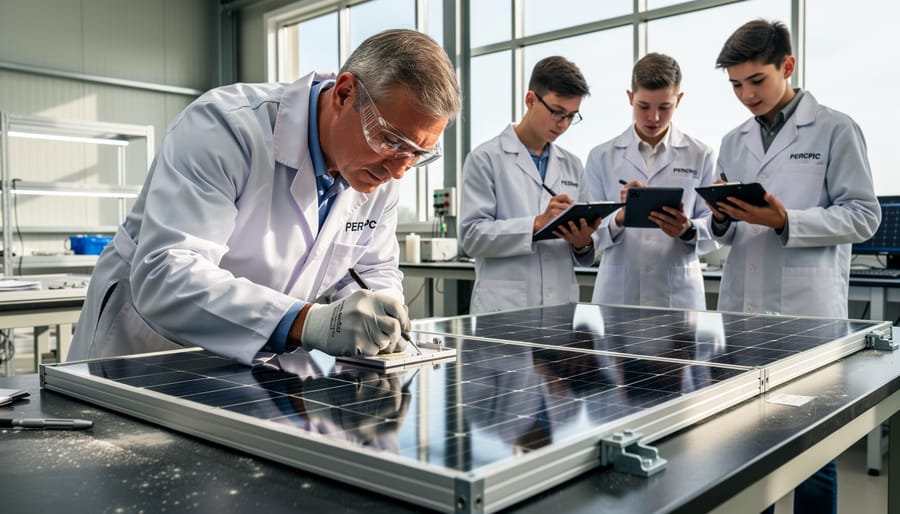
Field experience reveals critical insights about solar energy transfer efficiency that theory alone cannot capture. When installing solar tiles and modules, experienced technicians understand that optimal energy capture depends heavily on factors textbooks often oversimplify.
Roof orientation and shading analysis require on-site assessment skills developed through repeated installations. While classroom instruction covers azimuth angles and declination calculations, veteran installers recognize micro-climate patterns, seasonal vegetation growth, and neighboring structure impacts that dramatically affect long-term energy production. This practical wisdom becomes especially valuable when working with integrated solar roof shingles, where retrofit considerations and structural load calculations demand real-world problem-solving abilities.
Temperature management represents another area where field experience proves essential. Photovoltaic modules lose efficiency as operating temperatures rise, yet the degree of performance degradation varies based on installation techniques. Experienced professionals know that proper airflow beneath modules, strategic mounting gap specifications, and material selection for racking systems significantly influence thermal energy dissipation. These nuanced decisions directly impact the conversion efficiency of absorbed photons into usable electrical energy.
Installation quality also affects energy transfer at connection points. Loose electrical connections create resistance, generating heat loss and reducing system efficiency. Seasoned installers develop tactile sensitivity and visual inspection techniques that identify potential failure points before they compromise energy production.
Transferring this accumulated wisdom from experienced professionals to new workforce entrants presents challenges similar to optimizing energy transfer in photovoltaic systems. Just as proper installation techniques maximize solar energy conversion, structured mentorship programs and hands-on training initiatives ensure effective knowledge transfer. Universities collaborating with industry partners increasingly recognize that combining theoretical education with supervised field experience produces professionals capable of implementing optimization strategies that textbooks cannot fully convey. This intergenerational knowledge transfer sustains industry advancement and maintains installation quality standards essential for renewable energy expansion.
Applying Energy Transfer Principles to Knowledge Transfer
Minimizing ‘Resistance’ in Knowledge Flow
In solar photovoltaic systems, electrical resistance impedes current flow and reduces overall system efficiency. Similarly, organizational barriers can obstruct knowledge transfer between experienced professionals and emerging talent. Reducing these impediments requires systematic identification and elimination of common obstacles.
Communication gaps represent a primary source of resistance in knowledge flow. Establishing regular cross-generational touchpoints through structured mentorship programs, collaborative project teams, and informal knowledge-sharing sessions creates multiple pathways for information exchange. These interactions should be formally integrated into work schedules rather than treated as optional activities.
Documentation standards serve as another critical factor. Organizations must implement comprehensive knowledge management systems that capture both explicit technical information and tacit expertise. This includes video tutorials, annotated troubleshooting guides, and project post-mortems that preserve institutional knowledge regardless of personnel changes.
Cultural resistance often manifests when experienced professionals feel their expertise is undervalued or when younger employees perceive mentorship as criticism. Leadership must actively cultivate an environment that celebrates knowledge sharing as a core competency. Recognition programs, performance metrics tied to teaching effectiveness, and collaborative learning initiatives help normalize intergenerational exchange.
Finally, technological barriers require attention. Providing accessible platforms for virtual collaboration, shared digital workspaces, and mobile-friendly learning resources ensures knowledge flows freely across geographical and temporal boundaries, much like optimized conductors in photovoltaic systems minimize energy losses.
Maximizing ‘Absorption’ of Expertise
Just as photovoltaic cells maximize photon absorption through strategic material selection and surface engineering, organizations can optimize knowledge retention among new professionals through deliberate learning strategies. The key lies in creating conditions that enhance the capture and conversion of expertise into practical competencies.
Structured mentorship programs serve as the foundation for effective knowledge absorption. Pairing experienced professionals with newcomers facilitates direct knowledge transfer, ensuring critical industry insights don’t dissipate. Organizations should implement regular check-ins, shadowing opportunities, and project-based collaboration to reinforce learning pathways.
Documentation proves essential for preserving institutional knowledge. Creating comprehensive technical guides, video repositories, and case study databases allows professionals to revisit complex concepts repeatedly, strengthening retention. This approach mirrors how anti-reflective coatings reduce energy loss in solar cells by ensuring maximum photon penetration.
Modern training methodologies significantly enhance absorption efficiency. Virtual reality training enables immersive, hands-on experience without field risks, accelerating skill development. Cross-functional rotations expose professionals to diverse aspects of solar operations, broadening their expertise spectrum.
Regular competency assessments identify knowledge gaps early, allowing targeted interventions. By measuring absorption effectiveness through practical demonstrations and technical evaluations, organizations can adjust training intensity and methodology, ensuring optimal knowledge conversion rates across their workforce development initiatives.
Preventing ‘Energy Loss’ During Transfer
In solar energy systems, power losses during energy conversion represent one of the most significant efficiency challenges. Similarly, organizations face substantial knowledge loss when expertise transfers between experienced and emerging professionals. Just as photovoltaic systems employ specific engineering strategies to minimize electrical resistance and heat dissipation, workforce development programs require deliberate mechanisms to preserve critical tacit knowledge.
Structured mentorship programs serve as the primary conduit for knowledge preservation. These initiatives should pair seasoned professionals with newer team members for extended periods, typically spanning 12-18 months, allowing sufficient time for comprehensive knowledge exchange. Unlike brief orientations, sustained mentorship enables the transfer of nuanced decision-making processes, troubleshooting methodologies, and industry-specific insights that documentation alone cannot capture.
Documentation systems must evolve beyond static manuals to incorporate multimedia approaches. Video recordings of complex procedures, annotated project portfolios, and interactive digital platforms create accessible knowledge repositories. Universities collaborating with industry partners have demonstrated that combining written protocols with visual demonstrations increases knowledge retention by approximately 40 percent compared to text-only formats.
Cross-generational project teams facilitate organic knowledge transfer through collaborative problem-solving. When experienced professionals and recent graduates work alongside each other on actual installations or system designs, tacit knowledge flows naturally through observation, questioning, and shared decision-making processes. Educational program offerings that incorporate shadowing opportunities and hands-on apprenticeships further reinforce this practical knowledge exchange, ensuring critical expertise remains accessible as workforce demographics shift. Regular knowledge-sharing sessions where retiring professionals present case studies and lessons learned formalize this preservation effort while honoring institutional memory.
Structured Programs That Bridge the Generational Divide
University-Industry Collaboration Models
Strategic collaborations between universities and solar companies have emerged as powerful catalysts for developing skilled photovoltaic professionals. These industry-academic partnerships create integrated learning ecosystems that bridge the gap between theoretical knowledge and practical application, ensuring graduates enter the workforce with comprehensive competencies in solar energy systems.
Leading academic institutions now offer specialized programs developed in consultation with solar industry leaders, incorporating curriculum modules that address real-world challenges in photovoltaic installation, system optimization, and energy transfer efficiency. Students gain exposure to cutting-edge technologies while working on actual industry projects, from analyzing spectral response in advanced solar cells to optimizing inverter configurations for maximum energy conversion.
Companies benefit from this collaborative model by accessing a pipeline of well-prepared talent familiar with both fundamental principles and current industry practices. Many partnerships include cooperative education experiences where students alternate between classroom learning and paid industry placements, allowing them to apply theoretical concepts immediately. These apprenticeship programs often lead to permanent employment opportunities, reducing recruitment costs while building workforce loyalty.
Research collaborations further strengthen these partnerships, with university laboratories conducting advanced studies in energy transfer mechanisms, new materials development, and system efficiency improvements. Graduate students working on industry-sponsored research projects contribute valuable insights while gaining mentorship from experienced professionals, creating a knowledge transfer pathway that enriches both academic understanding and commercial innovation in solar technology advancement.
Online Educational Platforms for Continuous Learning
Digital education platforms have fundamentally transformed how solar energy knowledge is shared and preserved across the global photovoltaic industry. These online learning ecosystems break down traditional barriers of geography, cost, and institutional access, enabling professionals from diverse backgrounds to acquire specialized expertise in energy conversion principles and system optimization.
Leading universities and industry organizations now offer comprehensive digital courses covering photon-to-electron conversion, thermal management, and power conditioning systems. These programs provide structured pathways for workforce development, allowing experienced professionals to transfer critical knowledge to emerging talent through recorded lectures, interactive simulations, and virtual laboratory environments. AI-powered training platforms further enhance this learning transfer by personalizing educational content based on individual competency levels and career objectives.
The asynchronous nature of online educational platforms addresses a fundamental challenge in knowledge preservation: capturing institutional wisdom before experienced professionals retire. Video-based instruction, supplemented by downloadable technical resources and peer discussion forums, creates permanent repositories of solar expertise accessible to future generations. This democratization of knowledge ensures that innovations in energy transfer optimization, from advanced cell architectures to grid integration strategies, remain available beyond organizational boundaries.
Academic institutions partnering with industry leaders contribute validated curricula that balance theoretical foundations with practical applications, preparing learners to apply energy transfer principles in real-world photovoltaic installations. These collaborative programs strengthen the pipeline of qualified professionals capable of advancing solar technology while maintaining continuity of expertise across career transitions.
Case Study: Knowledge Transfer in Emerging PV Technologies
In 2019, a leading photovoltaic manufacturer in Germany faced a critical challenge when several veteran engineers specializing in mono PERC (Passivated Emitter and Rear Cell) technology announced their retirement within an 18-month window. The company recognized that without structured knowledge transfer, decades of specialized expertise in optimizing cell efficiency and manufacturing processes would be lost.
The organization partnered with a technical university to develop a comprehensive knowledge transfer program spanning twelve months. Senior engineers were paired with junior professionals in mentorship arrangements that combined theoretical instruction with hands-on application. The program structured knowledge transfer around three key components: documentation of tacit knowledge, collaborative problem-solving sessions, and incremental responsibility transfers.
The documentation phase proved particularly valuable. Veteran engineers recorded decision-making processes for troubleshooting common efficiency degradation issues, explaining not just the solutions but the reasoning behind diagnostic approaches. This created a knowledge repository that extended beyond standard operating procedures, capturing the nuanced understanding that typically takes years to develop independently.
Collaborative problem-solving sessions involved both cohorts working together on active production challenges. For instance, when addressing temperature coefficient optimization in PERC cells, senior engineers verbalized their analytical approach while junior professionals contributed fresh perspectives informed by recent academic research. This bidirectional exchange produced innovative solutions neither group would have developed independently.
The program incorporated measurable milestones to track knowledge absorption. Junior engineers progressively assumed greater responsibility for process optimization decisions, initially with oversight and eventually independently. Performance metrics included efficiency improvement rates, defect identification accuracy, and troubleshooting response times.
Results exceeded expectations. Within fifteen months, the new cohort successfully identified and resolved a cell passivation issue that had previously required senior engineer intervention. Post-program assessments showed that junior professionals achieved competency levels that typically required three to four years of experience in just fourteen months.
Key lessons emerged from this initiative. First, structured programs outperform informal knowledge sharing by ensuring comprehensive coverage of critical competencies. Second, university collaboration provided theoretical frameworks that enhanced practical understanding. Third, creating psychological safety where junior professionals could ask questions without judgment accelerated learning significantly. Finally, documenting tacit knowledge proved essential for long-term organizational resilience, creating resources that continue benefiting subsequent hiring cohorts.
This case demonstrates that intentional, well-structured knowledge transfer programs can effectively bridge generational expertise gaps in rapidly evolving photovoltaic technologies.
Building a Self-Sustaining Knowledge Ecosystem
Documentation and Knowledge Management Systems
Effective documentation and knowledge management systems serve as the backbone of successful knowledge transfer in solar organizations, functioning similarly to how conductors efficiently channel electrical energy in photovoltaic systems. These repositories must capture both explicit knowledge—documented procedures, technical specifications, and standardized processes—and tacit knowledge gained through years of hands-on experience that often remains unrecorded.
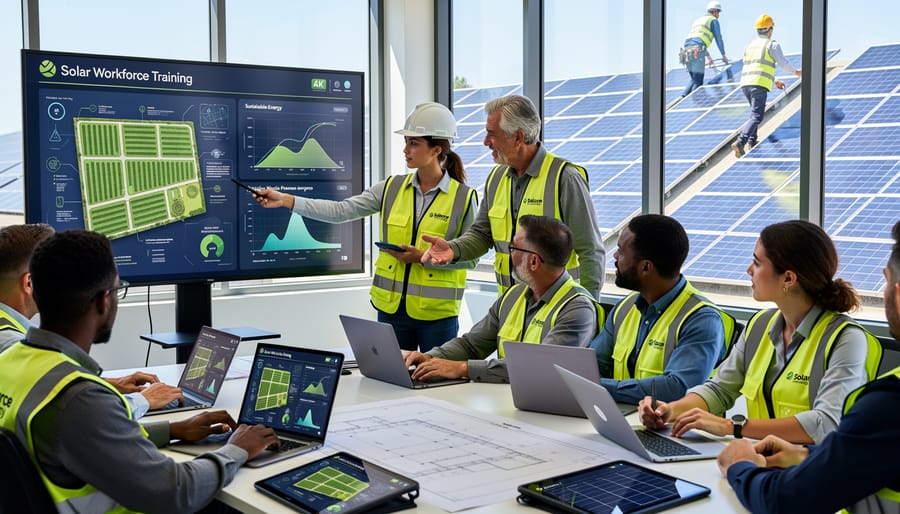
Leading solar companies now implement comprehensive digital platforms that centralize critical information, making it accessible across generations of professionals. These systems should include detailed installation case studies, troubleshooting guides with real-world scenarios, lessons learned from project challenges, and video demonstrations of complex procedures. The most effective repositories incorporate searchable databases, interactive modules, and multimedia content that accommodate different learning preferences.
Collaboration with universities enhances these systems by integrating academic research findings with practical industry applications, creating knowledge bases that bridge theory and practice. Educational program offerings can be directly linked to repository content, allowing new professionals to reference documented procedures while undergoing training.
To maximize effectiveness, organizations should establish regular review cycles where experienced professionals update documentation to reflect evolving technologies and methodologies. Implementing version control systems ensures information accuracy while maintaining historical context. Additionally, incorporating feedback mechanisms allows users to contribute insights, creating living repositories that continuously expand. These structured knowledge management approaches prevent critical expertise from being lost during workforce transitions, ensuring organizational resilience and maintaining operational excellence across technological advancement cycles in the solar industry.
Reverse Mentoring: When Young Professionals Teach Veterans
In solar energy organizations, knowledge transfer operates bidirectionally, with emerging professionals offering valuable expertise that complements veteran experience. Just as modern photovoltaic systems capture previously unutilized light wavelengths through advanced materials, younger team members harness cutting-edge digital capabilities that enhance operational efficiency across solar installations.
Recent graduates and early-career professionals typically possess proficiency in advanced data analytics platforms, machine learning applications for predictive maintenance, and cloud-based monitoring systems that weren’t part of traditional training programs. These reverse mentoring approaches enable seasoned engineers to leverage real-time performance optimization tools and AI-driven fault detection algorithms that significantly improve system uptime.
Universities partnering with solar companies increasingly incorporate Python programming, geographic information systems, and building information modeling into renewable energy curricula. Newer professionals bring immediate application of these technologies, demonstrating how satellite imagery analysis can identify optimal installation sites or how blockchain integration might streamline renewable energy certificate tracking.
Educational programs now emphasize digital twin technology and Internet of Things sensor networks, equipping young professionals with skills that transform how veterans approach system design and monitoring. This knowledge exchange proves particularly valuable in utility-scale projects where data visualization dashboards and automated reporting systems have become essential for managing distributed solar arrays efficiently. The collaborative dynamic creates an environment where technical innovation meets practical wisdom, ultimately strengthening organizational capacity to deploy increasingly sophisticated photovoltaic solutions.
The parallels between physical energy transfers in photovoltaic systems and knowledge transfers in the solar workforce reveal a fundamental truth: efficiency depends on optimized pathways. Just as solar panels maximize output through strategic design that minimizes conversion losses, the solar industry maximizes its potential through deliberate intergenerational learning frameworks that preserve and amplify institutional knowledge.
The data is compelling. Companies implementing structured knowledge transfer programs report reduced onboarding times, decreased error rates, and enhanced innovation capacity. These metrics mirror the performance improvements seen when solar installations optimize their energy conversion efficiency. Both systems require intentional design, continuous monitoring, and adaptive refinement to achieve sustained results.
For solar companies, the imperative is clear: integrate knowledge transfer protocols into operational frameworks with the same rigor applied to technical specifications. Educational institutions must expand collaborative partnerships that bridge academic theory with field-tested expertise, creating curriculum pathways informed by industry veterans. Individual professionals should actively engage in mentorship relationships, recognizing that career advancement increasingly depends on the ability to both receive and transmit specialized knowledge.
The renewable energy transition demands more than technological innovation alone. It requires building human infrastructure capable of sustaining accelerated growth across decades. Organizations that strategically invest in intergenerational learning today position themselves as industry leaders tomorrow, creating competitive advantages as difficult to replicate as proprietary technology. The choice facing the solar sector is not whether to prioritize knowledge transfer, but how quickly to implement systematic approaches that ensure organizational resilience and continued advancement toward global sustainability goals.