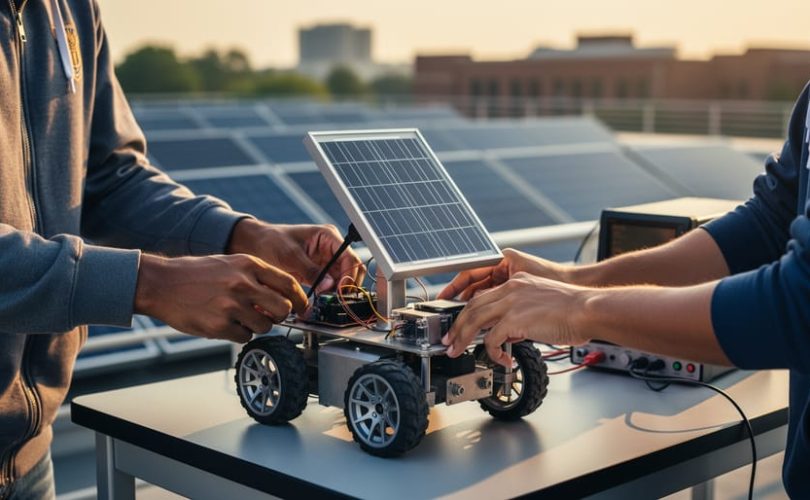
Educational solar robots represent a transformative intersection of hands-on learning and renewable energy technology, offering institutions and aspiring professionals an immediate pathway to mastering photovoltaic principles through practical application. These programmable devices harness solar energy to perform various tasks, converting abstract concepts like energy conversion efficiency, circuit design, and power optimization into tangible, measurable outcomes that students can observe and modify in real-time.
The pedagogical value extends far beyond basic assembly. Students working with solar robots develop critical competencies in electrical engineering fundamentals, microcontroller programming, and system troubleshooting—skills directly transferable to professional PV installation and maintenance roles. Universities partnering with industry leaders have documented measurable improvements in student retention of complex concepts when incorporating these tools into renewable energy curricula, particularly in understanding power output variations, load management, and energy storage principles.
For career-focused learners, educational solar robots serve as scaled-down laboratories that simulate real-world photovoltaic system challenges. Participants gain practical experience calculating optimal panel positioning, analyzing performance under varying light conditions, and diagnosing system inefficiencies—competencies that employers actively seek in entry-level technicians and engineers. The investment in these educational platforms delivers measurable returns through accelerated skill development, reduced learning curves in field applications, and enhanced comprehension of the technical foundations underlying utility-scale solar installations. This practical approach bridges the gap between theoretical knowledge and professional competency in an industry experiencing rapid workforce expansion.
What Makes Educational Solar Robots Effective Learning Tools
Core Components and Solar Technology Integration
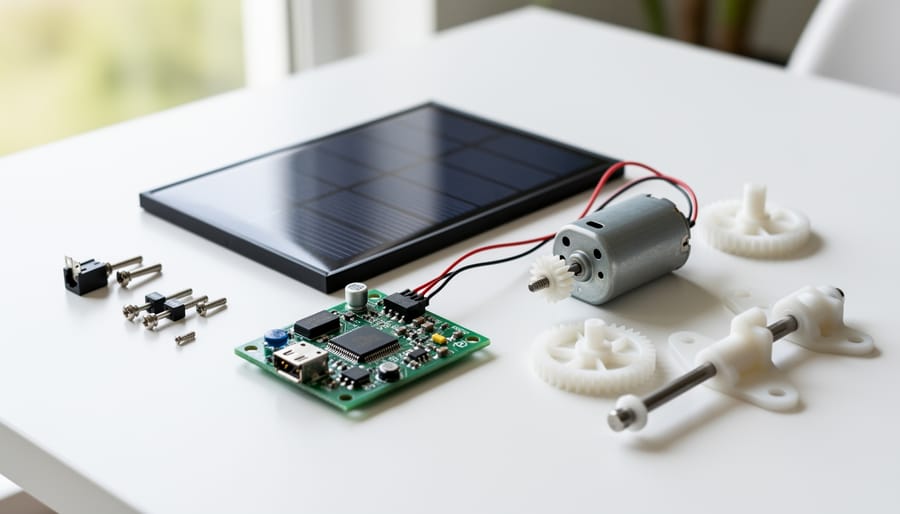
Educational solar robots comprise three fundamental components that mirror real-world photovoltaic systems: solar panels, electric motors, and integrated sensors. The solar panel, typically a small monocrystalline or polycrystalline module, serves as the primary power source by converting sunlight directly into electrical energy through photovoltaic principles. Students observe firsthand how voltage and current output vary with light intensity and panel orientation, establishing foundational understanding of maximum power point concepts critical in commercial installations.
The motor subsystem demonstrates energy conversion efficiency, transforming electrical power into mechanical motion. Most educational models incorporate DC motors that respond immediately to changes in solar input, allowing learners to quantify the relationship between irradiance levels and performance output. This direct feedback mechanism reinforces concepts of system sizing and energy budgeting that professionals apply when designing large-scale solar arrays.
Sensors add another dimension of learning by introducing measurement and monitoring capabilities. Light sensors enable robots to track optimal sun angles, while voltage and current sensors provide real-time performance data. These components familiarize students with monitoring systems used throughout the solar industry for performance analysis and preventive maintenance.
Universities partnering with industry leaders increasingly recognize that hands-on experience with these integrated systems bridges the gap between theoretical knowledge and practical application, preparing graduates for immediate contribution to renewable energy projects.
Pedagogical Benefits for PV Education
Solar robots transform abstract photovoltaic concepts into tangible learning experiences, bridging the gap between theoretical knowledge and practical application. Through hands-on interaction, students directly observe energy conversion processes as photovoltaic cells capture sunlight and transform it into mechanical motion, making the photoelectric effect immediately comprehensible rather than merely conceptual.
These educational tools excel at demonstrating system efficiency principles in real-time. Learners can measure input solar radiation against output performance, identifying losses through resistance, component inefficiencies, and environmental factors. This experiential approach enables students to understand critical parameters such as voltage-current relationships, maximum power point tracking, and the impact of irradiance levels on system performance.
Solar robots also illustrate real-world application challenges that professionals encounter in the renewable energy sector. Students experience how panel orientation affects power generation, observe performance variations under different lighting conditions, and troubleshoot system malfunctions. This practical exposure develops problem-solving skills essential for photovoltaic careers.
Through collaborative university programs, institutions incorporate solar robotics into curriculum frameworks that prepare aspiring professionals for industry demands. Students gain intuitive understanding of energy storage, load management, and system optimization—competencies that translate directly to designing and implementing commercial solar installations.
Applications in Academic and Professional Training Programs
Integration with University PV Curricula
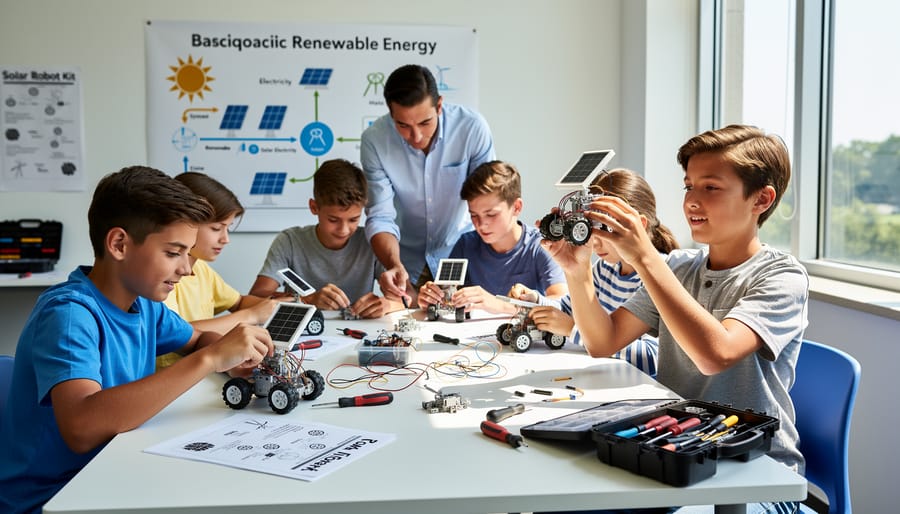
Universities worldwide are increasingly integrating educational solar robots into their photovoltaic curricula, recognizing their value in bridging theoretical knowledge with hands-on competency. Leading institutions have developed structured laboratory modules where students design, assemble, and troubleshoot solar-powered robotic systems, gaining direct experience with panel efficiency testing, energy storage optimization, and load management—skills essential for photovoltaic professionals.
Collaborative programs, such as those offered through partnerships with industry leaders, provide comprehensive educational frameworks that combine traditional classroom instruction with experiential learning. These initiatives typically feature tiered difficulty levels, allowing undergraduate students to begin with fundamental concepts like solar cell characteristics before advancing to complex applications involving microcontroller programming and power electronics integration. Graduate-level programs extend this foundation by incorporating research-oriented projects that explore emerging technologies such as maximum power point tracking algorithms and advanced battery management systems.
The practical component extends beyond individual learning, as many universities have established solar robotics competitions and interdisciplinary projects connecting engineering, environmental science, and business students. This collaborative approach mirrors real-world renewable energy implementation, where cross-functional teams address technical, environmental, and economic considerations simultaneously. Such integration complements broader infrastructure developments like solar-powered classrooms, creating immersive educational environments that prepare students comprehensively for careers in the photovoltaic industry. Faculty report improved student engagement and knowledge retention when solar robots supplement conventional teaching methods, validating their role as essential educational tools.
Hands-On Workshops for Aspiring PV Professionals
Solar robots serve as invaluable training tools in professional development workshops designed for individuals entering the photovoltaic industry. Many certification programs now integrate hands-on solar robot exercises to bridge the gap between theoretical knowledge and practical application. These workshops allow participants to experience real-world challenges in renewable energy system design, including optimizing panel angles, managing power distribution, and troubleshooting performance issues in controlled environments.
Technical training programs utilize solar robots to teach essential competencies such as circuit analysis, photovoltaic array configuration, and energy storage integration. Participants learn to measure voltage outputs, calculate efficiency ratios, and identify common system failures—skills directly transferable to commercial PV installations. Universities collaborating with industry leaders have developed structured curricula where aspiring professionals progress from basic solar robot assembly to advanced programming and system optimization.
Certification bodies increasingly recognize hands-on solar robot training as qualifying experience for entry-level credentials. These workshops provide documented proof of technical proficiency, enhancing employment prospects in the competitive renewable energy sector. By combining theoretical instruction with practical manipulation of miniature photovoltaic systems, these programs prepare participants for the technical demands of modern solar installations while fostering problem-solving abilities essential for industry success.
Classroom to Career Pathway Development
Solar robot projects create direct pathways between academic learning and photovoltaic industry careers by providing hands-on experience with essential professional competencies. Students develop system design capabilities as they configure solar panels, optimize energy collection angles, and integrate power management circuits—skills directly transferable to commercial PV installations. Troubleshooting exercises, where learners diagnose voltage irregularities or circuit failures in their robots, mirror real-world scenarios faced by solar technicians and engineers daily. Performance optimization tasks, such as maximizing energy efficiency under varying light conditions, teach the analytical mindset required for utility-scale solar farm management. These experiential learning opportunities build technical portfolios that demonstrate practical competency to prospective employers. Universities collaborating with industry partners increasingly recognize solar robotics as bridge experiences, preparing graduates with job-ready skills in circuit analysis, energy conversion efficiency calculations, and renewable system diagnostics—competencies that distinguish candidates in the competitive renewable energy job market.
Technical Learning Outcomes and Skill Development
Understanding Solar Panel Efficiency and Performance Variables
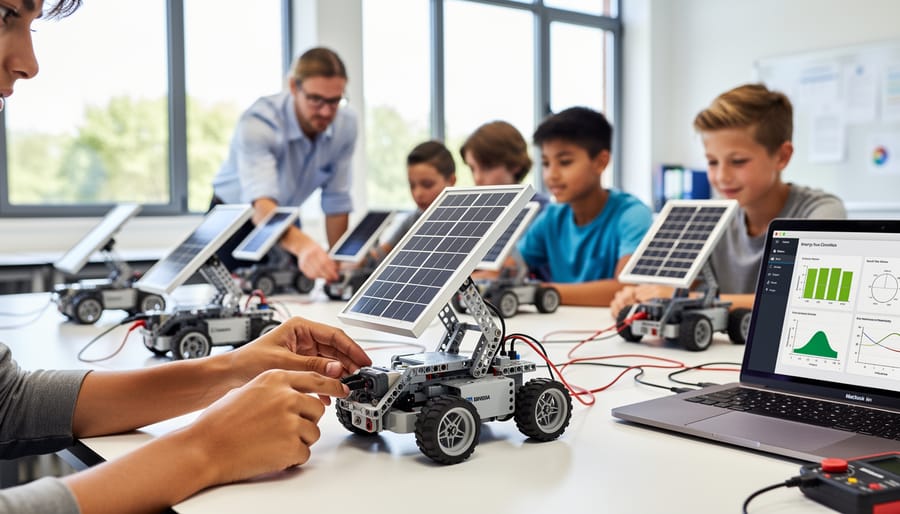
Educational solar robots provide hands-on demonstrations of the critical variables affecting photovoltaic system performance in real-world conditions. By manipulating the robot’s solar panel angle relative to the light source, learners observe immediate changes in power output, illustrating the importance of optimal tilt angles in utility-scale installations. Shading experiments reveal how partial obstruction dramatically reduces energy generation, a concept fundamental to site assessment and system design. Light intensity variations simulate different weather conditions and times of day, helping professionals understand capacity factors and energy yield predictions.
These interactive experiences translate abstract concepts into measurable data, allowing aspiring PV professionals to develop intuitive understanding before working with large-scale systems. The robots typically include voltage and current meters, enabling calculation of power output under varying conditions. This practical knowledge proves invaluable for site evaluators, system designers, and installation technicians who must optimize panel placement and configuration. Universities incorporating these tools into their renewable energy curricula report stronger student comprehension of performance metrics and troubleshooting methodologies, preparing graduates for immediate industry contribution.
Energy Storage and Power Management Concepts
Educational solar robots provide practical demonstrations of critical power management systems that mirror commercial photovoltaic installations. These hands-on platforms integrate rechargeable battery systems, typically lithium-ion or NiMH cells, allowing students to observe real-time energy storage dynamics as solar panels charge batteries during operation. The robots incorporate charge controllers that prevent overcharging and deep discharge, teaching essential battery protection protocols used in residential and utility-scale solar systems.
Students learn to balance power consumption with generation capacity by monitoring voltage levels, current flow, and state-of-charge indicators. This experiential learning translates directly to professional competencies in sizing battery banks, selecting appropriate charge controller technologies (PWM versus MPPT), and implementing energy management principles for grid-tied and off-grid installations.
Advanced educational models feature programmable power management systems where students optimize energy usage based on available solar input and battery reserves. These exercises develop critical thinking skills for designing efficient energy storage solutions, understanding depth-of-discharge limitations, and calculating system autonomy requirements. Universities partnering with industry leaders leverage these robots to bridge theoretical knowledge with practical applications, preparing students for careers in photovoltaic system design and renewable energy consulting.
System Design and Troubleshooting Competencies
Constructing and modifying educational solar robots cultivates essential problem-solving competencies that directly translate to professional photovoltaic applications. Students engage in hands-on troubleshooting as they diagnose performance issues, whether addressing circuit malfunctions, optimizing panel orientation, or balancing energy consumption with generation capacity. This iterative process mirrors real-world challenges faced by PV professionals in system design and maintenance. Through robot modifications, learners develop system-thinking abilities by understanding how individual components interact within the broader energy ecosystem. They learn to evaluate trade-offs between efficiency, cost, and performance while considering variables like shading, temperature, and load management. Universities incorporating these platforms into their curricula report that students demonstrate improved analytical skills and greater confidence when transitioning to industry roles. The experience of debugging sensor integration, adjusting power management algorithms, and optimizing energy storage prepares aspiring professionals for the complex decision-making required in commercial solar installations.
Selecting and Implementing Solar Robots in Educational Settings
Evaluation Criteria for Educational Solar Robot Kits
Selecting appropriate educational solar robot kits requires careful evaluation across multiple dimensions to ensure effective learning outcomes. Complexity level stands as the primary consideration, with kits ranging from elementary-level snap-together models to advanced university-grade systems featuring programmable microcontrollers and custom circuit design capabilities. The kit must align precisely with your learning objectives, whether introducing basic photovoltaic concepts or developing advanced system integration skills for aspiring professionals.
Durability becomes particularly critical in educational environments where repeated assembly and disassembly occurs. High-quality kits feature robust components, replaceable parts, and clear documentation to maximize longevity and minimize instructional downtime. Laboratory-grade materials and weatherproof designs prove essential for outdoor testing scenarios common in photovoltaic education programs.
Expandability represents another crucial factor, especially for institutions building long-term renewable energy curricula. Superior kits offer modular designs allowing students to progress from basic solar-powered movement to incorporating sensors, data logging systems, and wireless communication modules. This scalability enables universities and technical colleges to utilize single platform investments across multiple course levels.
Additional considerations include compatibility with standard educational frameworks, availability of comprehensive instructional materials, technical support quality, and integration capabilities with existing laboratory equipment. Educational institutions should also verify alignment with industry certification requirements and emerging photovoltaic workforce development standards to ensure graduates possess market-relevant competencies.
Curriculum Integration Strategies
Integrating solar robots into photovoltaic education programs requires strategic planning and structured implementation. For traditional classroom settings, instructors should position solar robot activities as hands-on laboratories that complement theoretical coursework on photovoltaic systems, energy conversion principles, and semiconductor physics. Dedicate specific class sessions to robot assembly and testing, allowing students to apply concepts learned during lectures to practical scenarios.
Online learning platforms benefit from incorporating solar robot kits as shipped materials that accompany virtual instruction. Provide detailed video tutorials demonstrating assembly procedures, troubleshooting techniques, and performance optimization strategies. Virtual learners should submit documentation of their robot’s performance metrics, including voltage output measurements and efficiency calculations, creating accountability and assessment opportunities.
Hybrid educational models offer optimal flexibility by combining synchronous online instruction with asynchronous hands-on experimentation. Students can attend live virtual sessions covering theoretical foundations, then independently work with their solar robots during designated laboratory periods. Universities partnering with industry organizations can establish maker spaces equipped with solar robots, multimeters, and light sources for collaborative learning experiences.
Assessment strategies should incorporate both qualitative observations and quantitative performance data. Require students to maintain engineering notebooks documenting design modifications, energy output measurements, and lessons learned throughout the experimentation process. This documentation approach develops professional competencies essential for careers in renewable energy while providing instructors with meaningful evaluation criteria.
The Future of Solar-Powered Educational Tools in PV Training
The photovoltaic education landscape is experiencing significant transformation as educational solar robots evolve beyond basic demonstration tools into sophisticated training platforms. Advanced features now incorporate real-time data analytics, enabling students to monitor power generation curves, voltage fluctuations, and efficiency metrics with professional-grade precision. These capabilities mirror the diagnostic tools used in commercial solar installations, preparing aspiring professionals for industry demands.
IoT integration represents a pivotal advancement in solar technology education. Modern solar robots can transmit performance data to cloud-based platforms, allowing instructors to facilitate remote learning experiences and enable collaborative analysis across multiple institutions. This connectivity supports universities developing comprehensive renewable energy curricula, where students can compare experimental results and analyze large datasets to understand variables affecting photovoltaic performance.
The integration of artificial intelligence and machine learning algorithms into educational robotics platforms is emerging as a game-changing trend. These systems can adapt difficulty levels based on learner progress, provide predictive maintenance simulations, and offer personalized feedback on system optimization techniques. Such adaptive learning environments align with industry certification requirements and professional development pathways.
Universities collaborating with industry partners are increasingly incorporating modular solar robot platforms that support progressive skill development. These systems allow learners to begin with fundamental concepts before advancing to complex scenarios involving battery management systems, maximum power point tracking, and grid integration principles.
The future trajectory indicates a shift toward hybrid learning models where hands-on solar robotics experiences complement virtual simulations and augmented reality applications. This multifaceted approach addresses diverse learning preferences while maintaining the tactile engagement essential for developing practical photovoltaic competencies, ensuring graduates possess both theoretical knowledge and applied skills demanded by the renewable energy sector.
Educational solar robots represent a transformative approach to photovoltaic education, bridging theoretical knowledge with hands-on experimentation. These innovative tools empower aspiring professionals to develop critical competencies in solar technology, renewable energy systems, and sustainable engineering practices. By engaging directly with photovoltaic principles through interactive assembly and experimentation, learners gain practical insights that traditional classroom instruction alone cannot provide. The effectiveness of these educational platforms is amplified when integrated into comprehensive curricula developed through industry-university collaborations, ensuring alignment with current professional standards and emerging market demands. For those committed to advancing their expertise in renewable energy, exploring practical solar learning opportunities through structured educational programs offers invaluable preparation for successful careers in the photovoltaic sector. Take the next step in your professional development by investigating hands-on training options that combine educational solar robotics with industry-recognized certification pathways.