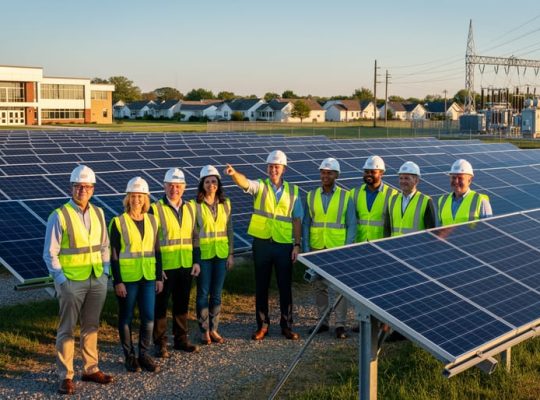
The solar industry stands at a crossroads where innovation cannot thrive in isolation. As photovoltaic technology advances at an unprecedented pace, the traditional model of proprietary development increasingly gives way to collaborative frameworks that accelerate breakthroughs while reducing redundant research costs. This shift has given birth to 2C Innovation Commons, a transformative approach that combines collective intelligence with structured intellectual property sharing to solve the most pressing challenges in solar energy deployment.
2C Innovation Commons represents a strategic alliance model where multiple stakeholders—manufacturers, research institutions, utilities, and technology developers—pool resources, knowledge, and pre-competitive research findings. Unlike conventional open-source initiatives, this framework establishes clear governance structures that protect commercial interests while enabling rapid knowledge transfer across organizational boundaries. The model specifically addresses the solar sector’s need for standardized testing protocols, shared performance data, and collaborative problem-solving around grid integration, energy storage compatibility, and installation efficiency.
Within Community Solar Innovation Labs, 2C Innovation Commons creates structured environments where competing entities work together on foundational challenges that benefit the entire industry. These collaborations typically focus on pre-competitive research areas such as material degradation analysis, performance monitoring methodologies, and safety standard development. By establishing shared datasets and validated testing procedures, participants reduce time-to-market for new technologies while maintaining competitive advantages in product differentiation and market strategy.
This collaborative framework has demonstrated measurable impact across multiple dimensions: accelerated research timelines, reduced development costs, enhanced technology reliability, and improved industry-wide standards. Understanding how 2C Innovation Commons operates provides essential insights for professionals navigating the evolving landscape of photovoltaic technology development and commercialization.
What Is 2C Innovation Commons?

The Collaboration Principle
The 2C Innovation Commons operates on the principle that breakthrough innovations in photovoltaic technology emerge most effectively through collaborative partnerships among diverse stakeholders. This framework brings together universities, private industry players, local communities, and research institutions to pool resources, share expertise, and accelerate solar technology development. Universities contribute cutting-edge research capabilities and emerging talent, while industry partners provide practical insights into market demands and manufacturing scalability. Research institutions offer specialized testing facilities and technical validation, and communities provide real-world deployment sites and feedback on implementation challenges. This multi-stakeholder approach creates a dynamic ecosystem where theoretical knowledge meets practical application, enabling faster iteration cycles and more robust solutions. By establishing formal partnerships and knowledge-sharing protocols, participants gain access to resources that would be prohibitively expensive or difficult to develop independently. The collaboration model also fosters cross-pollination of ideas across disciplines, leading to innovative approaches that transcend traditional sectoral boundaries. Through joint educational programs and workshops, the framework ensures continuous knowledge transfer while building a skilled workforce prepared to advance the renewable energy sector.
The Commons Approach
The commons approach fundamentally reimagines how solar technology innovation occurs by establishing shared resource pools that eliminate traditional barriers to advancement. Unlike proprietary models where knowledge remains locked behind patents and paywalls, innovation commons create accessible repositories of research data, testing protocols, and design specifications that any participant can utilize and build upon.
This framework operates through three interconnected pillars. First, shared physical infrastructure—including testing facilities, prototyping equipment, and demonstration sites—allows researchers and startups to access expensive resources without prohibitive capital investments. Second, open knowledge databases consolidate findings from multiple sources, enabling participants to avoid duplicating research and accelerate development timelines. Third, collective ownership structures ensure that breakthrough discoveries benefit the entire community rather than single entities.
Universities play a crucial role in sustaining these commons by contributing research capacity, student talent, and institutional credibility. Their educational programs prepare emerging professionals to engage effectively within collaborative frameworks, emphasizing interdisciplinary problem-solving and knowledge-sharing practices.
The commons approach delivers measurable benefits: reduced development costs through shared expenses, faster innovation cycles via collaborative troubleshooting, and enhanced technology transfer between academic institutions and commercial applications. For aspiring professionals, participation in innovation commons provides hands-on experience with cutting-edge photovoltaic systems while building networks across research institutions and industry partners. This democratization of resources particularly benefits smaller organizations and developing regions, creating a more inclusive pathway toward achieving global solar energy targets.
Community Solar Innovation Labs: The Testing Ground
Lab Infrastructure and Resources
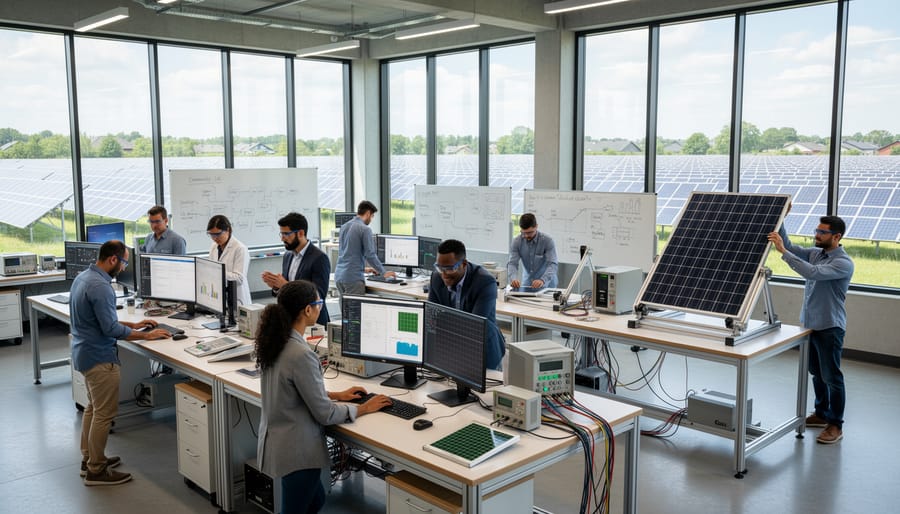
Community Solar Innovation Labs operating under the 2C Innovation Commons framework provide comprehensive infrastructure designed to accelerate photovoltaic technology development from concept to market-ready solutions. These facilities typically house advanced characterization equipment including solar simulators, spectroradiometers, and electrochemical impedance analyzers that enable precise performance evaluation of solar cells and modules under controlled conditions.
Testing capabilities extend beyond basic electrical measurements to include environmental stress testing chambers that simulate real-world conditions such as temperature cycling, humidity exposure, and UV degradation. This equipment allows researchers and entrepreneurs to validate long-term reliability and durability of their innovations before commercial deployment. Many labs also maintain clean rooms and fabrication stations equipped with screen printers, laminators, and encapsulation tools essential for prototype assembly.
Shared analytical resources often include scanning electron microscopes, X-ray diffraction systems, and thermal imaging cameras that provide detailed material characterization and fault detection capabilities. These high-value instruments, which would be cost-prohibitive for individual startups or small research teams, become accessible through the commons model.
Digital infrastructure complements physical equipment, with data management systems, simulation software licenses, and computational resources available to member organizations. University partnerships frequently expand resource availability by providing access to specialized equipment and expertise housed in academic research facilities. This comprehensive infrastructure ecosystem reduces capital barriers while maintaining professional-grade standards necessary for credible technology validation and certification processes.
Stakeholder Participation Models
The 2C Innovation Commons operates through a tiered participation model that accommodates diverse stakeholder needs and expertise levels. At the foundation, aspiring photovoltaic professionals gain hands-on experience through structured educational programs developed in collaboration with universities. These participants access laboratory equipment, attend workshops, and contribute to ongoing research projects while building practical skills in solar technology development and testing.
Mid-level participants include independent researchers, small-scale manufacturers, and renewable energy entrepreneurs who utilize the commons for prototype development and validation. These stakeholders benefit from shared resources that would otherwise require substantial capital investment, including specialized testing equipment and materials characterization tools. They often contribute by sharing findings from their experiments, creating a knowledge repository that benefits the broader community.
Established manufacturers and industry leaders engage with the commons primarily through collaborative research initiatives and technology validation programs. Rather than replacing proprietary research facilities, these organizations use the innovation labs to explore emerging technologies, conduct independent verification of new materials, and identify potential industry partnerships. Their participation often includes sponsoring specific research tracks, providing advanced equipment, or mentoring emerging professionals.
Academic researchers form a critical stakeholder group, conducting fundamental research while training the next generation of solar professionals. Universities partner with the commons to offer students real-world project experience and contribute peer-reviewed findings that advance industry knowledge. This multi-stakeholder approach ensures continuous innovation while maintaining accessibility for participants at all career stages, creating a sustainable ecosystem for photovoltaic technology advancement.
Breaking Down Barriers to Solar Innovation
Reducing Capital Requirements
One of the most significant barriers to photovoltaic innovation is the substantial capital investment required for specialized equipment and laboratory facilities. Community Solar Innovation Labs address this challenge by providing shared access to essential resources, effectively democratizing the innovation process. Through the 2C Innovation Commons model, emerging researchers and small-scale developers can utilize advanced characterization tools, testing equipment, and prototyping facilities without shouldering the full financial burden of ownership.
This shared infrastructure approach proves particularly valuable for university spin-offs, independent researchers, and early-stage companies exploring novel photovoltaic technologies. Rather than investing hundreds of thousands of dollars in equipment that may only be needed intermittently, innovators pay accessible usage fees or membership costs. The commons model also includes shared clean rooms, material processing equipment, and performance testing apparatus—resources typically available only to well-funded institutions or established corporations.
For aspiring professionals entering the renewable energy sector, this framework creates unprecedented opportunities to develop and validate concepts without securing substantial venture capital. The reduced financial risk encourages experimentation and accelerates the path from theoretical research to practical application, ultimately fostering a more diverse and competitive photovoltaic industry landscape.
Accelerating Knowledge Transfer
Knowledge transfer forms the backbone of effective innovation commons, enabling rapid capability development across the photovoltaic sector. Open educational resources play a pivotal role by providing accessible training materials on solar technologies, system design principles, and installation best practices. These resources democratize technical knowledge, allowing professionals from diverse backgrounds to acquire specialized skills without traditional barriers to entry.
University partnerships strengthen this ecosystem by connecting academic research with practical industry applications. Collaborative programs between innovation commons and higher education institutions facilitate internships, joint research initiatives, and curriculum development aligned with current market needs. These partnerships ensure that emerging professionals enter the workforce equipped with relevant, hands-tested competencies.
Peer-to-peer learning mechanisms create dynamic knowledge exchange channels where experienced practitioners share insights with newcomers while collectively solving technical challenges. Community solar projects benefit significantly from this collaborative approach, as participants contribute diverse perspectives on system optimization, regulatory compliance, and community engagement strategies. This horizontal knowledge flow accelerates problem-solving and reduces redundant experimentation, ultimately advancing photovoltaic deployment efficiency across participating organizations and fostering a culture of continuous improvement within the renewable energy sector.
Streamlining Market Pathways
The 2C Innovation Commons model fundamentally transforms how solar innovations reach commercial markets by establishing shared industry networks and standardized validation processes. Rather than individual researchers struggling to navigate complex commercialization pathways alone, participants gain access to collective relationships with manufacturers, distributors, and investors who understand the commons’ rigorous development standards.
This collaborative framework significantly reduces market entry barriers. When multiple stakeholders validate a technology through the commons, it carries inherent credibility that accelerates adoption discussions. Manufacturers can confidently evaluate prototypes knowing they’ve undergone peer review and real-world testing within the community solar context. Additionally, alignment with government incentives programs becomes more straightforward when innovations emerge from recognized collaborative platforms.
University partnerships within the commons provide another crucial advantage, offering direct connections to industry advisory boards and corporate research collaborations. These relationships create natural transition points where academic innovations can seamlessly move toward commercial applications. The commons essentially functions as a trusted intermediary, translating laboratory breakthroughs into market-ready solutions while maintaining the quality standards that industry partners require for investment and deployment decisions.
Real-World Applications: From PERC to Building-Integrated PV
Module Efficiency Improvements
Collaborative testing environments within the 2C Innovation Commons framework have demonstrated measurable advances in module efficiency across established photovoltaic technologies. A notable example involves the systematic optimization of Passivated Emitter and Rear Cell (PERC) technology, where shared laboratory resources enabled researchers from multiple institutions to conduct parallel testing protocols. Through this coordinated approach, participating organizations achieved efficiency improvements of 0.8% to 1.2% in mono PERC modules by refining rear surface passivation techniques and optimizing light capture mechanisms.
Multi-crystalline silicon technologies have similarly benefited from these collaborative testing platforms. One documented case study involved a consortium of university researchers and industry partners who utilized shared characterization equipment to analyze grain boundary effects on carrier lifetime. This joint investigation led to modified crystal growth parameters that reduced defect density, resulting in multi-crystalline modules achieving efficiencies approaching 19.5%, narrowing the performance gap with monocrystalline alternatives.
The commons model particularly excels in accelerating technology transfer from laboratory to production. By providing access to industry-standard testing protocols and equipment calibration procedures, smaller manufacturers gain insights typically available only to large-scale producers. Educational institutions participating in these commons programs integrate real-world efficiency data into their curriculum, preparing students with hands-on experience in performance optimization techniques. This combination of collaborative research infrastructure and educational integration ensures that efficiency improvements translate rapidly into commercially viable products while simultaneously building workforce competency in advanced module technologies.
Advancing Solar Tiles and Shingles
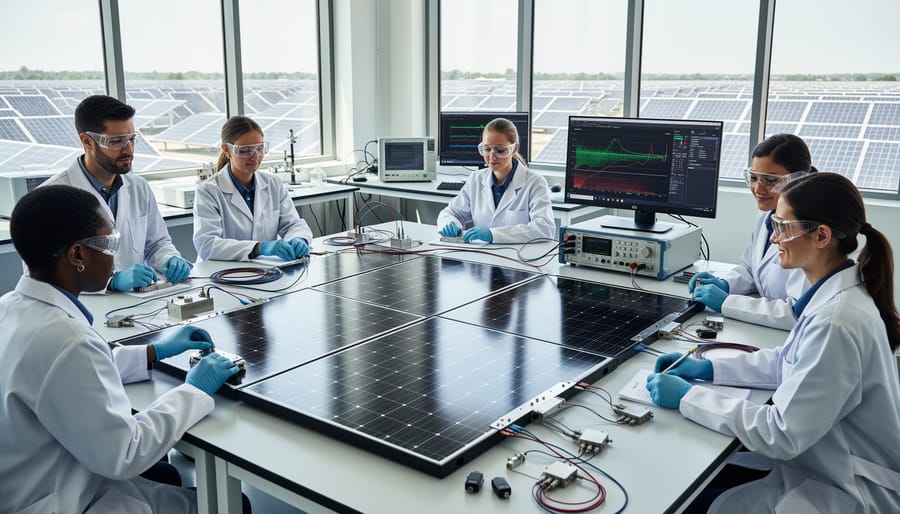
Solar tiles and shingles represent a transformative category of building-integrated photovoltaic innovations benefiting significantly from collaborative research environments. Through 2C Innovation Commons frameworks, researchers from multiple institutions pool expertise to address persistent challenges in durability, aesthetics, and installation efficiency.
Recent collaborative efforts have yielded significant advances in thin-film technology adapted specifically for roofing applications. University partnerships within innovation commons have developed photovoltaic cells that integrate seamlessly with traditional roofing materials while maintaining competitive conversion efficiencies approaching 20%. These developments emerge from shared testing facilities where researchers can evaluate product performance under diverse environmental conditions without duplicating expensive infrastructure.
Manufacturing scalability represents another area where collective research proves invaluable. Innovation commons participants share data on production techniques, quality control protocols, and supply chain optimization. This knowledge exchange accelerates the path from laboratory prototypes to commercially viable products, reducing individual development costs by an estimated 30-40%.
Educational programs affiliated with these commons prepare the next generation of professionals to install and maintain these sophisticated systems. Training modules developed collaboratively ensure standardized best practices across the industry, addressing safety concerns and installation precision crucial for long-term performance.
The shared research model also facilitates rapid iteration on design improvements, with feedback from field installations informing subsequent product generations. This collaborative approach positions solar tiles and shingles as increasingly competitive alternatives to traditional roofing solutions, advancing both renewable energy adoption and architectural aesthetics.
Educational Integration: Training Tomorrow’s Solar Innovators
University-Industry Collaboration Benefits
University partnerships within the 2C Innovation Commons framework generate significant value for both academic institutions and industry participants. These collaborations transform theoretical learning into practical experience, enabling students to engage directly with cutting-edge photovoltaic research and real-world technology challenges. Engineering and renewable energy students gain access to advanced testing facilities, pilot projects, and manufacturing processes that would otherwise remain beyond their academic reach.
Research synergies emerge naturally when academic expertise combines with industry resources and market knowledge. Universities contribute fundamental research capabilities, computational modeling, and analytical rigor, while industry partners provide application context, scaling expertise, and commercialization pathways. This reciprocal relationship accelerates innovation cycles and ensures research outcomes address actual market needs.
The commons model facilitates community-led education initiatives that extend beyond traditional classroom settings. Internship programs, collaborative research projects, and thesis opportunities within innovation commons sites prepare the next generation of photovoltaic professionals with hands-on competencies. Graduate students frequently contribute to breakthrough developments in materials science, system optimization, and performance testing while advancing their academic credentials.
Industry stakeholders benefit from accessing emerging talent pipelines and fresh perspectives on technical challenges. Universities gain funding opportunities, publication material, and enhanced relevance for their programs. This symbiotic relationship strengthens regional innovation ecosystems and maintains the solar industry’s competitive edge through continuous knowledge exchange and workforce development.
Skills Development for Commons Participation
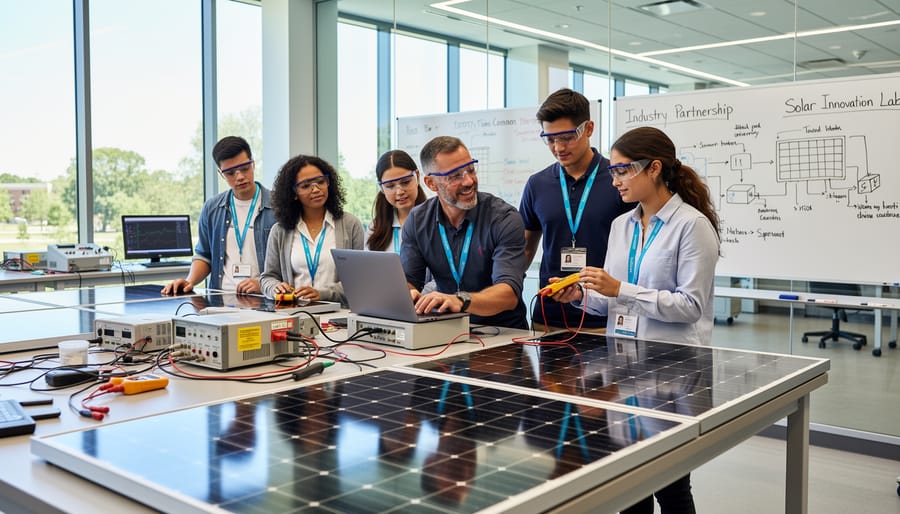
Effective participation in innovation commons requires aspiring photovoltaic professionals to develop a distinctive blend of technical, collaborative, and adaptive competencies. Unlike traditional industry roles, commons environments demand proficiency in open-source methodologies, including familiarity with shared documentation platforms, version control systems, and transparent knowledge-sharing protocols that enable distributed teams to coordinate complex solar technology projects.
Communication skills prove equally critical, as contributors must articulate technical concepts to diverse stakeholders—from academic researchers and industry partners to community members without specialized backgrounds. This includes translating complex photovoltaic performance data into actionable insights and presenting collaborative findings through multiple formats.
Intellectual property literacy represents another essential competency. Professionals must understand open licensing frameworks, creative commons designations, and the distinctions between proprietary and openly shared innovations. This knowledge ensures contributors can navigate the legal landscape while maximizing the commons’ collaborative potential.
Universities partnering with innovation commons increasingly offer specialized coursework addressing these competencies through interdisciplinary programs combining renewable energy engineering, collaborative innovation management, and sustainability studies. These educational pathways provide structured skill development through hands-on commons projects, preparing graduates to become effective contributors who can bridge technical expertise with the collaborative ethos that defines commons-based solar innovation.
Overcoming Implementation Challenges
Intellectual Property Considerations
The 2C Innovation Commons framework addresses intellectual property considerations through carefully structured agreements that balance open collaboration with commercial viability. Participants typically operate under shared innovation agreements that define ownership rights, licensing terms, and commercialization pathways from the outset. These agreements often employ tiered IP structures where foundational research remains accessible to all members while allowing individual organizations to retain proprietary rights on specific applications or improvements they develop.
Contributors maintain protection through attribution requirements and contributor agreements that recognize individual and institutional contributions to collective innovations. Many commons utilize Creative Commons or similar licensing models adapted for technical innovations, ensuring that derivative works acknowledge original contributors while enabling continued development. This approach proves particularly valuable in photovoltaic technology development, where incremental improvements build upon shared knowledge bases.
Universities participating in these frameworks benefit from clearly defined technology transfer protocols that protect academic freedom while enabling commercialization opportunities. The commons structure typically includes provisions for patent pooling, cross-licensing arrangements, and revenue-sharing mechanisms that incentivize participation without restricting market entry. This balanced approach ensures that breakthrough solar technologies developed collaboratively can reach commercial markets efficiently while maintaining the collaborative spirit essential for continued innovation and knowledge advancement across the renewable energy sector.
Sustaining Long-Term Engagement
Maintaining momentum in 2C Innovation Commons requires deliberate strategies that address both human motivation and material resources. Successful commons establish clear recognition systems that acknowledge participant contributions through public attribution, co-authorship opportunities on publications, and professional development benefits. Universities partnering with commons initiatives often provide continuing education credits or certificate programs that validate participant expertise, creating tangible career advancement incentives for photovoltaic professionals.
Resource sustainability depends on diversified funding models combining industry sponsorships, grant funding, and institutional support. Leading commons implement transparent governance structures where participants influence decision-making processes, fostering ownership and commitment. Regular milestone celebrations and progress reports maintain community enthusiasm while demonstrating tangible outcomes to stakeholders.
Educational programming serves dual purposes: attracting new participants while deepening existing member engagement. Workshops, webinars, and collaborative research projects create continuous learning opportunities that keep the community intellectually stimulated. Academic institutions contribute by offering graduate student involvement, laboratory access, and technical expertise, ensuring the commons maintains cutting-edge capabilities. Establishing measurable impact metrics—such as patents filed, technologies commercialized, or peer-reviewed publications—helps justify continued investment and demonstrates value to renewable energy stakeholders and funding organizations.
The 2C Innovation Commons represents a fundamental paradigm shift in how solar technology advances from laboratory concepts to market-ready solutions. By dismantling traditional silos that have historically slowed innovation, this collaborative framework creates unprecedented opportunities for knowledge sharing, resource optimization, and accelerated development cycles within the photovoltaic industry.
For aspiring professionals entering the solar sector, engaging with Innovation Commons initiatives provides invaluable hands-on experience and networking opportunities that complement formal education. Industry stakeholders should actively explore partnership opportunities with community solar innovation labs to leverage shared infrastructure and reduce research costs while contributing to collective advancement. Academic researchers can amplify their impact by participating in these collaborative environments, where theoretical discoveries find practical applications more rapidly through cross-disciplinary engagement.
The transformative potential extends beyond individual organizations to reshape entire market dynamics. As more stakeholders embrace this open innovation model, barriers to entry decrease for smaller enterprises, fostering diversity and competition that ultimately benefits consumers through improved technology and reduced costs. Universities partnering with Innovation Commons initiatives create educational programs that prepare graduates with real-world skills aligned to industry needs.
Moving forward, the photovoltaic industry’s trajectory depends significantly on widespread adoption of collaborative frameworks like 2C Innovation Commons. Stakeholders at every level should evaluate how they can contribute to and benefit from these ecosystems, recognizing that collective progress accelerates the global transition to sustainable energy more effectively than isolated efforts ever could.