Showing 12 Result(s)
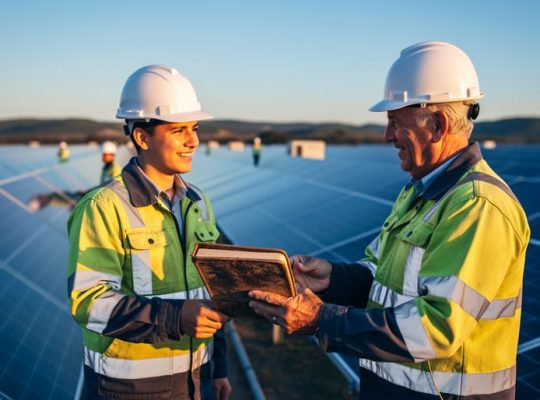
Senior engineer passing a rugged field notebook to a younger colleague beside rows of photovoltaic panels at golden hour, with distant technicians and inverter boxes softly blurred in the background.

Why Solar Companies Are Losing Their Most Valuable Asset (And How to Save It)

The photovoltaic industry faces a critical parallel between how solar panels convert sunlight into electricity and how experienced professionals must transfer knowledge to emerging talent. Just as photons striking semiconductor materials initiate a cascade of energy transformations—from radiant to electrical energy with quantifiable efficiency losses at each stage—the solar workforce experiences similar transfer dynamics when seasoned engineers pass technical expertise to new hires.
Understanding energy transfers in solar systems reveals three fundamental conversion stages: photon absorption in the active layer, electron-hole …


Senior solar technician mentoring a junior colleague on a commercial rooftop, both in safety gear, examining photovoltaic panels under warm golden-hour light with blurred panel rows and a distant city skyline.

Why Your Best Solar Technicians Keep Leaving (And How to Make Them Stay)

The solar industry faces a critical challenge: employee turnover rates averaging 15-20% annually cost photovoltaic companies between $50,000 and $150,000 per departed technical professional. This attrition disrupts project timelines, erodes institutional knowledge, and threatens competitive positioning in an industry projected to add 100,000 new jobs by 2030.
**Build strategic educational partnerships** with universities and technical institutions to create talent pipelines while offering current employees clear advancement pathways. These collaborations establish your organization as an industry leader invested in professional …

A team of solar professionals wearing safety gear, reviewing emergency response plans and safety protocols at a solar installation site, symbolizing preparedness in crisis management.

Critical Solar Emergency Response: Mastering Crisis Management for PV Professionals

In the high-stakes world of solar energy operations, crisis management isn’t just a contingency plan—it’s a critical operational framework that determines organizational resilience. The four distinct stages of crisis management—Prevention, Preparation, Response, and Recovery—form an integrated approach that safeguards photovoltaic installations, personnel, and stakeholder interests. Recent industry data reveals that solar companies implementing structured crisis management protocols experience 60% fewer operational disruptions and maintain significantly higher customer confidence levels during adverse events. …

Students and industry professionals collaboratively working on solar panels and digital learning platforms in an innovative classroom setting, representing the development of tomorrow’s solar workforce.

Building Tomorrow’s Solar Workforce Through Industry-Academic Innovation

Cross-sector collaboration in solar workforce development represents a transformative approach to addressing the renewable energy industry’s pressing skills gap. By uniting academic institutions, industry leaders, and government agencies, these strategic partnerships create robust pathways for developing the next generation of solar energy professionals. Recent data from the Solar Energy Industries Association indicates that the solar workforce must triple by 2030 to meet ambitious clean energy goals, making effective collaboration between sectors not just beneficial, but essential.
The convergence of educational expertise, …

Build a Solar Workforce That Shines: Creating an Effective Diversity Plan

In today’s rapidly evolving renewable energy sector, implementing a comprehensive workforce diversity plan has become essential for sustainable business growth and innovation. Recent industry studies demonstrate that companies with diverse teams achieve 35% higher financial returns and demonstrate superior problem-solving capabilities in complex solar projects. A well-structured diversity initiative extends beyond mere recruitment metrics, encompassing inclusive policies, mentorship programs, and cultural competency training specifically tailored for the renewable energy sector.
Leading solar organizations recognize that …

How Smart Solar Companies Build Truly Inclusive Teams That Innovate

Transform your workplace culture by implementing data-driven diversity initiatives, establishing clear metrics for inclusion outcomes, and creating accountability systems that drive measurable progress. The path to building an inclusive workforce demands strategic leadership commitment, structured mentorship programs, and equitable advancement opportunities. Today’s solar industry leaders recognize that workplace inclusion directly correlates with …

Conceptual illustration showing a split-screen of traditional solar installation training versus a virtual reality training environment, emphasizing the advanced, immersive nature of VR technology in educating solar professionals.

Virtual Reality Training Is Transforming How Solar Installers Master Their Craft

Virtual reality stands at the forefront of a technological revolution that’s reshaping how we train, learn, and interact within the renewable energy sector. As photovoltaic installations grow exponentially worldwide, traditional training methods struggle to keep pace with industry demands. VR technology offers an unprecedented solution, combining immersive learning environments with real-world applications for solar workforce development.
Recent studies from the National Renewable Energy Laboratory demonstrate that VR-based training can reduce learning time by up to 40% while improving knowledge retention by 75% compared to …

A solar technician using a tablet to monitor solar panel performance remotely, with digital data and augmented reality elements in the scene, showcasing the integration of technology in the solar industry.

Remote Solar Teams Are Transforming the PV Industry: New Data Reveals Why

The global shift toward remote work has fundamentally transformed the solar industry’s operational landscape, presenting unprecedented opportunities and challenges for photovoltaic organizations. Recent data from the International Renewable Energy Agency (IRENA) indicates that 73% of solar companies have permanently adopted hybrid or fully remote work models, significantly impacting project management, team collaboration, and technical training methodologies. This evolution has catalyzed innovative approaches to virtual site assessments, remote monitoring systems, and digital workforce management platforms, enabling solar …

An illustrated solar professional using augmented reality goggles and a tablet amidst a solar farm with digital holograms of interconnected systems, data streams, and icons highlighting advanced digital technologies in solar energy.

Digital Skills That Power Tomorrow’s Solar Industry

Digital upskilling has become imperative in the rapidly evolving solar energy sector, where technological advancement continues to reshape traditional roles and responsibilities. As photovoltaic systems become increasingly sophisticated, professionals must develop new digital competencies to remain competitive and drive innovation. From advanced monitoring systems and predictive maintenance algorithms to integrated smart grid solutions, the convergence of solar technology and digital transformation demands a workforce equipped with both technical expertise and digital fluency.
The integration of artificial intelligence, machine …

Conceptual illustration of a solar industry apprentice standing on a rooftop with solar panels, holding tools and a blueprint, surrounded by symbols of solar energy and renewable technology.

Solar Industry Apprenticeship: Your Fast Track to a High-Demand PV Career

The rapid growth of solar energy has created unprecedented opportunities for skilled professionals, driving the emergence of comprehensive solar apprenticeship programs across the United States. These structured training pathways combine hands-on experience with technical education, offering aspiring solar technicians a direct route into this dynamic industry. Through partnerships with established solar companies, educational institutions, and industry organizations, apprentices gain invaluable expertise in photovoltaic system design, installation, maintenance, and safety protocols while earning competitive wages.
Recent data from …