
The U.S. Climate Resilience Toolkit stands as a critical resource for photovoltaic professionals navigating the complexities of solar system optimization in challenging climate conditions. This comprehensive federal platform integrates real-time climate data, predictive modeling tools, and region-specific adaptation strategies to enhance solar infrastructure resilience. Solar facility managers can leverage the toolkit’s advanced assessment frameworks to identify vulnerability points, implement targeted mitigation measures, and develop robust climate adaptation plans that safeguard PV system performance. Through its interactive decision-support tools, climate mapping capabilities, and extensive case study database, the toolkit enables professionals to make data-driven decisions that maximize system efficiency while minimizing climate-related risks. For organizations investing in solar energy infrastructure, understanding and utilizing these federal resources has become increasingly vital as extreme weather events and climate variability continue to impact renewable energy systems across the United States.
Understanding Cold Climate Challenges for PV Systems
Temperature-Related Performance Issues
Extreme cold temperatures present significant challenges for photovoltaic systems, impacting both solar panel efficiency and long-term durability. During winter months, solar panels can experience thermal stress due to rapid temperature fluctuations, potentially leading to microcracks in the silicon cells and degradation of module components. Research indicates that while panels generally perform well in cold conditions due to reduced electrical resistance, extreme temperatures below -40°F (-40°C) can compromise system reliability.
The U.S. Climate Resilience Toolkit provides valuable resources for addressing these challenges, including detailed climate projections and adaptation strategies. System operators can utilize the toolkit’s temperature mapping features to anticipate extreme cold events and implement preventive measures. These may include installing cold-weather-rated components, implementing sophisticated monitoring systems, and adjusting maintenance schedules based on forecasted temperature patterns.
For optimal performance in cold climates, the toolkit recommends maintaining steeper tilt angles to prevent snow accumulation and selecting materials specifically designed for extreme temperature variations. Regular thermal imaging inspections, as suggested by the toolkit’s best practices, help identify potential stress points before they develop into system failures.
Snow and Ice Management
Snow accumulation and ice formation present significant challenges to photovoltaic system performance in cold climates. The U.S. Climate Resilience Toolkit provides essential resources for monitoring and managing these winter weather impacts. The toolkit incorporates data from weather stations and satellite imagery to analyze snow depth patterns and ice formation risk across different regions.
System operators can utilize the toolkit’s historical climate data to predict snow loads and plan appropriate maintenance schedules. This information helps in designing PV arrays with optimal tilt angles that facilitate natural snow shedding while maintaining generation efficiency. The toolkit also offers modeling capabilities to assess the thermal cycling effects of freeze-thaw patterns on solar panel materials and mounting structures.
Ice formation particularly affects system components such as sensors, wiring, and junction boxes. The toolkit’s temperature and precipitation forecasting features enable operators to anticipate and prepare for icing conditions. Implementation of preventive measures, such as heating elements or protective covers, can be strategically planned using the toolkit’s climate projections and risk assessment tools.
For long-term planning, the toolkit provides climate change scenarios that help stakeholders evaluate future snow and ice management needs, ensuring sustained system performance throughout the installation’s lifetime.

Leveraging the Climate Resilience Toolkit
Climate Data Integration
The U.S. Climate Resilience Toolkit provides comprehensive resources for integrating both historical climate data and future projections into system design decisions. This integration process begins with accessing the Climate Explorer tool, which offers detailed temperature, precipitation, and extreme weather event data specific to your location.
For historical analysis, the toolkit aggregates data from multiple reliable sources, including NOAA’s National Centers for Environmental Information and NASA’s climate data repositories. Users can analyze trends in temperature variations, precipitation patterns, and extreme weather events over decades, providing crucial baseline information for system planning.
The projection capabilities utilize downscaled climate models that offer insights into potential future conditions through 2100. These projections are available under different emissions scenarios, allowing designers to plan for various possible climate futures. The toolkit’s interactive visualizations help users understand how different climate variables might affect their systems over time.
To effectively use this data for system design:
1. Define your specific location and time horizon
2. Select relevant climate variables for your application
3. Download historical data to establish baseline conditions
4. Review projected changes under different scenarios
5. Incorporate uncertainty ranges into design parameters
The toolkit also provides guidance on interpreting confidence levels in projections and understanding the limitations of climate models. This comprehensive approach ensures that system designs account for both historical climate patterns and anticipated future changes, leading to more resilient installations.

Risk Assessment Tools
The U.S. Climate Resilience Toolkit offers comprehensive risk assessment tools designed to help organizations and communities evaluate their vulnerability to climate-related challenges. The Climate Explorer, a cornerstone feature, enables users to visualize historical climate data and future projections specific to their location, helping identify potential impacts on solar installations and infrastructure.
The Steps to Resilience framework provides a structured approach to risk assessment, guiding users through five key stages: exploring hazards, assessing vulnerability and risks, investigating options, prioritizing actions, and taking action. This systematic methodology helps solar professionals develop targeted strategies for climate adaptation.
Users can access specialized assessment tools including the Adaptation Workbook, which helps evaluate climate vulnerabilities specific to energy infrastructure. The toolkit’s built-in mapping capabilities allow professionals to overlay climate projections with existing solar installations, identifying areas requiring enhanced resilience measures.
The platform integrates real-world case studies demonstrating successful risk assessment implementations, providing valuable insights for similar projects. These resources are regularly updated with new data and methodologies, ensuring users have access to the most current climate science and assessment techniques.
For quantitative analysis, the toolkit provides standardized metrics and evaluation criteria, enabling users to measure and compare climate risks across different locations and timeframes. This data-driven approach supports informed decision-making in solar project planning and risk management strategies.
Adaptation Strategies
The U.S. Climate Resilience Toolkit provides comprehensive strategies to help photovoltaic systems adapt and thrive through environmental stress. Implementation begins with a thorough vulnerability assessment of existing solar installations, identifying potential climate-related risks and system weaknesses. This assessment forms the foundation for developing targeted adaptation measures.
Key implementation strategies include upgrading mounting systems to withstand extreme weather events, incorporating smart monitoring systems for real-time performance tracking, and establishing robust maintenance protocols. The toolkit recommends a multi-layered approach to resilience, combining physical infrastructure improvements with operational adaptations.
Facility managers are encouraged to utilize the toolkit’s decision-support tools, which help prioritize adaptation measures based on cost-effectiveness and risk reduction potential. These tools incorporate climate projections and local weather data to inform system modifications and operational adjustments.
The toolkit emphasizes the importance of stakeholder engagement and cross-departmental collaboration during implementation. This includes training maintenance personnel, updating emergency response procedures, and establishing clear communication channels for weather-related incidents. Regular evaluation of implemented strategies ensures continuous improvement and adaptation to changing climate conditions.
Success metrics should be established to measure the effectiveness of implemented measures, including system uptime during extreme weather events, recovery time after disruptions, and overall performance reliability.
Implementation Best Practices
System Design Considerations
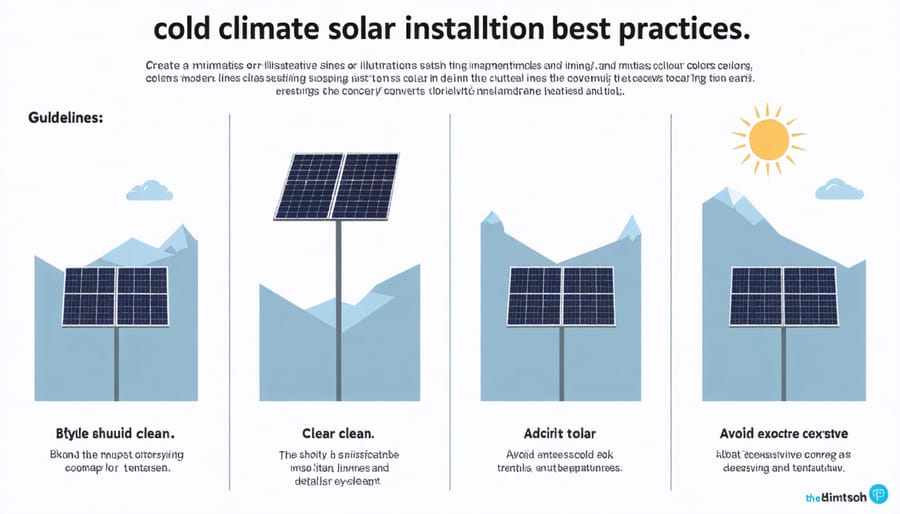
The U.S. Climate Resilience Toolkit incorporates several critical design considerations for optimizing photovoltaic systems in cold climates. Primary structural elements must account for snow and ice loading, requiring enhanced frame strength and resilient solar panel solutions that can withstand extreme winter conditions.
System designers must carefully evaluate mounting angles to facilitate natural snow shedding while maintaining optimal solar exposure. Typical installations in cold regions utilize steeper tilt angles, generally between 35-45 degrees, to prevent snow accumulation and maximize winter solar gain. The toolkit recommends incorporating temperature-resistant materials and components rated for extreme cold, including specialized inverters with cold-weather operation capabilities.
Thermal cycling protection is essential, as rapid temperature fluctuations can stress system components. Design considerations include implementing expansion joints and flexible mounting systems that accommodate thermal movement. The toolkit emphasizes the importance of robust grounding systems that remain effective despite frozen soil conditions.
Drainage systems must be carefully planned to manage snowmelt and prevent ice dam formation. This includes strategic placement of snow guards and heating elements in critical areas. The toolkit also provides guidance on implementing monitoring systems that can function reliably in sub-zero temperatures, enabling real-time performance tracking and early problem detection.
Monitoring and Maintenance Protocols
Regular monitoring and maintenance are critical components of ensuring optimal performance of photovoltaic systems in cold climates. The U.S. Climate Resilience Toolkit recommends implementing a comprehensive monitoring protocol that includes daily performance tracking, weekly visual inspections, and monthly detailed system assessments.
Key monitoring parameters should include power output measurements, inverter efficiency readings, and snow accumulation levels. Automated monitoring systems can provide real-time data and alert operators to potential issues before they escalate. These systems should be configured to track temperature fluctuations, which can significantly impact solar panel efficiency in cold regions.
Maintenance protocols should focus on snow removal strategies, ensuring proper drainage systems functionality, and regular inspection of weatherproofing elements. During winter months, schedule frequent checks of mounting hardware and structural supports, as thermal expansion and contraction can affect system integrity.
The toolkit emphasizes preventative maintenance scheduling based on historical weather data and regional climate patterns. This includes pre-winter preparation activities such as weatherization of electrical components and verification of heat tape functionality where applicable.
Documentation of all monitoring and maintenance activities is essential for compliance and performance optimization. Maintain detailed records of inspections, repairs, and system modifications, utilizing the toolkit’s standardized reporting templates to ensure consistency and facilitate long-term performance analysis.
Training maintenance personnel in cold-weather safety protocols and emergency response procedures is crucial for ensuring both system reliability and worker safety during extreme weather conditions.
Future-Proofing Solar Installations
In an era of increasing climate uncertainty, implementing effective resilience strategies for solar installations has become paramount. Forward-thinking solar professionals are leveraging advanced modeling tools and climate projections available through the U.S. Climate Resilience Toolkit to enhance system longevity and performance.
Key considerations for future-proofing solar installations include robust mounting systems designed to withstand extreme weather events, smart monitoring technologies that enable predictive maintenance, and adaptive management protocols that respond to changing environmental conditions. The toolkit’s climate projection data helps installers anticipate potential challenges and implement appropriate mitigation measures during the design phase.
Emerging technologies play a crucial role in enhancing installation resilience. Bifacial solar panels, which capture reflected light on both sides, demonstrate improved performance in snow-covered conditions. Advanced inverter technologies with enhanced grid support functions help maintain system stability during extreme weather events. Additionally, artificial intelligence-driven monitoring systems can predict and respond to environmental stressors before they impact system performance.
Climate adaptation strategies should also consider the evolution of building codes and safety standards. The toolkit provides valuable insights into regional climate trends, enabling installers to exceed current requirements and prepare for future regulatory changes. This proactive approach helps ensure installations remain compliant and efficient throughout their operational lifetime.
Integration with energy storage systems represents another critical aspect of future-proofing. Battery technology continues to advance, offering improved capacity and reliability for backup power during grid disruptions. The toolkit’s resources help professionals optimize storage system sizing based on projected climate patterns and energy demand forecasts.
Successful implementation requires regular assessment and updates to adaptation strategies as new climate data and technologies become available. Professional development and ongoing education ensure installation teams stay current with best practices and emerging solutions for climate resilience.
The U.S. Climate Resilience Toolkit stands as a vital resource for organizations and communities seeking to build resilience against climate-related challenges. By following the Steps to Resilience framework and utilizing the comprehensive tools and resources available, stakeholders can develop effective strategies to protect their assets and infrastructure from climate impacts.
Key takeaways from implementing climate resilience strategies include the importance of conducting thorough vulnerability assessments, engaging stakeholders throughout the planning process, and maintaining flexibility in adaptation approaches. Success requires a commitment to data-driven decision-making, regular monitoring of outcomes, and continuous adjustment of strategies based on new information and changing conditions.
To effectively implement climate resilience strategies, organizations should:
1. Establish a dedicated team responsible for resilience planning
2. Regularly assess and document climate-related risks and vulnerabilities
3. Prioritize actions based on both urgency and available resources
4. Develop specific, measurable goals with clear timelines
5. Create robust monitoring systems to track progress
6. Foster partnerships with relevant stakeholders and experts
7. Maintain updated emergency response plans
By leveraging the toolkit’s resources and following these actionable steps, organizations can build comprehensive climate resilience programs that protect their investments and ensure long-term sustainability. Remember that climate resilience is an ongoing process that requires continuous evaluation, learning, and adaptation to emerging challenges and opportunities.