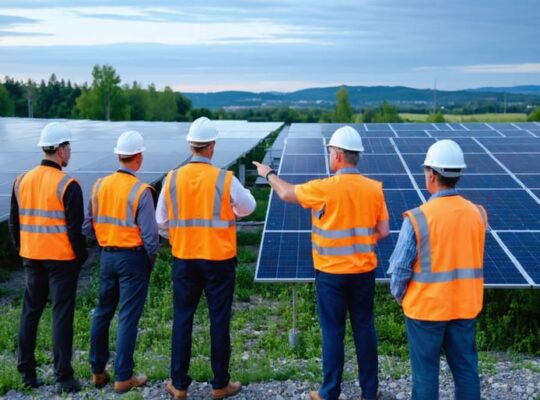
Solar co-operatives represent a transformative approach to renewable energy adoption, enabling communities to harness solar power through collective investment and shared infrastructure. These grassroots organizations empower residents to pool resources, negotiate bulk purchasing rates, and implement large-scale community power projects that would be financially unfeasible for individual households.
By aggregating demand and distributing costs across multiple participants, solar co-ops typically reduce installation expenses by 15-30% while providing members with professional guidance throughout the procurement and implementation process. This collaborative model has gained significant traction across North America, with successful implementations demonstrating both environmental and economic benefits for participating communities.
The growing prominence of solar co-operatives reflects a broader shift toward democratized energy production, where local communities take control of their energy future through collective action and shared responsibility. These initiatives not only accelerate the transition to renewable energy but also foster energy independence, strengthen community bonds, and create sustainable economic opportunities for participating neighborhoods.
What Makes Solar Co-ops Different?

Collective Purchasing Power
Solar co-ops leverage the fundamental principle of bulk purchasing to secure significant cost reductions for their members. By aggregating demand from multiple households or businesses, these cooperatives can negotiate more favorable terms with solar equipment manufacturers, installers, and service providers. This collective approach typically results in cost savings of 15-30% compared to individual installations.
The enhanced negotiating position extends beyond mere price considerations. Co-op representatives can demand higher quality standards, better warranty terms, and more comprehensive service agreements. They also possess greater leverage in securing specialized equipment or custom installations that might be cost-prohibitive for individual buyers.
Furthermore, the collective purchasing model enables co-ops to streamline the procurement process. By conducting thorough vendor evaluations and establishing standardized equipment specifications, they eliminate redundant research efforts and ensure consistent quality across installations. This efficiency translates to reduced soft costs, including permitting, design, and administrative expenses.
The consolidated buying power also attracts premium installers who might otherwise focus on larger commercial projects, giving residential members access to top-tier expertise and installation quality.
Shared Technical Expertise
Solar co-ops leverage collective expertise to enhance the implementation and management of community solar projects. Members benefit from shared knowledge across various technical aspects, from system design to maintenance protocols. Through organized workshops and solar education resources, participants gain valuable insights into optimal panel placement, inverter selection, and performance monitoring techniques.
Professional guidance from experienced solar engineers and certified installers ensures that installations meet industry standards and local regulations. This pooled expertise helps members navigate complex technical decisions, such as equipment specifications, grid integration requirements, and system sizing calculations. Co-op members can access detailed performance data and maintenance recommendations, enabling informed decision-making for system optimization.
The collaborative environment fosters knowledge transfer between experienced and new members, creating a sustainable learning ecosystem. Technical committees within co-ops often develop standardized best practices, troubleshooting guides, and maintenance schedules that benefit the entire membership. This shared technical foundation strengthens the co-op’s operational efficiency and helps maintain consistent system performance across all installations.
Technical Design Considerations
Grid Integration Strategies
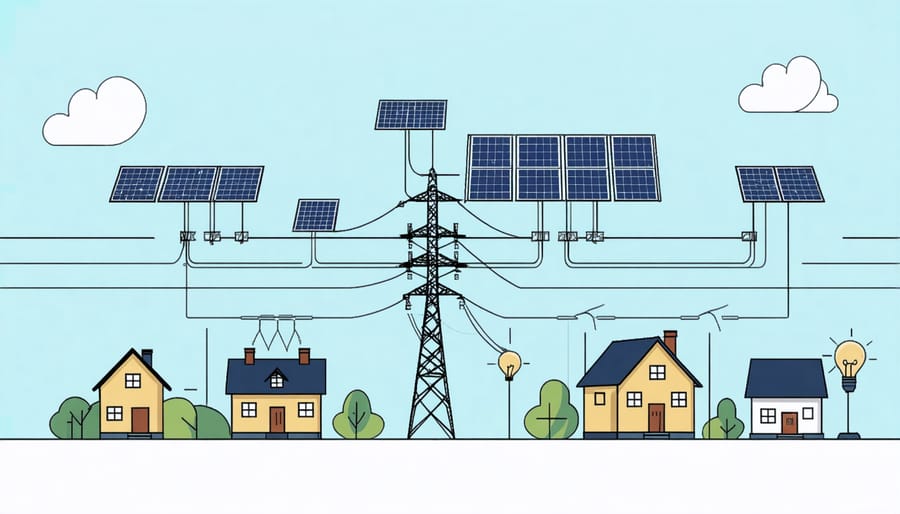
Grid integration for solar co-ops requires careful planning and coordination to ensure optimal system performance and compliance with utility requirements. The primary integration strategy involves implementing a master inverter system that coordinates multiple distributed solar arrays, managing their collective output to maintain grid stability.
Solar co-ops typically employ smart metering infrastructure to monitor and control power flow between member systems and the grid. This includes advanced monitoring equipment that tracks production, consumption, and export patterns across all connected installations. Net metering arrangements are established with local utilities to ensure fair compensation for excess power generation while maintaining grid reliability.
Load balancing plays a crucial role in grid integration, with sophisticated control systems distributing power efficiently among co-op members. These systems utilize predictive algorithms to anticipate peak demand periods and adjust generation accordingly. Many co-ops implement battery storage solutions to optimize grid integration, storing excess power during high production periods for use during peak demand or low production times.
Interconnection requirements vary by jurisdiction, but most solar co-ops must adhere to IEEE 1547 standards for grid connection. This involves installing appropriate safety equipment, including automatic disconnect switches and power quality monitoring devices. Co-ops often work with utility providers to establish dedicated feeders or upgrade existing infrastructure to accommodate the combined generation capacity.
Modern solar co-ops increasingly incorporate virtual power plant (VPP) capabilities, allowing member systems to function as a unified generation resource. This approach enhances grid stability and enables participation in demand response programs, providing additional value to both co-op members and the broader power system.
System Optimization
System optimization in solar co-ops requires a coordinated approach to maximize energy production and distribution across multiple interconnected installations. The primary focus lies in implementing advanced monitoring systems that track performance metrics across all member installations, enabling real-time adjustments and predictive maintenance protocols.
Load balancing plays a crucial role in optimizing shared solar installations. By analyzing consumption patterns across different times of day and seasons, co-op administrators can implement smart distribution algorithms that ensure optimal energy allocation among members. This includes coordinating energy storage systems and implementing peak-shaving strategies during high-demand periods.
Advanced inverter technologies enable better power quality management and grid integration. Modern solar co-ops employ string inverters or microinverters with sophisticated communication capabilities, allowing for granular control over each installation’s output. This technology facilitates rapid response to grid demands and maintains stable power delivery across the network.
Maintenance scheduling becomes more efficient through coordinated service planning. By synchronizing maintenance activities across multiple installations, co-ops can reduce operational costs and minimize system downtime. Regular performance analysis helps identify underperforming panels or components that may affect the overall system efficiency.
Data analytics and machine learning algorithms contribute significantly to system optimization. These tools analyze historical performance data, weather patterns, and consumption trends to predict future generation capacity and optimize energy distribution. This information enables co-op managers to make informed decisions about system upgrades and expansion planning.
Environmental factors are carefully considered in system design and optimization. Panel tilt angles, spacing, and orientation are standardized across installations to maximize solar exposure while minimizing mutual shading effects. Regular cleaning schedules and vegetation management protocols ensure consistent performance across all installations.
Financial Structure and Benefits
Cost Sharing Models
Solar co-ops employ various cost-sharing models to distribute expenses and benefits among members equitably. The most common approach is the proportional investment model, where members contribute based on their expected energy consumption or desired system capacity. This model ensures fair distribution of both initial costs and subsequent energy benefits.
Another popular framework is the subscription-based model, where participants pay monthly fees based on their allocated share of the system’s output. This approach reduces upfront costs and makes solar access more affordable for diverse income levels. Members typically receive credits on their utility bills proportional to their subscription level and the system’s performance.
Some co-ops implement hybrid models that combine upfront investments with ongoing maintenance fees. These structures often incorporate government solar incentives and tax benefits, which are distributed among members according to predetermined agreements.
The shared ownership model represents another approach, where members collectively own the solar installation and divide both costs and benefits based on ownership percentages. This model typically includes detailed agreements covering system maintenance, insurance, and eventual equipment replacement costs.
Financial institutions increasingly offer specialized lending products for solar co-ops, enabling flexible payment plans and reducing individual member burden. These financing options often include provisions for new member buy-in and existing member exit strategies, ensuring long-term project sustainability.
Long-term Economic Impact
The long-term economic impact of solar co-ops extends far beyond initial installation savings. Analysis shows that participants typically experience a return on investment within 7-10 years, with system lifespans exceeding 25 years. These cooperative ventures reduce individual maintenance costs by up to 30% through shared service contracts and bulk purchasing power for replacement components.
Studies indicate that solar co-op members save an average of 20-30% on their electricity bills, with cumulative savings often surpassing $30,000 over the system’s lifetime. The cooperative model also provides enhanced property values, with homes in solar co-ops showing a 4-6% premium in market value compared to similar properties without solar access.
The economies of scale achieved through collective purchasing and maintenance create sustainable cost advantages. Participating households benefit from reduced soft costs, including permitting, installation labor, and ongoing system monitoring. Additionally, many solar co-ops successfully negotiate better rates with utility companies for grid connection and net metering arrangements.
Financial institutions increasingly recognize solar co-ops as lower-risk investments, offering preferential financing terms to members. This improved access to capital further enhances the long-term economic viability of these projects. The cooperative structure also enables members to benefit from shared insurance policies and unified warranty management, reducing individual financial exposure while maximizing system performance and longevity.
Implementation Steps
Community Organization
The formation of a successful solar co-op begins with identifying and gathering interested community members who share a common goal of implementing renewable energy solutions. Initial outreach typically involves community meetings, local advertising, and partnerships with existing environmental organizations to attract potential participants. These community-led solar initiatives often start with a core group of committed individuals who can articulate the vision and benefits to others.
To establish a formal co-op structure, organizers must develop clear membership criteria, voting procedures, and governance protocols. This includes creating bylaws that outline decision-making processes, financial responsibilities, and member obligations. A steering committee should be formed to oversee the initial development phases and coordinate with solar installation contractors, legal advisors, and financial institutions.
Documentation requirements typically include articles of incorporation, membership agreements, and operational guidelines. The co-op should establish a transparent financial structure that details initial investment requirements, ongoing maintenance costs, and benefit distribution methods. Educational workshops and information sessions help ensure all members understand their roles, responsibilities, and the technical aspects of the solar installation.
Successful organization also requires establishing partnerships with local utilities, municipal authorities, and relevant regulatory bodies to address interconnection requirements and ensure compliance with local energy regulations.

Legal and Administrative Requirements
Establishing a solar co-op requires adherence to specific legal and administrative requirements to ensure proper operation and compliance with local regulations. The primary documentation includes articles of incorporation, bylaws, and membership agreements that outline governance structure, voting rights, and financial obligations.
Co-ops must obtain necessary permits from local authorities, including building permits, electrical permits, and zoning approvals. Environmental impact assessments may be required depending on the installation size and location. Additionally, interconnection agreements with utility companies must be secured to establish grid connection protocols and power purchase arrangements.
Insurance requirements typically include general liability coverage, property insurance, and directors and officers (D&O) insurance. The co-op must also maintain detailed financial records, including member equity contributions, operational expenses, and revenue distribution mechanisms.
Documentation for tax purposes is essential, as solar co-ops may qualify for various federal and state incentives. This includes maintaining records of renewable energy credits (RECs), tax equity arrangements, and depreciation schedules.
Member-specific documentation should include subscription agreements, payment records, and energy allocation protocols. Operating agreements must clearly define maintenance responsibilities, emergency procedures, and dispute resolution mechanisms.
Regular compliance reviews ensure adherence to cooperative principles, securities regulations, and renewable energy standards. Professional legal counsel specializing in renewable energy and cooperative law is recommended during formation and ongoing operations.
Solar co-ops have proven to be a transformative force in the renewable energy landscape, offering multiple advantages that extend beyond individual solar installations. By leveraging collective purchasing power, these organizations consistently deliver cost savings of 15-30% to their members while ensuring high-quality installations through vetted contractors. The community-driven approach has demonstrated remarkable success in expanding solar adoption across diverse socioeconomic groups and geographical regions.
Looking ahead, solar co-ops are positioned for significant growth as renewable energy continues to gain prominence in the global energy mix. The model’s scalability and adaptability make it particularly attractive for addressing emerging challenges in the renewable energy sector. Industry projections suggest that community solar installations, including co-op projects, could account for up to 20% of all solar deployments by 2025.
The future of solar co-ops lies in their potential to integrate advanced technologies such as smart grids, energy storage systems, and virtual power plants. These innovations will enhance the value proposition for members while contributing to grid resilience and stability. Additionally, the educational and advocacy components of solar co-ops will remain crucial in promoting renewable energy adoption and influencing energy policy at local and national levels.
As climate change concerns intensify and renewable energy technology becomes more sophisticated, solar co-ops will continue to play a vital role in democratizing access to clean energy while fostering sustainable community development.