
Photovoltaic (PV) research stands at the forefront of renewable energy innovation, driving transformative solutions for global energy challenges. Recent breakthroughs in perovskite solar cells and tandem architectures have pushed conversion efficiencies beyond 29%, marking a significant leap toward cost-effective solar power generation. This rapidly evolving field encompasses materials science, engineering, and computational modeling, creating unprecedented opportunities for cross-disciplinary collaboration and technological advancement.
Leading research institutions and industry partners are pioneering novel approaches to enhance solar cell durability, reduce manufacturing costs, and improve energy harvesting capabilities. From quantum dot applications to advanced surface texturing techniques, contemporary PV research focuses on optimizing every aspect of solar technology. These developments are particularly crucial as nations worldwide accelerate their transition to sustainable energy sources, making photovoltaic research instrumental in addressing climate change and energy security concerns.
As we witness the convergence of artificial intelligence, nanotechnology, and materials science in PV research, the field offers exciting prospects for both academic advancement and industrial innovation. This dynamic landscape demands continuous exploration of new methodologies and materials, positioning photovoltaic research at the intersection of environmental sustainability and technological progress.
The Evolution of PV Research in Industry-Academic Partnerships
Historical Context and Current Trends
Photovoltaic research has undergone significant transformation over the past decades, evolving from isolated laboratory experiments to highly collaborative, multi-institutional endeavors. In the 1970s and 1980s, PV research was primarily conducted within national laboratories and select universities, with limited interaction between institutions. The 1990s marked a shift toward more collaborative models, as researchers recognized the need for diverse expertise to tackle complex solar energy challenges.
Today’s PV research landscape is characterized by dynamic partnerships between academic institutions, industry leaders, and government organizations. International collaboration has become increasingly prominent, with research teams sharing resources, methodologies, and findings across borders. This collaborative approach has accelerated breakthrough discoveries in areas such as perovskite solar cells and tandem device architectures.
Current trends show a growing emphasis on interdisciplinary research, combining expertise from materials science, electronics, chemistry, and environmental studies. Research institutions are also focusing more on practical applications and commercialization potential, bridging the gap between laboratory innovations and market-ready solutions. This evolution reflects the industry’s maturation and its critical role in addressing global energy challenges.
Impact on Solar Technology Development
Academic-industry partnerships have catalyzed significant breakthroughs in photovoltaic technology development. These collaborations have accelerated the advancement of high-efficiency solar cells, with particularly notable achievements in perovskite solar cell development and tandem cell architectures. Through shared resources and expertise, research teams have successfully improved cell efficiency rates while simultaneously reducing production costs.
Key innovations include enhanced light-harvesting techniques, novel materials integration, and optimized manufacturing processes. For instance, partnerships between university laboratories and industrial manufacturers have led to the development of more durable solar panel coatings and advanced encapsulation methods that extend product lifespan. These improvements have directly contributed to the decreasing cost-per-watt of solar installations.
Moreover, collaborative research efforts have yielded significant advances in smart grid integration technologies and energy storage solutions. The synthesis of academic theoretical frameworks with practical industry applications has accelerated the commercialization of promising technologies, reducing the typical timeline from laboratory discovery to market deployment. This has proven especially valuable in scaling up emerging technologies like bifacial solar panels and building-integrated photovoltaics, making solar energy more accessible and efficient for widespread adoption.
Research Focus Areas in the Alumni Program
Advanced Materials Research
Advanced materials research in the photovoltaic sector focuses on developing innovative photovoltaic materials that enhance solar cell efficiency and reduce production costs. Recent breakthroughs include the development of perovskite solar cells, which have shown remarkable potential with efficiency rates exceeding 25% in laboratory conditions. These materials offer the advantages of low-cost manufacturing and excellent light absorption properties.
Researchers are also exploring multi-junction cells that combine different semiconductor materials to capture a broader spectrum of sunlight. This includes the integration of traditional silicon with emerging materials like gallium arsenide and indium phosphide. The investigation of quantum dots and organic semiconductors represents another promising avenue, potentially leading to more flexible and lightweight solar panels.
Nanomaterials research has opened new possibilities for improving solar cell performance through enhanced light trapping and electron transport. Scientists are studying various nanostructures, including carbon nanotubes and graphene, to create more efficient charge collection systems. Additionally, research into transparent conducting oxides and alternative electrode materials aims to reduce dependency on rare and expensive elements while maintaining or improving performance characteristics.

Efficiency Enhancement Studies
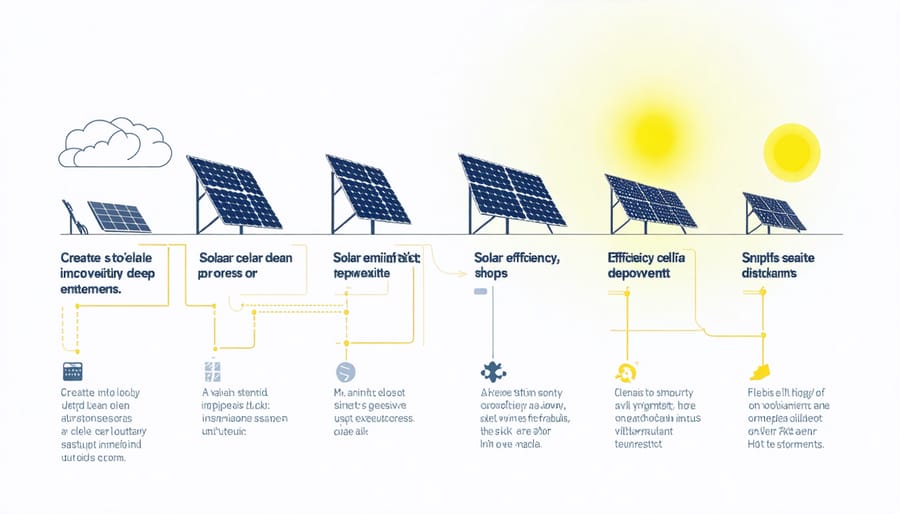
Efficiency enhancement studies represent a cornerstone of modern photovoltaic research, focusing on maximizing the conversion rate of solar energy into electrical power. Current research initiatives concentrate on developing advanced materials and innovative cell architectures to overcome the Shockley-Queisser limit, which theoretically caps single-junction solar cell efficiency at around 33%.
Multi-junction solar cells have emerged as a promising avenue, with researchers achieving conversion efficiencies exceeding 47% under concentrated sunlight. These cells utilize multiple semiconductor layers to capture different portions of the solar spectrum effectively. Parallel investigations into perovskite materials have shown remarkable progress, with efficiency improvements from 3.8% to over 25% in just a decade.
Surface modification techniques and passivation strategies are being explored to reduce recombination losses and enhance charge carrier collection. Researchers are also investigating quantum dot solar cells and upconversion materials to better utilize the full solar spectrum. Light management strategies, including advanced texturing and anti-reflection coatings, continue to play a crucial role in minimizing optical losses.
The integration of artificial intelligence and machine learning has accelerated the discovery of new materials and optimization of cell designs, leading to more efficient and cost-effective solar solutions.
Manufacturing Process Optimization
Manufacturing process optimization remains a critical focus in photovoltaic research, driving efforts to reduce production costs while improving cell efficiency and quality. Recent solar manufacturing innovations have led to significant breakthroughs in automated production lines, advanced material deposition techniques, and quality control systems.
Key areas of optimization include the development of high-throughput processing methods, implementation of artificial intelligence for defect detection, and refinement of thin-film deposition processes. Researchers are particularly focused on reducing material waste, optimizing energy consumption during manufacturing, and developing more sustainable production methods.
Industry-academia partnerships have yielded promising results in areas such as laser processing optimization, advanced metallization techniques, and novel encapsulation methods. These improvements have contributed to lower production costs, enhanced cell durability, and increased manufacturing yields.
Recent innovations in inline monitoring systems and predictive maintenance algorithms have also revolutionized quality control processes, enabling real-time adjustments and minimizing production losses. These advancements continue to drive down the levelized cost of solar energy while maintaining high product standards.
Real-World Applications and Industry Impact

Technology Transfer Success Stories
Several breakthrough technologies developed in PV research laboratories have successfully transitioned to commercial applications, demonstrating the vital link between academic research and industry innovation. A notable example is the development of PERC (Passivated Emitter and Rear Cell) technology at the University of New South Wales, which now dominates the commercial solar cell market, improving efficiency by up to 25% compared to traditional cells.
The commercialization of heterojunction solar cell technology, initially researched at Sanyo (now Panasonic), represents another significant success story. This technology has achieved record-breaking efficiencies exceeding 26% in production environments, showcasing how fundamental research can lead to transformative market solutions.
Similar to our alumni program success stories, the development of transparent conducting oxides (TCOs) for solar applications has created new opportunities for building-integrated photovoltaics. This innovation originated from collaborative research between universities and industry partners, resulting in more efficient and aesthetically pleasing solar installations.
These success stories highlight the importance of sustained research investment and strong industry-academic partnerships in advancing solar technology. They demonstrate how theoretical breakthroughs can be effectively translated into practical solutions that drive the renewable energy sector forward.
Market Integration Challenges and Solutions
Transitioning innovative photovoltaic research from laboratory settings to commercial markets presents significant challenges that require strategic solutions. Cost remains a primary barrier, as new technologies must compete with established solar solutions while delivering sufficient performance improvements to justify investment. Research institutions and industry partners are addressing this through collaborative development programs that help reduce manufacturing costs and optimize production processes.
Technical scalability poses another crucial challenge. Laboratory-scale successes often face difficulties in maintaining efficiency and reliability when scaled to industrial production levels. To overcome this, researchers are implementing staged development approaches, utilizing pilot production facilities to identify and resolve scaling issues before full commercialization.
Market acceptance and certification requirements also present hurdles. New PV technologies must undergo rigorous testing and certification processes to meet international standards and gain market trust. Research institutions are increasingly partnering with certification bodies early in the development process to streamline these procedures and ensure compliance from the outset.
Intellectual property management and technology transfer mechanisms play vital roles in successful market integration. Universities and research centers are establishing dedicated technology transfer offices to facilitate the commercialization process, protect innovations, and create clear pathways for industry adoption. These offices also help bridge the gap between academic research and commercial requirements, ensuring that innovations address real market needs while maintaining their technological advantages.
Future Research Directions
Emerging Technologies and Methodologies
Recent advancements in photovoltaic research have opened exciting new frontiers in solar technology development. Perovskite solar cells are emerging as a groundbreaking innovation, offering the potential for higher efficiency and lower production costs compared to traditional silicon-based cells. These materials have achieved remarkable efficiency improvements, rising from 3.8% to over 25% in just a decade.
Tandem solar cell technologies, which combine different photovoltaic materials to capture a broader spectrum of sunlight, represent another promising direction. By integrating perovskite layers with conventional silicon cells, researchers have achieved efficiency rates exceeding 29%, bringing us closer to the theoretical maximum efficiency.
Building-integrated photovoltaics (BIPV) are revolutionizing architectural design while contributing to the future of renewable energy. These systems incorporate solar cells into building materials, creating multifunctional components that generate electricity while serving traditional construction purposes.
Artificial intelligence and machine learning are transforming PV research methodology, enabling more efficient solar cell design optimization and performance prediction. These tools analyze vast datasets to identify optimal material combinations and manufacturing parameters, significantly accelerating the development process.
Quantum dot solar cells and organic photovoltaics represent emerging technologies with the potential for flexible, lightweight, and cost-effective solar solutions. While still in development, these technologies could revolutionize portable electronics and integrated energy systems.
Collaborative Research Opportunities
The photovoltaic research landscape thrives on collaboration, offering numerous opportunities for cross-institutional partnerships and joint research initiatives. Leading research institutions actively seek partnerships with industry players, government laboratories, and international research centers to accelerate innovation in solar technology development.
Current collaborative programs focus on key areas such as perovskite solar cell development, advanced manufacturing techniques, and grid integration solutions. These partnerships often combine academic expertise with industrial resources, creating synergistic relationships that benefit all participants while advancing the field of photovoltaics.
Research funding opportunities are available through various channels, including government grants, industry sponsorships, and international research programs. The European Union’s Horizon Europe program, for instance, allocates significant resources to renewable energy research, while the U.S. Department of Energy’s Solar Energy Technologies Office provides substantial funding for collaborative PV research projects.
Emerging partnership models include virtual research networks, shared laboratory facilities, and international exchange programs. These arrangements enable researchers to access specialized equipment, share expertise, and coordinate efforts across geographical boundaries. Additionally, many institutions offer visiting researcher positions and post-doctoral fellowships, creating opportunities for knowledge exchange and professional development.
For organizations interested in establishing research partnerships, formal channels exist through university technology transfer offices and industry liaison programs, facilitating the creation of meaningful collaborative relationships in PV research and development.
The continued advancement of photovoltaic research through alumni programs represents a critical cornerstone in shaping the future of solar energy technology. These programs create invaluable networks between academic institutions and industry partners, fostering innovation and accelerating the development of more efficient, cost-effective solar solutions. By maintaining strong connections with graduates who transition into various sectors of the solar industry, research institutions can better align their investigations with real-world challenges and market demands.
The impact of alumni-driven research extends beyond theoretical advancement, contributing directly to technological breakthroughs in solar cell efficiency, manufacturing processes, and integration strategies. These collaborative efforts have already yielded significant improvements in photovoltaic technology, from enhanced material performance to reduced production costs. As the global demand for renewable energy continues to grow, the role of sustained research through alumni networks becomes increasingly vital.
Looking ahead, the solar industry’s future success heavily depends on maintaining this robust research ecosystem. Alumni programs serve as bridges between academic discovery and commercial application, ensuring that new technologies can effectively transition from laboratory concepts to market-ready solutions. This continuous cycle of innovation, supported by experienced professionals who understand both academic and industry perspectives, will be essential in addressing upcoming challenges in solar energy adoption and grid integration.
By investing in and nurturing these research partnerships, we strengthen the foundation for a more sustainable energy future while creating opportunities for the next generation of photovoltaic professionals.