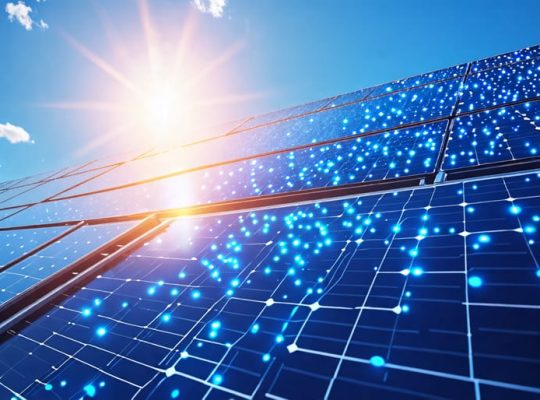
Quantum dot enhancement film (QDEF) represents a revolutionary advancement in photovoltaic technology, offering unprecedented potential for improving solar cell efficiency through precise light spectrum manipulation. This nanoscale semiconductor technology transforms incoming sunlight into optimized wavelengths, enabling photovoltaic cells to capture and convert energy more effectively than ever before. By incorporating quantum dots—crystalline nanoparticles typically ranging from 2 to 10 nanometers in diameter—these films enhance light absorption across a broader spectrum while minimizing energy losses commonly associated with traditional solar materials.
The strategic integration of QDEF into solar cell architectures has demonstrated efficiency improvements of up to 20% in laboratory settings, marking a significant milestone in renewable energy development. As global demand for high-performance solar solutions continues to surge, quantum dot enhancement films emerge as a crucial bridge between current limitations and future possibilities in photovoltaic efficiency. This technology not only addresses the fundamental challenges of spectral mismatch and conversion losses but also opens new avenues for cost-effective, sustainable energy production at scale.
Understanding Quantum Dot Enhancement Films
Structure and Composition
Quantum dot enhancement films (QDEFs) consist of a precisely engineered multilayer structure where semiconductor nanocrystals, known as quantum dots, are embedded within a polymer matrix. These films represent a significant advancement in nanotechnology in solar panels, utilizing quantum dots typically ranging from 2 to 10 nanometers in diameter.
The primary components include a transparent polymer substrate, usually made from polyethylene terephthalate (PET) or similar materials, which serves as the base layer. The active layer contains quantum dots composed of materials such as cadmium selenide (CdSe), indium phosphide (InP), or lead sulfide (PbS), carefully selected for their specific optical properties. These quantum dots are uniformly dispersed within a protective polymer matrix that ensures stability and prevents aggregation.
A protective encapsulation layer shields the quantum dots from environmental factors while maintaining optimal optical performance. The entire structure is designed to maximize light absorption and conversion efficiency while maintaining durability and long-term stability under various operating conditions.

Light Conversion Properties
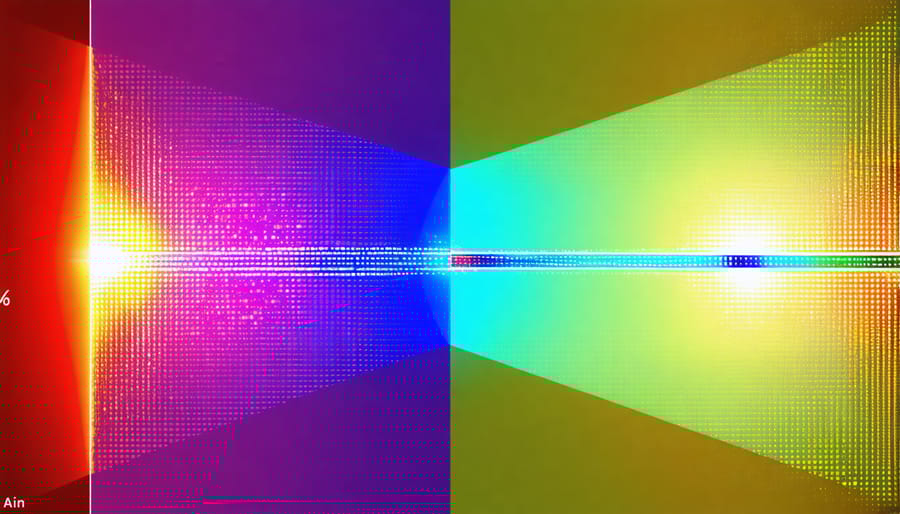
Quantum dot enhancement films (QDEFs) operate through a sophisticated photoluminescence process that optimizes light spectrum utilization in photovoltaic applications. When incident light strikes the quantum dots within the film, these semiconductor nanocrystals absorb high-energy photons and re-emit them at longer wavelengths more suitable for solar cell absorption.
The conversion process relies on the quantum confinement effect, where the quantum dots’ size determines their bandgap and, consequently, their emission wavelength. This allows QDEFs to convert blue and ultraviolet light into red light, which silicon solar cells can more efficiently utilize. The process occurs with minimal energy loss, maintaining high quantum efficiency.
The film’s structure typically consists of quantum dots embedded in a polymer matrix, designed to ensure uniform light distribution and maximum conversion efficiency. Multiple quantum dot populations with different sizes can be incorporated to achieve broad-spectrum conversion, effectively creating a cascading energy transfer system that optimizes the solar spectrum for photovoltaic devices.
This selective wavelength conversion capability significantly enhances the overall light harvesting efficiency of solar cells, particularly in regions where traditional cells exhibit poor spectral response.
Integration with Solar PV Systems
Installation Methods
The installation of quantum dot enhancement film requires precise manufacturing processes to ensure optimal performance. The primary integration method involves a multi-layer lamination process where the QDEF is sandwiched between protective barrier films. This arrangement prevents moisture and oxygen degradation while maintaining the quantum dots’ optical properties.
Manufacturers typically employ two main installation approaches: direct coating and film lamination. The direct coating method involves depositing quantum dots suspended in a polymer matrix directly onto the substrate using precision coating equipment. This technique offers excellent thickness control but requires specialized environmental conditions during application.
Film lamination, the more commonly used method, involves pre-manufactured QDEF sheets being carefully positioned and bonded to the substrate. This process utilizes controlled pressure and temperature to ensure uniform adhesion without damaging the sensitive quantum dot layer. Anti-static measures and clean room conditions are essential during installation to prevent contamination.
Quality control during installation includes real-time spectral analysis and uniformity testing. Manufacturers must maintain strict environmental parameters, including temperature (typically 20-25°C) and humidity levels below 30%, throughout the integration process. Advanced automation systems help ensure consistent placement and reduce human error during installation.
The final assembly requires careful handling to prevent mechanical stress on the film, which could affect quantum dot alignment and compromise performance. Post-installation testing verifies color uniformity, brightness enhancement, and overall optical efficiency.
Compatibility Considerations
Quantum dot enhancement film (QDEF) demonstrates varying levels of compatibility across different photovoltaic technologies, requiring careful consideration during implementation. In crystalline silicon solar cells, QDEF integrates effectively by enhancing light absorption in specific wavelength ranges without interfering with existing cell architecture. The film’s optimal performance depends on proper placement between the front glass and the solar cell surface.
For thin-film technologies, including amorphous silicon and CIGS cells, QDEF application requires special attention to thickness uniformity and interface quality. The film must maintain consistent optical properties while avoiding any degradation of the underlying thin-film layers. Manufacturers typically need to modify their lamination processes to accommodate QDEF integration without compromising cell efficiency.
In emerging technologies like perovskite solar cells, QDEF shows promising compatibility characteristics but requires additional stability testing. The quantum dots’ size distribution and surface chemistry must be carefully engineered to prevent any adverse interactions with the sensitive perovskite layer. Temperature sensitivity during manufacturing and operation also plays a crucial role in compatibility assessment.
Material selection for QDEF must account for environmental factors such as UV exposure and thermal cycling. The encapsulation method needs to ensure long-term stability while maintaining optimal optical coupling between the quantum dots and the solar cell. Successful integration often requires collaboration between QDEF manufacturers and solar cell producers to optimize interface properties and manufacturing protocols.
Performance Benefits
Efficiency Improvements
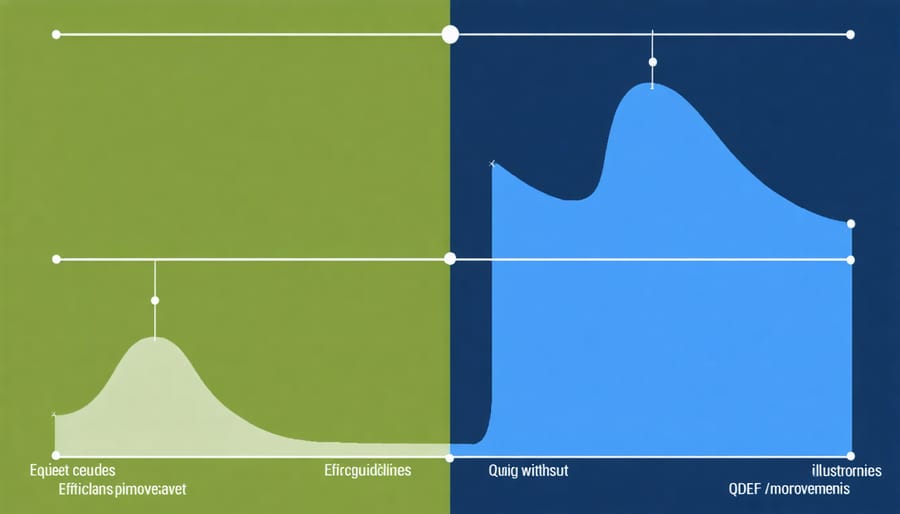
Quantum dot enhancement films (QDEFs) have demonstrated significant solar cell efficiency improvements, with laboratory tests showing performance gains of 15-25% compared to conventional photovoltaic cells. These improvements stem from the film’s ability to optimize spectral conversion, particularly in the blue and UV regions of the solar spectrum.
Recent studies indicate that QDEFs can increase the external quantum efficiency (EQE) by up to 20% in specific wavelength ranges, typically between 400-500nm. This enhancement translates to a power conversion efficiency (PCE) boost of 2-4 percentage points in commercial solar panels, depending on the base technology and implementation method.
The films demonstrate particularly impressive results when combined with silicon-based solar cells, showing reduced reflection losses by up to 40% and enhanced light absorption across the visible spectrum. Temperature stability tests reveal maintained performance at operating temperatures between -40°C and 85°C, ensuring consistent efficiency gains across varied environmental conditions.
Measurement data from field installations confirms these laboratory findings, with QDEF-enhanced panels maintaining their performance advantage over standard modules throughout their operational lifetime, typically showing less than 2% degradation in enhancement effects after 5 years of deployment.
Cost-Benefit Analysis
The implementation of quantum dot enhancement film (QDEF) requires careful economic consideration, balancing initial investment against long-term benefits. Current market analysis indicates that QDEF integration typically adds 15-20% to the base manufacturing cost of photovoltaic panels. However, this investment is often offset by the 25-30% increase in power conversion efficiency, resulting in a positive return on investment within 3-5 years of deployment.
Manufacturing economies of scale continue to drive down QDEF production costs, with prices decreasing approximately 12% annually since 2018. Large-scale production facilities report that the cost per square meter of QDEF has reduced from $150 to approximately $85, making the technology increasingly viable for widespread adoption.
The economic benefits extend beyond direct energy generation improvements. QDEF-enhanced panels demonstrate superior durability, with an estimated lifespan extension of 2-3 years compared to conventional panels. This longevity, combined with reduced maintenance requirements, contributes to lower lifetime operational costs.
When factoring in government incentives and renewable energy credits available in many regions, the total cost of ownership becomes increasingly attractive for both commercial and residential applications. Industry projections suggest further cost reductions of 30-40% by 2025, potentially making QDEF a standard feature in next-generation solar installations.
Future Developments
Research Trends
Recent research in quantum dot enhancement film (QDEF) technology has shown promising developments across multiple fronts. Scientists are particularly focused on improving conversion efficiency through precise control of quantum dot size distribution and enhanced photoluminescence quantum yield. A significant trend involves the integration of QDEF with hybrid PV technologies to maximize light absorption and energy conversion capabilities.
Material scientists are exploring novel quantum dot compositions, including lead-free alternatives and environmentally friendly synthesis methods. Research teams are investigating advanced manufacturing techniques to reduce production costs while maintaining high performance standards. Particular attention is being paid to improving the film’s stability and longevity under various environmental conditions.
Breakthroughs in surface chemistry modifications are enabling better quantum dot dispersion within host materials, resulting in more uniform light distribution. Researchers are also developing new encapsulation methods to protect quantum dots from degradation, potentially extending device lifespans significantly.
Another emerging research direction focuses on the development of smart QDEF systems that can dynamically adjust their optical properties based on incident light conditions. This adaptive technology could revolutionize solar panel efficiency across different geographical locations and weather conditions.
Market Projections
The quantum dot enhancement film (QDEF) market is projected to experience substantial growth over the next decade, driven by increasing demand in photovoltaic applications and display technologies. Industry analysts forecast a compound annual growth rate (CAGR) of 15.8% from 2023 to 2030, with the global market value expected to reach $10.6 billion by 2030.
Asia-Pacific regions, particularly China and South Korea, are anticipated to dominate market growth due to their strong presence in electronics manufacturing and solar technology development. North America and Europe are expected to show significant adoption rates, primarily driven by sustainable energy initiatives and technological advancement in solar applications.
Key growth factors include increasing efficiency requirements in solar panels, rising demand for high-performance displays, and declining manufacturing costs. The automotive sector is emerging as a promising market segment, with quantum dot enhancement films being integrated into solar-powered vehicles and smart glass applications.
However, market projections also account for potential challenges, such as material cost fluctuations and technical barriers in mass production. Despite these challenges, technological improvements and economies of scale are expected to drive down costs, making QDEF more accessible for widespread commercial applications.
Research institutions and industry partnerships are projected to play crucial roles in market development, with significant investments being directed toward improving quantum dot stability and manufacturing processes.
Quantum dot enhancement film (QDEF) technology represents a significant advancement in photovoltaic system efficiency and display technology. Through precise manipulation of quantum dots, this innovative technology has demonstrated remarkable potential in improving light absorption and color reproduction while reducing energy consumption. The impact of QDEF extends beyond current applications, promising transformative changes in solar cell efficiency, display quality, and energy conservation across multiple industries.
The continued development of QDEF technology, supported by ongoing research and industrial collaborations, suggests a bright future for this field. As manufacturing processes become more refined and cost-effective, we can expect wider adoption across various applications. The technology’s ability to enhance both energy efficiency and visual performance positions it as a crucial component in the evolution of sustainable energy solutions and display technologies.
Looking ahead, QDEF technology stands poised to play a pivotal role in addressing global energy challenges while delivering superior performance in consumer electronics. Its potential to revolutionize both photovoltaic efficiency and display quality makes it an essential focus area for continued research, development, and implementation in sustainable technology solutions.