Energy storage innovations are revolutionizing the renewable energy landscape, transforming how we capture, store, and utilize power across industrial and residential applications. Recent breakthroughs in solar power storage systems have achieved unprecedented efficiency levels, with advanced battery technologies now capable of retaining up to 95% of harvested energy.
The integration of artificial intelligence and machine learning algorithms has enabled dynamic load balancing and predictive maintenance, significantly extending storage system lifespans while reducing operational costs. From grid-scale vanadium flow batteries to innovative solid-state technologies, these developments are addressing critical challenges in renewable energy adoption, including intermittency issues and grid stability concerns.
As global energy demands continue to surge, these storage innovations represent more than technological achievements – they are essential components in the transition toward a sustainable energy future. With emerging technologies like hydrogen fuel cells and advanced thermal storage solutions entering the commercial market, the energy storage sector stands at the cusp of a transformative era, promising greater reliability, accessibility, and efficiency in renewable energy systems.
Advanced Battery Technologies for Solar PV Systems
Lithium-Ion Innovations
Recent advancements in lithium-ion technology have significantly enhanced the efficiency and reliability of solar energy storage systems. Researchers have developed high-density cathode materials that increase energy storage capacity by up to 25% compared to traditional lithium-ion batteries, while simultaneously reducing production costs.
A notable breakthrough involves the implementation of silicon-based anodes, replacing conventional graphite materials. This innovation has led to improved charge cycles and extended battery lifespan, with some newer models demonstrating up to 5000 charge cycles before significant degradation occurs.
Temperature management systems have also evolved, incorporating phase-change materials and advanced thermal monitoring. These improvements allow lithium-ion batteries to operate more efficiently across diverse climate conditions, addressing previous concerns about thermal runaway and performance degradation in extreme temperatures.
Manufacturers have introduced modular designs that facilitate easier maintenance and scalability. These systems enable facility managers to replace individual components rather than entire battery banks, significantly reducing long-term operational costs and improving system reliability.
Safety features have been enhanced through the integration of artificial intelligence-driven battery management systems. These systems continuously monitor cell health, voltage levels, and thermal conditions, automatically adjusting parameters to optimize performance and prevent potential failures.
The industry has also made substantial progress in recycling technologies, with new processes recovering up to 95% of critical materials from spent batteries, contributing to sustainability goals and reducing raw material dependencies.
Solid-State Battery Breakthroughs
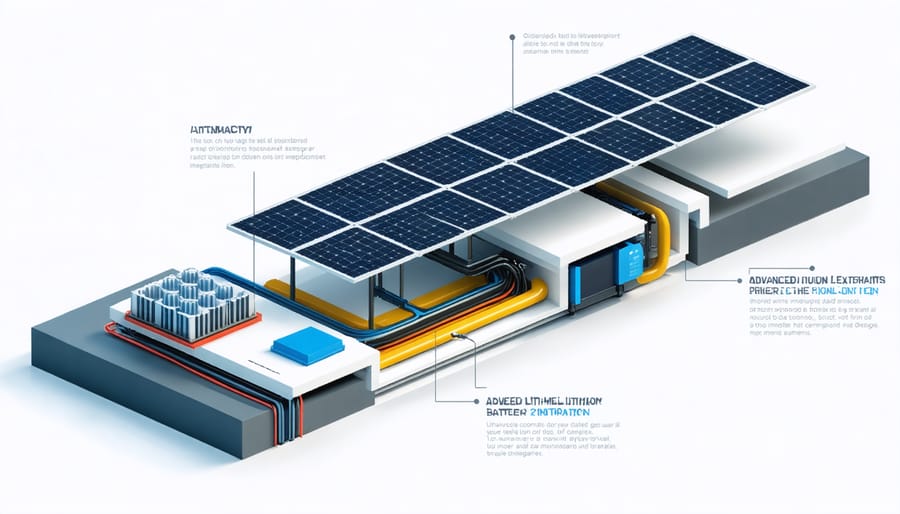
Solid-state batteries represent a significant leap forward in energy storage technology, offering numerous advantages over traditional lithium-ion batteries. These innovative devices replace liquid electrolytes with solid compounds, resulting in enhanced safety, improved energy density, and longer operational lifespans.
The primary advantage of solid-state batteries lies in their superior stability and safety characteristics. By eliminating liquid electrolytes, these batteries virtually eliminate the risk of thermal runaway and flammability issues that have historically challenged conventional battery technologies. This makes them particularly suitable for large-scale energy storage applications in photovoltaic systems.
Recent developments in solid-state battery technology have achieved remarkable energy density improvements, with some prototypes demonstrating up to 2.5 times the capacity of traditional lithium-ion batteries. This breakthrough enables more compact storage solutions while maintaining high performance levels. Additionally, solid-state batteries exhibit faster charging capabilities and improved cycling stability, potentially extending their operational life to over 10 years.
Manufacturing challenges remain the primary obstacle to widespread commercial adoption. However, significant progress has been made in developing scalable production methods through collaborative research between industry leaders and academic institutions. Several major manufacturers have announced plans to begin commercial production within the next three to five years, signaling a transformative shift in energy storage technology.
Thermal Energy Storage Integration
Phase Change Materials
Phase Change Materials (PCMs) represent a significant advancement in thermal energy storage for solar applications. These materials utilize latent heat storage principles, absorbing or releasing large amounts of energy during phase transitions while maintaining a nearly constant temperature. In solar energy systems, PCMs act as efficient thermal batteries, storing excess heat during peak production periods and releasing it when needed.
Common PCMs in solar applications include paraffin waxes, salt hydrates, and fatty acids, each selected based on their melting point and thermal properties. When integrated into building materials, PCMs can significantly enhance thermal management by absorbing surplus solar energy during the day and releasing it at night, reducing HVAC energy consumption by up to 30%.
In solar thermal storage systems, PCMs are particularly effective when incorporated into heat exchangers or storage tanks. These systems can maintain stable temperatures for extended periods, improving overall system efficiency and reliability. Recent developments include microencapsulated PCMs, which offer improved heat transfer rates and better integration possibilities with existing solar installations.
The technology has shown promising results in both residential and commercial applications, with some systems achieving energy storage densities five times higher than conventional water-based storage methods. This efficiency makes PCMs increasingly attractive for solar energy storage solutions, especially in regions with variable solar radiation patterns.
Molten Salt Storage Systems
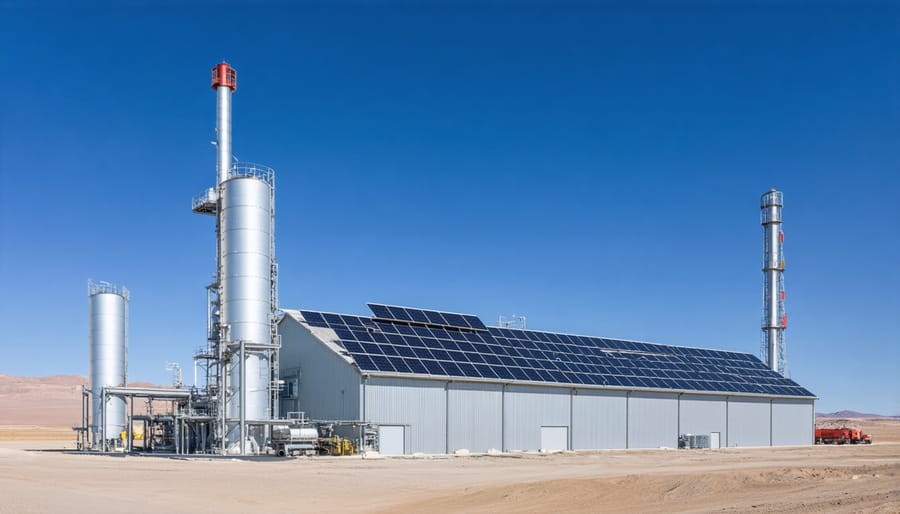
Molten salt storage systems represent a significant advancement in thermal energy storage technology, particularly for utility-scale solar power plants. These systems utilize a mixture of inorganic salts, typically comprising sodium nitrate and potassium nitrate, maintained in a liquid state at temperatures ranging from 290°C to 565°C. The fundamental principle involves capturing excess thermal energy during peak production periods and releasing it when needed, enabling continuous power generation even after sunset.
The storage mechanism consists of two separate tanks: a hot tank storing the heated molten salt and a cold tank containing the cooled salt. During charging, the salt mixture absorbs heat from the solar field, while during discharge, it releases thermal energy to generate steam for power production. This system achieves remarkable energy retention efficiency, typically exceeding 99% over 24 hours.
Modern molten salt facilities can store enough thermal energy to provide 10-15 hours of full-load electricity generation, making them crucial for grid stability. Recent technological improvements have focused on developing advanced salt compositions with enhanced thermal properties and reduced corrosion effects. These innovations have contributed to increased system longevity and reduced maintenance requirements, making molten salt storage an increasingly viable solution for large-scale renewable energy integration.
Smart Grid Integration Technologies
AI-Powered Storage Management
Artificial Intelligence is revolutionizing the way we manage and optimize smart energy storage solutions in photovoltaic systems. Advanced machine learning algorithms continuously analyze multiple data streams, including weather patterns, energy consumption habits, and grid demands, to make real-time decisions that maximize storage efficiency and system performance.
These AI systems can predict peak demand periods, optimize charging and discharging cycles, and automatically adjust storage parameters to extend battery life. By learning from historical data and system behavior, the algorithms can anticipate maintenance needs, prevent potential failures, and reduce operational costs.
The integration of AI-powered management systems has demonstrated impressive results, with some installations reporting up to 25% improvement in storage efficiency and a 20% reduction in degradation rates. These systems can also facilitate dynamic energy trading, enabling storage owners to participate in grid services and maximize economic returns.
Furthermore, AI algorithms can optimize hybrid storage systems, managing the interplay between different storage technologies such as lithium-ion batteries, flow batteries, and thermal storage. This intelligent coordination ensures each storage component operates within its optimal parameters while meeting specific application requirements and grid demands.
The implementation of predictive analytics also enables proactive maintenance scheduling, reducing downtime and extending system longevity through early detection of potential issues.
Virtual Power Plant Solutions
Virtual Power Plants (VPPs) represent a revolutionary approach to energy management, combining distributed energy resources into unified, intelligent networks. These sophisticated grid integration systems aggregate multiple storage assets, including residential batteries, commercial systems, and industrial storage facilities, creating a coordinated response to grid demands.
By implementing advanced control algorithms and real-time communication protocols, VPPs optimize power distribution across networks of storage devices. This coordination enables more efficient load balancing, frequency regulation, and voltage support services. The system’s ability to respond rapidly to grid fluctuations makes it particularly valuable for integrating intermittent renewable energy sources.
Key benefits of VPP solutions include enhanced grid reliability, reduced peak demand charges, and improved renewable energy integration. Storage operators can participate in energy markets more effectively, generating additional revenue streams through demand response programs and ancillary services.
Recent implementations have demonstrated significant improvements in grid stability, with some VPPs achieving response times under 100 milliseconds. These systems have proven particularly effective during peak demand periods, helping utilities avoid costly infrastructure upgrades while maintaining grid reliability.
The scalability of VPP architecture allows for continuous expansion, accommodating growing storage capacity and evolving grid requirements. This flexibility positions VPPs as a cornerstone technology for future smart grid development and renewable energy integration.

Emerging Storage Technologies
Hydrogen Storage Systems
Hydrogen storage systems represent a promising solution for integrating renewable energy sources with long-term energy storage capabilities. When coupled with photovoltaic systems, hydrogen storage offers unique advantages in terms of energy density and storage duration. The process involves using excess solar power to drive electrolysis, converting water into hydrogen and oxygen, which can then be stored for later use.
Modern hydrogen storage technologies employ various methods, including compression, liquefaction, and chemical storage in metal hydrides. Compressed hydrogen storage, the most widely adopted approach, typically operates at pressures between 350-700 bar in specialized composite tanks. These systems achieve energy densities of up to 1.5 kWh/L, making them suitable for both residential and commercial applications.
Recent innovations in metal hydride storage materials have improved absorption and desorption kinetics, allowing for more efficient hydrogen uptake and release. These advances have led to the development of compact storage solutions that can operate at lower pressures, reducing infrastructure costs and improving safety profiles.
Integration with PV systems requires sophisticated control systems to optimize hydrogen production during peak solar generation periods. Advanced power electronics and smart controllers ensure seamless operation between the PV array, electrolyzer, and storage system. The stored hydrogen can later be converted back to electricity using fuel cells, providing a reliable power source during periods of low solar generation or grid outages.
Current research focuses on developing new storage materials and improving system efficiency to reduce costs and enhance overall performance. This includes exploring novel nanomaterials and composite structures that could revolutionize hydrogen storage capabilities.
Flow Battery Developments
Flow battery technology has emerged as a promising solution for large-scale energy storage, offering distinct advantages over traditional battery systems. Recent developments have significantly improved their efficiency, durability, and cost-effectiveness, making them increasingly viable for grid-level applications.
Unlike conventional batteries, flow batteries store energy in liquid electrolytes housed in separate tanks, allowing for independent scaling of power and energy capacity. This flexibility enables customization based on specific storage requirements, from utility-scale installations to industrial applications.
Notable advancements include the development of new electrolyte compositions that enhance energy density and reduce system costs. Vanadium-based systems remain the most commercially mature, but innovative alternatives using organic compounds and earth-abundant materials are showing promising results in research laboratories.
Recent breakthroughs in membrane technology have improved ion selectivity and reduced crossover effects, leading to longer operational lifespans and better round-trip efficiency. These improvements, coupled with advanced manufacturing techniques, have helped reduce production costs by approximately 60% over the past decade.
Several commercial installations worldwide demonstrate the technology’s practical applications. For instance, a 200MW/800MWh flow battery facility in China has successfully provided grid stability services, while smaller installations in Europe and North America serve as proof-of-concept for renewable energy integration.
The technology’s ability to operate at room temperature, minimal self-discharge, and long cycle life make it particularly attractive for long-duration storage applications. As research continues, flow batteries are expected to play a crucial role in enabling the transition to renewable energy systems.
Energy storage innovations have fundamentally transformed the landscape of photovoltaic systems, addressing the longstanding challenge of intermittent solar power generation. These advancements have significantly improved system efficiency, grid stability, and the overall viability of solar energy as a primary power source. The integration of cutting-edge storage solutions has enabled higher energy independence, reduced grid stress, and enhanced economic benefits for both residential and commercial applications.
Looking ahead, the future of energy storage in PV systems appears promising, with continued research and development focusing on improving battery chemistry, reducing costs, and increasing storage capacity. Emerging technologies such as solid-state batteries, flow batteries, and hybrid storage systems are poised to further revolutionize the industry. These innovations, coupled with smart grid integration and advanced energy management systems, will play a crucial role in achieving greater renewable energy adoption.
The collaborative efforts between industry leaders, research institutions, and government agencies continue to drive progress in storage technology. As manufacturing scales up and costs decline, we can expect to see wider implementation of these storage solutions across different market segments. This evolution will be essential in meeting growing energy demands while supporting the global transition to sustainable power generation.
The impact of these storage innovations extends beyond technical improvements, contributing to environmental sustainability and energy security. As we move forward, the continued advancement of storage technologies will remain central to realizing the full potential of photovoltaic systems and achieving a more sustainable energy future.