The integration of solar power storage systems has revolutionized renewable energy deployment, transforming intermittent solar generation into a reliable, round-the-clock power source. As global energy demands surge and grid stability concerns intensify, photovoltaic (PV) storage solutions have emerged as a crucial bridge between variable solar production and consistent energy delivery. Advanced battery technologies, from lithium-ion to flow batteries, now enable businesses and households to capture excess daytime solar production for nighttime use, effectively addressing the fundamental challenge of solar intermittency. This technological convergence of PV generation and energy storage represents a pivotal advancement in sustainable energy infrastructure, offering enhanced grid resilience, reduced carbon emissions, and improved economic returns on solar investments. The rapid evolution of storage technologies, coupled with declining costs and increasing efficiency, positions PV energy storage as a cornerstone of the modern renewable energy landscape.
Understanding PV Energy Storage Technologies
Battery Storage Systems
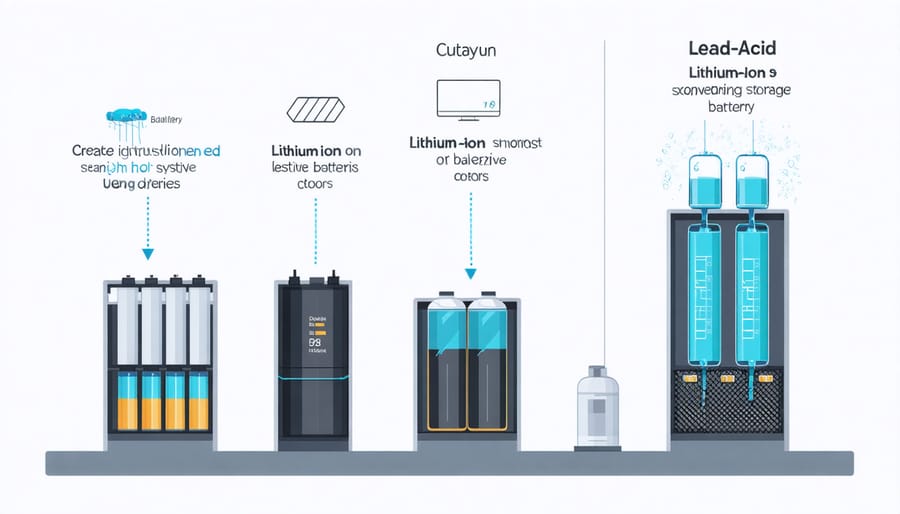
Battery storage systems play a crucial role in maximizing the effectiveness of photovoltaic installations. Lithium-ion batteries dominate the current market due to their high energy density, longer cycle life, and declining costs. These systems typically offer 85-95% round-trip efficiency and can last 10-15 years under optimal conditions, making them ideal for both residential and commercial applications.
Lead-acid batteries, while more established and cost-effective initially, present different characteristics. Despite lower energy density and shorter lifespans (5-10 years), they remain viable for backup power systems and off-grid installations where initial cost considerations outweigh long-term performance benefits. These systems achieve 70-85% round-trip efficiency and require more frequent maintenance compared to lithium-ion alternatives.
As the industry evolves, emerging battery technologies are reshaping energy storage capabilities. Flow batteries, sodium-ion, and solid-state batteries show promising potential for grid-scale applications. Flow batteries, in particular, offer unlimited cycle life and independent scaling of power and energy capacity, though their lower energy density currently limits widespread adoption.
Selection criteria for battery storage systems should consider various factors: required capacity, discharge rate, cycle life, maintenance needs, and environmental conditions. Temperature management is crucial, as extreme conditions can significantly impact battery performance and longevity. Modern systems incorporate advanced battery management systems (BMS) that monitor cell health, optimize charging cycles, and ensure safe operation throughout the battery’s lifetime.
Integration with PV systems requires careful planning of charge controllers, inverters, and monitoring systems to ensure optimal energy flow and system protection. This comprehensive approach maximizes system efficiency and extends battery life while maintaining reliable power supply.
Alternative Storage Solutions
While lithium-ion batteries dominate the PV storage market, several alternative storage solutions offer unique advantages for specific applications. Thermal energy storage systems convert excess solar power into heat, storing it in materials like molten salts or phase-change materials. This stored thermal energy can later be used for space heating, industrial processes, or electricity generation through thermal engines.
Hydrogen storage presents another promising avenue, where surplus solar electricity powers electrolyzers to produce hydrogen through water electrolysis. This hydrogen can be stored long-term and used in fuel cells or industrial applications, offering seasonal storage capabilities that traditional batteries cannot match.
Emerging technologies include gravity-based storage systems, which use excess electricity to lift heavy weights or pump water uphill, releasing the stored potential energy when needed. Compressed air energy storage (CAES) systems utilize underground caverns or tanks to store energy in the form of pressurized air, while flow batteries offer scalable storage solutions with independent power and energy ratings.
These alternatives complement traditional battery storage, providing options for diverse applications and helping overcome the intermittency challenges of solar power generation.
Integration Strategies for PV Storage
DC vs. AC Coupling
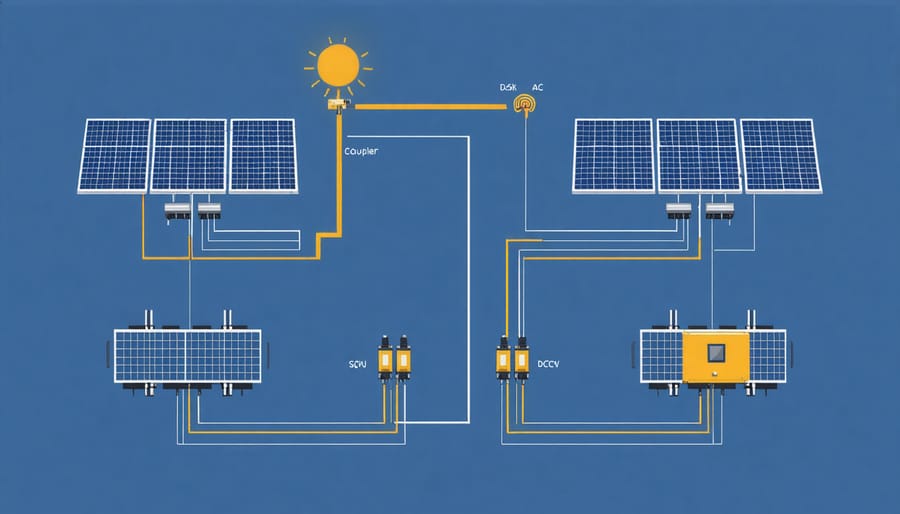
When designing a PV energy storage system, one of the fundamental decisions is choosing between DC and AC coupling configurations. DC coupling connects the solar panels and battery storage directly through a bidirectional inverter, maintaining the energy in DC form until final conversion for household use. This configuration typically offers higher overall system efficiency by reducing conversion steps and associated losses.
AC coupling, conversely, connects the solar panels and battery storage through separate inverters to the AC bus. The solar panels have their dedicated inverter for grid supply, while a separate bidirectional inverter manages battery charging and discharging. This configuration provides greater flexibility in system design and allows for easier retrofitting of storage to existing solar installations.
Each approach presents distinct advantages. DC coupling excels in new installations where maximum efficiency is paramount, offering potential energy savings of 2-3% compared to AC systems. It also typically requires less equipment and space, potentially reducing initial installation costs. AC coupling, however, proves more versatile for upgrading existing solar installations and enables independent operation of the PV and storage systems, facilitating maintenance and repairs.
The choice between coupling methods often depends on specific project requirements. DC coupling generally suits new installations prioritizing efficiency and simplified design, while AC coupling better serves retrofit projects and installations requiring system flexibility. Factors such as local regulations, existing infrastructure, and future expansion plans should inform this decision. System designers must carefully evaluate these considerations alongside project goals to determine the optimal coupling configuration.
Smart Integration Systems
Smart integration systems form the backbone of modern PV energy storage installations, enabling seamless coordination between solar generation, storage components, and grid infrastructure. These sophisticated systems utilize advanced monitoring and control technologies to optimize energy flow, maximize efficiency, and ensure reliable power delivery.
At the heart of these systems are intelligent energy management controllers that continuously monitor various parameters including power generation, storage levels, grid conditions, and energy consumption patterns. These controllers employ predictive algorithms to make real-time decisions about when to store excess solar energy and when to discharge stored power, based on factors such as electricity prices, weather forecasts, and load demands.
Grid integration capabilities have become increasingly sophisticated, with modern systems supporting bi-directional power flow and advanced grid services. Smart inverters play a crucial role by providing functions such as voltage regulation, frequency support, and reactive power compensation. These features help maintain grid stability while maximizing the economic benefits of the PV storage system.
Remote monitoring platforms provide system owners and operators with detailed performance analytics, system health indicators, and automated alerts. These platforms typically offer user-friendly interfaces accessible via web browsers or mobile applications, enabling real-time system oversight and performance optimization.
The integration of communication protocols such as Modbus, SunSpec, and IEEE 2030.5 ensures interoperability between different system components and enables participation in grid services markets. Advanced cybersecurity measures protect these systems from unauthorized access while maintaining reliable operation.
As grid requirements evolve, these smart integration systems continue to adapt, incorporating new functionalities to support grid modernization efforts and facilitate the transition toward a more distributed and renewable energy infrastructure.
Maximizing System Efficiency
Sizing and Configuration
Proper sizing and configuration of PV energy storage systems are crucial elements for maximizing PV system efficiency and ensuring optimal performance. The process begins with a comprehensive load analysis to determine daily energy consumption patterns and peak demand requirements.
For residential applications, storage capacity typically ranges from 5-15 kWh, while commercial installations may require 50-500 kWh or more. The storage system should be sized to accommodate at least 24 hours of critical load coverage, with additional capacity for backup during extended periods of low solar production.
Key configuration parameters include the battery chemistry selection (lithium-ion, lead-acid, or flow batteries), inverter specifications, and system architecture (AC or DC coupling). DC-coupled systems generally offer higher efficiency but require careful matching of voltage specifications between PV arrays and storage components.
Temperature management systems, monitoring capabilities, and safety features must be integrated into the configuration design. Modern storage systems utilize smart controllers that optimize charging cycles and protect against over-discharge, thereby extending battery life and maintaining system reliability.
The configuration should also account for future expansion possibilities, grid connection requirements, and local regulatory compliance. Professional system designers typically employ specialized software tools to model various scenarios and validate system specifications before implementation.
Maintenance and Monitoring
Regular maintenance and monitoring are crucial for optimizing PV energy storage system performance and longevity. A comprehensive maintenance schedule should include quarterly inspections of battery systems, inverters, and electrical connections. During these inspections, technicians should check for signs of corrosion, loose connections, and proper ventilation in battery enclosures.
Battery monitoring systems (BMS) play a vital role in tracking system health and performance metrics. These systems continuously monitor parameters such as state of charge, temperature, voltage levels, and cycling patterns. Modern BMS platforms often incorporate remote monitoring capabilities, enabling real-time performance analysis and early detection of potential issues.
For lithium-ion battery systems, maintaining optimal temperature ranges (typically between 20-25°C) is essential for maximizing battery life. Temperature control systems should be regularly calibrated and maintained. Additionally, periodic capacity testing helps identify degradation patterns and ensures the system continues to meet energy storage requirements.
Documentation of maintenance activities, including performance data and intervention records, is essential for warranty compliance and system optimization. Maintenance personnel should be properly trained and certified to handle energy storage systems safely. Emergency response protocols should be established and regularly reviewed to address potential safety incidents.
Preventive maintenance measures, such as cleaning of cooling systems and updating system firmware, help minimize downtime and extend system lifespan. Regular analysis of performance data enables operators to optimize charging cycles and implement strategies for maximizing storage efficiency.

Economic Considerations
The economic viability of PV energy storage systems has improved significantly in recent years, driven by declining battery costs and increasing electricity rates. The initial investment for a residential PV storage system typically ranges from $8,000 to $15,000, depending on capacity and technology choice. Commercial installations can range from $20,000 to several hundred thousand dollars, scaling with system size and complexity.
Return on investment (ROI) calculations for PV storage systems must consider multiple factors, including local electricity rates, peak demand charges, available incentives, and battery degradation over time. Most residential systems achieve payback periods between 5-10 years, while commercial systems often see faster returns due to demand charge reduction capabilities.
Financial benefits of PV storage systems include reduced electricity bills through peak shaving, enhanced self-consumption of solar energy, and potential revenue from grid services. Users can maximize savings by storing excess solar production during low-demand periods and utilizing stored energy during peak rate hours. Additional value streams may include backup power capabilities, participation in demand response programs, and protection against future utility rate increases.
Government incentives significantly impact the economics of PV storage. The Investment Tax Credit (ITC) applies to storage systems charged primarily by solar, while state-level programs offer additional rebates and performance-based incentives. Some utilities provide special tariffs or programs for storage-enabled systems, further improving the financial proposition.
Lifecycle costs must account for periodic maintenance, potential battery replacement after 10-15 years, and system monitoring. However, technological improvements continue to extend battery lifespans and reduce degradation rates, enhancing long-term economic benefits. The modular nature of modern storage systems also allows for gradual capacity expansion, enabling phased investment approaches that align with budget constraints and evolving energy needs.
Photovoltaic energy storage technology stands at the forefront of renewable energy innovation, playing a crucial role in advancing sustainable power solutions. Throughout this exploration, we’ve seen how PV storage systems have evolved from simple backup solutions to sophisticated, grid-interactive platforms that enhance energy independence and system reliability.
The integration of advanced battery technologies, smart management systems, and improved efficiency metrics has transformed PV storage into a viable solution for both residential and commercial applications. As costs continue to decrease and performance improves, these systems are becoming increasingly accessible to a broader range of users.
Looking ahead, the future of PV energy storage appears promising. Emerging technologies such as solid-state batteries, advanced thermal storage solutions, and artificial intelligence-driven management systems are set to further revolutionize the field. Research institutions and industry leaders are actively developing more efficient and sustainable storage solutions, with particular focus on improving energy density, extending lifecycle performance, and reducing environmental impact.
The continued growth of renewable energy adoption, coupled with supportive policies and increasing grid modernization efforts, suggests a robust future for PV storage technologies. As we move toward a more sustainable energy landscape, the role of effective energy storage will become increasingly critical in managing intermittent renewable resources and ensuring reliable power distribution.
Success in this evolving sector will depend on ongoing collaboration between researchers, industry professionals, and policymakers to address remaining challenges and capitalize on emerging opportunities.