
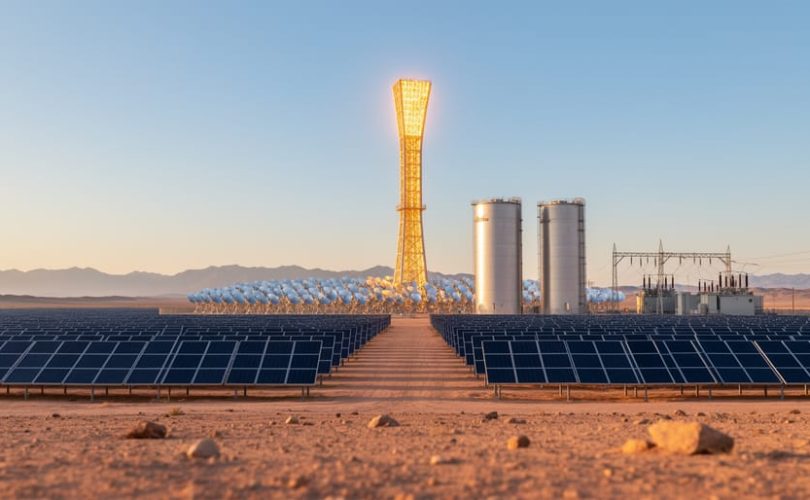
Concentrated Solar Power (CSP) energy storage represents a transformative approach to addressing renewable energy’s most persistent challenge: delivering reliable electricity when the sun isn’t shining. Unlike conventional solar PV energy storage that relies on battery systems, CSP technology captures solar thermal energy in molten salt or other heat-transfer mediums, storing it at temperatures exceeding 500°C for dispatch during peak demand periods or nighttime hours.
This thermal storage capability distinguishes CSP systems from photovoltaic installations, offering storage durations extending beyond 10 hours at utility scale—a critical advantage for grid stability and baseload power generation. Modern CSP facilities achieve capacity factors approaching 70% when paired with adequate thermal storage, rivaling conventional fossil fuel plants while maintaining zero emissions during operation.
For aspiring photovoltaic professionals and renewable energy stakeholders, understanding CSP energy storage principles becomes increasingly vital as hybrid solar installations combining PV and CSP technologies emerge as optimal solutions for comprehensive grid integration. These hybrid configurations leverage photovoltaic systems’ lower capital costs and rapid deployment alongside CSP’s dispatchable thermal storage, creating complementary generation profiles that maximize renewable energy penetration.
The economic viability, technical specifications, and optimization strategies for CSP thermal storage require careful analysis within specific geographic and regulatory contexts. This article examines the fundamental mechanisms driving CSP energy storage performance, practical integration approaches with photovoltaic systems, and evidence-based assessment of when this technology delivers measurable advantages over alternative storage solutions.
Understanding CSP Energy Storage Technology
The Thermal Storage Advantage
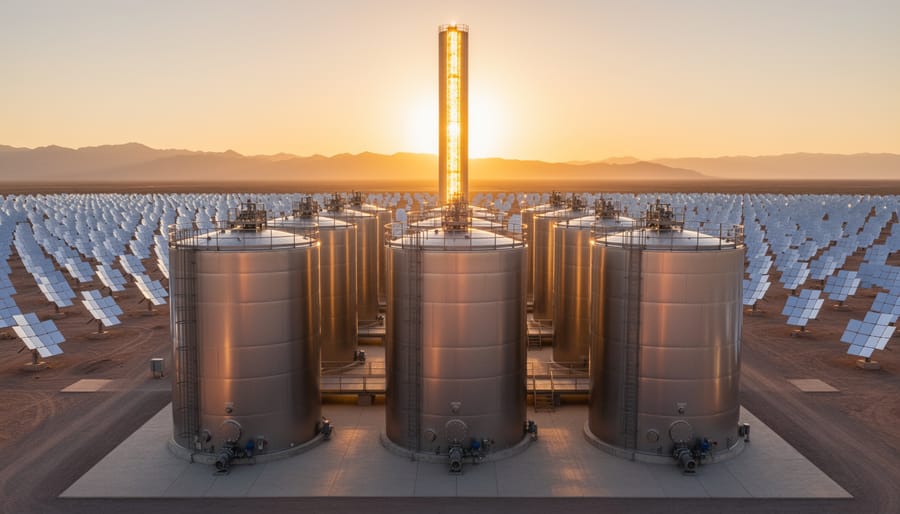
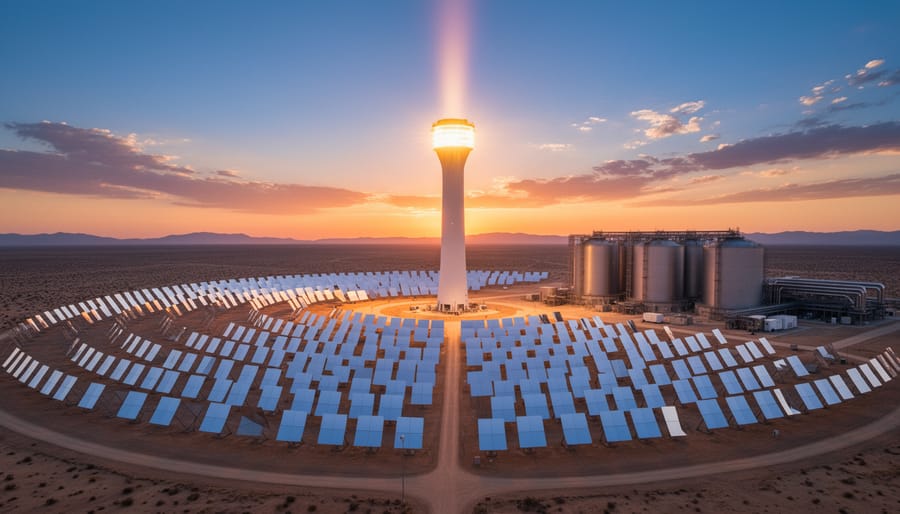
The fundamental advantage of thermal energy storage in CSP systems lies in its ability to capture solar heat during peak sunlight hours and retain it for electricity generation when needed. Unlike photovoltaic systems that convert sunlight directly to electricity, CSP technology collects solar radiation as thermal energy in a heat transfer fluid, typically molten salt composed of sodium and potassium nitrate. This heated fluid reaches temperatures between 290°C and 565°C, creating a substantial thermal reservoir.
The molten salt storage mechanism offers remarkable duration capabilities, with commercial CSP plants routinely storing energy for 6 to 15 hours of full-load electricity generation. Some advanced facilities have demonstrated storage capacity exceeding 17 hours, enabling continuous power delivery well after sunset. This extended storage window addresses one of renewable energy’s most significant challenges: dispatchability on demand.
Efficiency metrics for thermal storage systems demonstrate practical viability, with round-trip efficiencies typically ranging from 85% to 95%. The storage process involves minimal energy loss because heat naturally remains contained within insulated tanks, unlike battery systems that experience self-discharge. The two-tank molten salt configuration maintains thermal energy for days with proper insulation, though economic considerations typically favor daily cycling.
Storage capacity scales efficiently with tank size, making CSP particularly suitable for utility-scale applications requiring 50 MW to 300 MW output. This scalability, combined with the relatively low cost of storage materials compared to lithium-ion batteries, positions thermal storage as an economically attractive solution for large-scale renewable energy integration and grid stability enhancement.
How CSP Storage Differs from Battery Systems
CSP thermal storage and battery systems represent fundamentally different approaches to energy storage, each with distinct advantages and limitations. The primary difference lies in the storage medium itself: CSP systems store energy as heat in materials like molten salt, while battery systems store energy electrochemically in lithium-ion or other chemical compounds.
From a cost perspective, CSP thermal storage offers significant advantages in large-scale applications. Molten salt storage typically costs between $20-50 per kilowatt-hour of capacity, substantially lower than lithium-ion batteries, which range from $150-300 per kilowatt-hour. This cost differential becomes increasingly pronounced as storage duration extends beyond four hours, where thermal storage economics become particularly favorable.
Longevity represents another critical distinction. Molten salt storage systems can operate effectively for 30 years or more with minimal degradation, experiencing virtually no capacity loss over time. In contrast, lithium-ion batteries typically degrade 2-3 percent annually, resulting in replacement needs after 10-15 years of operation. This durability advantage translates to lower lifecycle costs and reduced maintenance requirements for CSP installations.
Performance characteristics also differ considerably. Battery systems excel in response time, providing near-instantaneous discharge capabilities ideal for grid stabilization and frequency regulation. CSP thermal storage, however, demonstrates superior performance in sustained, long-duration discharge applications, making it optimal for baseload power generation and extended evening peak demand periods. Additionally, thermal storage systems face fewer safety concerns compared to batteries, which carry risks of thermal runaway and require sophisticated management systems to prevent degradation and ensure safe operation.
Hybrid CSP-PV System Architectures
Direct Integration Models
Direct integration models represent a sophisticated approach to combining CSP thermal storage capabilities with photovoltaic arrays, creating hybrid systems that leverage the strengths of both technologies. In these configurations, PV panels generate electricity during peak sunlight hours while CSP components capture and store thermal energy in molten salt tanks or other storage media, maintaining temperatures between 290°C and 565°C.
The technical architecture requires careful coordination of energy flows. During daylight hours, both systems operate simultaneously, with excess PV generation directed to the grid or battery storage while CSP collectors charge thermal storage tanks. When solar irradiance decreases or during evening peak demand periods, the stored thermal energy drives steam turbines to generate dispatchable electricity, effectively extending the operational window of the solar facility.
Key technical requirements for successful direct integration include synchronized control systems that manage power distribution between generation sources, thermal storage units with sufficient capacity to bridge generation gaps, and heat exchangers capable of maintaining optimal working fluid temperatures. Research collaborations with universities have demonstrated that properly designed systems can achieve capacity factors exceeding 60 percent, significantly higher than standalone PV installations.
Energy flow management relies on advanced algorithms that predict solar resource availability, electricity demand patterns, and storage state-of-charge. These systems optimize when to dispatch stored thermal energy versus direct PV generation, maximizing economic returns while ensuring grid stability. Modern integration designs incorporate digital monitoring platforms that track thermal losses, conversion efficiencies, and system performance metrics in real-time, enabling operators to fine-tune operations and identify optimization opportunities throughout the facility lifecycle.
Grid-Scale Hybrid Applications
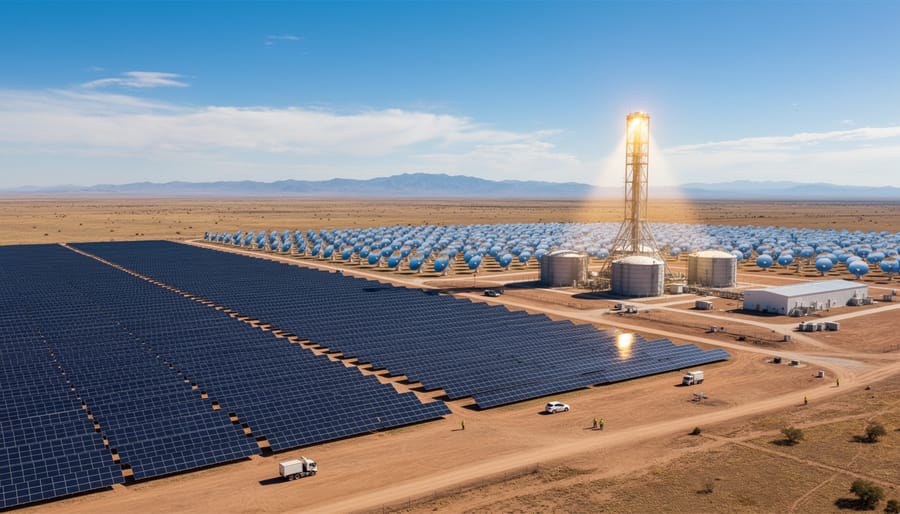
Utility-scale facilities worldwide are demonstrating the practical advantages of integrating CSP thermal storage with photovoltaic arrays. These hybrid solar systems leverage complementary strengths: PV panels generate cost-effective daytime electricity, while CSP towers with molten salt storage dispatch power during evening peak demand periods.
The Atacama-1 project in Chile exemplifies this approach, combining 210 MW of combined cycle capacity with 17.5 hours of thermal storage. Performance data shows the facility maintains 95% dispatch reliability during peak hours, substantially outperforming standalone PV installations. Similarly, the Noor Midelt complex in Morocco integrates 800 MW of hybrid generation, achieving a capacity factor exceeding 70% through strategic storage deployment.
Economic analysis from these facilities reveals compelling advantages. The Copiapó Solar project in Chile reports 30% higher annual revenue compared to comparable PV-only installations, attributed to premium pricing during evening demand windows. Operational data indicates thermal storage systems respond within 10 minutes to grid signals, providing essential flexibility services.
Technical integration challenges include synchronized inverter management and optimized charge-discharge scheduling between technologies. Research collaborations between universities and project operators have developed advanced forecasting algorithms that maximize storage utilization. Current operational data suggests hybrid configurations reduce levelized costs by 15-20% compared to standalone CSP facilities, while extending daily generation windows by 6-8 hours beyond PV production periods. These proven implementations validate hybrid architecture as a viable pathway toward dispatchable renewable energy portfolios at utility scale.
Optimization Strategies for CSP-Enhanced PV Systems
Dispatch Scheduling and Load Matching
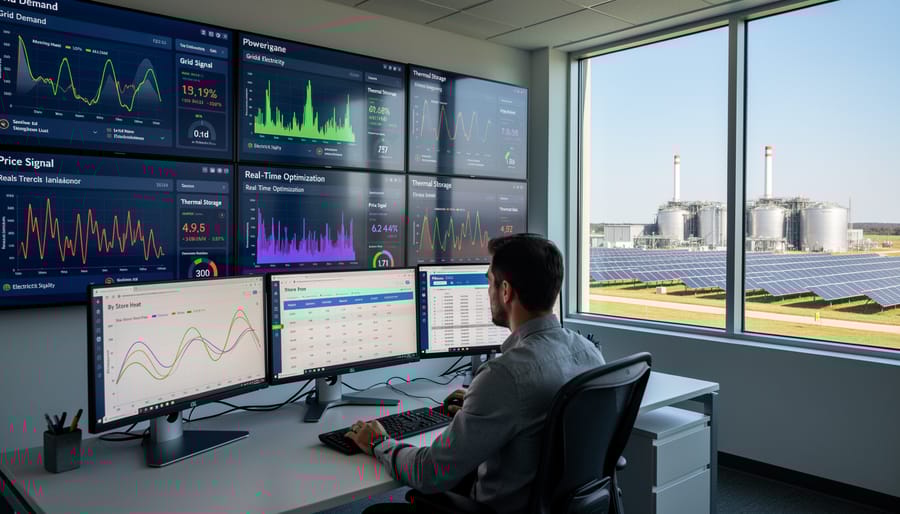
Effective dispatch scheduling represents a critical optimization layer for CSP energy storage systems, determining precisely when to charge thermal storage and when to release energy for electricity generation. Modern dispatch algorithms leverage sophisticated predictive analytics, integrating real-time demand forecasts, electricity market pricing signals, and solar radiation predictions to maximize economic returns while meeting grid reliability requirements.
Load matching optimization begins with analyzing historical consumption patterns and peak demand periods. CSP facilities equipped with thermal storage can strategically shift energy delivery to high-value evening hours when solar PV generation ceases but electricity demand remains elevated. This capability proves particularly valuable in markets with time-of-use pricing structures, where electricity commands premium rates during peak periods. Advanced scheduling systems continuously monitor day-ahead and real-time market prices, automatically adjusting storage dispatch to capture maximum revenue opportunities.
Machine learning algorithms increasingly enhance dispatch decision-making by identifying complex patterns in weather forecasts, grid conditions, and market behavior. These systems account for storage efficiency losses, turbine ramp rates, and minimum operating requirements to develop optimal charging and discharging schedules. Research collaborations between universities and industry operators continue refining these methodologies, incorporating probabilistic forecasting to manage uncertainty in both solar resource availability and demand projections.
Successful implementation requires integrating multiple data streams: meteorological services provide irradiance forecasts, grid operators communicate system needs, and market platforms deliver pricing information. This coordinated approach enables CSP facilities to function as dispatchable baseload resources, bridging the intermittency gap inherent in conventional photovoltaic installations.
Capacity Sizing and Configuration
Determining appropriate storage capacity for CSP systems requires careful analysis of project objectives and operational requirements. The solar multiple, which represents the ratio of solar field capacity to power block capacity, typically ranges from 1.5 to 3.0 for systems with thermal storage. Higher solar multiples enable extended storage durations but increase capital costs.
Storage duration commonly varies between 6 and 15 hours, with selection depending on electricity pricing structures and grid requirements. Markets with significant evening peak demand justify longer storage periods, maximizing revenue potential through time-shifted energy delivery. Projects targeting baseload or intermediate generation typically implement 10-15 hour storage configurations.
Component sizing follows integrated analysis of collector field area, receiver thermal capacity, and storage tank volume. Engineers must balance receiver output with storage charging rates to prevent thermal losses and ensure efficient operation. The power block rating should align with discharge requirements while maintaining acceptable capacity factors.
Academic collaborations through university research programs provide validated sizing methodologies and simulation tools. Educational workshops offered by industry organizations help professionals master capacity optimization techniques for specific applications. Regional solar resource data, ambient conditions, and cooling water availability significantly influence final configuration decisions. Comprehensive feasibility studies incorporating Monte Carlo simulations reduce financial risk by accounting for operational uncertainties and performance variability across different scenarios.
Efficiency Maximization Techniques
Maximizing efficiency in CSP energy storage systems requires a multifaceted approach that addresses thermal management, material selection, and system design. The primary challenge lies in minimizing thermal losses during both storage periods and energy retrieval cycles.
Advanced insulation materials, including high-performance ceramics and vacuum-insulated panels, significantly reduce heat dissipation from storage tanks. These materials can decrease thermal losses by up to 1% per day, compared to 3-5% in conventional systems. Implementing multi-layer insulation strategies creates thermal barriers that maintain storage temperatures above 500°C for extended periods.
Optimizing heat transfer rates involves selecting appropriate heat transfer fluids and enhancing surface area contact between storage media and heat exchangers. Synthetic oils and molten salts with superior thermal conductivity facilitate faster charging and discharging cycles. Direct contact heat exchangers eliminate intermediate transfer steps, improving round-trip efficiency from typical ranges of 75-85% to over 90%.
Regular maintenance protocols, including thermal imaging inspections and seal integrity assessments, prevent efficiency degradation over time. Universities collaborating with industry leaders continue developing novel phase-change materials and thermocline optimization techniques that promise further efficiency gains. Educational programs focusing on thermal system management equip professionals with skills to implement these advanced strategies effectively.
Economic Analysis and Cost Considerations
Levelized Cost of Storage Comparison
The Levelized Cost of Storage (LCOS) serves as a critical metric for comparing energy storage technologies across their operational lifespans. Current analysis reveals that CSP thermal storage systems demonstrate competitive advantages in specific applications, particularly for utility-scale projects requiring extended discharge durations.
CSP thermal storage typically exhibits LCOS values ranging from $0.05 to $0.15 per kilowatt-hour for systems with 10-15 hours of storage capacity. This compares favorably with lithium-ion battery systems, which range from $0.10 to $0.25 per kilowatt-hour when deployed for similar long-duration applications. The cost advantage of thermal storage becomes more pronounced as discharge duration increases beyond six hours, where battery degradation and replacement cycles significantly impact lifecycle economics.
Several factors contribute to CSP’s favorable LCOS profile. The storage medium itself—molten salt or other heat transfer fluids—costs substantially less than battery electrochemicals. Additionally, thermal storage systems demonstrate minimal capacity degradation over 30-year operational periods, while battery systems typically require replacement every 10-15 years.
Recent technological advancements and manufacturing scale improvements have driven LCOS reductions of approximately 30-40 percent over the past decade for both technologies. Industry projections suggest further decreases of 20-25 percent by 2030 for CSP thermal storage through enhanced heat exchanger efficiency and advanced storage materials.
For hybrid configurations integrating CSP with photovoltaic systems, the combined LCOS can achieve optimization through complementary operational profiles, enabling cost-effective dispatchable renewable energy generation that meets grid reliability requirements while maintaining economic competitiveness with conventional power sources.
Revenue Optimization Opportunities
CSP energy storage systems unlock substantial revenue opportunities beyond traditional electricity sales, fundamentally improving project economics through strategic market participation. The dispatchable nature of thermal storage enables CSP facilities to generate power during peak demand periods when electricity prices reach their highest levels, often commanding premiums of 200-300% above base rates. This price arbitrage capability allows operators to store thermal energy during low-value periods and dispatch electricity when market conditions are most favorable.
Participation in ancillary services markets provides additional revenue streams through frequency regulation, spinning reserves, and voltage support services. CSP plants with storage can respond rapidly to grid operator signals, earning capacity payments that significantly enhance financial returns. Many jurisdictions now offer dedicated capacity mechanisms that compensate generators for their availability during critical supply periods, with CSP storage qualifying for premium rates due to its predictable, weather-independent dispatch capabilities.
Demand response programs represent another lucrative opportunity, particularly in regions with time-of-use pricing structures. CSP facilities can contract directly with large industrial consumers or utilities to guarantee power delivery during specific high-value windows. Universities researching renewable energy economics have documented cases where strategic market participation increases CSP project revenues by 15-30% annually, demonstrating how integrated storage transforms CSP from a variable renewable resource into a premium dispatchable asset that commands market-leading compensation across multiple revenue channels.
Technical Challenges and Limitations
Geographic and Climate Constraints
CSP systems with integrated thermal storage require specific geographic and climatic conditions to operate at optimal efficiency. The most critical requirement is high direct normal irradiance (DNI), typically exceeding 2,000 kWh per square meter annually. This limits viable deployment to regions within the global sunbelt, approximately 40 degrees north and south of the equator, including areas in the southwestern United States, northern Africa, the Middle East, Australia, and parts of South America.
Clear sky conditions throughout the year significantly impact performance, as CSP technology depends on concentrated direct sunlight rather than diffuse radiation. Sites with frequent cloud cover, high humidity, or persistent air pollution experience reduced output and economic viability. Water availability presents another constraint, particularly for wet-cooling systems, though dry-cooling alternatives exist with modest efficiency trade-offs.
Land requirements are substantial compared to traditional photovoltaic installations, necessitating large, relatively flat terrain with minimal shading obstacles. These site-specific limitations contrast with energy storage innovations for standard PV systems, which offer greater geographic flexibility. Regional grid infrastructure and transmission capacity also influence deployment decisions, as CSP plants typically operate at utility scale requiring robust interconnection capabilities for optimal integration with existing power networks.
Scalability and Application Boundaries
CSP energy storage demonstrates clear advantages in utility-scale applications, typically those exceeding 50 MW capacity where long-duration storage of 6-15 hours is required. The thermal storage systems integrated with CSP facilities achieve economies of scale that make them cost-competitive with lithium-ion batteries at these larger capacities. For instance, molten salt storage becomes increasingly economical as facility size grows, with per-kilowatt-hour costs decreasing significantly above 100 MW installations.
However, conventional battery systems remain superior for distributed generation, residential applications, and smaller commercial installations below 10 MW. Batteries offer faster response times (milliseconds versus minutes), higher round-trip efficiency (85-95% compared to CSP’s 30-40% solar-to-electric efficiency), and modular scalability without minimum size constraints. Geographic limitations also restrict CSP deployment to regions with high direct normal irradiance, typically areas receiving over 2,000 kWh/m²/year of direct sunlight, effectively limiting implementation to desert and semi-arid climates. This makes CSP storage unsuitable for many locations where photovoltaic systems with battery storage can operate effectively, highlighting the complementary rather than competitive relationship between these technologies.
Future Developments and Research Directions
Advanced Storage Materials and Methods
Researchers and industry partners are advancing thermal storage capabilities through innovative materials that promise higher efficiency and cost-effectiveness. Phase-change materials (PCMs) represent a significant breakthrough, storing thermal energy through latent heat transitions rather than sensible heat alone. Salt hydrates, organic compounds, and eutectic mixtures can absorb substantial energy during melting and release it upon solidification, achieving energy densities exceeding traditional molten salt systems by 30-40 percent.
Universities collaborating with CSP developers are investigating high-temperature ceramics and composite materials that maintain stability above 700 degrees Celsius, enabling greater thermodynamic efficiency. Novel configurations include thermocline storage systems with stratified temperature zones and modular concrete block storage that reduces material costs while improving scalability.
Encapsulated PCM systems, where microscopic capsules suspend phase-change compounds in stable matrices, address degradation challenges that previously limited commercial deployment. These advanced storage methods demonstrate particular promise for hybrid CSP-photovoltaic installations, where thermal storage complements battery systems to provide extended discharge durations. Educational programs increasingly emphasize these emerging technologies, preparing professionals to implement next-generation storage solutions as they transition from research facilities to commercial-scale projects.
Academic and Industry Collaboration
Leading academic institutions are driving CSP storage innovation through dedicated research programs. The National Renewable Energy Laboratory (NREL) collaborates with universities worldwide to develop advanced thermal storage materials and system integration strategies. Major universities including MIT, Stanford, and the German Aerospace Center conduct cutting-edge research on molten salt chemistry, phase-change materials, and thermocline storage optimization.
Industry partnerships between technology manufacturers and research institutions accelerate knowledge transfer from laboratory to commercial deployment. Companies like Abengoa, SolarReserve, and BrightSource Energy maintain active research collaborations, providing real-world data and testing facilities for academic studies. These partnerships enable pilot projects that validate storage optimization techniques under actual operating conditions.
Educational initiatives have expanded to meet growing workforce demands. Specialized certificate programs and graduate courses in CSP technology now integrate storage system design and optimization. Professional development workshops offered through organizations like the Solar Energy Industries Association equip practitioners with practical skills in thermal storage management, performance modeling, and hybrid system configuration, ensuring the industry maintains technical expertise for advancing CSP storage applications.
CSP energy storage represents a complementary rather than competitive technology for photovoltaic system optimization. While standalone battery storage dominates the residential and commercial solar market, CSP thermal storage offers distinct advantages in utility-scale applications requiring extended discharge durations of 6-15 hours. The integration of molten salt thermal storage with concentrated solar power can achieve round-trip efficiencies of 85-95% while providing dispatchable renewable energy that supports grid stability.
For professionals evaluating storage options, CSP systems excel in regions with high direct normal irradiance, large land availability, and utility-scale project requirements. Conventional battery storage remains preferable for distributed generation, shorter duration applications, and projects requiring rapid response times. The economic viability depends critically on project scale, local climate conditions, and grid service requirements.
Moving forward, aspiring photovoltaic professionals should assess storage technologies based on specific project parameters rather than seeking universal solutions. Key evaluation criteria include discharge duration requirements, project scale, available solar resource type, land constraints, and grid interconnection needs. Industry stakeholders benefit from understanding both PV-battery and CSP-thermal storage pathways to recommend appropriate solutions.
Educational institutions and professional development programs increasingly emphasize hybrid renewable energy systems, recognizing that optimal grid decarbonization requires diverse storage technologies. Professionals should pursue continued education in thermal and electrochemical storage mechanisms, economic modeling frameworks, and emerging hybrid configurations that combine photovoltaic generation with various storage modalities to meet evolving energy system demands.


