
The solar industry stands at the forefront of global energy transformation, offering unprecedented career opportunities across engineering, manufacturing, sales, and installation sectors. With projected growth rates exceeding 20% annually through 2030, solar energy now employs over 3.4 million professionals worldwide, making it one of the fastest-growing segments in renewable energy.
Professional pathways in solar energy span from technical roles like photovoltaic system designers and solar installation technicians to business-focused positions including project managers and sustainability consultants. Entry-level positions typically require specialized certifications, while advanced roles demand comprehensive renewable energy expertise combined with industry experience.
The sector’s rapid expansion has created unique opportunities for cross-disciplinary professionals, particularly in emerging fields like solar storage technology, smart grid integration, and building-integrated photovoltaics. Leading markets including China, the United States, and European Union are actively recruiting skilled workers, offering competitive compensation packages and robust career advancement potential.
For aspiring professionals, the solar industry presents a rare convergence of environmental impact, technological innovation, and career stability. Educational institutions worldwide are responding with specialized training programs, industry partnerships, and research opportunities, creating clear pathways for entry into this dynamic field.
The Evolving Solar Job Market
High-Demand Solar Positions
The solar industry consistently shows strong demand for several key positions across its value chain. Solar Installation Technicians remain among the most sought-after professionals, responsible for the physical implementation of photovoltaic systems. Project Managers with solar expertise are equally valuable, coordinating complex installations and ensuring efficient resource allocation.
Solar Sales Engineers and Consultants play crucial roles in system design and client relations, requiring both technical knowledge and commercial acumen. Research and Development Engineers are increasingly important as the industry focuses on improving solar technology efficiency and developing new solutions.
Operations and Maintenance Technicians are essential for ensuring optimal system performance, while Quality Control Specialists maintain industry standards and regulatory compliance. Solar Data Analysts and Performance Monitoring Specialists represent emerging roles, leveraging technology to optimize energy production.
Financial Analysts and Solar Project Developers with expertise in renewable energy economics are particularly valued as the industry expands globally. Manufacturing positions, especially in specialized areas like cell production and testing, continue to grow with increased demand for solar components worldwide.

Regional Market Differences
The solar industry job market exhibits distinct regional characteristics across global energy markets, with significant variations in employment opportunities and growth patterns. Asia-Pacific leads in manufacturing positions, particularly in China and Southeast Asia, where large-scale production facilities drive demand for technical specialists and quality control professionals. European markets emphasize research and development roles, with strong opportunities in solar technology innovation and system design, especially in Germany and Denmark.
North American markets focus heavily on installation and project development positions, with the United States experiencing substantial growth in residential and commercial solar projects. Emerging markets in Africa and Latin America show increasing demand for project managers and technical trainers, particularly in rural electrification initiatives. The Middle East presents unique opportunities in utility-scale solar projects, requiring specialized expertise in desert-based installations and high-temperature operations.
Salary ranges and certification requirements also vary significantly by region, with developed markets typically offering higher compensation but demanding more stringent qualifications. Understanding these regional differences is crucial for professionals planning international career moves in the solar sector.
Leading International Solar Training Programs

University-Industry Partnerships
The integration of academic institutions and solar industry leaders has become increasingly vital for developing skilled professionals in the renewable energy sector. Through collaborative educational programs, universities and solar companies create tailored curricula that combine theoretical knowledge with practical industry experience.
These partnerships typically feature internship programs, research opportunities, and specialized training modules designed to bridge the gap between academic learning and industry requirements. Students benefit from hands-on experience with cutting-edge solar technologies, while companies gain access to fresh talent and innovative research capabilities.
Many leading universities now offer solar-specific degree programs developed in consultation with industry partners. These programs often include guest lectures from industry professionals, site visits to solar installations, and project-based learning opportunities. Students can participate in real-world solar projects, gaining valuable experience in system design, installation, and maintenance.
Industry partners frequently contribute by providing equipment for training labs, offering mentorship programs, and creating dedicated research centers. This collaboration ensures that graduates possess both theoretical understanding and practical skills required by employers. Some partnerships even extend to joint research initiatives, focusing on technological innovations and improving solar energy efficiency.
These university-industry alliances have proven instrumental in developing a skilled workforce capable of meeting the growing demands of the solar sector while fostering innovation and technological advancement.
Government-Backed Initiatives
Government-backed initiatives play a crucial role in developing the solar industry workforce through comprehensive training programs and financial support mechanisms. The U.S. Department of Energy’s Solar Energy Technologies Office (SETO) leads several nationwide programs, including the Solar Ready Vets initiative, which helps military veterans transition into solar careers through specialized training and job placement assistance.
State-level programs have shown remarkable success in workforce development. California’s Clean Energy Job Program has trained over 12,000 workers since 2015, while New York’s Green Jobs Green New York initiative provides funding for solar installation training and certification programs. These programs often collaborate with community colleges and technical schools to deliver industry-recognized credentials.
The impact of these initiatives extends beyond direct job creation. The Solar Training Network, a federal program, has established partnerships with more than 400 employers and educational institutions, creating a robust pipeline of qualified professionals. Additionally, state renewable portfolio standards have indirectly stimulated job growth by mandating increased solar energy adoption.
Financial incentives, such as tax credits for companies providing apprenticeships and grants for training facilities, have encouraged private sector participation in workforce development. The Solar Foundation reports that government-sponsored programs have contributed to a 167% increase in solar employment over the past decade.
International cooperation has also emerged as a key component, with programs like the International Solar Alliance facilitating knowledge transfer and training standardization across borders. These collaborative efforts ensure that workforce development aligns with global industry standards and best practices, preparing professionals for opportunities in the expanding international solar market.
Skills Development and Certification
Technical Competencies
Success in the solar industry requires a robust foundation of technical competencies that vary across different roles and specializations. Core technical skills include electrical system design, photovoltaic system installation, energy assessment, and system maintenance. Professionals must understand fundamental principles of solar radiation, power generation, and energy conversion efficiency.
Knowledge of electrical codes, safety protocols, and industry standards is essential, particularly for installers and system designers. Proficiency in Computer-Aided Design (CAD) software, energy modeling tools, and monitoring systems is increasingly important as the industry becomes more digitalized.
Engineers and designers need expertise in structural analysis, load calculations, and site assessment. They must understand inverter technology, battery storage systems, and grid integration requirements. Familiarity with various solar technologies, including monocrystalline, polycrystalline, and thin-film panels, enables informed decision-making for different applications.
Technical sales professionals require understanding of system specifications, performance metrics, and ROI calculations. Project managers must combine technical knowledge with scheduling and resource allocation skills. Quality control specialists need proficiency in testing equipment and inspection procedures.
As the industry evolves, expertise in smart grid technologies, energy storage solutions, and advanced monitoring systems becomes increasingly valuable. Understanding of building codes, permitting processes, and interconnection requirements is crucial for successful project implementation. Continuous learning and adaptation to emerging technologies remain essential for long-term career success in the solar sector.
Professional Certifications
Professional success in the solar industry often hinges on obtaining recognized certifications that validate expertise and competency. The industry follows strict international certification standards established by organizations such as the North American Board of Certified Energy Practitioners (NABCEP) and the International Renewable Energy Agency (IRENA).
Key certifications include the NABCEP PV Installation Professional Certification, which is considered the gold standard in North America, and the IEC Technical Committee 82 certifications for solar photovoltaic energy systems. The Clean Energy Council (CEC) accreditation is crucial for professionals working in Australia, while the Solar Energy Industries Association (SEIA) provides recognized credentials in various markets.
These certifications typically require candidates to complete specific training programs, accumulate hands-on experience, and pass comprehensive examinations. Many certification programs mandate regular renewal through continuing education to ensure professionals stay current with evolving technology and safety standards.
Entry-level professionals often start with fundamental certifications like the NABCEP PV Associate or similar regional credentials. Advanced certifications in specialized areas such as system design, storage integration, and commercial installations provide opportunities for career advancement and higher earning potential. Educational institutions and industry training centers worldwide offer preparation courses aligned with these certification requirements, often incorporating practical training components and theoretical knowledge assessment.
Future Outlook and Opportunities
Emerging Technologies
The solar industry continues to evolve rapidly with emerging solar technologies creating new employment opportunities across various specializations. Perovskite solar cells, which promise higher efficiency and lower production costs, are generating positions for materials scientists and process engineers. Bifacial solar panels are driving demand for installation specialists and performance analysts who can optimize their unique dual-sided energy capture capabilities.
Building-integrated photovoltaics (BIPV) technology is creating roles for architectural solar designers and specialized installers who can seamlessly incorporate solar elements into building structures. The advancement of floating solar farms has introduced opportunities for hydroelectric engineers and environmental impact assessors.
AI and machine learning integration in solar operations has sparked demand for data scientists and smart grid specialists who can optimize energy production and distribution. Energy storage technologies, particularly advanced battery systems, require electrical engineers and energy management experts to design and maintain these crucial components.
The emergence of solar-powered transportation infrastructure is creating positions for charging station designers and electric vehicle integration specialists, while innovations in solar manufacturing automation are increasing the need for robotics engineers and process automation experts.
Career Advancement Paths
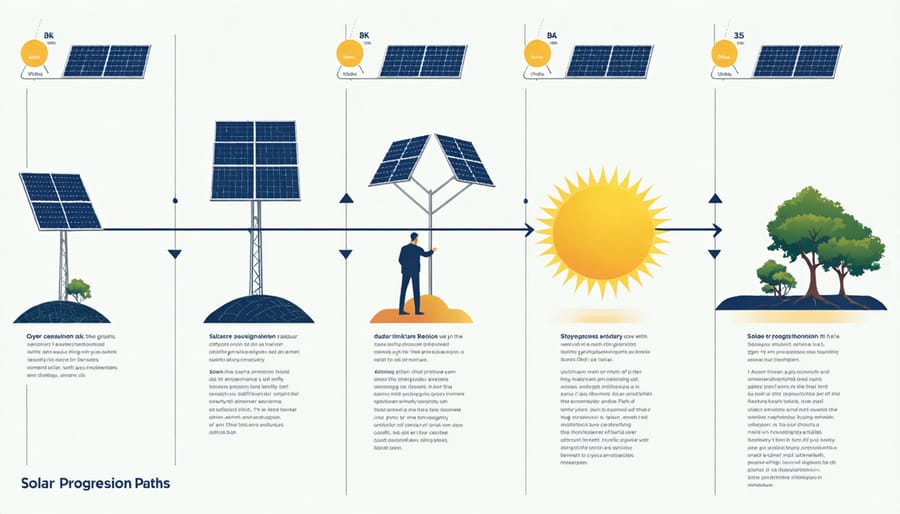
The solar industry offers diverse career advancement opportunities, allowing professionals to progress through various levels of expertise and responsibility. Entry-level installers can advance to lead installation positions or transition into system design roles after gaining field experience and additional certifications. Solar sales representatives often progress to sales management positions, overseeing teams and developing strategic partnerships.
Technical professionals can advance from maintenance technicians to senior engineering roles, eventually reaching positions such as Chief Technical Officer or Director of Operations. Project managers frequently evolve into program directors or executives overseeing multiple large-scale solar installations across regions.
Research and development positions offer paths from junior researcher to senior scientist, with opportunities to lead innovation teams or establish specialized consulting practices. Quality assurance specialists can progress to quality control management, ensuring compliance across multiple projects or facilities.
Business development professionals often advance from coordinator roles to executive positions, managing international partnerships and market expansion initiatives. Additionally, experienced professionals can transition into training and education roles, contributing to workforce development programs or establishing their own consulting firms.
The industry’s rapid growth continues to create new specialized positions and management opportunities, particularly in emerging areas such as energy storage integration and smart grid technologies.
The solar industry presents abundant opportunities for professionals seeking meaningful careers in renewable energy. As we’ve explored, positions range from technical roles like solar installers and engineers to business-focused positions in sales, project management, and consulting. Success in this dynamic field requires a combination of technical expertise, industry certifications, and soft skills.
To begin your solar career journey, consider these actionable steps: First, identify your target role based on your skills and interests. Next, pursue relevant certifications such as NABCEP for technical positions or project management credentials for leadership roles. Building practical experience through internships or entry-level positions is crucial for career advancement.
Educational partnerships with universities and technical schools offer structured pathways into the industry. Many institutions now provide specialized renewable energy programs that combine theoretical knowledge with hands-on training. Networking through industry associations, attending solar conferences, and joining professional forums can create valuable connections and job opportunities.
As the solar sector continues to grow globally, staying informed about technological advances and industry trends will ensure long-term career success. The future of solar energy is bright, and now is an excellent time to join this transformative industry.