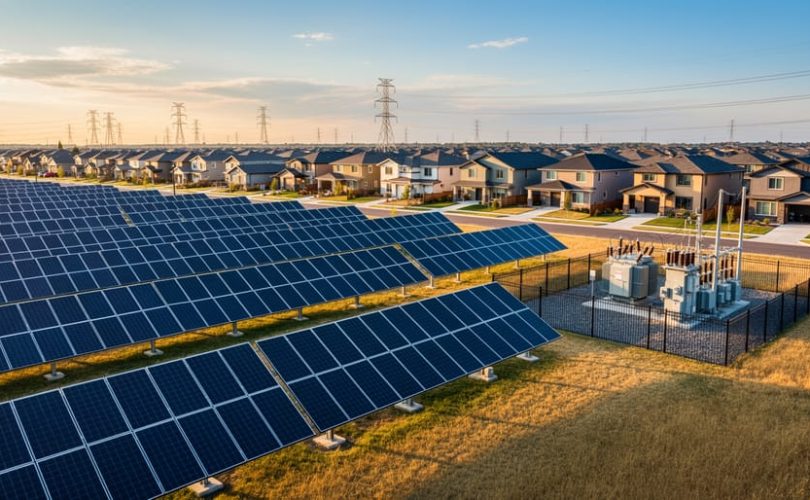
Xcel Energy’s Community Solar program operates through a subscription-based model where customers purchase or lease portions of larger solar arrays without installing panels on their properties. Subscribers receive monthly bill credits for their share of electricity generated, typically offsetting 50-120% of household consumption depending on subscription size and local regulations. The program functions across Colorado, Minnesota, and New Mexico, each with distinct policy frameworks that determine credit rates, subscriber eligibility, and utility compensation structures.
Understand how the Federal Energy Regulatory Commission’s policies intersect with state-level renewable portfolio standards to create the regulatory foundation enabling Xcel’s program. These mechanisms differ substantially from national community solar initiatives, particularly regarding ownership structures and community benefit requirements. Minnesota’s Value of Solar methodology, for instance, calculates subscriber credits differently than Colorado’s net metering approach, directly affecting program economics and accessibility.
Evaluate whether Xcel’s model genuinely advances local energy autonomy or primarily serves utility revenue objectives. The program maintains centralized utility control over array siting, development timelines, and interconnection processes, contrasting with community-owned cooperative models that transfer decision-making authority to local stakeholders. Subscription terms typically span 20-25 years with limited transferability, creating long-term customer commitments that benefit utility cash flow predictability.
Compare Xcel’s utility-sponsored approach against third-party developer models and municipal solar programs to identify trade-offs in administrative simplicity, project scale, community engagement, and economic benefit distribution. This comparative analysis proves essential for photovoltaic professionals evaluating program design options, policy advocacy strategies, and career opportunities within evolving community solar markets.
Understanding Xcel Energy’s Community Solar Model
Program Structure and Participation Requirements
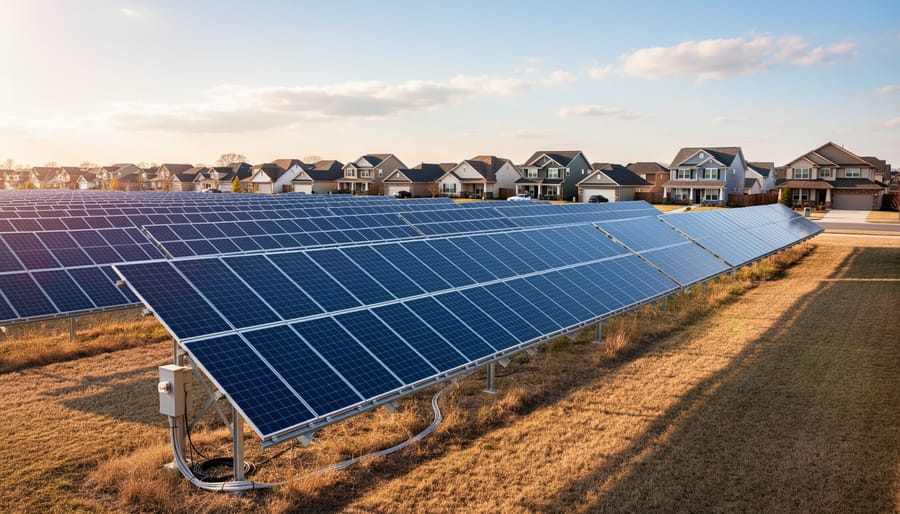
Xcel Energy’s community solar program operates through a subscription-based model accessible to residential and business customers across multiple service territories, including Minnesota, Colorado, and New Mexico. Participants subscribe to a portion of a community solar garden’s output without requiring rooftop installations, making solar energy accessible to renters, property owners with unsuitable roofs, and those preferring shared renewable investments.
Subscription requirements vary by state due to differing regulatory frameworks. In Minnesota, customers can subscribe to a minimum of 200 watts and a maximum equivalent to 120 percent of their average annual electricity consumption. Colorado participants face similar consumption-based caps, typically limited to offsetting no more than their annual usage. Business customers generally enjoy higher subscription thresholds, enabling greater participation in larger-scale projects.
The credit allocation mechanism functions through bill credits applied to subscribers’ monthly electricity statements. Subscribers receive credits based on their proportional share of the solar garden’s generation, calculated at the program’s predetermined credit rate. These credits offset standard electricity charges, with any excess typically carried forward to subsequent billing cycles rather than paid as cash refunds.
Geographic availability remains concentrated in Xcel’s primary service territories, though expansion continues as regulatory approval and solar garden development progress. Minnesota features the most mature program structure, benefiting from supportive state legislation mandating utility participation. Colorado and New Mexico programs reflect more recent implementations with evolving enrollment procedures and capacity constraints. Prospective subscribers should verify specific program availability through Xcel’s online portal or designated community solar coordinators within their service area.
Technical Framework and Grid Integration
Xcel Energy’s community solar gardens typically employ crystalline silicon photovoltaic modules, predominantly polycrystalline and monocrystalline technologies, chosen for their proven reliability and cost-effectiveness in utility-scale applications. Individual installations range from 500 kilowatts to 5 megawatts in capacity, with most gardens sized between 1-2 megawatts to optimize land use while maintaining manageable interconnection requirements.
The technical integration process begins with developers submitting interconnection applications through Xcel’s established queue system. Projects must comply with grid interconnection protocols outlined in IEEE 1547 standards and local utility requirements. Xcel conducts feasibility studies and impact analyses to assess system compatibility with existing distribution infrastructure, evaluating factors including voltage regulation, protection coordination, and power quality.
Community solar installations connect at distribution voltage levels, typically 12.47 kV or 25 kV, feeding energy directly into local circuits. Advanced inverter technology enables these systems to provide grid support functions such as voltage regulation and frequency response. Smart meters at subscriber premises track energy consumption while virtual net metering credits are calculated based on the proportional generation from the shared array.
The distributed nature of community solar provides grid benefits including reduced transmission losses, enhanced system resilience, and improved voltage support during peak demand periods. However, Xcel maintains centralized control over interconnection approval and operational parameters, ensuring network stability while accommodating increasing renewable penetration across its service territory.
Policy Foundations Enabling Community Solar
State Renewable Energy Standards and Mandates
State renewable portfolio standards (RPS) have been instrumental in driving Xcel Energy’s community solar development across its service territories. These regulatory frameworks establish specific targets for utilities to source electricity from renewable energy sources, creating a policy foundation that incentivizes innovative programs like community solar.
Minnesota’s Solar Energy Standard, enacted in 2013, requires Xcel Energy to generate 1.5% of its retail electric sales from solar energy by 2020, creating direct impetus for the utility’s community solar garden program. This mandate, combined with the state’s broader RPS requiring 26.5% renewable energy by 2025, positioned Minnesota as a national leader in community solar deployment. The state’s approach includes specific provisions for distributed solar resources, recognizing their value in grid resilience and local economic development.
Colorado’s RPS, established in 2004 and strengthened through subsequent legislation, mandates that investor-owned utilities like Xcel obtain 30% of electricity from renewable sources by 2020. The state requires that at least 3% come from distributed generation, including community solar projects under 2 MW. This distributed generation carve-out ensures that large-scale renewable projects don’t overshadow community-level initiatives.
These state mandates create compliance obligations that make community solar programs financially attractive for utilities while simultaneously advancing state clean energy goals. Universities including the University of Minnesota and Colorado State University have collaborated with policymakers to evaluate program effectiveness, contributing research that informs ongoing policy refinements and supports workforce development in renewable energy sectors.
Virtual Net Metering and Credit Allocation Policies
Virtual net metering (VNM) represents the foundational mechanism enabling Xcel Energy’s community solar program to function without requiring physical connections between subscribers and solar arrays. Unlike traditional net metering where customers must install solar panels on their property, VNM allows bill credits generated by a remote solar facility to be allocated across multiple subscriber accounts based on their subscription levels.
Under Xcel’s VNM framework, the community solar garden feeds electricity directly into the utility grid at its physical location. The system generates credits based on actual energy production, which Xcel then distributes proportionally to subscribers through a credit allocation system. These credits appear as line items on monthly electricity bills, offsetting standard consumption charges at rates determined by state regulatory commissions.
The credit rate structure varies by jurisdiction within Xcel’s service territory. In Minnesota, the Public Utilities Commission established a formula-based value of solar methodology that calculates credits based on avoided costs, including energy, capacity, transmission, distribution, and environmental factors. Colorado initially implemented a retail rate credit structure but transitioned to a resource-adjusted approach that reflects wholesale energy values plus adders for renewable energy attributes.
Regulatory frameworks governing these credit mechanisms prioritize transparency and consumer protection. State public utility commissions mandate detailed reporting requirements, ensuring subscribers receive accurate credit calculations. The allocation process follows a hierarchy system where subscribers designate specific accounts to receive credits, with any excess production typically credited at wholesale rates or carried forward to subsequent billing periods.
This administrative structure enables participation from renters, multi-family dwelling residents, and property owners with unsuitable rooftops, democratizing solar access while maintaining utility oversight of grid operations and billing systems. Educational institutions partnering with Xcel have utilized these programs as practical learning laboratories, allowing students to analyze real-world VNM performance data and credit allocation patterns.

Local Energy Autonomy Through Shared Solar Access
Democratizing Solar Access for Renters and Multi-Family Residents
Traditional solar photovoltaic installations present significant barriers for substantial portions of the population. Approximately 77% of residential customers cannot install rooftop solar due to unsuitable roof conditions, shading issues, structural limitations, or most commonly, lack of property ownership. The Xcel Energy Community Solar program directly addresses this equity gap by decoupling solar access from individual property characteristics.
Community solar models fundamentally transform the ownership equation. Renters who previously had no pathway to renewable energy investment can now subscribe to solar gardens without landlord approval or property modifications. Multi-family dwelling residents, whose unit-level control over building infrastructure is inherently limited, gain equivalent access to solar benefits as single-family homeowners. This democratization extends beyond housing status to include individuals with constrained financial resources, as subscription minimums typically remain accessible compared to $15,000-$30,000 rooftop installation costs.
The program’s credit allocation mechanism ensures subscribers receive tangible economic benefits regardless of their housing situation. Monthly utility bills reflect proportional credits based on solar garden production, creating a direct financial incentive previously unavailable to non-homeowners. Research partnerships between Xcel and universities, including sustainability-focused academic programs, have documented participation rates among renters exceeding 35% in certain service territories, demonstrating genuine market demand.
This inclusive framework represents a critical policy innovation for energy transition equity. By removing physical and legal barriers, community solar programs enable broader population participation in distributed generation, advancing both renewable energy adoption rates and social justice objectives within the electricity sector.

Economic Benefits and Local Investment Retention
The Xcel community solar program generates substantial economic benefits by retaining energy investment within participating communities rather than exporting capital to distant fossil fuel markets. When subscribers purchase solar credits from local arrays, those dollars support regional solar developers, installers, maintenance crews, and equipment suppliers, creating a multiplier effect throughout the local economy. Studies indicate that distributed solar projects generate approximately 2.5 times more local economic activity per dollar invested compared to utility-scale generation built outside service territories.
Employment impacts extend beyond initial construction. Community solar facilities require ongoing operations and maintenance support, establishing stable regional jobs in monitoring, cleaning, vegetation management, and equipment servicing. Xcel’s procurement processes often prioritize Minnesota-based contractors and suppliers, strengthening state workforce development in photovoltaic technologies. Educational partnerships with universities and technical colleges further enhance this employment pipeline by training aspiring professionals in solar operations and grid integration.
Participants benefit from reduced energy cost volatility, as subscription pricing structures typically lock in predictable rates or guaranteed savings percentages over 20-25 year terms. This financial stability contrasts sharply with conventional electricity pricing subject to fuel cost fluctuations and infrastructure cost recovery mechanisms. The community solar economics demonstrate that aggregated local investment in distributed generation creates resilient revenue streams that remain within regional economies while providing subscribers protection against rising utility rates and fossil fuel price spikes.
Community Resilience and Distributed Generation
Distributed generation through Xcel’s community solar program enhances local grid resilience by diversifying energy sources and reducing dependence on centralized power plants. When solar arrays are strategically positioned near consumption centers, transmission losses decrease significantly—typically by 5-8% compared to distant utility-scale facilities. This localized approach provides critical redundancy during grid disruptions, as community solar installations can support essential services when configured with appropriate infrastructure.
From an energy security perspective, distributed solar resources reduce vulnerability to single-point failures in transmission infrastructure. Multiple smaller generation sites create a more robust energy network capable of maintaining partial service during extreme weather events or equipment failures. Universities collaborating with Xcel have documented that communities with higher distributed generation penetration experience faster restoration times following outages. Educational programs now emphasize designing community solar projects with grid support capabilities, preparing the next generation of photovoltaic professionals to optimize both economic returns and resilience benefits. This dual-purpose approach strengthens the business case for community solar while addressing broader infrastructure reliability concerns.
Challenges and Limitations Within the Xcel Framework
Utility Control Versus True Community Ownership
Xcel Energy’s community solar program operates under a utility-owned model that fundamentally differs from traditional energy cooperatives in structure and governance. In this framework, Xcel retains ownership of the solar arrays, operational control, and ultimate decision-making authority over project locations, capacity, and implementation timelines. Subscribers purchase a portion of the energy generated rather than holding equity stakes in the infrastructure itself.
This arrangement contrasts sharply with fully community-owned cooperatives, where members typically possess voting rights, participate in governance decisions, and share both risks and profits proportionally. True cooperative models enable local communities to determine project priorities, select development partners, and reinvest revenues according to collective values. The distinction carries significant implications for energy autonomy and democratic participation.
Under Xcel’s model, subscribers gain financial benefits through bill credits but exercise minimal influence over project development or operational policies. The utility maintains control over critical aspects including technology selection, maintenance protocols, and potential expansion plans. This centralized authority can streamline implementation and leverage economies of scale, yet it simultaneously limits grassroots engagement and community-driven innovation.
Research conducted through university partnerships examining distributed energy governance suggests that ownership structures directly impact long-term sustainability outcomes and local economic benefits. While Xcel’s program reduces entry barriers for residential participants, it preserves traditional utility control rather than redistributing energy decision-making power to communities. Educational programs emphasizing these structural differences help aspiring professionals understand how policy frameworks shape authentic community participation versus subscriber-based participation models.
Economic Accessibility and Subscriber Value
Xcel Energy’s community solar program presents a complex economic accessibility picture. Subscription fees typically require participants to purchase or lease solar garden shares, with costs varying by project size and location. While Xcel promotes bill credits offsetting electricity charges, upfront capital requirements and credit checks can exclude low-to-moderate income households from participation.
The program does include a Low-Income Solar Garden component, mandating that developers reserve capacity for qualified subscribers earning below area median income thresholds. These participants receive enhanced bill credits and reduced subscription fees. However, research from collaborating universities indicates that middle-to-upper income households constitute the majority of subscribers across most projects.
Long-term savings potential depends heavily on electricity rate structures and credit allocation methodologies. Subscribers generally save 5-15% on annual electricity costs after accounting for subscription fees, though actual savings fluctuate with utility rate adjustments. The program’s economic benefits remain most accessible to financially stable households who can navigate administrative requirements and absorb initial costs, raising questions about whether community solar genuinely democratizes renewable energy access or primarily serves those already positioned to invest in sustainability initiatives.
Educational Implications for Photovoltaic Professionals
Technical Competencies for Community Solar Projects
Participating in Xcel’s community solar program requires professionals to develop several core technical competencies. Understanding grid interconnection procedures is fundamental, as these projects must comply with utility-specific requirements and distributed generation standards to ensure safe, reliable integration with the electrical grid. Engineers must navigate Minnesota’s interconnection processes, including application protocols, equipment specifications, and protection system requirements that differ from standard rooftop installations.
Virtual net metering administration represents another critical knowledge area. Professionals must comprehend how subscriber credits are calculated, allocated, and applied to individual utility accounts. This involves understanding billing systems, customer enrollment procedures, and the data management systems that track production and distribute benefits among multiple subscribers.
Solar array design for shared-use applications demands specialized expertise beyond conventional installations. Designers must optimize systems for diverse subscriber portfolios, accounting for varied consumption patterns and ensuring equitable capacity allocation. Technical considerations include site assessment for ground-mounted arrays, optimal panel orientation for Minnesota’s climate, and scalability for subscriber growth.
Regulatory compliance knowledge encompasses Minnesota’s community solar legislation, utility commission orders, and ongoing policy modifications. Professionals must stay current with program caps, subscription limits, and evolving technical standards while coordinating with Xcel Energy’s program administrators to ensure project eligibility and successful implementation.

Policy Literacy and Stakeholder Engagement Skills
Professionals entering the community solar sector must develop robust policy literacy to navigate the complex regulatory landscape governing programs like Xcel’s offering. Understanding state-level renewable portfolio standards, net metering regulations, and utility commission oversight structures proves essential for effective program participation and advocacy. The Minnesota Public Utilities Commission’s framework, which authorizes Xcel’s community solar program, exemplifies how policy mechanisms shape program accessibility, credit calculations, and subscriber protections.
Building productive relationships with utility stakeholders requires professionals to comprehend utility business models and operational constraints. Xcel Energy operates within regulatory parameters that balance renewable energy expansion with grid reliability and shareholder obligations, creating tensions that informed professionals must recognize when designing community engagement strategies.
Effective community engagement demands culturally competent communication skills that translate technical program details into accessible information for diverse subscribers. Academic institutions increasingly partner with industry stakeholders to develop educational programs addressing these competencies, preparing future professionals to bridge technical expertise with community needs. Successful practitioners employ transparent communication about program benefits, limitations, and actual contributions to local energy autonomy, ensuring stakeholders maintain realistic expectations about community solar’s role in broader energy transition goals.
Comparative Policy Analysis: Xcel Versus Other Community Solar Models
Xcel Energy’s community solar program operates under a utility-administered framework distinct from alternative models employed across the United States. Understanding these differences illuminates the policy choices shaping local energy autonomy and stakeholder control.
Xcel’s approach follows a third-party developer model where independent solar companies construct and operate facilities, while Xcel manages subscription administration, billing credits, and grid integration. This hybrid structure maintains utility oversight while leveraging private capital for deployment. Subscribers receive credits on their electricity bills proportional to their share, with Xcel retaining responsibility for program compliance and regulatory reporting.
In contrast, fully cooperative models transfer substantially more control to member-owners. Community solar cooperatives, prevalent in states like Minnesota and Colorado, enable participants to collectively own generation assets and make governance decisions. Members typically receive direct returns on investment and exercise voting rights over project development priorities. These structures maximize local autonomy but require greater participant commitment and technical expertise.
Municipal initiatives represent another alternative, with local governments developing solar arrays to serve residents within their jurisdictions. Municipal programs often prioritize low-income access and integrate with broader sustainability planning. However, these initiatives face capital constraints and regulatory limitations in territories served by investor-owned utilities like Xcel.
Third-party developer programs without utility intermediation have emerged in states with aggressive renewable portfolio standards. These arrangements allow companies to contract directly with subscribers, potentially offering more competitive pricing and flexible terms. Nevertheless, they may lack the standardization and consumer protections inherent in utility-administered frameworks.
Research conducted through university partnerships examining program performance suggests that Xcel’s model achieves rapid scalability and regulatory compliance while potentially limiting subscriber influence over project siting and technology selection. The centralized administration reduces barriers to participation for residential customers but concentrates decision-making authority with the utility and approved developers.
Each framework presents distinct tradeoffs between accessibility, autonomy, financial returns, and implementation complexity. Evaluating these models requires considering regional policy environments, utility regulatory structures, and stakeholder priorities for community energy development.
Xcel’s community solar program represents significant progress in democratizing renewable energy access, yet it simultaneously illustrates the inherent tensions within utility-administered frameworks. The program has successfully expanded solar participation beyond property owners, generating valuable data on subscriber engagement and grid integration that benefits the broader photovoltaic sector. However, the retained utility control over project siting, capacity allocation, and credit structures reveals the limitations of achieving genuine local energy autonomy within incumbent power structures.
For aspiring photovoltaic professionals, understanding these implementation models is essential as the industry continues evolving. The distinction between utility-controlled community solar and cooperatively-owned alternatives will increasingly shape career opportunities and project development pathways. Academic research collaborations with institutions studying these programs provide crucial insights into optimization strategies and policy refinements needed to enhance community benefits.
Moving forward, policy evolution must address several critical areas: streamlining interconnection processes for smaller-scale community projects, establishing minimum local ownership thresholds, implementing transparent capacity allocation mechanisms, and creating pathways for community solar projects to participate in emerging distributed energy resource aggregation markets. State regulatory commissions play a pivotal role in balancing utility financial interests against authentic community energy goals.
The future of community solar depends on whether regulatory frameworks can transition from utility accommodation models toward structures that genuinely empower community-led initiatives. Professionals entering the photovoltaic sector should actively engage with policy development processes, contribute technical expertise to community energy organizations, and pursue educational opportunities that emphasize both technical competency and energy justice principles. Understanding these programmatic complexities positions emerging professionals to advocate effectively for models that maximize environmental benefits while advancing equitable energy access and meaningful local control.