
Solar energy efficiency represents one of the most critical metrics in renewable energy technology, determining how effectively photovoltaic systems convert sunlight into usable electricity. Modern solar panels typically achieve conversion efficiencies between 15-22% in commercial applications, while laboratory prototypes have reached remarkable efficiencies exceeding 40% using advanced multi-junction cells. This fundamental measure drives continuous innovation in photovoltaic technology, from enhanced cell architectures to breakthrough materials science.
Understanding solar efficiency extends beyond simple conversion rates, encompassing system-wide performance factors including temperature coefficients, shade tolerance, and degradation rates. These elements collectively determine the real-world effectiveness of solar installations, directly impacting energy production and return on investment. As global energy demands escalate and climate change concerns intensify, improving solar efficiency stands at the forefront of renewable energy research and development.
This comprehensive analysis explores the current state of solar energy efficiency, examining both theoretical limits and practical achievements while highlighting emerging technologies that promise to reshape the industry’s future. Whether you’re a renewable energy professional, researcher, or environmentally conscious consumer, grasping these efficiency metrics is crucial for making informed decisions about solar technology implementation.
Understanding Solar PV Efficiency Fundamentals
Solar Cell Conversion Efficiency
The photovoltaic conversion process is fundamental to understanding solar cell efficiency. Current commercial solar panels typically achieve efficiency rates between 15% and 20%, while high-end panels can reach up to 23%. These rates represent the percentage of solar energy successfully converted into usable electricity.
Laboratory conditions have yielded even more promising results, with multi-junction cells achieving efficiency rates above 40%. These advanced cells utilize multiple layers of semiconductor materials to capture different portions of the solar spectrum. Silicon-based single-junction cells, which dominate the commercial market, have a theoretical maximum efficiency of 33% due to the Shockley-Queisser limit.
Recent technological breakthroughs have pushed efficiency boundaries further. Perovskite solar cells have shown rapid improvement, advancing from 3.8% to over 25% efficiency in just a decade. Tandem cell configurations, combining different materials like silicon and perovskite, are approaching 30% efficiency in laboratory settings, demonstrating the potential for future commercial applications.
Factors Affecting Solar Panel Performance
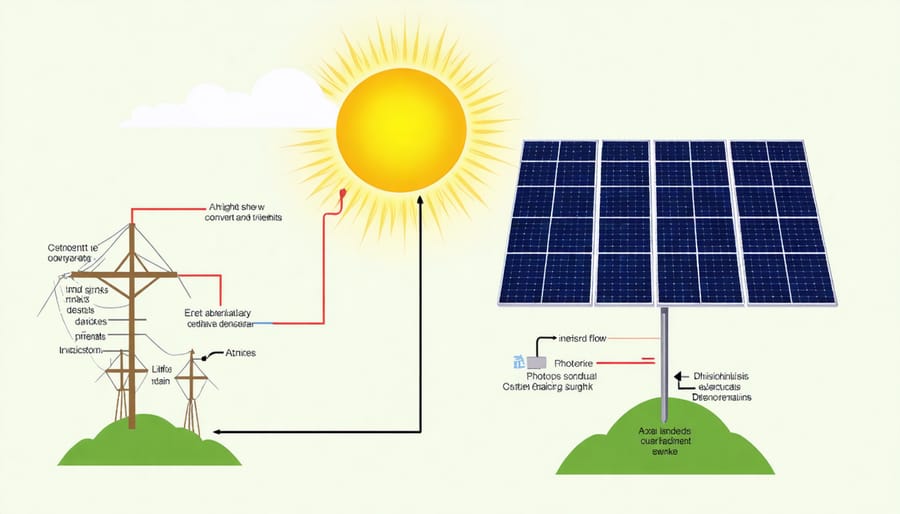
Several key factors significantly influence solar panel performance and overall system efficiency. Temperature plays a crucial role, with most photovoltaic cells experiencing a decrease in efficiency as temperatures rise above their rated operating conditions. For every degree Celsius increase above 25°C, efficiency typically drops by 0.3-0.5%.
Shading presents another critical challenge, as even partial shade on a single cell can disproportionately affect the entire panel’s output. Dust, dirt, and atmospheric pollution accumulation can reduce efficiency by 5-15%, highlighting the importance of regular maintenance. Geographic location and panel orientation also significantly impact performance, with optimal tilt angles varying by latitude.
Panel age and degradation contribute to efficiency losses, with most quality panels experiencing a 0.5-1% annual decline in performance. Weather conditions, including cloud cover and seasonal variations in sunlight intensity, directly affect energy conversion rates. Additionally, the quality of installation and system components, particularly inverters and wiring, can impact overall system efficiency by 3-7%.
Current Solar PV Technology Efficiencies
Monocrystalline vs. Multicrystalline Efficiency
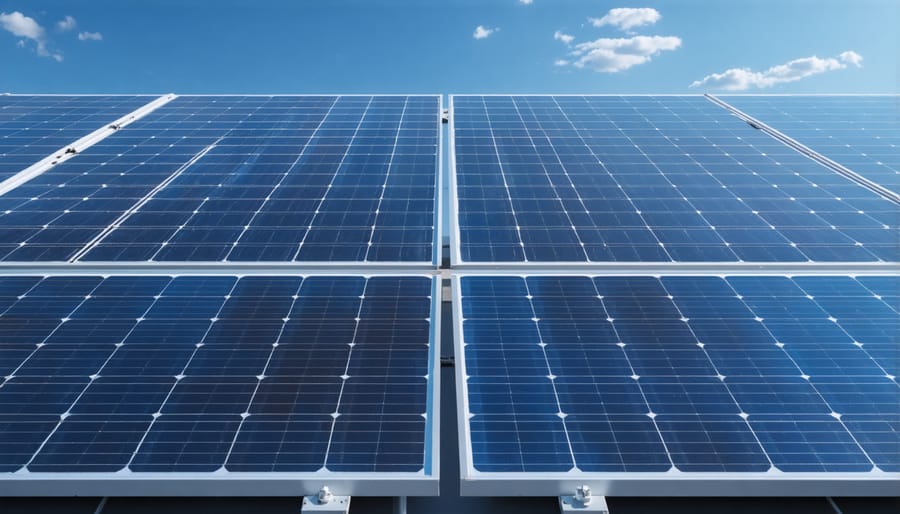
Monocrystalline and multicrystalline solar cells represent two distinct approaches to photovoltaic technology, each offering different efficiency levels. Monocrystalline cells, manufactured from single crystal silicon, typically achieve efficiency rates between 15-22% in commercial applications, with some premium models reaching up to 25%. This higher efficiency is attributed to their uniform molecular structure, which allows for better electron flow and superior performance in low-light conditions.
In contrast, multicrystalline (also known as polycrystalline) cells generally operate at efficiency rates of 13-17%. These cells are produced from multiple silicon crystals melted together, creating visible grain boundaries that slightly reduce their overall efficiency. However, multicrystalline technology has seen significant improvements in recent years, with advanced manufacturing processes narrowing the efficiency gap between the two technologies.
The efficiency difference becomes particularly notable in space-constrained installations where maximum power output per square meter is crucial. While monocrystalline panels require more precise manufacturing processes and command higher prices, their superior efficiency often justifies the investment in residential and commercial applications where space is limited. Multicrystalline panels, despite lower efficiency rates, remain competitive in large-scale installations where cost-per-watt takes precedence over space efficiency.
PERC Technology Advancements
PERC (Passivated Emitter and Rear Cell) technology represents a significant advancement in solar cell efficiency, offering substantial improvements over traditional solar cell designs. This innovative technology adds an additional dielectric passivation layer on the rear side of the solar cell, which reduces electron recombination and allows for better capture of light that passes through the cell.
The key efficiency enhancement of PERC technology comes from its ability to reflect unused light back through the solar cell, providing a second opportunity for energy generation. This design feature, combined with improved surface passivation, typically increases cell efficiency by 1-2% compared to standard cells, with some manufacturers achieving efficiency rates above 22% in mass production.
PERC modules demonstrate superior performance in real-world conditions, particularly in low-light situations and at higher temperatures. The technology’s enhanced rear-side passivation reduces electron recombination losses, resulting in better overall energy yield throughout the day. This translates to improved performance ratios and higher energy production per installed capacity.
Manufacturing processes for PERC cells have become increasingly streamlined, making them a cost-effective option for both residential and commercial installations. The technology’s proven reliability and durability, combined with its higher efficiency, has led to widespread adoption across the solar industry, making it the current standard for high-performance solar panels.
Maximizing Solar Panel Efficiency
Installation Optimization
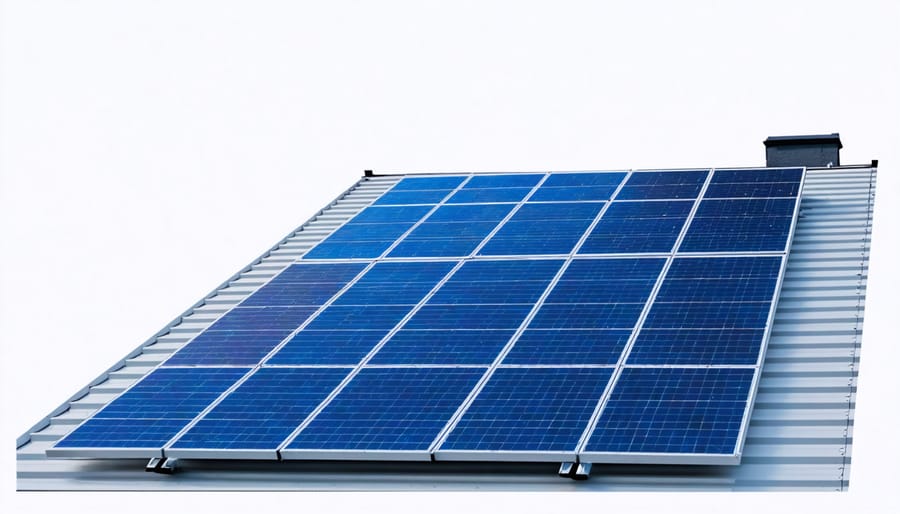
The optimization of solar panel installation plays a crucial role in maximizing energy generation efficiency. Proper placement and orientation can significantly impact system performance, often yielding 15-25% higher energy output compared to suboptimal installations.
Panel orientation should prioritize southern exposure in the Northern Hemisphere, with an optimal tilt angle typically equal to the installation site’s latitude. This arrangement ensures maximum solar radiation capture throughout the year. However, site-specific factors such as local weather patterns, shadowing effects, and seasonal variations may necessitate adjustments to these general guidelines.
Installation height and spacing between panels require careful consideration to minimize mutual shading and maximize airflow, which helps maintain optimal operating temperatures. Adequate ventilation beneath panels can reduce temperature-related efficiency losses by 3-5%.
Advanced mounting systems with tracking capabilities can increase energy yield by 25-35% compared to fixed installations. Single-axis trackers follow the sun’s daily east-to-west movement, while dual-axis systems also adjust for seasonal variations in the sun’s altitude.
The importance of proper wiring configuration cannot be overstated. Series and parallel connections must be optimized to minimize voltage drops and resistance losses. Professional installers should conduct detailed site surveys, considering factors such as:
– Local solar radiation patterns
– Structural integrity of mounting surfaces
– Potential shading from nearby structures or vegetation
– Local building codes and regulations
– Annual weather patterns and environmental conditions
Regular maintenance and cleaning schedules should be established during installation planning to ensure sustained system efficiency throughout the installation’s lifetime.
Maintenance and Performance Monitoring
Regular maintenance and performance monitoring are crucial for maintaining optimal solar energy efficiency. A well-maintained solar system can operate at peak efficiency for 25-30 years, while neglected systems may experience significant performance degradation.
Key maintenance practices include quarterly panel cleaning to remove dust, debris, and bird droppings that can reduce light absorption. In areas with heavy pollution or frequent dust storms, more frequent cleaning may be necessary. Professional inspection of electrical connections, mounting hardware, and inverter systems should be conducted annually to identify and address potential issues before they impact performance.
Performance monitoring systems play a vital role in maintaining efficiency. Modern solar installations incorporate sophisticated monitoring equipment that tracks power output, voltage levels, and overall system health in real-time. These systems can detect efficiency drops and alert operators to potential problems, enabling prompt intervention.
Data analysis from monitoring systems helps identify patterns in performance fluctuations, allowing for predictive maintenance scheduling. Key metrics to monitor include:
– Daily energy production
– Performance ratio
– Inverter efficiency
– Panel degradation rate
– System availability
Environmental factors affecting performance should be regularly assessed, including shade patterns from growing vegetation, new construction, or seasonal variations. Thermal imaging can identify hot spots or damaged cells that require attention.
Documentation of maintenance activities and performance data is essential for warranty purposes and system optimization. This historical data enables technicians to make informed decisions about system upgrades or component replacements, ensuring sustained efficiency throughout the system’s lifetime.
Future of Solar PV Efficiency
The future of solar photovoltaic efficiency holds tremendous promise, with researchers and manufacturers pursuing multiple pathways to enhance energy conversion rates. Current emerging solar technologies are pushing the boundaries of traditional efficiency limits, with several breakthrough developments on the horizon.
Perovskite solar cells represent one of the most significant advancements, demonstrating remarkable potential for higher efficiency rates while maintaining lower production costs. These materials have shown rapid efficiency improvements, rising from about 3% to over 25% in just a decade of research. When combined with traditional silicon in tandem cells, they’re projected to achieve efficiency rates exceeding 30% within the next five years.
Quantum dot solar cells are another promising innovation, offering the possibility of capturing a broader spectrum of solar energy. These microscopic semiconductors can be tuned to specific wavelengths of light, potentially increasing overall energy conversion efficiency. Researchers predict that quantum dot technology could achieve theoretical efficiency limits of up to 45% in the coming decades.
Multi-junction solar cells continue to evolve, with new materials and manufacturing techniques enabling better performance. These cells, which use multiple layers of photovoltaic materials to capture different parts of the solar spectrum, are expected to reach commercial efficiency rates of 40% or higher within the next decade.
Concentrated photovoltaic (CPV) systems are also advancing rapidly. By combining high-efficiency multi-junction cells with sophisticated tracking and concentrating systems, researchers anticipate achieving system-level efficiencies above 50% in laboratory settings within the next few years.
The integration of artificial intelligence and machine learning is revolutionizing solar cell design and optimization. These technologies enable rapid testing of new materials and configurations, accelerating the development cycle for higher-efficiency solar cells.
Several research institutions are exploring novel surface treatments and anti-reflection coatings that could boost efficiency by reducing energy losses from reflection and heat. These improvements, combined with advanced light-trapping structures, could add several percentage points to current efficiency ratings across all solar technologies.
As manufacturing processes become more refined and new materials enter commercial production, the cost-per-watt of high-efficiency solar cells is expected to decrease significantly, making advanced solar technology more accessible to the general market.
Solar photovoltaic efficiency has made remarkable strides over the past decades, with current commercial panels typically achieving 15-20% efficiency, while advanced laboratory cells have reached beyond 40%. These improvements stem from continuous technological innovations in cell design, materials science, and manufacturing processes. The industry’s progress demonstrates the increasing viability of solar energy as a primary power source.
Looking ahead, several promising developments suggest further efficiency improvements. Emerging technologies like perovskite solar cells, multi-junction devices, and enhanced light-capturing techniques show potential for pushing efficiency boundaries even higher. Research institutions and industry leaders continue to invest in breakthrough technologies that could revolutionize solar energy conversion.
However, efficiency isn’t solely about maximum theoretical performance. Practical considerations such as cost-effectiveness, durability, and real-world performance under varying conditions remain crucial factors. The industry’s focus has shifted toward optimizing the balance between efficiency and economic viability, ensuring solar technology becomes increasingly accessible and practical for widespread adoption.
As global energy demands grow and climate concerns intensify, the role of solar energy becomes increasingly vital. With ongoing research, technological advancement, and improving manufacturing processes, solar efficiency will continue to enhance, making photovoltaic technology an increasingly attractive and sustainable energy solution for future generations. The combination of rising efficiency rates and declining production costs positions solar energy as a cornerstone of the global renewable energy transition.