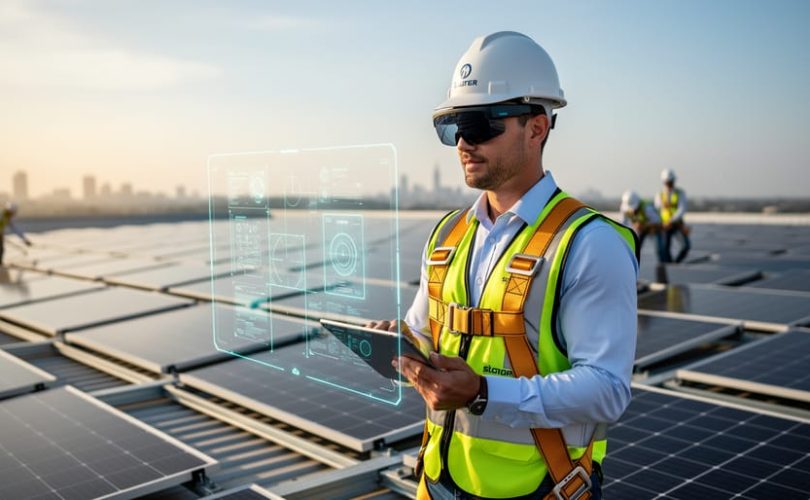
Construction errors cost the solar industry billions annually, yet emerging augmented reality technology is transforming how photovoltaic professionals monitor installations, document progress, and prevent costly mistakes before they escalate. AR overlays digital information onto physical construction environments through specialized headsets or mobile devices, enabling real-time comparison between design specifications and actual site conditions with unprecedented precision.
For solar project managers overseeing complex installations across distributed sites, AR technology addresses three critical challenges: maintaining quality control across multiple work zones simultaneously, creating comprehensive documentation that satisfies regulatory requirements and client expectations, and identifying installation discrepancies before they compromise system performance. Traditional site monitoring relies on manual measurements, static blueprints, and periodic inspections—methods that introduce human error and delay problem detection until remediation becomes expensive.
The integration of augmented reality into solar construction workflows represents more than incremental improvement. This technology fundamentally reimagines how teams visualize panel arrays before installation, verify mounting angles against engineering specifications during construction, and generate photographic documentation embedded with geospatial and temporal metadata for compliance reporting. Early adopters report 30-40% reductions in rework costs and significant decreases in project timeline delays attributable to specification mismatches.
Understanding AR’s practical applications requires examining specific use cases within photovoltaic construction contexts: from pre-installation site assessments that overlay proposed arrays onto existing terrain, to quality assurance processes that highlight deviation between installed components and approved designs. This technology bridges the gap between engineering intent and field execution, creating accountability systems that benefit contractors, developers, and ultimately system owners expecting maximum energy production from their investments.
The Construction Monitoring Challenge in Solar PV Projects
Multi-Site Coordination Complexities
Managing augmented reality implementation across multiple solar construction sites presents significant logistical obstacles that require strategic planning and resource allocation. Site managers must coordinate AR device deployment, ensure consistent connectivity infrastructure, and maintain standardized documentation protocols across geographically dispersed locations. Each installation site may present unique environmental conditions affecting AR functionality, from varying lighting conditions that impact marker recognition to remote locations with limited cellular connectivity for cloud-based data synchronization.
The complexity multiplies when project teams need real-time access to shared documentation and progress updates across multiple sites simultaneously. Establishing unified training protocols becomes critical, as inconsistent AR usage patterns can undermine data quality and documentation standardization. Organizations must invest in centralized project management platforms that aggregate AR-captured data from all locations, enabling comprehensive oversight while following solar installation best practices.
Additionally, coordinating equipment maintenance, software updates, and technical support across multiple sites demands dedicated IT resources and clear communication channels. Research collaboration with universities has shown that implementing phased AR rollouts rather than simultaneous multi-site deployments reduces operational disruption and allows for iterative refinement of coordination strategies.
Documentation and Compliance Requirements
Solar construction projects require comprehensive documentation to satisfy multiple stakeholder requirements, and augmented reality technology significantly streamlines this demanding process. AR-enabled devices automatically capture time-stamped photographic and video evidence throughout installation phases, creating an immutable digital record that satisfies regulatory compliance mandates. These systems document critical milestones including foundation preparation, racking assembly, module installation, and electrical connections, ensuring adherence to local building codes and National Electrical Code standards.
Quality assurance records benefit substantially from AR integration, as technicians can overlay inspection checklists directly onto live equipment views, systematically verifying torque specifications, connection integrity, and proper grounding procedures. The technology generates detailed compliance reports that include geospatial data, installation parameters, and as-built specifications, reducing documentation time by up to 60 percent compared to traditional methods.
For client reporting purposes, AR platforms compile visual progress updates and performance verification data into professional deliverables that enhance transparency and build confidence. Academic researchers collaborating with industry professionals have documented that AR-enhanced documentation reduces post-installation disputes by providing irrefutable evidence of proper installation procedures, while simultaneously creating valuable training materials for aspiring photovoltaic professionals seeking to understand real-world construction standards and best practices.
What Augmented Reality Brings to Solar Construction Sites
AR Hardware and Software Ecosystems
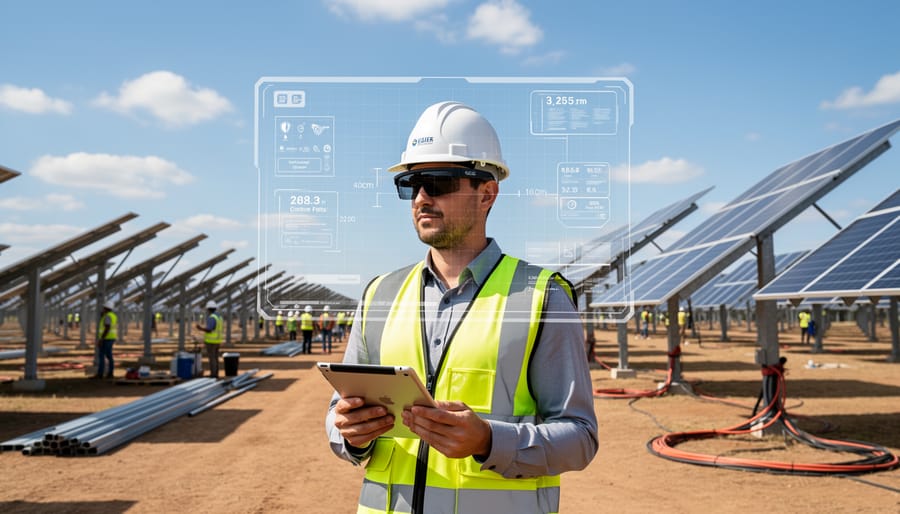
The augmented reality hardware and software ecosystem for construction applications has matured significantly, offering construction professionals multiple platforms tailored to field conditions and project requirements. Smart glasses represent the most immersive option, with devices like Microsoft HoloLens 2, RealWear Navigator, and Trimble XR10 designed specifically for industrial environments. These hands-free solutions enable workers to overlay digital information directly onto physical structures while maintaining mobility and safety compliance on active construction sites.
Tablets and smartphones provide more accessible entry points for AR implementation, leveraging existing devices many teams already possess. iPad Pro models with LiDAR scanning capabilities and Android tablets running construction-specific AR applications offer robust functionality for site documentation and progress tracking without requiring specialized hardware investments.
The software landscape includes platforms specifically engineered for construction workflows. Solutions like Trimble Connect, Autodesk Construction Cloud with BIM 360, and GAMMA AR integrate seamlessly with existing project management systems and building information modeling databases. These platforms enable real-time collaboration between field teams and office personnel, facilitating immediate design verification and issue resolution.
For photovoltaic installations, certain platforms now incorporate solar-specific features including array layout visualization, electrical routing overlays, and mounting system verification tools. This specialization ensures AR technology addresses the unique technical requirements of renewable energy construction projects, supporting precision installation and quality assurance protocols.
Integration with Solar Design and Planning Systems
Augmented reality platforms achieve maximum effectiveness when integrated seamlessly with existing solar project management ecosystems. Modern AR applications connect directly with Building Information Modeling (BIM) systems, allowing construction teams to visualize three-dimensional design models overlaid onto physical installation sites in real-time. This integration enables workers to verify component placement, identify spatial conflicts, and ensure alignment with approved specifications without referencing separate documentation.
The connection between AR tools and solar design software creates particularly valuable workflows for photovoltaic installations. Design parameters, including panel orientation angles, inverter locations, and electrical routing plans, transfer automatically from planning platforms to AR visualization systems. Construction personnel can then access this information through mobile devices or AR headsets, reducing interpretation errors and accelerating installation processes.
Integration with project management platforms further enhances documentation capabilities. Progress updates captured through AR applications synchronize automatically with scheduling software, generating real-time completion metrics and alerting stakeholders to potential delays. Quality control checkpoints documented via AR photo and video capture link directly to compliance databases, creating comprehensive audit trails. This interconnected approach eliminates redundant data entry, reduces administrative overhead, and ensures all team members access current project information regardless of their location or role within the construction workflow.
Real-Time Site Monitoring Through AR Visualization
Overlay Comparison: Design vs. As-Built
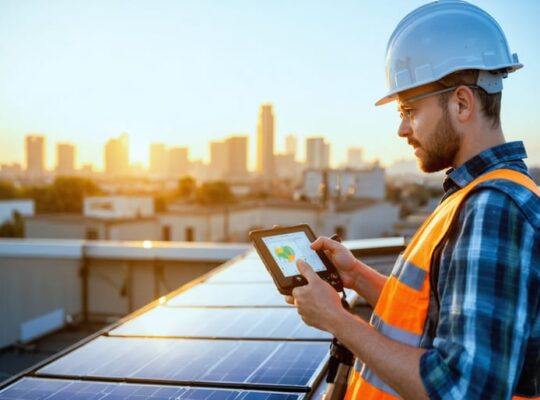
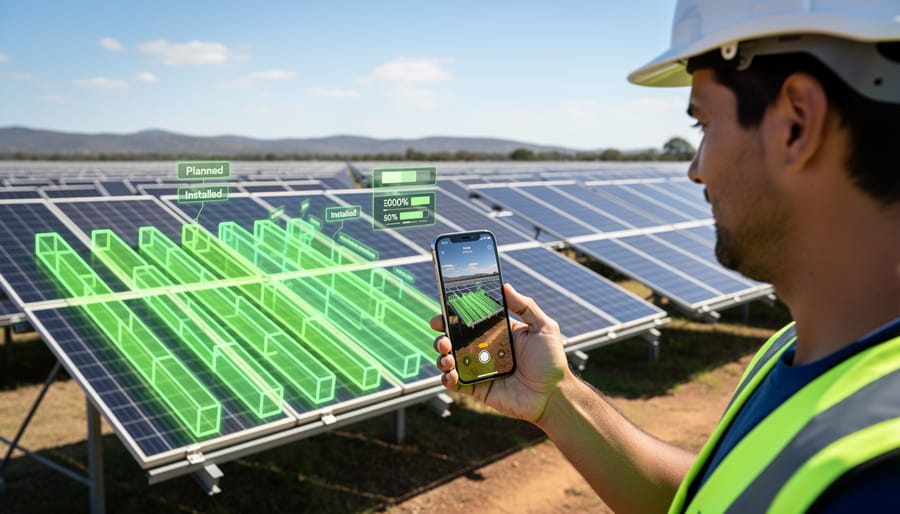
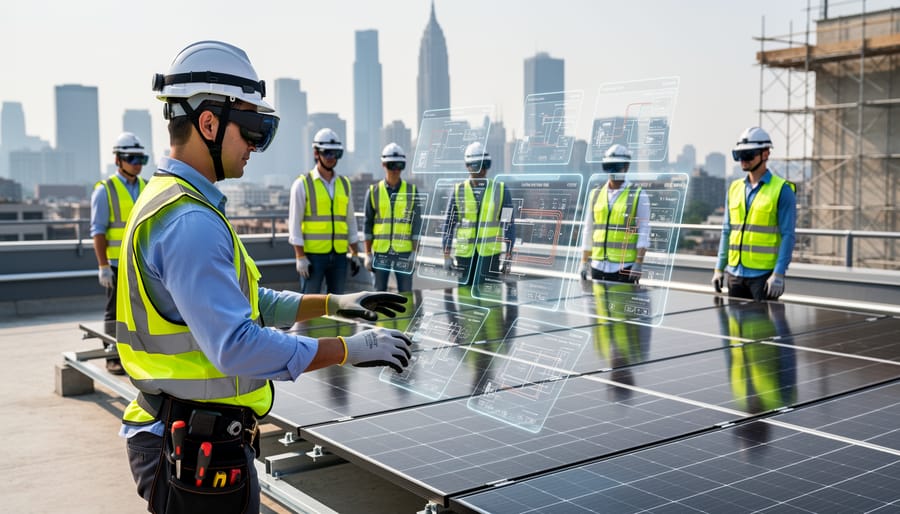
Augmented reality overlay comparison represents one of the most powerful applications for construction site monitoring in solar installations. This technology enables real-time verification by superimposing digital design specifications directly onto the physical environment through AR-enabled devices such as tablets or smart glasses. Site supervisors can instantly compare planned solar array layouts against actual panel placement, identifying discrepancies that might otherwise go unnoticed until later project phases.
The overlay function works by anchoring CAD models or BIM data to physical reference points on-site. As installers position mounting systems and panels, project managers can view a transparent digital layer showing the intended configuration alongside the emerging physical installation. This immediate visual feedback allows teams to detect placement errors, verify mounting angles, and confirm spacing requirements before proceeding to subsequent installation phases.
Early error detection through AR comparison substantially reduces rework costs and project delays. Research collaboration between construction technology firms and academic institutions has demonstrated that AR-assisted verification catches up to 70% more installation errors during active construction compared to traditional inspection methods. This capability proves particularly valuable in large-scale solar farms where small deviations compound across hundreds of panels, potentially affecting overall system performance and energy output calculations.
Progress Tracking and Milestone Verification
Augmented reality systems enable real-time progress visualization by overlaying planned construction timelines against actual site conditions, allowing project managers to instantly identify schedule deviations. For photovoltaic installations, AR applications track panel mounting completion, electrical connections, and inverter configurations with percentage-based metrics that update automatically as work advances. These systems capture photographic evidence at predetermined milestones, creating immutable digital records that satisfy regulatory requirements and stakeholder reporting needs.
Advanced AR platforms integrate with smart solar monitoring infrastructure to verify that installed components match specifications before system activation. Automated milestone documentation eliminates manual reporting errors while providing construction teams with immediate feedback on quality benchmarks. University research collaborations have demonstrated that AR-enabled tracking reduces documentation time by approximately 40 percent compared to traditional methods, while improving accuracy in progress assessments. Educational programs now incorporate these AR tracking methodologies, preparing aspiring professionals to leverage visual analytics for enhanced project oversight and stakeholder communication throughout solar installation lifecycles.
Enhanced Documentation Capabilities with AR
Spatial Photo and Video Capture
Augmented reality transforms standard photography into intelligent documentation systems that capture far more than visual data. When construction personnel photograph solar panel installations, inverter connections, or mounting assemblies through AR-enabled devices, the system automatically embeds precise GPS coordinates, compass orientation, elevation data, and timestamps into each image. This georeferenced documentation creates a comprehensive digital record that eliminates guesswork about photo locations or contexts during later review stages.
The technology proves particularly valuable for large-scale photovoltaic installations where thousands of components require systematic documentation. AR tagging enables project managers and quality assurance teams to navigate directly to photographed locations, verify installation standards against captured images, and maintain regulatory compliance records. Universities collaborating on solar research projects utilize these capabilities to document experimental installations with scientific precision. The spatial metadata also facilitates seamless integration with building information modeling systems, enabling automated progress tracking and issue resolution workflows that reduce documentation time by up to sixty percent compared to manual cataloging methods.
Automated As-Built Documentation
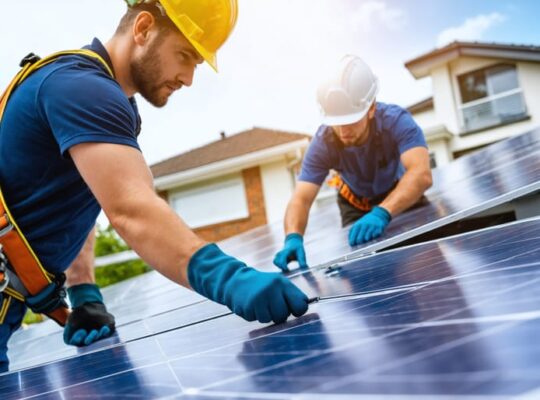
Augmented reality systems revolutionize project documentation by automatically capturing as-built records during the construction process. Unlike traditional methods that require manual measurements and photographs after installation, AR-enabled devices continuously document component placements, orientations, and specifications in real-time. When workers wearing AR headsets or using tablet devices install photovoltaic modules, mounting systems, or electrical connections, the technology simultaneously records precise spatial data and timestamps.
This automated approach generates comprehensive digital records that accurately reflect actual installation conditions rather than theoretical plans. The system integrates data from multiple sources including BIM models, IoT sensors, and photogrammetry to create detailed three-dimensional documentation. For solar installations, this capability proves particularly valuable when documenting array configurations, wire routing, and equipment positioning—information essential for future maintenance operations and system optimization.
Research collaborations between technology providers and universities have demonstrated that automated as-built documentation reduces documentation time by up to seventy percent while significantly improving accuracy. These digital records seamlessly integrate with facility management systems, providing long-term value for asset management and supporting warranty validation throughout the system’s operational lifespan.
Defect and Issue Tracking
Augmented reality transforms defect identification into a streamlined, digitally-documented process that significantly reduces construction errors and rework costs. AR-enabled devices allow site inspectors to overlay digital annotations directly onto physical structures, marking issues such as misaligned solar panel arrays, improper mounting installations, or electrical connection discrepancies in real-time. These annotations automatically capture geospatial coordinates, timestamps, and photographic evidence, creating comprehensive defect records that eliminate ambiguity in communication.
The technology enables immediate assignment of identified issues to responsible contractors or subcontractors through integrated project management platforms. Team members receive notifications with precise location data and visual context, ensuring rapid response and remediation. Progress tracking occurs through the same AR interface, where supervisors verify completed repairs by comparing current conditions against original defect documentation. This closed-loop system maintains accountability throughout the correction process, generating audit trails that satisfy quality assurance requirements and provide valuable data for continuous improvement initiatives in photovoltaic installation practices.
Remote Collaboration and Expert Consultation
Virtual Site Visits and Remote Inspections
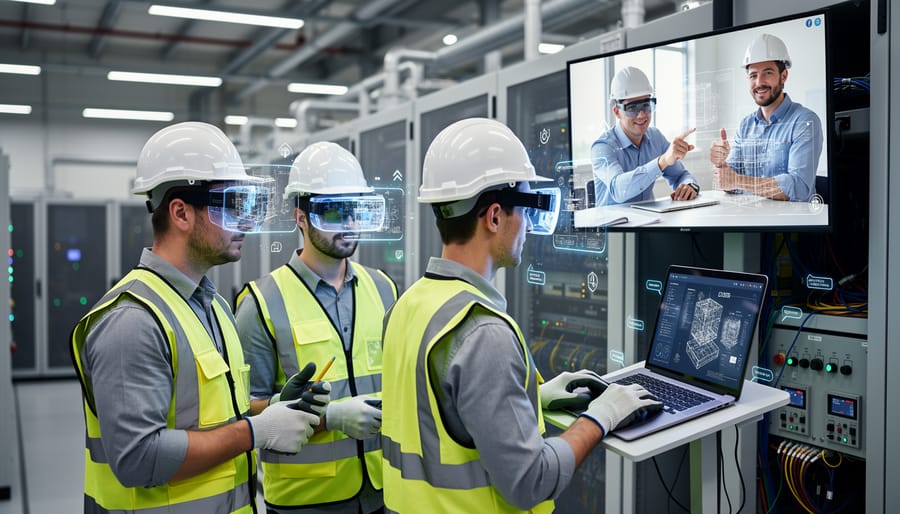
Augmented reality transforms how stakeholders engage with solar construction projects by enabling comprehensive remote assessments without physical presence on-site. Through AR-enabled devices such as tablets and smart glasses, clients can conduct real-time virtual walkthroughs, examining installation progress, panel alignment, and mounting configurations from any location. This technology proves particularly valuable for geographically dispersed project teams and international stakeholders who require frequent oversight.
Inspectors utilize AR applications to overlay design specifications onto live video feeds, instantly identifying deviations from engineering plans and verifying compliance with safety standards. The technology facilitates detailed documentation through annotated imagery and measurements, creating permanent records that satisfy regulatory requirements. Remote inspection capabilities significantly reduce travel expenses and project delays while maintaining rigorous quality control standards.
Educational institutions collaborating with solar industry leaders increasingly incorporate AR-based virtual site assessment into training programs, preparing aspiring photovoltaic professionals for technology-driven project management roles. These immersive experiences provide students with practical exposure to construction monitoring scenarios, bridging the gap between theoretical knowledge and field application while advancing workforce development in the renewable energy sector.
Real-Time Expert Guidance
Augmented reality transforms construction site support by enabling real-time collaboration between field technicians and remote subject matter experts. Through AR-enabled devices, on-site personnel can share their precise viewpoint with engineers located at headquarters or university research centers, creating a synchronized visual environment where both parties observe identical installation conditions. Remote experts can overlay digital annotations, measurements, and corrective instructions directly onto the technician’s field of view, eliminating miscommunication inherent in verbal descriptions or static photographs.
This capability proves particularly valuable during photovoltaic array installations, where electrical configurations and mounting specifications require precise execution. When technicians encounter unexpected structural conditions or equipment discrepancies, they can instantly consult with engineering specialists who guide them through solutions without costly site visits or work stoppages. The shared AR interface allows experts to highlight specific components, demonstrate proper techniques through holographic overlays, and verify completed work against digital specifications. This collaborative approach reduces installation errors, accelerates problem resolution, and provides continuous knowledge transfer from experienced professionals to emerging workforce members—supporting both project efficiency and professional development initiatives.
Safety and Training Applications
Hazard Visualization and Safety Compliance
Augmented reality technology significantly enhances construction site safety by providing real-time visual indicators of potential hazards specific to photovoltaic installations. AR-enabled devices overlay digital information onto the physical environment, instantly highlighting high-voltage electrical components, underground cable routes, and energized equipment that pose safety risks to workers. These systems can display exclusion zones around active electrical panels and inverters, ensuring personnel maintain appropriate clearances during installation and maintenance activities.
The technology integrates with building information modeling data and safety protocols to create dynamic hazard maps that update as construction progresses. Workers viewing the site through AR headsets or tablets see color-coded warnings indicating arc flash boundaries, fall hazard zones, and areas requiring personal protective equipment. This visual guidance proves particularly valuable for training new technicians, as it reinforces safety compliance requirements in context rather than through abstract classroom instruction.
Furthermore, AR systems document safety inspections by capturing timestamped photographic evidence of hazard mitigation measures and proper installation techniques. This creates verifiable compliance records for regulatory audits while supporting continuous improvement initiatives through data-driven safety analysis.
On-Site Training and Skill Development
Augmented reality transforms construction site training by overlaying digital instructions directly onto physical infrastructure, enabling workers to learn in context rather than traditional classroom settings. For photovoltaic installations, AR headsets guide technicians through complex module mounting sequences, electrical connections, and safety protocols while they perform actual tasks. This hands-on approach significantly reduces onboarding time and minimizes costly errors during critical installation phases.
Universities partnering with industry leaders increasingly incorporate AR training modules into renewable energy curricula, preparing students for solar installation careers through immersive simulations before site deployment. These innovative training methods allow trainees to visualize underground electrical pathways, identify optimal panel orientations, and practice emergency response procedures without disrupting active projects. By bridging theoretical knowledge with practical application, AR-enhanced training accelerates skill development while maintaining rigorous safety standards essential to professional photovoltaic construction environments.
Implementation Considerations for Solar Installation Companies
Technology Selection and Infrastructure Requirements
Selecting appropriate AR technology requires careful evaluation of platform compatibility, deployment scalability, and integration capabilities with existing construction management systems. When choosing AR platforms for solar installation projects, prioritize solutions that support both marker-based and markerless tracking, as construction environments demand flexibility in anchoring digital content to physical locations. Cloud-based platforms offer advantages for multi-site operations, enabling real-time synchronization of documentation across distributed teams.
Hardware requirements vary based on application complexity. Head-mounted displays like Microsoft HoloLens provide hands-free operation ideal for field technicians, while tablet-based solutions offer cost-effective alternatives for documentation review and client presentations. Ensure devices feature ruggedized construction ratings, extended battery life, and sufficient processing power for rendering three-dimensional solar array models overlaid on physical sites.
Infrastructure considerations include robust wireless connectivity across construction zones, secure cloud storage for project data, and compatibility with Building Information Modeling software commonly used in photovoltaic installations. Educational institutions collaborating with industry partners can provide valuable insights into emerging AR standards and interoperability protocols. Establish data governance protocols addressing privacy, version control, and regulatory compliance requirements specific to renewable energy projects, ensuring seamless integration with quality assurance workflows and documentation standards mandated by utility interconnection agreements.
Training and Change Management
Successful AR implementation in photovoltaic construction requires comprehensive training programs that address both technical proficiency and workflow adaptation. Field teams must develop competencies in AR device operation, digital interface navigation, and real-time data interpretation to maximize technology benefits. Organizations should establish structured onboarding protocols that include hands-on simulation exercises, allowing personnel to practice overlaying design specifications onto physical infrastructure before deployment on active sites.
Effective change management strategies involve early stakeholder engagement and transparent communication about AR’s role in enhancing rather than replacing human expertise. Construction managers should designate AR champions within teams who can provide peer support and troubleshoot common challenges during the transition period. Partnerships with universities and technical training institutions can facilitate knowledge transfer through certificated programs specifically designed for solar industry applications.
Resistance to adoption often stems from concerns about learning curves and productivity disruptions. Addressing these apprehensions requires demonstrating tangible value through pilot projects that showcase error reduction and documentation efficiency gains. Regular feedback sessions enable continuous refinement of AR workflows, ensuring the technology aligns with actual field conditions and team preferences. Investment in ongoing professional development, including refresher courses and advanced feature training, sustains long-term adoption success and positions organizations at the forefront of construction innovation.
Future Developments in AR for Solar Construction
The augmented reality landscape for solar construction is poised for transformative advancement as emerging technologies converge to create increasingly sophisticated monitoring and documentation capabilities. Integration with artificial intelligence represents the most significant development on the horizon, enabling automated quality inspection protocols that can identify installation defects, misaligned modules, and structural irregularities in real time without human intervention.
Machine learning algorithms are being developed to analyze AR-captured data and compare installations against design specifications with unprecedented accuracy. These systems will flag deviations instantly, allowing construction teams to address issues before they compound into costly rework. This AI-enhanced inspection capability promises to reduce quality control timelines by up to 60 percent while improving detection rates for subtle installation errors that human inspectors might overlook.
Enhanced data analytics will transform how project stakeholders interpret construction progress. Future AR platforms will aggregate information from multiple sources, generating predictive insights about project timelines, resource allocation, and potential bottlenecks. This analytical depth supports more informed decision-making throughout the construction lifecycle.
The integration of AR technology with drone surveying systems represents another frontier, combining aerial data capture with ground-level AR visualization. Drones equipped with photogrammetry capabilities will create comprehensive site models that AR systems can overlay with design information, enabling simultaneous monitoring of large-scale installations across multiple perspectives.
Perhaps most revolutionary is the convergence of AR with digital twin technology. These virtual replicas of physical solar installations will incorporate real-time operational data, maintenance histories, and performance metrics. Construction teams using AR headsets will access complete facility information throughout the building process, establishing seamless transitions from construction to operations. Universities collaborating on photovoltaic research are already exploring these applications, with several pilot programs demonstrating promising results in educational and commercial settings.
Augmented reality technology represents a transformative solution to longstanding challenges in solar construction site monitoring and documentation. By overlaying digital information onto physical environments, AR addresses critical pain points including design verification accuracy, real-time quality control, enhanced stakeholder communication, and comprehensive project documentation. The technology’s ability to reduce costly errors, accelerate installation timelines, and improve collaboration among distributed teams positions it as an essential tool for advancing professional practices in the photovoltaic industry.
For aspiring photovoltaic professionals and industry stakeholders, understanding AR applications is increasingly important as the technology transitions from experimental to standard practice. Implementation requires careful consideration of hardware selection, software integration, team training, and cybersecurity protocols, yet the return on investment through improved efficiency and reduced rework justifies the initial learning curve. As solar installations grow more complex and precision requirements become more stringent, AR provides the visualization and verification capabilities necessary to maintain competitive advantage.
This technological advancement aligns directly with Mose Solar’s commitment to innovation and industry education. Through partnerships with universities and comprehensive educational program offerings, fostering knowledge transfer about emerging technologies like AR ensures that the next generation of renewable energy professionals possesses the skills and understanding to implement these tools effectively. As the solar industry continues its rapid expansion, embracing augmented reality for construction monitoring represents not merely an operational enhancement but a strategic investment in professional development and sustainable industry growth.