
International trade barriers and policy shifts are fundamentally reshaping global solar PV markets, creating complex challenges for industry stakeholders worldwide. As supply chains become increasingly interconnected and geopolitical tensions rise, five critical trade issues have emerged as decisive factors influencing market dynamics, investment decisions, and industry growth trajectories.
From escalating tariff disputes between major manufacturing hubs to evolving technical standards and certification requirements, these challenges demand strategic responses from industry players at every level. The interplay between domestic manufacturing incentives, international trade agreements, and environmental policies has created a multilayered landscape that significantly impacts project economics and market access.
Understanding these trade issues is crucial for stakeholders navigating the rapidly evolving solar energy sector, whether developing new manufacturing facilities, planning large-scale installations, or formulating policy responses. This analysis examines the most pressing international trade challenges facing the industry today, their implications for market participants, and potential strategies for adaptation and mitigation.
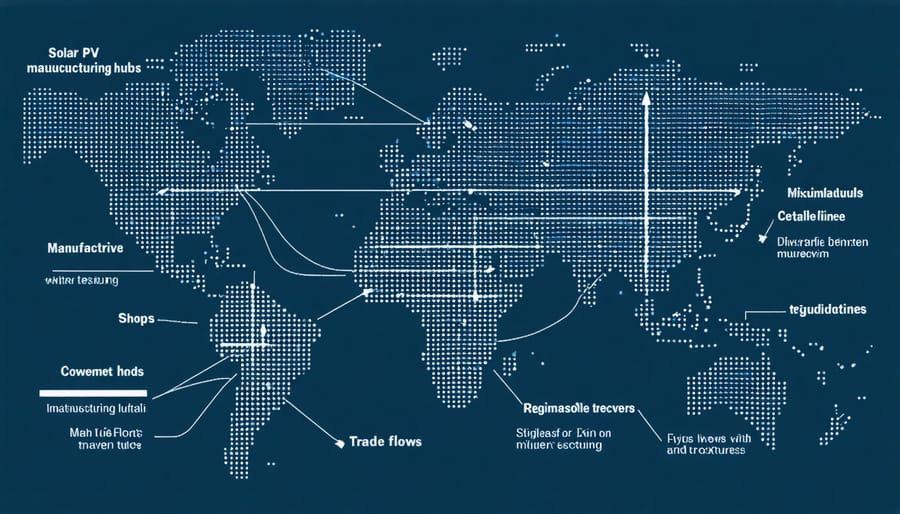
Tariffs and Their Impact on Solar PV Market Access
Section 201 Solar Tariffs
Section 201 solar tariffs, implemented in 2018, represent a significant trade measure affecting the global solar industry. These tariffs, initially set at 30% with a 5% annual decrease, have substantially influenced market dynamics within the solar photovoltaic sector.
The policy primarily targets imported crystalline silicon photovoltaic cells and modules, with the stated goal of protecting domestic manufacturers. However, the tariffs have generated mixed results across the industry. While some U.S. manufacturing facilities have increased production capacity, the higher costs have impacted project development timelines and installation costs.
Analysis of market data indicates that these tariffs have led to a 16% increase in solar panel prices compared to pre-tariff levels, affecting both utility-scale and residential installations. The policy includes specific exemptions for certain products and countries, particularly developing nations, which has created new supply chain patterns and procurement strategies.
Recent modifications to the tariff structure, including the bifacial solar panel exemption and quota adjustments, have introduced additional complexity to market operations. Industry stakeholders must carefully navigate these regulations while maintaining competitive pricing and ensuring project viability. The policy’s impact extends beyond U.S. borders, influencing global manufacturing decisions and international trade relationships in the renewable energy sector.
Regional Trade Agreement Implications
Regional trade agreements (RTAs) significantly influence market access and trade dynamics in the solar PV industry. These agreements create preferential trading conditions between participating nations, often reducing or eliminating tariffs and establishing standardized certification requirements for solar products.
The European Union’s Solar Alliance and the Asia-Pacific Economic Cooperation (APEC) renewable energy initiatives demonstrate how RTAs can facilitate technology transfer and market expansion. These arrangements typically include provisions for intellectual property protection, technical standards harmonization, and dispute resolution mechanisms specific to renewable energy technologies.
However, RTAs can also create complex challenges. Different agreements may have conflicting requirements, leading to a “spaghetti bowl” effect where companies must navigate multiple regulatory frameworks. This complexity particularly affects small and medium-sized solar manufacturers attempting to enter new markets.
Key implications include preferential duty rates for member countries, streamlined customs procedures, and mutual recognition of product certifications. For instance, the ASEAN Free Trade Area has reduced import duties on solar components among member states, stimulating regional market growth.
To maximize benefits from RTAs, solar PV companies must strategically plan their manufacturing locations and supply chains. Understanding these agreements’ requirements and limitations is crucial for market entry decisions and long-term business sustainability. Companies should also monitor ongoing trade negotiations, as new agreements can create opportunities or challenges for existing market strategies.
Supply Chain Disruptions and Dependencies

Raw Material Access
Access to critical raw materials remains a significant concern in international trade, particularly affecting the solar photovoltaic industry. The increasing demand for rare earth elements, silicon, and other essential components has led to global supply chain challenges that impact manufacturing capabilities worldwide. Geographic concentration of these materials in specific regions creates dependency relationships that can affect market stability and pricing.
Key materials like polysilicon, silver, and copper face supply constraints due to limited mining operations, processing facilities, and export restrictions from dominant producing countries. These limitations often result in price volatility and delivery uncertainties, affecting production schedules and cost structures across the industry. Additionally, environmental and social concerns surrounding raw material extraction have led to increased scrutiny and regulatory requirements, further complicating access to these vital resources.
To address these challenges, many companies are investing in alternative material research, developing recycling programs, and establishing strategic partnerships with suppliers. Governments are also implementing policies to secure domestic supply chains and reduce dependency on single-source regions, though these efforts often require significant time and capital investment to yield results.
Manufacturing Concentration Risks
The global solar PV industry faces significant vulnerabilities due to concentrated manufacturing capabilities in specific geographic regions. Currently, Asia, particularly China, dominates the production of key solar components, including solar cells, modules, and essential raw materials. This concentration creates substantial supply chain risks and potential bottlenecks that can affect the entire industry.
Recent global events, including trade disputes and the COVID-19 pandemic, have highlighted the dangers of over-reliance on single-region manufacturing. When production disruptions occur in dominant manufacturing regions, the ripple effects impact project developments and installations worldwide, leading to increased costs and delayed timelines.
To address these risks, industry stakeholders are actively pursuing manufacturing diversification strategies. Countries like India, Vietnam, and Mexico are emerging as alternative production hubs, while the United States and European Union are implementing policies to encourage domestic manufacturing capacity. These efforts aim to create more resilient supply chains and reduce dependency on single-source regions.
However, establishing competitive manufacturing capabilities in new locations requires significant investment in infrastructure, workforce training, and technology transfer. The transition toward more distributed manufacturing must balance cost considerations with supply chain security to ensure sustainable industry growth.
Technical Standards and Certification Requirements

International Certification Challenges
International certification requirements present significant challenges for solar PV manufacturers and distributors seeking to enter new markets. Different regions maintain distinct certification standards, testing protocols, and compliance requirements, creating a complex web of regulations that companies must navigate. For instance, the IEC certification widely accepted in Europe may not suffice for market entry in North America, where UL certification is predominant.
The certification process often involves extensive laboratory testing, documentation submission, and facility inspections, which can take several months to complete. These requirements significantly increase time-to-market and operational costs, particularly challenging for smaller manufacturers and emerging market players. The financial burden of multiple certifications can reach hundreds of thousands of dollars per product line.
Adding to these challenges, certification standards frequently evolve with technological advancements and changing safety requirements. Companies must continuously update their certifications and modify products to maintain compliance. The lack of harmonized international standards creates redundant testing requirements, where similar tests must be repeated for different markets.
Some countries also require in-country testing, even when products hold certifications from internationally recognized laboratories, further complicating market access and increasing costs. This fragmentation in certification processes remains a significant barrier to efficient international trade in the solar PV sector.
Harmonization Efforts
Global efforts to harmonize trade requirements and standards in the solar PV industry have gained significant momentum in recent years. International organizations, including the International Electrotechnical Commission (IEC) and the International Organization for Standardization (ISO), are leading initiatives to establish unified technical specifications and certification processes.
The International Laboratory Accreditation Cooperation (ILAC) plays a crucial role in promoting mutual recognition agreements between testing facilities worldwide, reducing duplicate testing requirements and associated costs. Similarly, the Solar Protocol aims to standardize quality assurance protocols across major markets, facilitating smoother international trade flows.
Regional harmonization efforts are also noteworthy, with the European Union’s RED II directive setting comprehensive sustainability criteria that influence global supply chains. The Asia-Pacific Economic Cooperation (APEC) has implemented the Solar Standards and Certification Initiative, working to align testing requirements across member economies.
Despite these advances, challenges remain in achieving full harmonization. Different national priorities, existing regulatory frameworks, and varying technical capabilities among countries continue to pose obstacles. Industry stakeholders are actively participating in working groups and technical committees to bridge these gaps, focusing on developing consensus-based standards that balance innovation, safety, and market access requirements.
Intellectual Property Rights Protection
Patent Disputes
Patent disputes represent a significant challenge in international solar PV trade, particularly between major manufacturing nations and emerging markets. The most prominent conflicts often center around intellectual property rights for critical technologies, including cell architecture designs, manufacturing processes, and advanced materials.
Notable cases include the long-standing disputes between Chinese and European manufacturers over polysilicon processing techniques and anti-reflective coating technologies. These conflicts have led to multiple World Trade Organization (WTO) complaints and bilateral negotiations, resulting in significant market uncertainties and price fluctuations.
Recent resolution mechanisms have included cross-licensing agreements and technology-sharing partnerships between competing firms. The establishment of international patent pools has emerged as a promising solution, allowing companies to access essential technologies while ensuring fair compensation for innovations.
The resolution framework developed by the International Renewable Energy Agency (IRENA) has helped standardize dispute settlement procedures. This framework emphasizes mediation before litigation and promotes transparent technology transfer agreements. Additionally, regional patent offices have implemented expedited examination procedures for green technologies, facilitating faster resolution of intellectual property conflicts.
Moving forward, industry stakeholders are advocating for more harmonized international patent standards and simplified licensing procedures to reduce trade friction and accelerate solar technology adoption globally.
Technology Transfer Challenges
Technology transfer in international trade presents significant challenges, particularly in the solar PV industry where intellectual property protection and competitive advantages are crucial. Developing nations often face barriers when accessing advanced solar technologies, while developed countries express concerns about protecting their innovations and maintaining market leadership.
Key obstacles include restrictive licensing agreements, complex patent regulations, and limited technical expertise in recipient countries. Companies must navigate varying international standards, certification requirements, and local manufacturing capabilities when transferring technology across borders. This complexity can significantly impact project timelines and implementation costs.
To address these challenges, several solutions have emerged. International cooperation frameworks facilitate knowledge sharing while protecting intellectual property rights. Technical assistance programs help bridge the expertise gap, enabling smoother technology adoption. Additionally, joint ventures between established manufacturers and local partners create sustainable pathways for technology transfer.
Successful technology transfer requires careful consideration of local market conditions, technical capabilities, and regulatory frameworks. Organizations must develop comprehensive strategies that balance protection of intellectual property with the need for global solar PV deployment. This includes establishing clear technology transfer agreements, providing adequate training programs, and ensuring ongoing technical support for sustainable implementation.
Local Content Requirements
Local content requirements (LCRs) represent significant trade policy measures implemented by governments to promote domestic manufacturing and economic development within their borders. These policies typically mandate that a certain percentage of components, materials, or production processes must originate from domestic sources. In the solar PV industry, LCRs have become increasingly prevalent as nations seek to develop their manufacturing capabilities and create local jobs.
Countries implementing LCRs often justify these measures as necessary steps to build domestic industrial capacity and reduce dependence on foreign suppliers. However, these requirements can create significant barriers to international trade and market access. For manufacturers, compliance with varying local content requirements across different markets increases production costs and complicates supply chain management.
The impact of LCRs extends beyond immediate trade relationships. These policies can lead to market fragmentation, reduced competition, and potentially higher costs for end consumers. While some domestic industries may benefit from protection against foreign competition, the overall economic efficiency of the global market may suffer. This is particularly relevant in the solar PV sector, where cost reduction and technological advancement often rely on specialized global supply chains.
Critics argue that LCRs can violate World Trade Organization (WTO) agreements and other international trade commitments. Several high-profile trade disputes have emerged from these requirements, leading to formal complaints and legal challenges. The resolution of these disputes often involves complex negotiations and can take years to conclude, creating uncertainty in the market.
To address these challenges, some countries are exploring alternative approaches, such as investment incentives and research and development support, which can achieve similar domestic development goals without explicitly restricting trade.
The international solar PV trade landscape faces persistent challenges that require coordinated global solutions. Trade barriers, supply chain disruptions, and policy uncertainties continue to impact market dynamics, while technological advancements and increasing demand drive industry growth. As nations work to address these challenges through diplomatic channels and policy reforms, the future outlook for solar PV trade remains cautiously optimistic. Success will depend on strengthening international cooperation, harmonizing standards, and developing resilient supply chains. The industry must balance competitive interests with the shared goal of accelerating global solar adoption to meet climate objectives. Moving forward, stakeholders must prioritize transparent dialogue and collaborative solutions to ensure sustainable growth in the international solar PV market.