Solar panel durability testing stands as the cornerstone of photovoltaic system reliability, determining whether modules can withstand decades of environmental exposure while maintaining optimal energy production. As manufacturers push boundaries with innovative materials and designs, rigorous testing protocols have become increasingly critical in identifying long-term performance challenges and ensuring system longevity.
Industry-standard tests, including the IEC 61215 certification protocol, subject panels to extreme conditions that simulate years of real-world exposure within weeks. These accelerated stress tests evaluate mechanical load resistance, thermal cycling stability, and degradation patterns under various environmental factors. Understanding these testing methodologies is crucial for stakeholders across the solar energy sector, from manufacturers and installers to end-users and investors.
Recent advancements in testing technologies, coupled with machine learning analytics, have revolutionized our ability to predict panel performance and identify potential failure modes before deployment. This scientific approach to durability assessment has become instrumental in driving industry innovation and establishing reliable performance guarantees that support the expanding global solar infrastructure.
Essential Solar Panel Durability Tests
Mechanical Load Testing
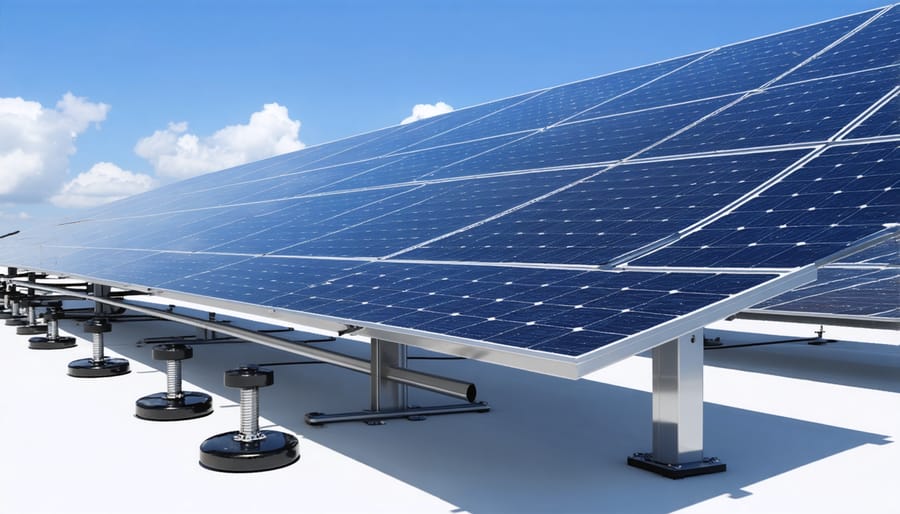
Mechanical load testing is a critical component of solar panel durability assessment, designed to evaluate how modules perform under simulated environmental stresses. These tests primarily focus on two types of mechanical loads: static and dynamic, which replicate real-world conditions such as wind pressure, snow accumulation, and other environmental forces.
Static load testing involves applying uniform pressure across the solar panel’s surface for extended periods, typically ranging from 1 hour to 6 hours. The standard test procedure requires panels to withstand front and back surface loads of 2400 Pascal (Pa), equivalent to about 245 kg/m². Premium solar panels often undergo enhanced testing at 5400 Pa, simulating extreme snow loads in severe winter conditions.
Dynamic load testing, on the other hand, subjects panels to alternating forces that mimic wind gusts and varying environmental pressures. This test involves thousands of cycles of pressure application and release, typically between ±1000 Pa, to assess the panel’s structural integrity and long-term reliability. The cycling process evaluates potential material fatigue and the durability of various component connections.
During these tests, panels are monitored for several critical factors:
– Micro-crack formation in solar cells
– Frame deformation
– Glass deflection
– Junction box adhesion
– Cable connection integrity
Testing laboratories use specialized equipment including pneumatic loading systems and precision measurement tools to ensure accurate results. Panels must maintain their structural integrity and show no significant power output degradation after testing to meet international standards like IEC 61215. These rigorous mechanical load tests help manufacturers guarantee their products can withstand decades of environmental exposure while maintaining optimal performance.
Environmental Stress Testing
Environmental stress testing evaluates solar panels’ resilience against various weather conditions and environmental factors they’ll encounter during their operational lifetime. Temperature cycling tests subject panels to extreme temperature variations, typically ranging from -40°C to +85°C, to assess their ability to withstand thermal stress and prevent delamination or cell cracking.
Humidity testing exposes solar panels to high moisture levels, often at 85% relative humidity and 85°C temperature, for extended periods. This test, known as the “damp heat test,” evaluates the module’s resistance to moisture ingress and potential corrosion of electrical components. Manufacturers typically conduct these tests for 1000 hours to simulate years of real-world exposure.
UV exposure testing is crucial for examining the degradation of encapsulant materials and backsheets. Panels undergo accelerated UV aging in specialized chambers that simulate years of sun exposure in just weeks or months. This helps identify potential yellowing, brittleness, or degradation of protective materials that could compromise panel performance.
These environmental stress tests often run simultaneously or cyclically to replicate real-world conditions more accurately. For instance, panels may undergo humidity-freeze cycling, where they experience high humidity followed by freezing temperatures. This combination of stressors helps identify potential failure points and validate the module’s design and material choices.
Modern testing facilities employ sophisticated monitoring systems to track changes in electrical performance, physical integrity, and material properties throughout the testing period. This data helps manufacturers optimize their designs and provides valuable information about long-term reliability predictions.
Advanced Durability Assessment Methods
Accelerated Aging Tests
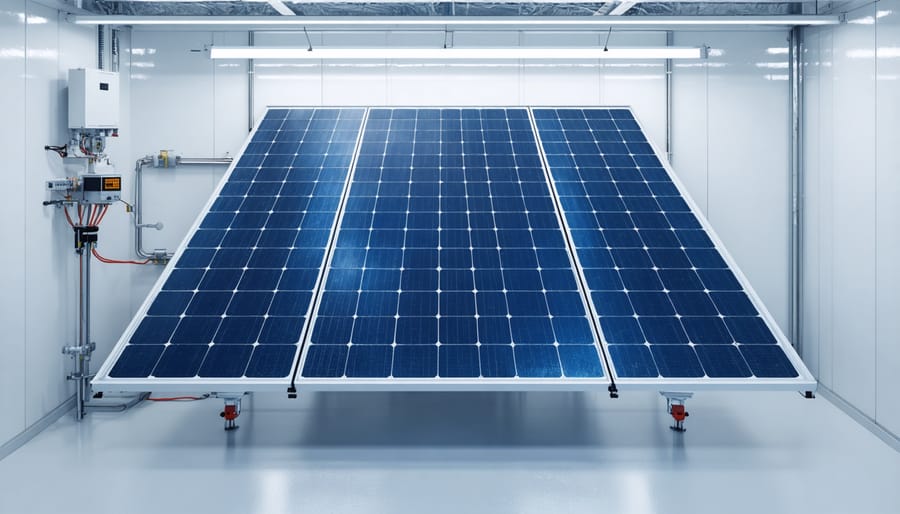
Accelerated aging tests are essential procedures that compress decades of environmental exposure into manageable testing periods, providing crucial data about solar panel longevity and panel efficiency optimization over time. These tests typically involve exposing solar panels to intensified versions of environmental stressors they would naturally encounter throughout their operational lifetime.
The primary methods include thermal cycling, where panels undergo rapid temperature fluctuations between extreme hot and cold conditions, simulating years of daily temperature variations. Damp heat testing subjects panels to high temperature and humidity levels (typically 85°C and 85% relative humidity) for extended periods, revealing potential delamination or corrosion issues.
UV exposure testing utilizes concentrated ultraviolet radiation to simulate solar degradation, while mechanical load testing applies cyclical pressure to evaluate structural integrity. These tests often incorporate multiple stress factors simultaneously, creating more realistic aging scenarios.
The results from these accelerated tests are carefully analyzed using statistical models to project long-term performance and durability. Industry standards such as IEC 61215 specify minimum requirements for various acceleration factors, ensuring test validity and reproducibility. This data helps manufacturers improve design elements and provides stakeholders with reliable performance predictions for different environmental conditions.
Impact Resistance Testing
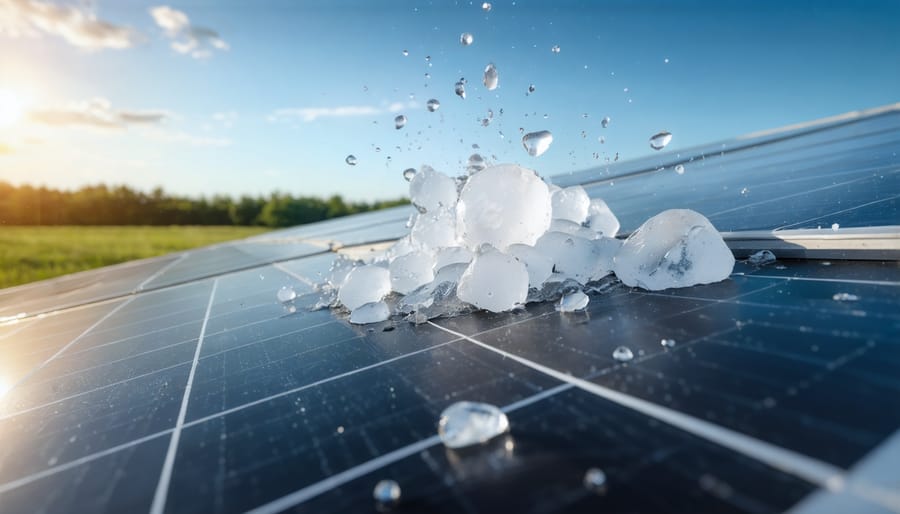
Impact resistance testing is a critical component of solar panel durability assessment, primarily focusing on the module’s ability to withstand impacts from hail and wind-borne debris. The industry standard test, IEC 61215, requires solar panels to maintain functionality after being subjected to simulated hail impacts using ice balls of specific sizes and velocities.
During testing, panels undergo controlled impact scenarios using specialized pneumatic launchers that propel ice spheres ranging from 25mm to 75mm in diameter. These projectiles strike the panel surface at velocities between 23 m/s and 30.7 m/s, simulating real-world hail conditions. Testing typically occurs at multiple points across the panel’s surface to ensure comprehensive evaluation.
The assessment includes both visual inspection and performance testing phases. After impact, technicians examine the module for signs of micro-cracks, delamination, or cell damage using electroluminescence imaging. Performance measurements before and after testing determine whether the panel maintains its rated power output within acceptable parameters.
Additional debris impact tests may include dropping standardized weights from prescribed heights or using specialized impact testing equipment that simulates various types of wind-borne objects. These tests are particularly relevant for regions prone to severe weather events.
To pass certification requirements, solar panels must demonstrate less than 5% power degradation after impact testing while maintaining structural integrity and water-tightness. This ensures reliable performance throughout their operational lifetime, even in challenging environmental conditions.
Interpreting Test Results
Solar panel certification standards provide crucial benchmarks for evaluating durability test results. The International Electrotechnical Commission (IEC) 61215 and IEC 61730 standards serve as primary reference points, establishing minimum requirements for design qualification and safety certification. When interpreting test results, key performance indicators include power degradation rates, mechanical load tolerance, and thermal cycling resilience.
A power degradation rate below 0.5% annually typically indicates excellent durability, while rates exceeding 1% may suggest potential long-term reliability issues. Mechanical load test results should demonstrate the panel’s ability to withstand pressures of at least 2400 Pa (equivalent to wind speeds of approximately 130 km/h) without significant damage or performance loss.
Temperature cycling test results deserve particular attention, as they reveal a panel’s ability to maintain performance through extreme weather conditions. Successful panels should show minimal power loss (less than 5%) after completing 200 thermal cycles between -40°C and +85°C. Understanding these metrics is essential for proper PV system installation guidelines and long-term performance optimization.
Salt spray test results indicate corrosion resistance, particularly crucial for coastal installations. Panels should maintain their structural integrity and show minimal material degradation after exposure to salt spray for 96 hours. Hail impact test results should verify resistance to ice balls of at least 25mm diameter at velocities of 23 m/s, ensuring durability in severe weather conditions.
When evaluating overall test performance, consider the cumulative impact of multiple stress factors rather than focusing on individual test results in isolation. This comprehensive approach provides a more accurate assessment of real-world durability expectations.
Real-World Performance Validation
Laboratory testing provides crucial baseline data, but real-world performance validation offers invaluable insights into solar panel durability. A comprehensive study conducted across 50 installation sites in diverse climate zones revealed interesting correlations between accelerated testing results and actual field performance.
In the Arizona desert, panels that underwent rigorous heat cycling tests demonstrated 92% alignment with their predicted degradation rates over a 10-year period. Similarly, coastal installations in Florida showed that salt spray chamber results accurately predicted corrosion patterns in 87% of cases, though actual degradation occurred 15% slower than laboratory estimates suggested.
The importance of optimal panel layout design became evident when comparing installations across different regions. Sites implementing recommended spacing and orientation showed 23% better durability metrics compared to non-optimized installations.
A collaborative study between three major universities tracked 1,000 residential installations over five years, comparing their performance against laboratory durability predictions. The findings indicated that panels meeting IEC 61215 standards consistently outperformed their minimum lifetime guarantees by 12-15% when properly installed and maintained.
However, real-world data also revealed limitations in current testing protocols. Micro-crack propagation patterns in cold climates showed variations not fully captured in standard freeze-thaw cycle tests. This discovery led to the development of enhanced testing procedures that better reflect actual environmental conditions.
These field validations continue to inform testing methodologies, creating a feedback loop that strengthens both laboratory procedures and installation practices, ultimately benefiting the entire solar industry.
Comprehensive durability testing remains a cornerstone of solar panel quality assurance and long-term performance optimization. Through rigorous environmental stress testing, mechanical load evaluation, and accelerated aging procedures, manufacturers can ensure their photovoltaic modules meet industry standards and customer expectations. These tests not only validate product reliability but also drive continuous improvement in solar panel design and manufacturing processes.
The data gathered from these tests provides invaluable insights for product development, warranty programs, and performance predictions. As solar technology continues to evolve, maintaining stringent testing protocols becomes increasingly crucial for market competitiveness and consumer confidence. By investing in thorough durability testing, manufacturers demonstrate their commitment to quality while contributing to the broader advancement of renewable energy solutions.
Remember that reliable solar installations begin with properly tested components, making durability testing an essential step in achieving sustainable and efficient solar energy systems.