Solar desalination stands at the forefront of sustainable water solutions, offering a revolutionary approach to addressing global freshwater scarcity through the power of solar energy. As traditional desalination methods consume massive amounts of fossil fuels and contribute to environmental degradation, off-grid desalination solutions powered by solar technology present a viable path toward energy-efficient water purification.
Recent technological breakthroughs in photovoltaic-driven desalination have achieved remarkable efficiency rates, converting seawater to potable water at costs competitive with conventional methods. These innovations integrate advanced membrane technology with sophisticated solar tracking systems, optimizing energy capture while minimizing operational expenses. For coastal communities and water-stressed regions, solar desalination represents not just an environmental choice, but an economic imperative.
The convergence of declining solar panel costs, improved energy storage solutions, and enhanced membrane technology has created a perfect storm of opportunity in the desalination sector. With global water demand projected to exceed supply by 40% by 2030, solar-powered desalination systems offer a scalable, sustainable solution that addresses both water security and climate change objectives. This transformative technology demonstrates how renewable energy can solve multiple environmental challenges simultaneously while creating new opportunities for sustainable development.
Understanding Solar Desalination Technology
PV-Powered Reverse Osmosis Systems
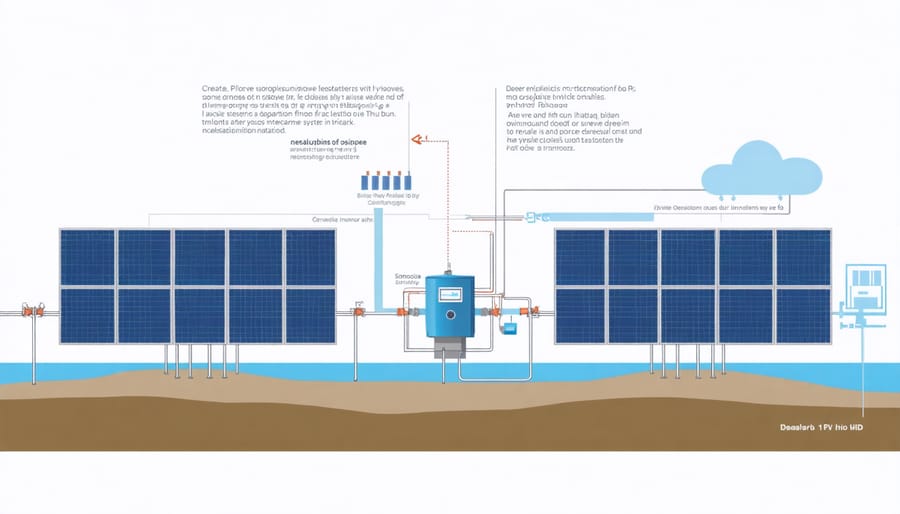
PV-powered desalination plants utilize photovoltaic arrays to generate the electrical energy required for reverse osmosis (RO) systems. These systems typically consist of high-efficiency solar panels connected to power conditioning equipment, which converts DC electricity to AC power suitable for RO operation.
The process begins with solar panels capturing sunlight and converting it into electrical energy. This power drives high-pressure pumps that force seawater through semi-permeable membranes, effectively separating pure water from dissolved salts. Modern PV-RO systems incorporate energy recovery devices and advanced control systems to optimize energy consumption and maximize water production efficiency.
A typical medium-scale installation requires approximately 3-4 kWh of energy to produce one cubic meter of fresh water. The exact energy requirement depends on factors such as feedwater salinity, system configuration, and membrane characteristics. Advanced energy recovery systems can reduce energy consumption by up to 60%, making the process increasingly cost-effective.
To ensure continuous operation, these systems often incorporate energy storage solutions or hybrid power arrangements. Battery banks store excess solar energy for use during low-sunlight periods, while intelligent control systems manage power distribution and system performance. Some installations also feature variable frequency drives to adjust pump speeds based on available solar power, optimizing system efficiency throughout the day.
Direct Solar Desalination Methods
Direct solar desalination methods harness solar energy to convert seawater into fresh water through various thermal processes. These techniques utilize solar radiation to heat and evaporate seawater, leaving behind salt and other impurities while collecting pure water vapor for condensation.
The most common direct method is the solar still, which consists of a shallow basin containing seawater covered by a transparent, sloped surface. Solar radiation passes through the transparent cover, heating the water and causing evaporation. The water vapor condenses on the cooler surface and flows into collection channels, producing purified water.
Advanced direct solar desalination systems include multiple-effect humidification-dehumidification (HDH) systems, which enhance efficiency by recycling heat through multiple stages. Solar ponds represent another innovative approach, using salinity gradients to trap solar energy and generate the heat required for desalination.
Basin-type solar stills typically achieve efficiency rates of 30-45%, producing 3-5 liters of fresh water per square meter daily. Enhanced designs incorporating heat storage materials, wicking materials, or multiple slopes can improve these rates significantly.
Modern developments in direct solar desalination include the integration of nanomaterials for improved absorption and heat transfer, as well as hybrid systems that combine multiple technologies to maximize efficiency and output. These advancements make direct solar desalination increasingly viable for small to medium-scale applications in water-scarce regions.
Efficiency and Performance Metrics

Energy Consumption Optimization
Energy efficiency optimization in solar desalination systems requires a strategic approach encompassing multiple technical considerations and optimal system design practices. Key strategies include implementing advanced heat recovery systems, incorporating thermal energy storage, and optimizing membrane configuration for reduced energy consumption.
Modern solar desalination plants utilize double-effect heat recovery mechanisms, which can improve thermal efficiency by up to 25%. This involves capturing and reusing waste heat from the distillation process, significantly reducing the overall energy requirement. Integration of phase-change materials (PCMs) in thermal storage systems enables continuous operation during periods of low solar irradiance, maintaining consistent production rates while maximizing energy utilization.
Membrane configuration optimization plays a crucial role in reducing specific energy consumption. Advanced membrane designs featuring enhanced surface area and improved permeability characteristics can decrease the energy required for water treatment by 15-20%. Implementation of pressure exchangers and energy recovery devices (ERDs) in reverse osmosis systems can recover up to 60% of the energy from the concentrated brine stream.
Variable frequency drives (VFDs) for pump control and smart monitoring systems enable dynamic adjustment of energy consumption based on real-time operational conditions. These automated systems can reduce energy waste by matching power consumption to actual production demands. Additionally, hybrid systems combining photovoltaic panels with thermal collectors maximize solar energy utilization, achieving overall system efficiencies of up to 70%.
Regular maintenance schedules, including membrane cleaning and component optimization, ensure sustained energy efficiency throughout the system’s operational lifetime. This comprehensive approach to energy management is essential for achieving cost-effective and environmentally sustainable desalination operations.
Water Quality Standards
Solar desalination systems must produce water that meets stringent quality standards for various applications, from drinking water to industrial use. The World Health Organization (WHO) establishes guidelines for drinking water quality, requiring total dissolved solids (TDS) levels below 1000 mg/L, with an ideal target of 500 mg/L or less. Solar-powered desalination processes can effectively achieve these benchmarks through carefully controlled treatment stages.
The primary quality parameters monitored in solar desalination include salinity levels, pH balance, turbidity, and microbial content. Modern solar desalination systems incorporate multiple purification stages to ensure compliance with international standards. These typically include pre-treatment filtration, the main desalination process, and post-treatment adjustment of mineral content.
For drinking water applications, solar desalination systems must achieve a minimum 99.9% reduction in bacterial content and maintain pH levels between 6.5 and 8.5. Advanced membrane-based systems powered by solar energy can consistently produce water with TDS levels below 200 mg/L, well within acceptable limits for human consumption.
Quality assurance in solar desalination involves continuous monitoring through automated sensors and regular laboratory testing. Parameters such as conductivity, oxidation-reduction potential (ORP), and residual chlorine are measured in real-time to ensure consistent water quality. Modern systems also incorporate remote monitoring capabilities, allowing operators to maintain quality standards through precise control of operating parameters.
The integration of solar power does not compromise water quality standards; rather, it provides consistent and reliable energy for maintaining optimal treatment conditions throughout the purification process.
Implementation Challenges and Solutions
Technical Considerations
Solar desalination systems face several engineering challenges that require careful consideration during design and implementation. The primary technical hurdle involves optimizing thermal efficiency while managing energy consumption. Engineers must balance the surface area of solar collectors with the desired output volume of freshwater, considering factors such as incident solar radiation and thermal losses.
Material selection plays a crucial role in system longevity and performance. Components must withstand high temperatures, corrosive saltwater, and varying pressure conditions. Advanced materials such as specialized polymers and corrosion-resistant metals are commonly employed to enhance durability and heat transfer efficiency.
Heat management systems require precise engineering to maintain optimal operating temperatures. This includes incorporating heat exchangers, thermal storage solutions, and pressure regulation mechanisms. Modern designs often integrate vacuum systems to lower the boiling point of seawater, reducing energy requirements and improving overall system efficiency.
Brine disposal presents another significant technical challenge. Engineers must design systems that effectively manage concentrated salt solutions while minimizing environmental impact. Solutions include implementing multi-stage flash distillation or incorporating crystallization systems for salt recovery.
Control systems and automation are essential for maintaining consistent operation. Advanced monitoring equipment tracks parameters such as temperature, pressure, and salinity levels, while automated systems adjust operational parameters to optimize performance under varying conditions. These systems must be robust enough to handle environmental fluctuations while maintaining reliable operation.
Economic Viability
The economic viability of solar desalination systems depends on several key factors, including initial capital investment, operational costs, maintenance requirements, and energy efficiency. Current estimates indicate that solar-powered desalination plants can produce freshwater at costs ranging from $0.5 to $2.0 per cubic meter, varying significantly based on location, scale, and technology implementation.
Investment costs typically range between $1,000 and $2,000 per cubic meter of daily production capacity. While this initial outlay is considerable, operational costs are substantially lower compared to conventional desalination methods, primarily due to reduced energy expenses. Solar desalination systems can achieve energy cost savings of 40-60% compared to grid-powered alternatives.
Return on investment (ROI) calculations generally show break-even periods of 5-8 years, depending on factors such as local electricity rates, water scarcity conditions, and government incentives. Areas with high solar irradiance and water stress often demonstrate faster ROI periods. Additionally, technological advancements in photovoltaic efficiency and membrane technology continue to improve cost-effectiveness.
Long-term economic benefits include reduced dependency on fossil fuels, lower maintenance costs due to simpler mechanical systems, and increased operational reliability. When factoring in environmental costs and rising energy prices, solar desalination becomes increasingly competitive with conventional methods, particularly in remote locations and regions with abundant solar resources.
Environmental Impact
Solar desalination presents significant environmental advantages compared to conventional desalination methods. The process harnesses renewable solar energy, substantially reducing greenhouse gas emissions and dependence on fossil fuels. When properly implemented, solar-powered desalination systems can decrease carbon dioxide emissions by up to 80% compared to traditional grid-powered systems.
The environmental sustainability of solar panels extends throughout their operational lifetime, offering a clean energy solution for water purification. However, consideration must be given to brine discharge management, as the concentrated salt solution produced during desalination can impact marine ecosystems if not properly handled.
Modern solar desalination facilities incorporate advanced brine management systems, including dilution techniques and carefully selected discharge locations to minimize environmental impact. These systems often feature zero-liquid discharge (ZLD) technologies, which recover valuable minerals from the brine while eliminating harmful discharge altogether.
The land use requirements for solar desalination plants are notable, but innovative designs incorporating dual-use approaches, such as agrivoltaics or floating solar arrays, help optimize space utilization. Additionally, these systems typically have lower chemical requirements compared to conventional desalination methods, reducing the environmental footprint of water treatment processes and supporting marine ecosystem preservation.
Future Developments and Innovations
Advanced PV Technologies
Recent advancements in photovoltaic technology have significantly enhanced the efficiency and cost-effectiveness of solar-powered desalination systems. Multi-junction solar cells, incorporating multiple semiconductor layers, can now achieve conversion efficiencies exceeding 40% under concentrated sunlight, marking a substantial improvement over traditional single-junction cells.
Perovskite solar cells represent a breakthrough in PV technology, offering exceptional light absorption properties and rapidly improving efficiency rates. These cells can be manufactured using solution-processing techniques, potentially reducing production costs while maintaining high performance in desalination applications.
Bifacial solar panels have emerged as another promising innovation, capable of capturing both direct sunlight and reflected light from water surfaces, making them particularly suitable for coastal desalination facilities. These panels can increase energy yield by 5-30% compared to conventional modules, depending on installation conditions and surface reflectivity.
Advanced thin-film technologies, including CIGS (Copper Indium Gallium Selenide) and CdTe (Cadmium Telluride), offer improved performance in high-temperature coastal environments while requiring less semiconductor material than traditional silicon cells. These technologies demonstrate enhanced salt spray resistance and maintain efficiency under partial shading conditions common in seaside locations.
Integration of smart tracking systems with these advanced PV technologies allows for optimal solar energy capture throughout the day. Combined with anti-soiling coatings and self-cleaning surfaces, these systems maintain peak performance while minimizing maintenance requirements in challenging coastal environments.
Research continues in developing specialized PV modules specifically designed for maritime conditions, incorporating features such as enhanced corrosion resistance and improved performance under high humidity levels, crucial for long-term reliability in seawater desalination applications.

Integration with Smart Grid Systems
The integration of solar desalination systems with smart grid integration systems represents a significant advancement in renewable water treatment technology. Modern control systems enable optimal coordination between power generation, water production, and grid demand, maximizing efficiency and reliability.
These intelligent systems incorporate advanced monitoring capabilities that track real-time performance metrics, including solar irradiance levels, water quality parameters, and energy consumption patterns. Sophisticated algorithms analyze this data to optimize system operations, adjusting production rates based on available solar resources and grid demands.
Grid integration possibilities extend beyond simple power management. When connected to smart grids, solar desalination facilities can participate in demand response programs, contributing to grid stability while generating additional revenue streams. During peak solar production periods, excess energy can be fed back into the grid, while off-peak hours may utilize grid power to maintain consistent operation.
The implementation of energy storage solutions, such as batteries or thermal storage systems, further enhances grid integration capabilities. These storage systems enable facilities to operate more flexibly, balancing production schedules with energy availability and grid requirements.
Remote monitoring and control capabilities allow operators to manage multiple facilities from centralized locations, reducing operational costs while improving system reliability. Automated fault detection and predictive maintenance protocols help prevent system failures and optimize maintenance schedules.
Future developments in smart grid integration are focused on enhancing system autonomy, improving demand forecasting capabilities, and implementing machine learning algorithms for more sophisticated operation optimization.
Solar photovoltaic-powered desalination emerges as a promising solution to address global water scarcity challenges while maintaining environmental sustainability. The integration of solar PV technology with desalination processes demonstrates significant potential in providing clean water access to coastal regions and water-stressed communities worldwide. Through continued technological advancements and declining solar PV costs, these systems are becoming increasingly viable for large-scale implementation.
The advantages of solar desalination extend beyond environmental benefits. The technology offers energy independence, reduced operational costs, and scalability to meet varying water demands. Research indicates that solar PV desalination systems can achieve efficiency rates of up to 90% while significantly reducing carbon emissions compared to conventional desalination methods.
Looking ahead, the future of solar desalination appears promising, with ongoing developments in high-efficiency PV modules, energy storage solutions, and membrane technology. These innovations are expected to further enhance system performance and reduce production costs. Additionally, the integration of smart monitoring systems and automated controls is improving operational efficiency and maintenance procedures.
For widespread adoption, continued collaboration between research institutions, industry stakeholders, and government bodies remains crucial. Investment in research and development, coupled with supportive policies and incentives, will accelerate the deployment of solar desalination technologies. As water scarcity becomes more prevalent due to climate change and population growth, solar PV-powered desalination stands as a sustainable and practical solution for ensuring water security in the 21st century.
The technology’s potential to provide clean water while utilizing renewable energy positions it as a key component in achieving global sustainability goals and addressing water access challenges in coastal and arid regions worldwide.