
As digital networks in solar technology continue to evolve, 6G network technology stands poised to revolutionize our interconnected world beyond current technological boundaries. Promising theoretical speeds up to 1 terabyte per second and latency times below 1 millisecond, 6G represents a quantum leap in communication capabilities that will fundamentally transform renewable energy systems and global technology integration. This next-generation network architecture, expected to debut commercially by 2030, combines advanced artificial intelligence, quantum computing, and holographic communications to enable unprecedented applications in smart grid management, real-time energy distribution, and automated solar facility optimization. While 5G laid the groundwork for the Internet of Things (IoT), 6G’s enhanced capabilities will facilitate the Internet of Everything (IoE), creating a seamless digital ecosystem where solar energy systems can operate with unprecedented efficiency and intelligence. As research institutions and technology leaders worldwide collaborate on developing 6G standards, understanding its potential impact on renewable energy infrastructure becomes crucial for industry professionals preparing for the next wave of technological advancement.
The Evolution of Network Technology in Solar Energy
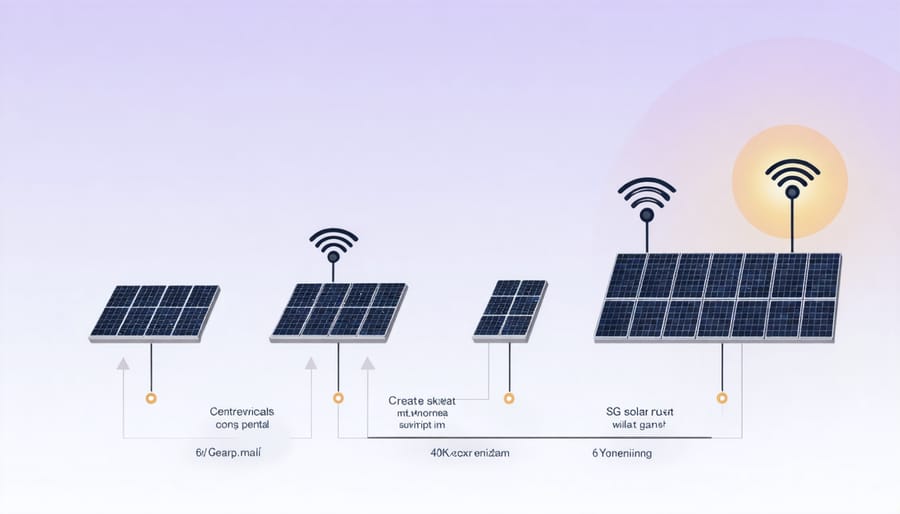
From 5G to 6G: A Quantum Leap for Solar Tech
While 5G technology has revolutionized solar monitoring and control systems, the transition to 6G promises unprecedented capabilities for renewable energy applications. The quantum leap from 5G to 6G networks represents a transformative advancement in how solar technologies operate and integrate with smart grids.
Where 5G offers latency of around 1 millisecond, 6G aims to achieve latency as low as 0.1 milliseconds, enabling real-time response in solar energy management systems. This ultra-low latency, combined with speeds up to 1 terabyte per second, will support advanced AI-driven optimization of solar panels and enhanced predictive maintenance capabilities.
6G’s ability to process massive amounts of data simultaneously will revolutionize solar farm operations through holographic communications and digital twin technology. While 5G connects thousands of devices per square kilometer, 6G will support millions, enabling unprecedented integration of distributed solar resources and micro-grid management.
The enhanced spatial awareness and precise positioning of 6G networks will also improve solar tracking systems, potentially increasing energy yield by up to 45% compared to current technologies. This evolution marks a significant milestone in achieving more efficient and sustainable solar energy solutions.
Key Features of 6G Supporting Solar Networks
6G networks are being designed with unprecedented capabilities that will revolutionize solar energy systems. These networks will operate at terahertz frequencies (above 100 GHz), enabling ultra-high-speed data transmission crucial for real-time solar monitoring and optimization. The technology promises latency rates below 1 millisecond and reliability rates exceeding 99.999%, essential for maintaining stable grid connections in solar installations.
Key features include intelligent surface technology that can enhance signal propagation, particularly beneficial for remote solar installations. The integration of artificial intelligence and machine learning capabilities allows for predictive maintenance and automated system optimization, maximizing solar energy harvesting efficiency.
6G’s enhanced connectivity supports massive machine-type communications (mMTC), enabling thousands of solar sensors to communicate simultaneously. This facilitates comprehensive monitoring of large-scale solar farms and distributed energy resources. The network’s energy-aware architecture incorporates self-charging capabilities through ambient RF energy harvesting, reducing the power consumption of communication infrastructure in solar installations.
The technology also introduces holographic connectivity and precision sensing features, enabling detailed 3D mapping of solar installation sites and real-time performance visualization. These capabilities support more efficient installation planning and maintenance procedures for solar energy systems.
6G-Enabled Solar Technology Transfer Networks
Real-Time Monitoring and Control Systems
6G networks will revolutionize real-time monitoring and control systems for solar installations through ultra-low latency communications and advanced sensing capabilities. These networks will enable microsecond response times and near-instantaneous data processing, allowing for unprecedented precision in solar array management and performance optimization.
The implementation of 6G technology will introduce holographic sensing and imaging capabilities, providing operators with detailed, three-dimensional visualization of solar installations. This enhanced monitoring will enable the detection of microscopic defects, thermal anomalies, and performance degradation before they impact system efficiency.
Artificial Intelligence and Machine Learning algorithms, powered by 6G’s superior data transmission capabilities, will continuously analyze vast amounts of sensor data to optimize panel positioning, predict maintenance needs, and automatically adjust system parameters for maximum energy yield. The network’s ability to handle massive amounts of connected devices will support dense sensor deployment across solar farms, creating a comprehensive monitoring ecosystem.
Smart maintenance systems enabled by 6G will utilize augmented reality for remote diagnostics and guided repairs. Technicians will receive real-time feedback and instructions overlaid on their field of view, improving maintenance efficiency and reducing downtime. The integration of autonomous drones and robots for inspection and cleaning will be seamlessly coordinated through the 6G network’s ultra-reliable communication channels.
These advanced monitoring and control capabilities will significantly improve solar installation efficiency, reduce operational costs, and enhance the overall reliability of renewable energy systems.

Global Data Exchange and Optimization
6G network technology represents a transformative leap in global data exchange capabilities, particularly beneficial for the solar energy sector. The enhanced network infrastructure enables real-time sharing of solar performance metrics, environmental data, and system optimization parameters across international boundaries with unprecedented speed and reliability.
Through its ultra-low latency and massive connectivity features, 6G facilitates the creation of a global solar performance database, allowing solar installations worldwide to contribute and access valuable operational data. This interconnected ecosystem enables solar facilities to benchmark their performance against similar installations in different geographical locations, leading to improved efficiency and operational strategies.
The network’s advanced AI-driven analytics capabilities process vast amounts of shared data to identify patterns, predict maintenance needs, and optimize energy production across different time zones and weather conditions. Solar facilities can leverage this collective intelligence to enhance their operational protocols and adapt to changing environmental conditions more effectively.
Furthermore, 6G’s enhanced security protocols ensure the safe transmission of sensitive performance data while maintaining transparency where needed. This secure environment encourages greater participation in data sharing initiatives, fostering international collaboration in solar technology advancement.
The technology also supports real-time remote monitoring and control of solar installations across continents, enabling rapid response to performance issues and facilitating the implementation of global best practices in solar energy management.
Practical Applications in Solar PV Systems
Smart Grid Integration
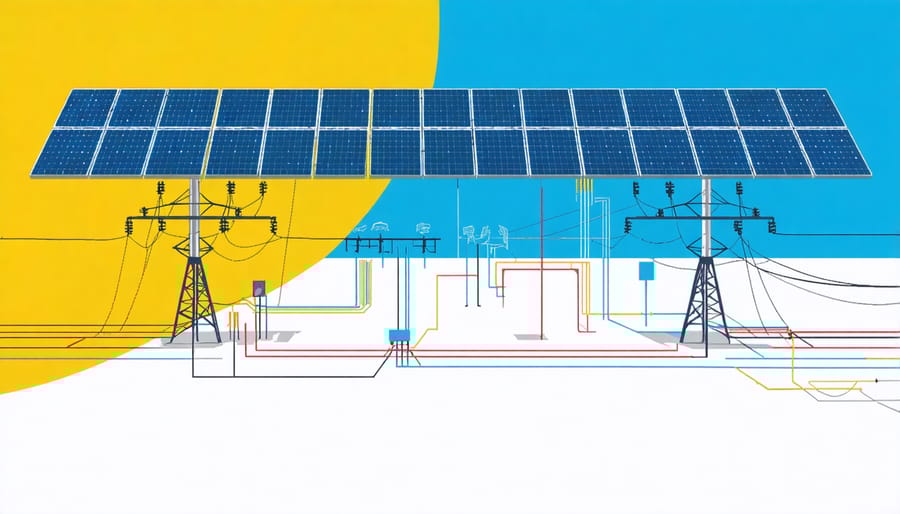
The integration of 6G networks with smart grid infrastructure represents a transformative leap in power distribution and management capabilities. This revolutionary convergence enables unprecedented real-time monitoring, control, and optimization of energy resources, particularly in the realm of solar PV innovation.
Through ultra-reliable low-latency communication (URLLC) and massive machine-type communications (mMTC), 6G technology facilitates microsecond-level response times and supports millions of connected devices per square kilometer. This enhanced connectivity enables sophisticated demand-response systems, predictive maintenance protocols, and dynamic load balancing across the power grid.
The implementation of 6G-enabled smart grids significantly improves the integration of renewable energy sources, particularly solar power systems. Advanced sensors and artificial intelligence algorithms leverage the increased bandwidth and reduced latency to optimize power flow, predict consumption patterns, and manage energy storage systems with unprecedented precision. This technological synergy has demonstrated a substantial economic impact of solar integration across various regions.
Key benefits include enhanced grid stability through instantaneous fault detection and self-healing capabilities, improved energy efficiency through AI-driven optimization, and reduced operational costs through automated grid management. The holistic integration of 6G technology also enables advanced cybersecurity measures, protecting critical infrastructure from emerging threats while ensuring reliable power distribution.
As smart grid technologies continue to evolve alongside 6G networks, the potential for revolutionary advances in energy management and distribution becomes increasingly apparent, promising a more sustainable and efficient energy future.
Automated Maintenance and Performance Optimization
In the era of 6G networks, automated maintenance and performance optimization will reach unprecedented levels of sophistication through the integration of artificial intelligence and machine learning systems. These networks will enable real-time monitoring and predictive maintenance capabilities that far exceed current technologies, ensuring optimal network performance while minimizing downtime and operational costs.
6G networks will incorporate self-healing mechanisms that can detect and resolve issues before they impact service quality. Advanced AI algorithms will continuously analyze network performance metrics, traffic patterns, and hardware status, making immediate adjustments to maintain peak efficiency. This proactive approach will significantly reduce the need for manual intervention and prevent potential network failures.
The implementation of digital twins in 6G infrastructure will create virtual replicas of network components, allowing operators to simulate and optimize network configurations without risking disruption to live services. These digital models will enable engineers to test updates, predict maintenance needs, and identify potential bottlenecks before they occur in the physical network.
Quantum computing integration will enhance the network’s ability to process vast amounts of performance data and make complex optimization decisions in microseconds. This capability will be crucial for managing the ultra-dense networks of the future, where millions of devices communicate simultaneously.
Edge computing nodes will work in concert with central systems to distribute maintenance tasks and optimization processes across the network. This distributed intelligence approach will ensure rapid response times and efficient resource allocation, particularly in high-demand scenarios or during unexpected network stress events.
The system will also incorporate environmental awareness, automatically adjusting network parameters based on weather conditions, user density, and local infrastructure changes to maintain optimal performance while minimizing energy consumption.
Future Implications for Solar Industry
Educational and Training Opportunities
6G networks will revolutionize educational and professional development opportunities through unprecedented connectivity and immersive learning experiences. The technology’s ultra-low latency and high-bandwidth capabilities will enable truly interactive remote learning environments, featuring holographic presentations and real-time collaborative spaces that feel indistinguishable from physical classrooms.
Advanced haptic feedback systems and extended reality (XR) integration will allow students and professionals to participate in hands-on training scenarios from anywhere in the world. This is particularly valuable for technical fields, where practical experience is crucial. Engineers and technicians can remotely access sophisticated simulation environments for equipment maintenance, system design, and troubleshooting exercises.
The integration of artificial intelligence with 6G networks will enable personalized learning paths that adapt in real-time to individual progress and learning styles. Advanced sensing technologies and brain-computer interfaces will facilitate direct knowledge transfer and skill acquisition, dramatically reducing traditional learning curves.
Professional development programs will benefit from seamless access to global expertise through ultra-high-definition volumetric video conferencing and instantaneous translation services. This will break down geographical barriers in specialized education and training, allowing organizations to maintain consistently high standards across international operations.
Universities and training institutions are already developing curricula that incorporate these emerging capabilities, preparing the workforce for the enhanced connectivity and learning opportunities that 6G will bring to various industries, including renewable energy and sustainable technologies.
Research and Development Prospects
Research and development in 6G technology is poised to revolutionize numerous sectors, particularly in renewable energy and solar power applications. The integration of artificial intelligence, quantum computing, and holographic communications presents unprecedented opportunities for advancing collaborative solar innovation frameworks and smart grid management systems.
Key innovations under development include sub-terahertz communication frequencies, enabling data transfer rates up to 1 terabyte per second, which will significantly enhance real-time monitoring and optimization of solar installations. Advanced sensing capabilities and intelligent surfaces are being engineered to improve energy harvesting efficiency and enable seamless integration with existing infrastructure.
Researchers are exploring novel applications such as brain-computer interfaces, volumetric displays, and digital twin technology that could transform how we design, maintain, and optimize solar energy systems. The development of zero-energy devices and sustainable network architectures aligns with the growing emphasis on environmental sustainability.
Industry experts anticipate that 6G will enable more sophisticated energy management systems, allowing for better prediction of solar output, enhanced grid stability, and improved energy storage solutions. These advancements are expected to contribute significantly to the achievement of global renewable energy goals and the transition toward a more sustainable future.
The convergence of 6G network technology and solar energy systems represents a transformative development in renewable energy infrastructure. This integration promises to revolutionize how solar installations operate, communicate, and participate in the broader energy ecosystem. The enhanced data transmission capabilities, ultra-low latency, and advanced connectivity of 6G will enable more efficient technology transfer across global solar markets, facilitating rapid adoption of innovative solutions and best practices.
Looking ahead, the implementation of 6G in solar applications will likely accelerate the development of smart grid systems, improve real-time monitoring capabilities, and enable more sophisticated energy management solutions. The technology’s ability to support massive machine-type communications will be particularly beneficial for large-scale solar installations, allowing for unprecedented levels of automation and optimization.
However, successful integration will require continued collaboration between telecommunications providers, solar industry stakeholders, and research institutions. The development of standardized protocols and frameworks will be essential to ensure seamless interoperability and maximize the potential benefits of this technological convergence.
As we move toward a more sustainable future, the synergy between 6G networks and solar technology will play a crucial role in advancing renewable energy adoption and improving system efficiency. This partnership will not only enhance the performance and reliability of solar installations but also contribute significantly to the global transition toward clean energy solutions.