Nonprofit organizations can now leverage multiple solar grant opportunities to achieve substantial solar investment returns while advancing their environmental missions. The Federal Solar Investment Tax Credit (ITC) offers nonprofits innovative financing structures through third-party partnerships, enabling access to tax incentives traditionally unavailable to tax-exempt organizations. State-level grant programs, including the Solar for All initiatives and community solar projects, provide dedicated funding streams specifically designed for mission-driven organizations. Environmental Protection Agency’s Environmental Justice grants further complement these opportunities, offering up to $100,000 for sustainable energy projects in underserved communities. By strategically combining these funding sources with renewable energy certificates (RECs) and performance-based incentives, nonprofits can offset up to 75% of their solar installation costs while creating long-term operational savings. The growing availability of these financial instruments, coupled with declining solar technology costs, presents an unprecedented opportunity for nonprofits to transition to clean energy while strengthening their financial sustainability.

Understanding Nonprofit Solar Grants
Federal Grant Programs
The federal government offers several significant solar project funding options specifically designed for nonprofit organizations. The Department of Energy’s Solar Energy Technologies Office (SETO) administers grants ranging from $50,000 to $1.5 million for innovative solar projects. Eligibility typically requires organizations to demonstrate financial stability, a clear project implementation plan, and measurable environmental impact metrics.
The Rural Energy for America Program (REAP) provides grants covering up to 25% of total project costs for nonprofit organizations in rural areas. Applications are accepted year-round, with competitive funding rounds occurring twice annually. Organizations must be located in eligible rural areas and demonstrate project feasibility through comprehensive energy audits.
The Environmental Protection Agency’s Environmental Justice Small Grants Program offers funding opportunities specifically for nonprofits serving disadvantaged communities. These grants support solar installations that address environmental and public health issues in underserved areas. Organizations can receive up to $75,000 per project, with additional funding available for capacity building and technical assistance.
Requirements for federal grants typically include:
– Detailed project proposals with clear objectives
– Demonstrated organizational capacity
– Evidence of community benefit
– Comprehensive budget documentation
– Environmental impact assessments
– Long-term sustainability plans
Successful applicants often combine multiple funding sources to maximize their solar implementation potential.
State and Local Incentives
State and local governments across the United States offer diverse incentive programs to support nonprofit organizations in their solar energy initiatives. These programs vary significantly by region and can include direct grants, rebates, tax incentives, and performance-based rewards.
Many states maintain dedicated clean energy funds that provide specific allocations for nonprofit solar projects. For example, California’s Self-Generation Incentive Program (SGIP) offers substantial rebates for solar installations combined with energy storage systems. New York’s NY-Sun program provides sector-specific funding opportunities for nonprofit organizations, particularly those serving low-income communities.
Local municipalities often supplement state-level incentives with their own programs. Cities like Boulder, Colorado, and Cambridge, Massachusetts, have established sustainable energy funds that prioritize nonprofit solar installations. These local programs frequently offer technical assistance alongside financial support, helping organizations navigate the complexities of solar implementation.
Regional utility companies may also provide additional incentives through their renewable energy programs. These can include enhanced net metering rates, production-based incentives, or special solar procurement programs designed specifically for nonprofit entities.
Organizations should consult their state energy offices and local sustainability departments to identify available opportunities, as programs often have limited funding windows and specific application periods. Many regions also offer specialized incentives for nonprofits that combine solar installations with educational initiatives or community benefit programs.
Leveraging RECs for Additional Revenue
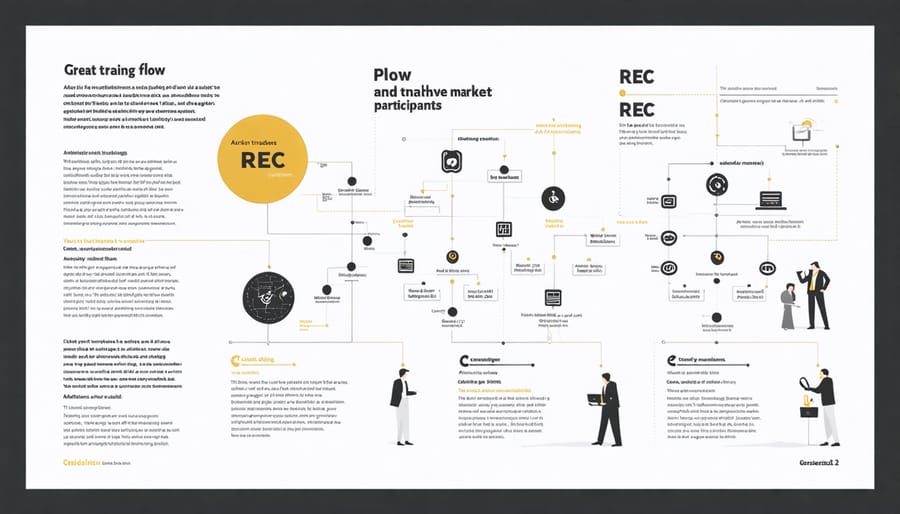
REC Market Fundamentals
Renewable Energy Certificates (RECs) represent a critical component of innovative financing solutions for nonprofit solar projects. These tradable environmental commodities verify that one megawatt-hour of electricity has been generated from renewable sources, creating an additional revenue stream beyond direct energy savings.
REC markets operate on a supply-and-demand basis, with prices varying significantly by region and compliance requirements. In states with robust Renewable Portfolio Standards (RPS), RECs typically command higher values due to utility companies’ mandatory procurement obligations. Voluntary markets, while generally offering lower prices, provide additional opportunities for nonprofits to monetize their solar generation.
The value of RECs fluctuates based on several factors: regulatory changes, renewable energy deployment rates, and market participant behavior. Current market trends show prices ranging from $5 to $400 per REC, depending on the jurisdiction and certificate type. Solar-specific RECs (SRECs) often command premium prices in markets with solar carve-out provisions.
For nonprofits, understanding REC aggregation and long-term contracting options is essential. Aggregators can combine RECs from multiple small-scale installations, improving market access and negotiating power. Forward contracts provide revenue certainty but may sacrifice potential upside if market prices increase.
Organizations should carefully evaluate REC monetization strategies, considering factors such as:
– Market jurisdiction and applicable regulations
– Current and projected REC prices
– Transaction costs and minimum volume requirements
– Contract duration and price stability preferences
– Administrative capabilities for REC tracking and verification
Maximizing REC Value
Renewable Energy Certificates (RECs) represent a significant opportunity for nonprofits to enhance the financial returns of their solar investments. By implementing strategic REC management practices, organizations can maximize the value of these environmental attributes and create sustainable revenue streams.
To optimize REC value, nonprofits should first understand their local REC market dynamics and compliance requirements. Markets with strong renewable portfolio standards typically offer higher REC prices, making it crucial to time REC sales appropriately. Organizations should consider establishing relationships with REC aggregators or brokers who can provide market insights and facilitate transactions at optimal prices.
Long-term REC contracts can provide stable revenue streams, though organizations must weigh this against the potential for higher spot market prices. Some nonprofits choose to enter into forward contracts for a portion of their RECs while maintaining flexibility with the remainder to capitalize on market upswings.
Quality certification programs can enhance REC value. Programs like Green-e certification demonstrate environmental integrity and can command premium prices in voluntary markets. Nonprofits should maintain detailed documentation of their solar generation and REC creation to ensure compliance and maximize marketability.
Technology solutions play a crucial role in REC optimization. Modern monitoring systems can accurately track solar production and automate REC reporting requirements. Organizations should invest in reliable monitoring platforms and establish clear protocols for data collection and verification.
Additionally, nonprofits can explore partnerships with corporations seeking to meet environmental goals through REC purchases. These relationships often result in better pricing and can lead to additional funding opportunities through corporate social responsibility initiatives.
By implementing these strategies while maintaining compliance with regulatory requirements, nonprofits can create substantial additional value from their solar installations through effective REC management.
Integration Strategies
Financial Planning Framework
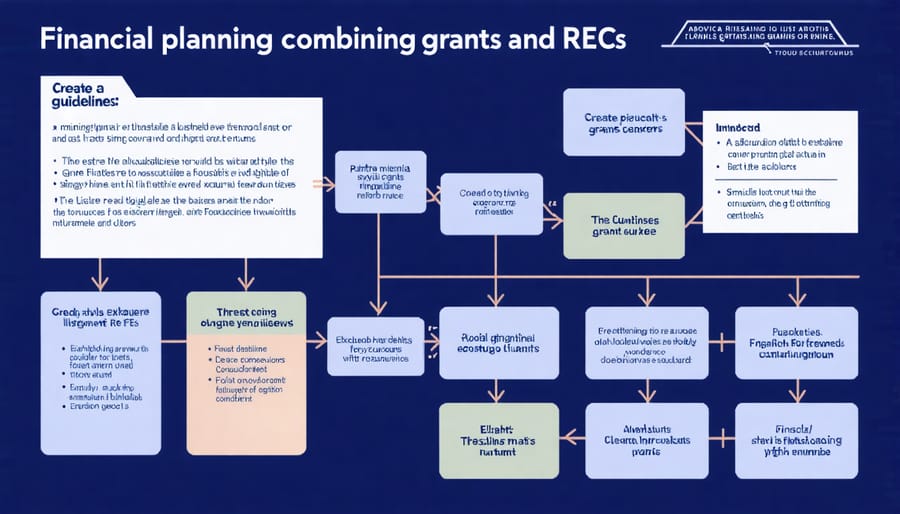
Developing a robust financial strategy for nonprofit solar projects requires careful planning and integration of multiple funding sources. The process begins with a comprehensive assessment of available funding options, including federal and state grants, foundation support, and alternative funding platforms.
Start by creating a detailed project budget that includes all installation costs, maintenance requirements, and potential revenue streams. This budget should account for both immediate expenses and long-term operational costs. Calculate your organization’s energy consumption patterns and potential solar generation capacity to determine the optimal system size and associated costs.
Next, establish a timeline for grant applications, considering that many funding programs have specific submission windows and implementation deadlines. Research and maintain a database of relevant grant opportunities, including application requirements, deadlines, and funding cycles. This proactive approach ensures you don’t miss crucial funding windows.
Incorporate Renewable Energy Certificate (REC) revenue projections into your financial planning. Research your state’s REC market conditions and establish relationships with REC aggregators or brokers. Consider entering into long-term REC contracts to secure stable revenue streams that can supplement grant funding.
Develop multiple funding scenarios that combine different proportions of grants, RECs, and other funding sources. This approach helps create a resilient financial strategy that isn’t dependent on a single funding source. Include contingency plans for scenarios where certain funding sources may not materialize.
Track and document your organization’s environmental impact and community benefits. This information strengthens grant applications and helps demonstrate the value of your solar project to potential funders. Maintain detailed records of energy production, cost savings, and emission reductions to support future funding requests and report to stakeholders.
Consider establishing partnerships with other nonprofits or community organizations to share resources and potentially access larger funding pools. This collaborative approach can increase your organization’s competitiveness in grant applications and create economies of scale for solar installations.
Compliance and Reporting
Maintaining compliance with nonprofit solar grant requirements while participating in Renewable Energy Certificate (REC) markets requires careful attention to documentation and reporting procedures. Organizations must establish robust tracking systems to monitor both their solar energy production and REC transactions to ensure transparency and accountability.
Grant recipients typically need to submit quarterly or annual reports detailing their solar installation’s performance metrics, including total energy generation, carbon emissions avoided, and financial savings achieved. These reports should clearly distinguish between energy used for the organization’s operations and any portion allocated to REC markets.
Many grant programs require recipients to maintain detailed records of:
– Solar system maintenance and operational status
– Energy production data from monitoring systems
– Financial transactions related to REC sales
– Documentation of how grant funds were utilized
– Evidence of continued nonprofit status
– Impact assessments on community benefit programs
Organizations must ensure their participation in REC markets doesn’t conflict with grant terms. Some grants may restrict the percentage of RECs that can be sold or require a portion of certificates to be retired for environmental claims. Grant recipients should maintain separate accounting for RECs generated through grant-funded systems versus those from other solar installations.
Compliance often includes maintaining specific insurance coverage and keeping detailed maintenance records. Regular system inspections and performance verification by certified professionals may be required to demonstrate proper stewardship of grant-funded equipment.
To avoid compliance issues, organizations should:
– Review grant agreements thoroughly before entering REC markets
– Implement automated monitoring systems for accurate reporting
– Maintain organized documentation systems
– Seek legal counsel for complex REC transactions
– Schedule regular compliance audits
– Keep stakeholders informed of REC market activities
Failure to meet compliance requirements can result in grant repayment obligations or disqualification from future funding opportunities. Organizations should designate a compliance officer or team member responsible for coordinating these various reporting and documentation requirements.
Solar grants represent a significant opportunity for nonprofit organizations to transition to renewable energy while maintaining their financial sustainability. By understanding and strategically pursuing available funding options, nonprofits can substantially reduce their environmental impact while redirecting operational cost savings toward their core missions.
To successfully implement solar projects, nonprofits should first conduct a comprehensive energy audit to determine their facility’s solar potential and expected return on investment. This initial assessment will strengthen grant applications and help organizations develop realistic project timelines and budgets.
Key action steps for nonprofits interested in solar investments include:
1. Research federal, state, and local grant programs specifically designed for nonprofit solar installations
2. Develop relationships with solar developers experienced in nonprofit projects
3. Create a detailed implementation plan incorporating both technical and financial considerations
4. Prepare comprehensive grant applications highlighting community benefits and environmental impact
5. Consider hybrid funding approaches combining grants with other financial instruments
Organizations should maintain detailed documentation of their energy consumption patterns and facility specifications, as these records are often required for grant applications. Additionally, nonprofits should explore partnerships with other community organizations to potentially increase their funding opportunities through collaborative proposals.
Remember that successful solar implementation often requires a long-term perspective. While the initial application process may be complex, the potential benefits – including reduced operating costs, enhanced environmental stewardship, and improved community standing – make solar investments particularly valuable for nonprofit organizations.
To maximize chances of success, nonprofits should:
– Stay informed about upcoming grant cycles and application deadlines
– Engage board members and stakeholders early in the planning process
– Consider hiring grant writing professionals with renewable energy expertise
– Develop contingency plans for various funding scenarios
– Create a maintenance and monitoring plan for post-installation sustainability
By taking a methodical approach to solar grant opportunities and maintaining focus on long-term sustainability goals, nonprofits can successfully navigate the transition to solar energy while strengthening their organizational capacity and environmental impact.