The University of Virginia Solar Car team stands at the forefront of academic innovation in renewable energy transportation, transforming theoretical photovoltaic concepts into tangible engineering solutions that inform commercial solar-powered transportation systems. Since its founding, this student-led initiative has consistently demonstrated how advanced PV integration transcends laboratory experimentation, delivering real-world insights into energy efficiency, battery management, and aerodynamic design that directly influence industry standards.
UVA’s solar vehicle project exemplifies the critical intersection between academic research and practical application in the renewable energy sector. The team’s iterative approach to optimizing solar cell configurations, power electronics, and energy storage systems provides invaluable data for professionals developing next-generation transportation technologies. Their participation in international competitions like the American Solar Challenge and Formula Sun Grand Prix serves as a proving ground for innovative PV integration techniques that address fundamental challenges facing commercial solar vehicle development.
Understanding UVA’s methodologies offers photovoltaic professionals essential perspectives on system optimization, from maximum power point tracking algorithms to lightweight structural design principles. The project’s collaborative framework bridges multiple engineering disciplines, creating a comprehensive model for how academic institutions contribute to advancing solar transportation technology while preparing the next generation of renewable energy specialists to tackle industry-scale implementation challenges.
The UVA Solar Car Project: Engineering Innovation Meets Renewable Energy
Design Philosophy and Technical Specifications
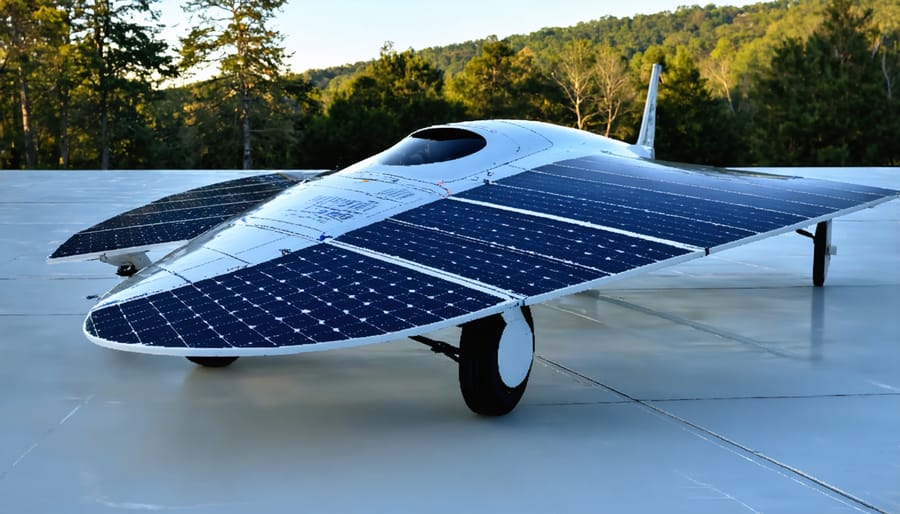
The University of Virginia’s solar car exemplifies a sophisticated engineering approach that balances aerodynamic efficiency, structural optimization, and energy management. The design philosophy centers on minimizing energy consumption while maximizing solar energy capture, principles that directly inform commercial solar system design for transportation applications.
Aerodynamic optimization remains paramount, with computational fluid dynamics simulations guiding the vehicle’s streamlined profile. The teardrop-shaped body reduces drag coefficients to approximately 0.12-0.15, significantly lower than conventional vehicles. This reduction translates directly to decreased energy requirements, enabling extended range on limited solar input. Carbon fiber composites and aerospace-grade aluminum form the chassis, achieving target weights between 150-200 kilograms while maintaining structural integrity for safety certification.
The photovoltaic array typically comprises high-efficiency monocrystalline silicon cells or advanced multi-junction gallium arsenide modules, achieving conversion efficiencies exceeding 22-24% and 30% respectively. These modules integrate seamlessly into the vehicle’s curved surface through custom encapsulation methods that protect cells while minimizing optical losses. Strategic cell placement maximizes sun exposure angles throughout daily operation, with approximately 4-6 square meters of active solar collection area.
The electrical architecture employs maximum power point tracking controllers to optimize energy harvest under varying irradiance conditions. Lithium-ion battery packs store surplus energy, with capacities ranging from 5-20 kilowatt-hours depending on race regulations and design objectives. Energy management systems continuously monitor power flow between solar array, battery storage, and motor controller, implementing algorithms that balance immediate power demands against long-term energy conservation.
This integrated approach demonstrates how academic solar vehicle projects advance practical knowledge in renewable energy systems, power electronics, and sustainable transportation engineering.
Competition Performance and Real-World Testing
The University of Virginia’s solar racing team has demonstrated consistent competitiveness in the Formula Sun Grand Prix and American Solar Challenge, benchmark events that test both vehicle design and team strategy. These multi-day endurance races require teams to navigate thousands of miles using only solar energy, providing invaluable real-world validation of photovoltaic integration principles under variable weather conditions and diverse terrain.
UVA’s vehicles have achieved notable rankings among collegiate competitors, with performance metrics revealing crucial insights into energy management optimization. During the 2019 American Solar Challenge, the team’s telemetry data showed that strategic battery management and predictive weather modeling contributed to maintaining consistent speeds despite cloud cover variations—a finding directly applicable to commercial solar transportation development.
Competition environments accelerate innovation cycles that typically take years in traditional research settings. UVA’s iterative design improvements between racing seasons have yielded measurable efficiency gains, including a 15% reduction in aerodynamic drag and enhanced maximum power point tracking algorithms that improved energy harvest by 8%. These technical advances contribute to the broader knowledge base shared among academic institutions and industry partners.
Beyond competitive results, participation in international events like the World Solar Challenge provides teams exposure to global best practices. Collaborative exchanges with universities from Australia, Europe, and Asia foster knowledge transfer regarding advanced battery chemistry, lightweight composite materials, and intelligent energy distribution systems. These cross-institutional partnerships strengthen the academic foundation supporting commercial solar transportation development, while providing students hands-on experience that directly translates to careers in renewable energy sectors.
Solar PV Technology Integration: From Panels to Propulsion
PV Module Selection and Vehicle Surface Optimization
Solar car projects like UVA’s initiative require meticulous photovoltaic module selection to maximize energy capture within severe dimensional and weight constraints. The choice between monocrystalline and multi-crystalline silicon technologies fundamentally shapes vehicle performance, with monocrystalline cells typically offering 22-24% efficiency compared to multi-crystalline’s 18-20%. For transportation applications, this efficiency differential translates directly into additional range and competitive advantage.
Vehicle surface optimization presents unique challenges absent in stationary installations. Solar cars demand modules with exceptional power-to-weight ratios, typically requiring cells no thicker than 180 micrometers encapsulated in lightweight protective materials. The curved aerodynamic surfaces of modern solar vehicles necessitate either flexible thin-film alternatives or precisely segmented crystalline arrays that conform to complex geometries without compromising structural integrity.
University research programs have demonstrated that effective module selection extends beyond raw efficiency metrics. Temperature coefficients become critical considerations, as vehicle-mounted cells experience greater thermal stress than rooftop installations. Premium monocrystalline modules with temperature coefficients around -0.35%/°C maintain superior performance compared to alternatives losing 0.45%/°C or more under elevated operating temperatures.
Surface area optimization requires strategic placement analysis, balancing maximum solar exposure against aerodynamic penalties. UVA’s engineering teams collaborate with industry partners to model sun angle variations throughout competition routes, determining optimal tilt angles and array configurations. This interdisciplinary approach integrates electrical engineering, materials science, and mechanical design principles.
Educational programs emphasizing these selection criteria prepare aspiring professionals for commercial solar vehicle development. The lessons learned from academic projects directly inform emerging applications in solar-assisted electric vehicles, where auxiliary PV systems extend range without compromising aesthetics or functionality. Industry stakeholders increasingly recognize that university solar car competitions serve as proving grounds for technologies approaching commercial viability.

Energy Storage and Power Management Systems
The UVA solar car project demonstrates sophisticated power management crucial for reliable solar vehicle operation. At the system’s core, lithium-ion battery packs store captured solar energy, enabling continuous propulsion even during suboptimal sunlight conditions. These energy storage systems must balance competing demands: sufficient capacity for extended operation while minimizing weight penalties that reduce efficiency.
Maximum power point tracking (MPPT) controllers serve as intelligent intermediaries between photovoltaic arrays and battery systems. These devices continuously analyze voltage and current characteristics to extract optimal power from solar cells across varying irradiance levels and temperatures. Advanced MPPT algorithms can improve energy harvest by 20-30% compared to basic charge controllers, a critical advantage in competitive solar racing where every watt matters.
The power distribution network manages energy flow between generation, storage, and consumption subsystems. Battery management systems (BMS) monitor individual cell voltages, temperatures, and state-of-charge parameters, preventing dangerous overcharge or deep discharge conditions while maximizing usable capacity. Regenerative braking capabilities further enhance efficiency by converting kinetic energy back into stored electrical power during deceleration.
University collaborations have refined these technologies through iterative design cycles, with student teams exploring emerging solutions like supercapacitors for peak power demands and predictive energy management algorithms. These educational initiatives prepare future professionals to address real-world challenges in commercial solar transportation applications, translating lessons learned from racing into practical vehicle electrification strategies.
Bridging Academic Research and Commercial Solar Transportation
Educational Value for Aspiring PV Professionals
University solar car programs like UVA’s initiative represent invaluable training environments for aspiring photovoltaic professionals, bridging the gap between theoretical knowledge and real-world application. These programs provide hands-on experience in critical areas including solar panel selection, integration strategies, maximum power point tracking (MPPT) systems, and energy storage optimization—skills directly transferable to commercial PV installations and advanced transportation projects.
Participants gain practical expertise in designing and implementing complete photovoltaic systems under real-world constraints such as weight limitations, aerodynamic considerations, and variable environmental conditions. This experiential learning develops problem-solving capabilities that classroom instruction alone cannot provide. Students work with industry-standard tools and methodologies, from photovoltaic modeling software to energy management systems, preparing them for immediate contribution to the renewable energy workforce.
The collaborative nature of these projects mirrors professional solar industry practices, where cross-functional teams must coordinate electrical engineering, mechanical design, and project management. Team members develop competencies in system integration, performance monitoring, and efficiency optimization—competencies increasingly demanded as the solar transportation sector expands.
Many universities have formalized these educational opportunities through dedicated renewable energy curricula, research partnerships with solar manufacturers, and industry mentorship programs. Alumni from solar car teams frequently pursue careers in photovoltaic system design, energy consulting, and electric vehicle development, carrying forward innovation methodologies learned through competitive solar racing. This pipeline of skilled professionals directly supports the growing demand for expertise in integrating solar technology with advanced transportation infrastructure.
Technology Transfer to Commercial Applications
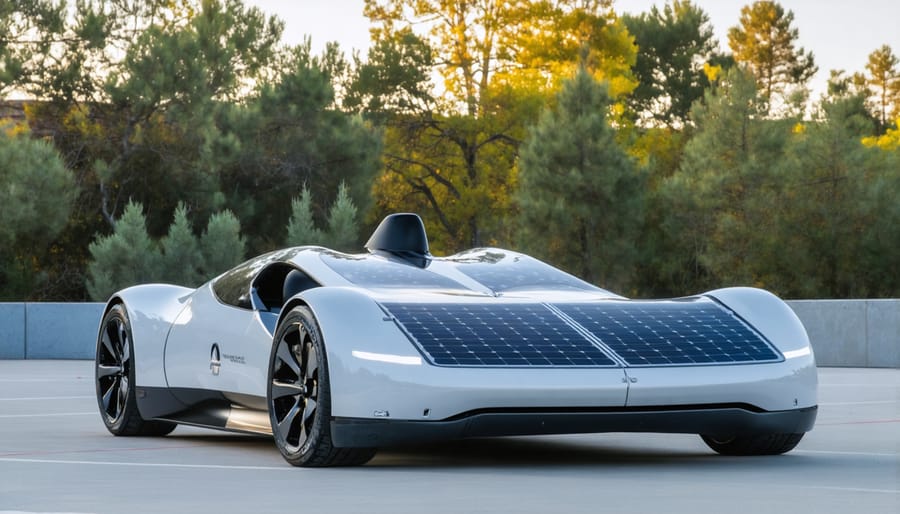
University solar car programs have catalyzed significant technological advances that now benefit commercial applications. UVA Solar Car’s innovations in lightweight photovoltaic integration, power management systems, and aerodynamic design have directly informed mainstream electric vehicle development. The team’s work on maximum power point tracking algorithms has been adapted for commercial charging infrastructure, optimizing energy harvest from solar canopies at charging stations.
Battery management systems pioneered in competitive solar vehicles have influenced thermal regulation strategies in commercial EVs, extending battery lifespan and improving performance. UVA’s telemetry and data analytics platforms developed for race monitoring have evolved into fleet management solutions used by commercial operators to track vehicle efficiency and optimize routes based on solar availability.
The university’s collaboration with industry partners has accelerated the integration of flexible solar panels into vehicle roofs, a feature now appearing in production vehicles from major manufacturers. These partnerships demonstrate how solar transportation technology transitions from academic research to practical implementation. Additionally, power conversion efficiency improvements developed through competitive pressures have reduced costs for commercial solar-assisted vehicles, making sustainable transportation increasingly accessible to consumers and fleet operators.
Advanced Transportation Systems: Scaling Solar Integration
Fleet Vehicles and Commercial Transportation
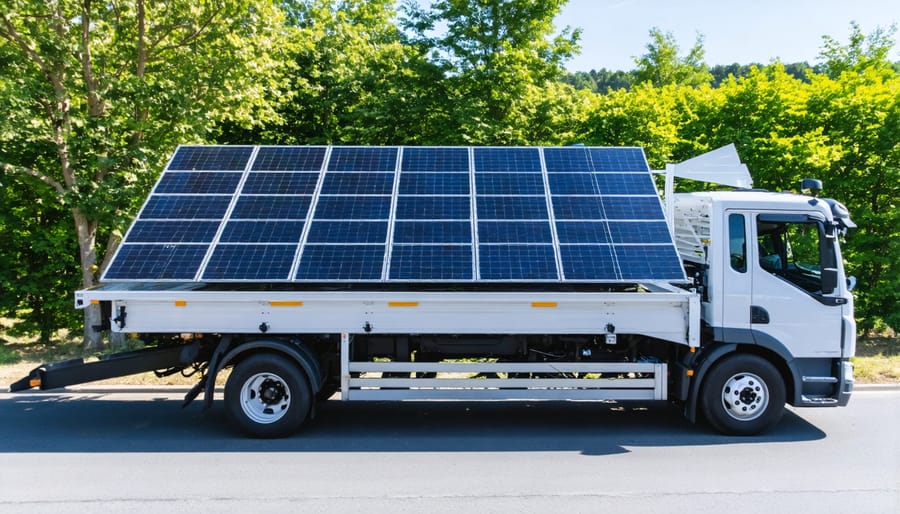
The photovoltaic integration principles demonstrated by UVA’s solar car project have immediate applicability to commercial fleet vehicles and public transportation systems. While passenger solar cars remain primarily experimental, the technology’s adaptation to delivery trucks, transit buses, and corporate fleets represents a practical pathway toward reducing transportation-related carbon emissions at scale.
Commercial fleet operators are increasingly installing auxiliary solar panels on vehicle rooftops to supplement onboard power systems. Delivery companies have begun integrating 200-400 watt solar arrays on delivery vans, extending daily range by 10-25 miles depending on geographic location and weather conditions. This supplementary charging reduces dependence on grid infrastructure and lowers operational costs, particularly for vehicles with predictable urban routes and frequent daytime stops.
Public transit agencies have piloted solar-enhanced buses that utilize rooftop PV systems to power auxiliary functions including air conditioning, lighting, and electronic displays. By offsetting these parasitic loads, solar integration preserves battery capacity for propulsion, effectively extending range without increasing battery pack size or weight. Universities collaborating on solar car projects, like UVA, provide valuable research data that transit authorities use to optimize panel placement, power management algorithms, and charge controller efficiency.
The lessons learned from maximizing power-to-weight ratios and aerodynamic efficiency in solar car competitions directly inform commercial vehicle design. Fleet managers can leverage these academic innovations to develop business cases for solar integration, particularly as panel efficiency improvements and cost reductions continue accelerating adoption across the transportation sector.
Infrastructure Integration and Smart Grid Connectivity
Solar-integrated vehicles like the UVA solar car represent a critical node in emerging smart grid architectures, where transportation and energy systems converge to create bidirectional power flows. These vehicles function not merely as energy consumers but as mobile energy storage units capable of stabilizing grid demand through vehicle-to-grid (V2G) technology.
When solar cars connect to charging infrastructure, they can both draw power during peak solar production hours and return stored energy during periods of high grid demand. This capability transforms university solar car projects into living laboratories for distributed energy resource management. The UVA solar car’s battery systems, designed for competition efficiency, demonstrate scalable principles applicable to commercial electric vehicles participating in demand response programs.
Smart grid connectivity enables real-time communication between solar vehicles and energy management systems, optimizing charging schedules based on renewable energy availability and grid conditions. Universities collaborating on solar car development, including UVA, contribute valuable research on power electronics, battery management systems, and grid interface protocols that directly inform commercial V2G deployments.
The integration extends beyond individual vehicles to fleet management scenarios where multiple solar-powered vehicles aggregate their storage capacity, creating virtual power plants. This distributed architecture enhances grid resilience while maximizing renewable energy utilization. For aspiring photovoltaic professionals, understanding these interconnected systems is essential, as the transportation sector increasingly functions as both load and resource within modernized electrical infrastructure. Educational programs focusing on solar vehicle development provide hands-on experience with these complex integration challenges.
Performance Challenges and Engineering Solutions
Environmental Variables and System Reliability
Solar vehicle performance depends critically on environmental factors that university teams like UVA must account for during design and competition. Solar irradiance varies substantially with geographic location, time of day, and atmospheric conditions—cloud cover can reduce panel output by 50-90%, while humidity and aerosol particles diminish efficiency through light scattering. Seasonal variations affect sun angle and day length, with winter months presenting particular challenges for energy collection.
Temperature impacts create a dual challenge: photovoltaic cells lose approximately 0.4-0.5% efficiency per degree Celsius above 25°C, while battery systems require thermal management to maintain optimal operating ranges between 15-35°C. UVA’s engineering approach addresses these variables through predictive modeling algorithms that optimize energy consumption based on weather forecasts and route topology.
Strategies for maximizing reliability include redundant battery management systems, aerodynamic designs minimizing drag coefficients below 0.15, and maximum power point tracking controllers that extract optimal energy across varying light conditions. Geographic planning considers elevation changes, shading patterns, and regional climate data—essential factors that translate directly from academic competition experience to commercial solar vehicle development and real-world deployment scenarios.
Material Science and Next-Generation PV Technologies
The UVA solar car project leverages cutting-edge photovoltaic materials that represent the forefront of transportation-specific solar technology. Modern solar racing vehicles predominantly utilize monocrystalline PERC (Passivated Emitter and Rear Cell) panels, which achieve conversion efficiencies exceeding 24% under optimal conditions. These high-performance cells incorporate advanced passivation layers that minimize electron recombination, maximizing energy capture from limited surface areas.
Emerging flexible solar modules present transformative opportunities for curved vehicle surfaces, utilizing thin-film technologies and lightweight substrates that conform to aerodynamic designs. These innovations address the critical power-to-weight ratio challenge inherent in solar transportation, where every gram impacts performance. Contemporary solar car projects integrate carbon fiber composites and aluminum honeycomb structures to minimize weight while maintaining structural integrity under the solar array.
Tandem solar cells combining perovskite and silicon layers show promise for future applications, potentially pushing efficiencies beyond 30%. Universities collaborating on solar car initiatives actively test these sustainable PV technologies under real-world conditions, generating valuable data for commercial transportation applications. This research directly informs the development of solar-integrated electric vehicles and auxiliary power systems for conventional automobiles.
Industry Implications and Future Pathways
The University of Virginia’s solar car project exemplifies how academic initiatives are accelerating the commercial viability of solar-powered transportation. These collegiate programs serve as critical testing grounds for photovoltaic integration technologies that will shape the industry’s trajectory over the next decade.
For PV professionals, the immediate market opportunities lie in lightweight, high-efficiency solar modules specifically designed for vehicle integration. Current solar racing vehicles achieve efficiencies exceeding 24% with cells optimized for curved surfaces and dynamic conditions—capabilities that translate directly to commercial electric vehicle auxiliary power systems. Industry analysts project the solar vehicle component market will reach $3.2 billion by 2030, driven primarily by range-extending applications in passenger vehicles and fleet operations.
Policy frameworks are evolving to support solar transportation adoption. Several jurisdictions now offer incentives for vehicles with integrated photovoltaic systems, recognizing their potential to reduce grid dependence during peak hours. Policymakers increasingly view university solar car programs as workforce development pipelines, with participants entering careers in automotive engineering, energy storage, and advanced materials development. This creates opportunities for industry stakeholders to partner with academic institutions on talent recruitment and applied research initiatives.
The technological trajectory points toward three key developments: flexible thin-film photovoltaics for seamless vehicle integration, intelligent energy management systems that optimize solar harvesting based on driving patterns, and bidirectional charging capabilities that enable vehicles to function as mobile grid assets. UVA’s collaborative approach with industry partners demonstrates how university programs can validate these technologies before commercial deployment.
For renewable energy professionals entering this field, expertise in aerodynamics, power electronics, and materials science will prove increasingly valuable. The lessons from solar car competitions—particularly regarding system optimization under resource constraints—provide practical frameworks for addressing real-world challenges in solar transportation. As battery costs decline and PV efficiency improves, the question shifts from whether solar vehicles are viable to how quickly the industry can scale production and infrastructure to meet emerging demand.
Projects like the University of Virginia’s solar car initiative serve as critical proving grounds for advancing solar photovoltaic integration in transportation systems. These academic endeavors bridge the gap between theoretical research and practical application, demonstrating the feasibility of solar-powered mobility while identifying technical challenges that must be overcome for widespread commercial adoption.
For aspiring photovoltaic professionals, engagement with solar vehicle projects offers invaluable hands-on experience with system design, energy management, and real-world performance optimization. Universities conducting this research provide educational pathways into an evolving sector where innovation directly impacts sustainability outcomes. Collaborative opportunities between academic institutions and industry partners create environments where breakthrough technologies emerge and future professionals develop expertise in emerging solar transportation systems.
The path toward commercially viable solar transportation depends on continued research investment and educational program development. As efficiency improvements in photovoltaic cells advance and integration techniques mature, the lessons learned from student-led initiatives like UVA’s solar car will inform next-generation vehicle design. These projects ultimately accelerate the transition toward cleaner transportation infrastructure, making today’s experimental technologies tomorrow’s standard features in sustainable mobility solutions.