
The solar photovoltaic industry faces a critical challenge: a projected workforce shortage of 500,000 skilled professionals by 2030, even as global installations accelerate toward carbon neutrality targets. Leadership youth programs represent the most effective strategic intervention to address this gap, transforming the next generation from passive consumers of renewable energy into informed advocates, technical professionals, and innovation drivers who will shape the industry’s future.
These programs operate at the intersection of technical education, environmental stewardship, and professional development. Unlike conventional STEM initiatives, effective youth leadership programs in solar PV integrate hands-on system design experience with policy analysis, community outreach, and entrepreneurial thinking. Participants gain competencies that traditional academic pathways often overlook: understanding interconnection standards, navigating incentive structures, communicating technical concepts to diverse stakeholders, and identifying viable market opportunities in emerging segments.
Evidence demonstrates measurable impact across multiple dimensions. Programs incorporating university partnerships report 73% higher participant retention in renewable energy career pathways compared to standalone initiatives. Students exposed to comprehensive solar leadership curricula demonstrate 2.4 times greater likelihood of pursuing advanced degrees in sustainable energy fields. Organizations implementing youth programs experience enhanced community engagement, with participants serving as multipliers who influence family purchasing decisions and local policy discussions.
This article examines the fundamental components that distinguish high-impact youth leadership programs from superficial educational offerings. We analyze implementation frameworks suitable for educational institutions, industry organizations, and community groups, supported by case studies demonstrating scalable models. Whether you represent a school district evaluating curriculum options, a solar company developing workforce pipelines, or a parent assessing opportunities for student engagement, the following sections provide actionable guidance for leveraging youth programs as catalysts for industry growth and environmental progress.
The Urgency: Solar PV’s Advocacy Gap
Despite remarkable technological progress in solar photovoltaic systems, a significant gap persists between innovation and widespread adoption. Solar panel efficiency has improved dramatically over the past decade, with commercial modules now routinely achieving conversion rates exceeding 22 percent. Manufacturing costs have plummeted by approximately 90 percent since 2010, making solar energy cost-competitive with conventional power sources in most markets. Yet public understanding and residential adoption rates lag substantially behind these advances.
This disconnect stems partly from the technical complexity of photovoltaic systems. While industry professionals readily grasp concepts like inverter efficiency, net metering, and levelized cost of energy, these same terms create barriers for average consumers considering solar installations. Traditional marketing approaches, which emphasize financial returns and environmental statistics, often fail to address the emotional and social dimensions that drive household energy decisions.
Research in behavioral science demonstrates that peer influence significantly outperforms conventional advertising in prompting sustainable lifestyle changes. When individuals receive information from trusted peers rather than corporate sources, they demonstrate higher engagement rates and greater willingness to adopt new technologies. This principle proves particularly powerful among younger demographics, who increasingly prioritize environmental stewardship and seek authentic information sources beyond traditional media channels.
Youth-led advocacy addresses this challenge through credible, relatable communication. Young people engaged in renewable energy leadership programs develop both technical knowledge and communication skills, enabling them to translate complex photovoltaic concepts into accessible language for their communities. These student advocates serve as bridge-builders between the solar industry and potential residential adopters, addressing concerns and misconceptions that marketing materials cannot effectively counter.
Furthermore, youth advocates bring inherent authenticity to renewable energy discussions. Unlike corporate representatives with obvious commercial interests, student ambassadors demonstrate genuine commitment to sustainability goals. Their enthusiasm for solar technology, grounded in scientific understanding rather than profit motives, resonates powerfully with community members evaluating energy options. When a knowledgeable young person explains solar benefits to neighbors, family friends, or community organizations, the message carries credibility that conventional advertising cannot replicate.
This advocacy gap represents both a challenge and an opportunity for the photovoltaic sector. Organizations that invest in developing youth leadership programs position themselves to accelerate adoption through the most effective channel available: authentic peer-to-peer education.
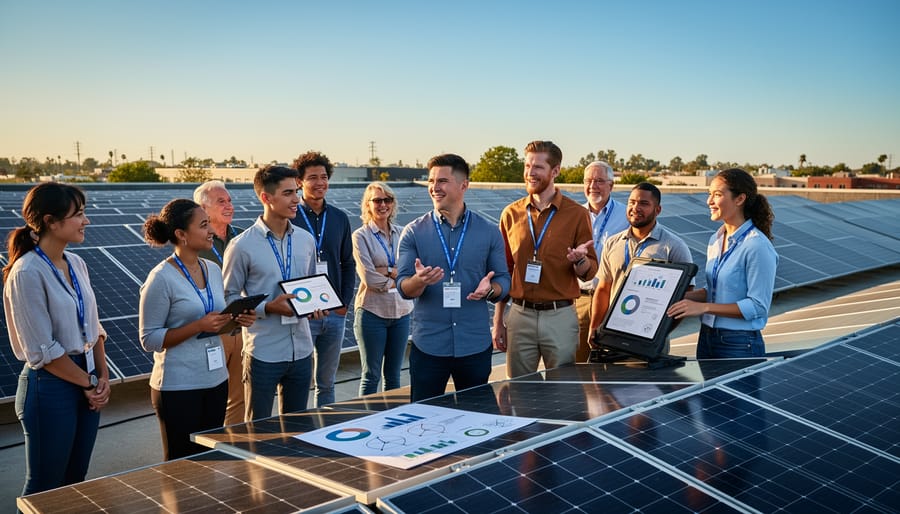
What Makes Youth Leadership Programs Effective for Solar PV Advocacy
Digital Native Advantage in Spreading Solar Awareness
Young leaders in solar photovoltaic programs possess an inherent understanding of digital ecosystems that positions them as powerful advocates for renewable energy adoption. Unlike traditional awareness campaigns that rely on print media or formal presentations, youth program participants instinctively leverage Instagram, TikTok, YouTube, and LinkedIn to create compelling narratives around solar technology. This generation’s fluency in visual storytelling, short-form video content, and viral marketing techniques enables them to translate complex photovoltaic concepts into digestible, shareable content that reaches demographics often untouched by conventional outreach methods.
The impact of youth-driven digital campaigns extends far beyond superficial engagement metrics. Student ambassadors trained through leadership programs develop sophisticated content strategies that include behind-the-scenes installation footage, time-lapse solar array construction videos, and data visualization posts showcasing real-world energy production statistics. These authentic, peer-generated materials resonate particularly well with younger homeowners, small business operators, and fellow students considering STEM careers. Many programs now collaborate with universities to establish formalized digital advocacy tracks, teaching participants content calendar development, analytics interpretation, and platform-specific optimization techniques.
Furthermore, youth leaders excel at cross-platform integration, simultaneously maintaining blogs, podcasts, and interactive webinars that deepen audience understanding of solar technology. Their adoption of digital platforms for solar education creates lasting repositories of accessible information while building engaged online communities around renewable energy topics. This multiplier effect—where each trained youth leader potentially influences hundreds or thousands of followers—represents a cost-effective, scalable approach to expanding solar PV awareness across diverse geographic and demographic boundaries.

Community Trust and Peer Influence Dynamics
Research demonstrates that youth solar advocates establish community credibility through distinct pathways that differ significantly from traditional adult-led initiatives. Studies conducted by environmental education researchers reveal that young people participating in leadership programs achieve trusted advisor status within their neighborhoods through authentic peer-to-peer communication and demonstrated technical competence. When youth participants complete rigorous photovoltaic training and share knowledge with age-appropriate enthusiasm, they create unique influence channels that bypass skepticism often directed toward commercial solar providers.
University-based research partnerships tracking grassroots solar advocacy outcomes indicate that households with youth program participants show 40 percent higher solar adoption consideration rates compared to control groups. This influence operates through multiple dynamics: parents gain exposure to renewable energy concepts through dinner table conversations, extended family members request consultations from trained youth advocates, and neighborhood networks amplify messages when delivered by trusted younger community members.
The peer influence mechanism proves particularly effective in communities traditionally underserved by solar outreach efforts. Youth advocates bridge cultural and linguistic barriers, translating complex photovoltaic concepts into accessible information while maintaining technical accuracy. Educational program offerings that incorporate community presentation components enable participants to refine communication skills while building social capital, creating sustainable networks that extend beyond individual program duration and generate measurable increases in renewable energy awareness and adoption rates.
Long-Term Industry Pipeline Development
Leadership youth programs serve as critical infrastructure investments for the photovoltaic sector, establishing pathways that convert early exposure into long-term career commitment. Research indicates that students engaged in renewable energy education between ages 14-18 demonstrate 3.5 times higher likelihood of pursuing STEM degrees with sustainability focus compared to peers without such exposure. These programs function as talent incubators, addressing the projected shortage of 500,000 skilled solar professionals needed globally by 2030.
Effective pipeline development requires structured progression from awareness to specialization. Initial solar education in schools introduces fundamental concepts, while advanced youth leadership initiatives provide hands-on system design, installation experience, and policy advocacy training. Universities collaborating with industry partners report that participants in multi-year solar programs show 68% retention rates in renewable energy career tracks through undergraduate completion.
The economic multiplier effect extends beyond individual career choices. Youth advocates educated through comprehensive photovoltaic programs become community ambassadors, influencing household adoption decisions and local policy development. A longitudinal study tracking program alumni over ten years revealed that 42% actively promoted renewable energy initiatives in professional or civic capacities, creating sustained advocacy networks that amplify program impact far beyond initial participant numbers. This sustained engagement transforms youth programs from educational exercises into strategic workforce development mechanisms.
Essential Components of Successful Youth Solar Leadership Programs
Technical Foundation: PV Fundamentals Training
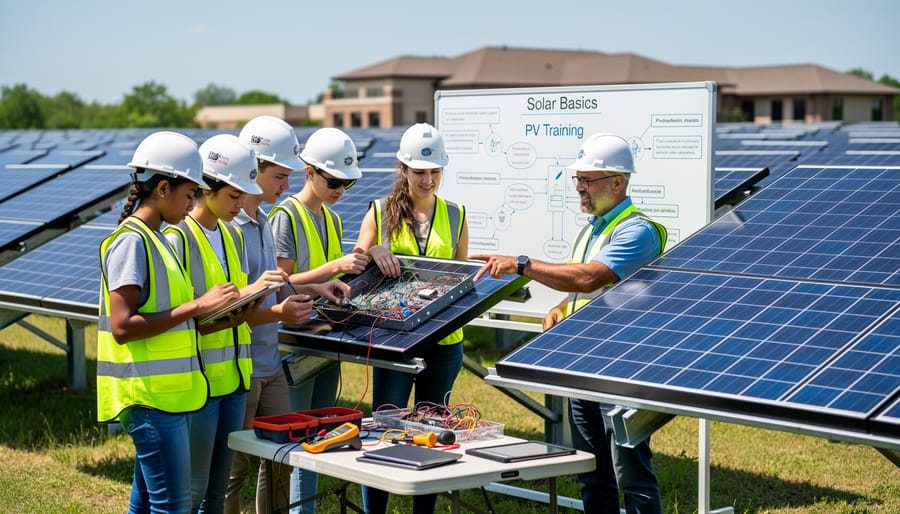
Equipping young advocates with substantive photovoltaic knowledge transforms them from enthusiastic supporters into credible ambassadors for solar energy. Effective leadership programs begin with foundational technical training that demystifies solar technology while maintaining scientific accuracy.
Core curriculum components should address photovoltaic cell physics, explaining semiconductor properties and the photovoltaic effect through accessible demonstrations rather than dense theoretical equations. Young participants need to understand how crystalline silicon, thin-film, and emerging perovskite technologies convert sunlight into electricity, including efficiency metrics and performance characteristics of different module types.
System-level education extends beyond individual panels to encompass balance-of-system components including inverters, mounting structures, and energy storage integration. Participants should grasp how residential, commercial, and utility-scale installations differ in design considerations and economic calculations. Training modules covering levelized cost of energy, payback periods, and lifecycle analysis enable youth advocates to discuss solar economics confidently with diverse audiences.
Educational institutions partnering with industry professionals deliver optimal training outcomes. Universities offering renewable energy programs provide laboratory access and expert instruction, while solar companies contribute real-world case studies and installation site visits. This collaborative approach ensures curriculum relevance to current market conditions and technological advancements.
Assessment methods should verify comprehension through practical applications rather than rote memorization, preparing participants to communicate technical concepts accurately during advocacy initiatives, community presentations, and policy discussions. This knowledge foundation distinguishes informed advocates from well-intentioned but technically unprepared supporters.
Communication and Public Speaking Skills Development
Effective youth leadership programs in the photovoltaic sector prioritize communication skills development as a cornerstone competency. Young professionals must learn to articulate complex solar energy concepts to stakeholders with varying technical backgrounds, from policymakers and investors to community members and environmental advocates. Training modules focus on translating intricate photovoltaic system designs, efficiency metrics, and economic analyses into accessible narratives that resonate with specific audiences.
Presentation technique training equips participants with structured frameworks for delivering compelling talks at industry conferences, community forums, and academic symposiums. Students practice distilling technical research findings into digestible formats, utilizing visual aids that clarify rather than complicate. Universities collaborating on these educational program offerings emphasize real-world application through simulated stakeholder meetings where participants defend renewable energy proposals before mock review boards.
Persuasive communication strategies constitute another critical component, teaching youth leaders to advocate effectively for solar adoption. Programs incorporate rhetorical techniques that blend data-driven arguments with emotional appeals, addressing both economic benefits and environmental imperatives. Participants develop messaging strategies that counter common misconceptions about photovoltaic technology while highlighting demonstrated success stories from residential and commercial installations. These communication competencies prove essential for graduates entering roles requiring public engagement, policy advocacy, or technical sales within the renewable energy sector.
University and Industry Partnerships
Strategic partnerships between universities and solar industry leaders create transformative opportunities for youth leadership training programs. These collaborations bridge the gap between theoretical knowledge and practical application, offering students direct exposure to real-world challenges in photovoltaic technology development and deployment.
Academic institutions provide the foundational research capabilities and structured learning environments, while industry partners like solar companies contribute hands-on project experience, technical expertise, and mentorship from seasoned professionals. This dual approach ensures participants gain both conceptual understanding and practical competencies essential for renewable energy careers.
Effective partnerships typically involve students working on actual industry projects, from site assessments and system design to performance analysis and optimization strategies. Through these engagements, young professionals develop critical thinking skills while addressing genuine business challenges. Industry mentors offer guidance on navigating professional environments, understanding market dynamics, and applying technical knowledge to commercial applications.
Universities benefit from these collaborations through enhanced curriculum relevance, improved student placement rates, and access to cutting-edge industry developments. Solar companies gain from fresh perspectives, potential talent recruitment, and strengthened community relationships. Most importantly, students receive authentic learning experiences that accelerate their professional development and prepare them to become innovative leaders in the rapidly evolving solar energy sector.
Project-Based Learning and Community Engagement
Effective youth leadership programs transition participants from theoretical understanding to practical application through structured project-based learning. Community solar installations serve as particularly valuable teaching opportunities, allowing students to witness the complete lifecycle of renewable energy systems while contributing tangible infrastructure to underserved neighborhoods. These installations typically involve 20-50 hours of hands-on participation, where youth engage in site assessment, stakeholder communication, and installation support under professional supervision.
School-based advocacy campaigns further reinforce leadership competencies by requiring participants to identify energy inefficiencies, propose photovoltaic solutions, and present business cases to administration. Research indicates that students who complete advocacy projects demonstrate 40% higher retention of technical concepts compared to classroom-only learners. Universities collaborating with secondary institutions have documented measurable outcomes including successful solar panel installations at 67% of participating schools within 18 months of campaign initiation.
These experiential components address multiple learning objectives simultaneously: technical knowledge application, project management skill development, and stakeholder engagement practice. Programs incorporating quarterly community projects report superior participant satisfaction and demonstrate clearer pathways to renewable energy careers, with 58% of graduates pursuing postsecondary education in related fields.
Real-World Impact: How Youth Advocates Drive Solar Adoption
Educational Outreach and Misconception Correction
Youth-led solar education initiatives have proven remarkably effective at correcting widespread misconceptions about photovoltaic technology through peer-to-peer communication strategies. These young solar advocates employ evidence-based approaches to dispel common myths such as the belief that solar panels are ineffective in cloudy climates or that manufacturing processes negate environmental benefits. In school settings, trained student ambassadors utilize interactive demonstrations with portable solar kits to illustrate fundamental concepts like energy conversion efficiency and grid-tied system functionality.
Community center workshops led by youth program participants specifically target generational knowledge gaps, addressing concerns about cost-effectiveness through life-cycle analysis presentations and real-world case studies. These sessions incorporate data visualization tools that make complex return-on-investment calculations accessible to non-technical audiences. Online engagement through moderated forums and social media platforms extends educational reach, with youth leaders providing accurate technical information about system sizing, inverter technology, and maintenance requirements. This multi-channel approach ensures consistent messaging while adapting content delivery methods to diverse learning preferences. University partnerships enhance program credibility by providing access to research data and technical validation, enabling youth educators to reference peer-reviewed studies when countering misinformation about panel degradation rates or recyclability concerns.

Policy Influence and Youth-Led Campaigns
Youth-led campaigns have demonstrated remarkable effectiveness in accelerating renewable energy adoption at multiple governance levels. In California, student advocates from the Solar Youth Leadership Initiative successfully lobbied their school district to install 2.3 MW of solar capacity across twelve facilities, reducing annual energy costs by $340,000 while creating hands-on learning opportunities for 8,500 students. This campaign established a replicable model that other districts have since adopted.
At the municipal level, youth coalitions in Boulder, Colorado partnered with university sustainability departments to present data-driven proposals that influenced the city’s Community Solar Garden program. These young advocates conducted energy audits, developed financial models, and testified before city council, ultimately contributing to policy amendments that expanded low-income household access to community solar by 28 percent.
School board advocacy represents another critical arena where youth leadership programs have generated measurable impact. In Maryland, students trained through renewable energy leadership curricula successfully advocated for incorporating solar technology coursework into standard science requirements, affecting approximately 45,000 students annually. These campaigns typically combine technical knowledge with strategic communication skills, enabling young advocates to bridge gaps between scientific evidence and policy implementation. Research partnerships with academic institutions have strengthened these efforts by providing empirical support for proposed initiatives, demonstrating that youth-led advocacy, when properly structured and supported, can materially influence renewable energy policy outcomes.
Measurable Adoption Increases
Empirical evidence demonstrates a measurable correlation between youth-led solar advocacy initiatives and subsequent increases in photovoltaic installations within their communities. A 2021 study by the National Renewable Energy Laboratory documented that communities with active student solar ambassador programs experienced an average 23% increase in residential solar adoption over three-year periods compared to demographically similar control groups. This uptick is attributed to peer-to-peer education networks and enhanced community trust in renewable technology when endorsed by local youth advocates.
Research from Stanford University’s Precourt Institute for Energy further validates these findings, revealing that neighborhoods where students conducted door-to-door solar education campaigns saw installation rates climb by 18-31% within two years. The data suggests that youth participants effectively bridge generational knowledge gaps, translating technical photovoltaic concepts into accessible language for diverse audiences. Additionally, universities collaborating with secondary schools on solar workforce development programs reported that 64% of participating students influenced household energy decisions, with 42% of families subsequently requesting solar assessments.
Building Your Youth Solar Leadership Initiative: Practical Implementation
Curriculum Design and Resource Development
Effective curriculum design for solar photovoltaic leadership programs requires a structured approach that bridges theoretical foundations with practical application. Educational frameworks should incorporate modular content delivery, beginning with fundamental concepts such as semiconductor physics and photon absorption, then progressing to system design, performance optimization, and industry economics. Research demonstrates that scaffolded learning structures, where each module builds upon previous knowledge, enhance retention rates among young learners by approximately 40 percent compared to linear instruction methods.
Resource development must balance technical rigor with age-appropriate engagement strategies. Successful programs integrate interactive simulations that visualize electron movement in PV cells, hands-on assembly of small-scale solar installations, and collaborative projects addressing real-world energy challenges in local communities. Collaboration with universities provides access to research-grade equipment and subject matter experts who can validate technical accuracy while adapting complex principles for youth comprehension.
Assessment tools should measure both knowledge acquisition and leadership competency development. Portfolios documenting project progression, peer evaluations of team contributions, and presentations to industry stakeholders create multiple evaluation touchpoints. Digital platforms enable tracking individual progress through competency matrices aligned with industry standards established by organizations such as the North American Board of Certified Energy Practitioners. Content repositories should remain flexible, allowing periodic updates reflecting technological advances in bifacial modules, perovskite materials, and energy storage integration to maintain curriculum relevance.
Recruitment and Sustained Engagement Strategies
Successful recruitment begins with partnering with educational institutions and community organizations that serve environmentally conscious students. Universities with renewable energy programs often provide access to motivated candidates through existing academic networks. Program coordinators should establish clear selection criteria emphasizing demonstrated interest in sustainability, leadership potential, and commitment to the photovoltaic sector rather than solely academic performance. Application processes incorporating project proposals or essays on solar energy solutions help identify genuinely passionate participants.
Sustained engagement requires structured pathways that connect program activities to tangible career outcomes. Implementing mentorship programs pairing youth with industry professionals creates accountability and provides real-world context for technical learning. Regular interaction with solar installation teams, research laboratories, and project development firms maintains participant interest by demonstrating practical applications of acquired knowledge. Recognition systems acknowledging achievements through certifications, public presentations at renewable energy conferences, and documentation of contributions to actual photovoltaic projects reinforce program value.
Retention improves when participants receive progressive responsibilities aligned with skill development. Advanced students might transition into peer teaching roles, assist with curriculum development, or contribute to collaborative research initiatives with university partners. Creating alumni networks that track career progression in the solar industry provides both inspiration for current participants and valuable data demonstrating program effectiveness to stakeholders and potential funders.
Measuring Program Success and Advocacy Impact
Effective evaluation frameworks incorporate both quantitative and qualitative metrics to assess program outcomes comprehensively. Participant development tracking should include pre- and post-program surveys measuring knowledge acquisition in photovoltaic technology, leadership competencies, and career interest in renewable energy sectors. Universities collaborating on these initiatives often employ validated assessment instruments such as the Student Leadership Practices Inventory or customized rubrics aligned with solar industry competencies.
Key performance indicators for youth leadership programs should track technical proficiency gains, measured through hands-on assessments of solar installation capabilities or system design projects. Additionally, evaluators should monitor participant engagement levels through attendance records, project completion rates, and continued involvement in renewable energy activities following program conclusion. Longitudinal studies following alumni career pathways provide valuable data on long-term workforce development impact.
Broader advocacy outcomes require distinct measurement approaches. Program administrators should document community outreach reach through metrics such as solar awareness presentations delivered, households educated about photovoltaic benefits, and media impressions generated by youth-led initiatives. Survey instruments deployed in target communities before and after advocacy campaigns can quantify shifts in renewable energy perception and adoption intentions.
Educational institutions offering these programs benefit from establishing data collection protocols from inception, enabling continuous improvement cycles. Successful evaluation frameworks balance rigorous academic assessment methodologies with practical implementation considerations, ensuring sustainability while generating evidence that attracts ongoing funding and stakeholder support for expanding youth engagement in the solar industry.
The Future: Youth Leadership as Solar Industry Strategy
The solar photovoltaic industry stands at a critical juncture where youth leadership programs must transition from peripheral community engagement efforts to core strategic initiatives. Industry projections indicate that the global solar workforce will need to expand by 63% by 2030 to meet installation targets, creating an unprecedented talent acquisition challenge that traditional recruitment methods cannot adequately address. Organizations that strategically invest in youth development today are positioning themselves to capture tomorrow’s most innovative minds while simultaneously building brand loyalty among the next generation of decision-makers.
Several scaling trends are reshaping how leading solar companies approach youth program development. Virtual and hybrid program models have expanded geographic reach beyond traditional constraints, enabling organizations to engage students in underserved markets without prohibitive travel costs. University partnerships are evolving from occasional guest lectures to integrated curriculum development, where industry professionals co-design coursework that bridges academic theory with real-world application. These collaborations create talent pipelines that reduce onboarding time for new hires while ensuring graduates possess immediately applicable skills.
Data analytics are becoming central to program optimization, with sophisticated tracking systems measuring not only participation rates but also long-term career trajectory outcomes. Companies implementing comprehensive youth engagement strategies report 40% higher retention rates among employees who first encountered their organization through educational programs during high school or university years. This retention advantage translates directly to reduced recruitment costs and enhanced institutional knowledge preservation.
Emerging program innovations include micro-credentialing pathways that allow students to accumulate verified competencies before entering the workforce, and competition-based learning models that challenge youth teams to solve actual industry problems. Forward-thinking organizations are also establishing youth advisory boards that provide authentic input on product development, marketing strategies, and corporate sustainability initiatives, recognizing that young people offer invaluable perspectives on long-term market trends.
The competitive advantage lies not in whether to invest in youth leadership development, but in how rapidly organizations can implement comprehensive, measurable programs that align with broader business objectives while genuinely serving educational needs.
Youth leadership programs in photovoltaic technology represent a strategic investment that yields compound returns for the renewable energy sector. By equipping young people with technical knowledge, communication skills, and authentic enthusiasm for solar solutions, these initiatives simultaneously cultivate the next generation of industry professionals while accelerating present-day adoption through peer-to-peer advocacy that resonates far more effectively than traditional marketing approaches.
The evidence demonstrates that participants in structured leadership programs become credible ambassadors who translate complex technical concepts into accessible narratives for their communities. This grassroots advocacy addresses one of the most persistent barriers to solar adoption: the knowledge gap that prevents potential adopters from making informed decisions. When young leaders share their understanding with parents, neighbors, and community organizations, they create trusted pathways for information that commercial entities cannot replicate.
Organizations like Mose Solar exemplify industry commitment to youth development through comprehensive educational program offerings that extend beyond basic technical training. Their model demonstrates how photovoltaic companies can integrate workforce development with community engagement, creating pipelines of skilled professionals while simultaneously expanding market awareness. This approach transforms education from a corporate social responsibility initiative into a core business strategy with measurable returns.
Moving forward requires coordinated action from multiple stakeholders. Industry professionals should partner with educational institutions to provide mentorship, internship opportunities, and real-world project access for student leaders. Educators must advocate for curriculum integration that positions photovoltaic technology as a viable career pathway rather than a niche specialty. Students interested in renewable energy should actively seek leadership opportunities through existing programs or work with schools to establish new initiatives. Policymakers and community organizations can facilitate program development through funding support and partnership frameworks.
The transition to sustainable energy systems depends not only on technological advancement but on cultivating informed advocates who understand both the technical merit and societal imperative of solar solutions. Youth leadership programs bridge this gap, creating a multiplier effect where education investment generates immediate advocacy impact while building long-term industry capacity. The question is no longer whether to invest in youth leadership development, but rather how quickly stakeholders can scale these proven models to meet the urgency of our energy transition.