Showing 70 Result(s)
Gloved hands hold a curved semi-transparent flexible solar panel against a modern glass facade, backlit by golden-hour sunlight with a softly blurred city skyline behind.

Organic Solar Panels Are Reshaping the Future of Renewable Energy

The global solar energy market stands at a critical inflection point. While silicon-based photovoltaic systems dominate current installations, their manufacturing costs, material rigidity, and energy-intensive production processes create significant barriers to universal adoption. Organic solar panels—photovoltaic devices utilizing carbon-based semiconducting materials—represent a transformative alternative that addresses these fundamental limitations through innovative hybrid material architectures.
Unlike conventional crystalline silicon panels, organic photovoltaics leverage lightweight polymers and small organic molecules …

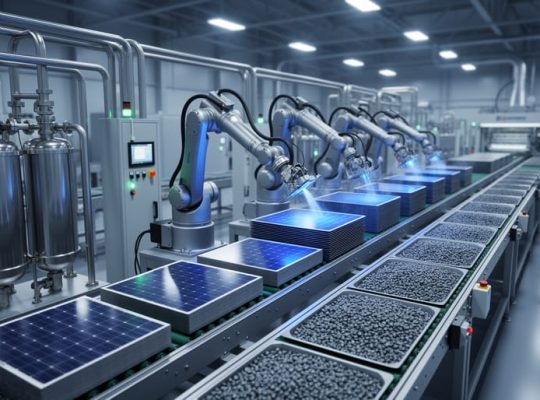
Wide view of a clean solar panel manufacturing line with robotic arms moving blue silicon wafers, closed-loop stainless pipes and filtration tanks reclaiming slurry, and trays of recovered silicon pellets on conveyors, with technicians in cleanroom suits softly blurred in the background.

How Zero Waste Production Is Transforming Solar Panel Manufacturing

The photovoltaic manufacturing industry stands at a critical juncture where environmental responsibility directly intersects with economic viability. Zero waste production represents a paradigm shift that transforms conventional solar panel manufacturing from a linear resource-consumption model into a circular ecosystem where every material input serves a purpose and nothing exits as waste. This approach transcends simple recycling initiatives—it fundamentally redesigns production processes to eliminate waste generation at the source, recover valuable materials from production byproducts, and establish closed-loop systems that …

Low-angle view of a modern office tower with semi-transparent photovoltaic glass facade and solar roof canopy at golden hour, with a softly blurred city skyline and pedestrians in the background.

How BIPV Panels Transform Buildings Into Power Generators

Building-Integrated Photovoltaics (BIPV) represent a transformative shift in solar energy technology, where photovoltaic materials replace conventional building components while simultaneously generating electricity. Unlike traditional rack-mounted solar panels added after construction, BIPV systems serve dual functions as both architectural elements and power generators, integrated directly into facades, roofing, windows, and shading devices during the construction phase.
The global BIPV market has accelerated dramatically as architects, engineers, and developers recognize the aesthetic and functional advantages of seamlessly …

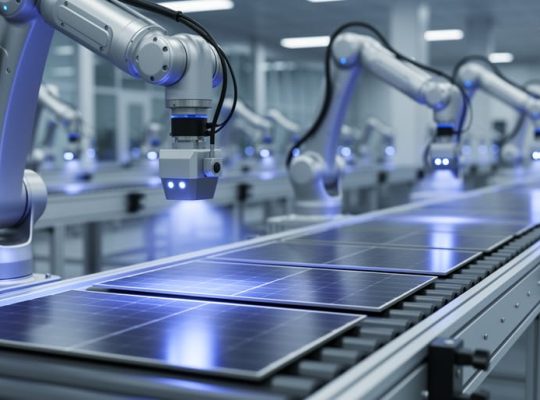
Robotic arms and laser metrology sensors inspect silicon solar cells on a moving conveyor inside a modern, spotless solar panel manufacturing line, with automated stations fading into the background.

How Inline Metrology and PAT Transform Solar Panel Production Lines

The solar photovoltaic industry has undergone a fundamental transformation, evolving from labor-intensive assembly processes to sophisticated automated production lines where precision meets scale. Modern PV manufacturing facilities now operate with inline metrology systems that measure critical parameters in real-time, detecting defects measured in micrometers while panels move at speeds exceeding one unit per minute. This integration of Process Analytical Technology (PAT) automation has reduced manufacturing defects by up to 40% while simultaneously increasing throughput, fundamentally changing quality assurance from reactive inspection …

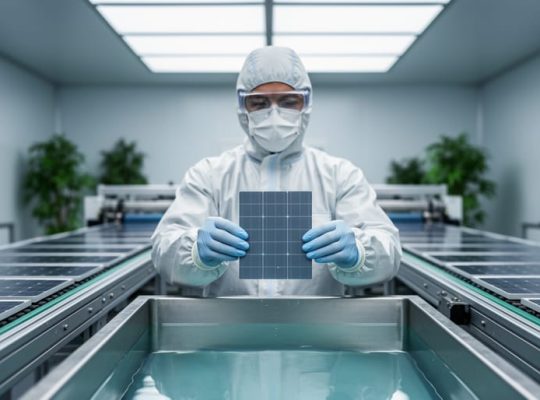
Cleanroom technician in protective suit holding a silicon wafer above a clear liquid bath on an automated solar panel production line, with conveyors of cells and softly lit indoor plants blurred in the background.

How Green Chemistry Is Transforming Solar Panel Production (And Why It Matters)

Green chemistry is revolutionizing photovoltaic manufacturing by replacing hazardous substances with safer alternatives that protect workers, communities, and ecosystems without compromising solar panel performance. The solar industry faces a critical paradox: while producing clean energy technology, conventional PV manufacturing relies on toxic chemicals including hydrofluoric acid, lead-based pastes, and chlorinated solvents that pose significant environmental and occupational health risks.
This transformation addresses three urgent priorities. First, regulatory pressure from the European Union’s REACH directive and similar …

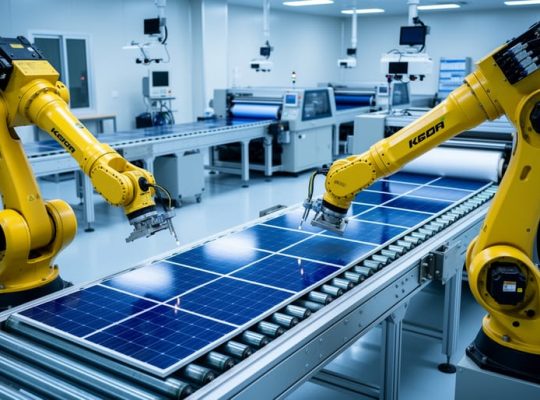
Two industrial robotic arms place blue silicon solar cells onto an automated conveyor inside a cleanroom solar panel factory, with machine vision cameras and a long production line softly blurred in the background.

How Robots Are Revolutionizing Solar Panel Production Lines

The transformation of silicon wafers into high-performance solar photovoltaic modules represents one of modern manufacturing’s most sophisticated achievements, blending precision engineering with automation technologies that determine the global renewable energy landscape. Today’s solar panel production facilities operate as integrated ecosystems where raw materials journey through twelve distinct stages—from silicon ingot casting to final electrical testing—with tolerances measured in micrometers and quality standards that reject modules showing even microscopic defects.
Understanding this manufacturing process has …

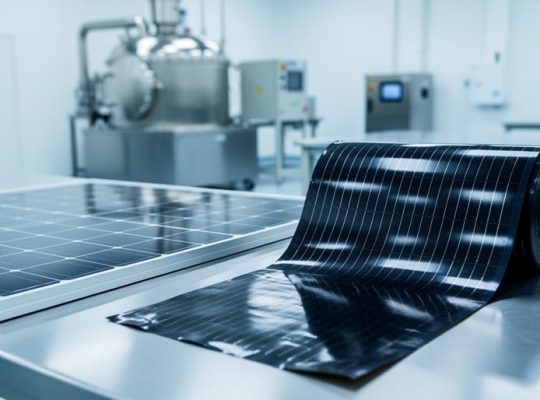
Monocrystalline solar panel section with square cells next to a flexible amorphous thin-film sheet unwinding from a roll on a clean factory bench, shot from a 45-degree angle above with soft diffused lighting and blurred crystal growth and deposition equipment in the background.

Why Monocrystalline Panels Outperform Amorphous Solar Technology (Manufacturing Secrets Revealed)

The performance gap between monocrystalline and amorphous solar panels originates in their fundamentally different manufacturing processes, where silicon crystal structure determines everything from efficiency ratings to real-world applications. Monocrystalline technology produces panels reaching 20-22% efficiency through precision cultivation of single silicon crystals, while amorphous thin-film variants achieve 6-10% efficiency by depositing non-crystalline silicon layers onto substrates.
Understanding this manufacturing distinction matters because production methods directly influence cost structures, energy payback periods, …

Gloved hands hold a thin, flexible perovskite solar cell sheet in sharp focus, with a field of rigid crystalline silicon panels blurred in the background under warm daylight.

Perovskite Solar Cells Could Replace Silicon (But There’s a Catch)

The solar industry stands at a pivotal crossroads as perovskite solar cells emerge to challenge silicon’s four-decade dominance of the photovoltaic market. Silicon currently commands over 95% of global solar installations, yet perovskite technology has achieved a remarkable efficiency leap from 3.8% to over 26% in just fifteen years—a progression that took silicon nearly half a century. This unprecedented advancement has sparked intense debate among researchers, manufacturers, and investors about whether perovskites represent an evolutionary improvement or a revolutionary replacement for conventional silicon panels.

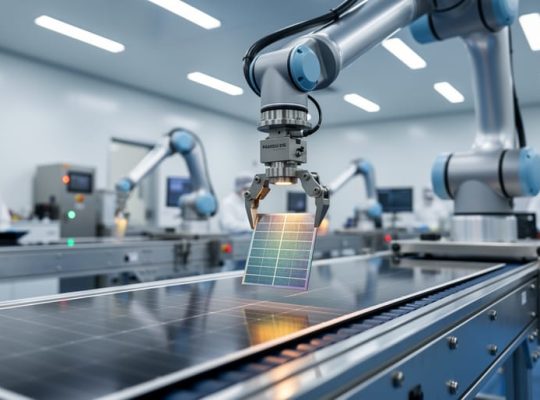
Robotic arm placing a shimmering perovskite–silicon tandem solar cell onto a conveyor in a cleanroom solar factory, 45-degree angle from above, crisp LED lighting, shallow depth of field with blurred automated equipment and technicians in the background.

How Manufacturing Breakthroughs Are Making Solar Panels 40% More Efficient

Solar energy manufacturing stands at an inflection point where production innovations directly determine the technology’s accessibility, affordability, and global adoption potential. The photovoltaic industry has achieved remarkable cost reductions—dropping from $76 per watt in 1977 to under $0.30 per watt today—through systematic manufacturing improvements that span material science breakthroughs, automated production processes, and advanced facility designs.
Manufacturing efficiency drives this transformation. When production lines increase throughput by 15-20% through robotic automation, those savings cascade to …

Robotic arms place blue-black solar cells onto a conveyor in a brightly lit factory, with additional assembly lines, autonomous mobile robots, and machine-vision cameras visible in the background.

Inside JA Solar’s Global Manufacturing Network: How Automation Drives PV Module Production

JA Solar operates one of the world’s most sophisticated networks of photovoltaic manufacturing facilities, combining strategic geographic positioning with cutting-edge automation to produce over 60 gigawatts of solar modules annually. The company’s manufacturing footprint spans key locations across China, Vietnam, Malaysia, and the United States, each facility engineered to leverage advanced robotics, artificial intelligence-driven quality control, and Industry 4.0 integration that sets new standards for efficiency and precision in solar panel production.
Understanding where and how JA Solar manufactures its products …

Monocrystalline silicon ingot being pulled from a glowing crucible in a cleanroom, with a polycrystalline silicon block and wafer slices blurred on a nearby stainless workbench

Why Monocrystalline Panels Cost More (And What Happens During Production)

The silicon wafer beneath every solar panel tells a story of manufacturing precision that directly determines energy output, production costs, and long-term system performance. Monocrystalline and polycrystalline technologies diverge at the crystallization stage—where molten silicon either forms a single, uniform crystal structure or multiple crystal fragments—creating fundamental differences that cascade through efficiency ratings, temperature coefficients, space requirements, and ultimately, project economics.
Understanding these manufacturing distinctions empowers photovoltaic professionals to make informed specification …

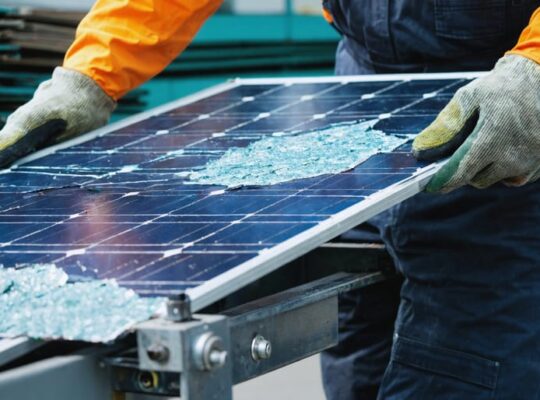
Worker in safety gear lifting a cracked solar panel onto a conveyor inside a recycling facility, with stacks of decommissioned panels and sorting machinery softly blurred in the background under diffused daylight.

Why Solar Panels Are Becoming a Waste Crisis (And How Recycling Can Fix It)

The solar photovoltaic industry faces a mounting crisis: by 2050, an estimated 78 million metric tons of solar panel waste will require processing, yet fewer than 10% of decommissioned panels currently enter specialized recycling streams. This looming environmental challenge threatens to undermine solar energy’s sustainability credentials precisely when global renewable capacity must triple to meet climate targets.
Traditional waste management approaches—landfilling intact panels or crude dismantling—recover minimal value while releasing hazardous materials including lead, cadmium, and selenium into soil and groundwater. …

Close-up of a solar panel’s laminated edge showing transparent encapsulant over blue photovoltaic cells with water droplets on the outer glass, blurred rows of panels and cloudy sky in the background, lit by soft diffused daylight

Why Your Solar Panels Fail Early (And How Advanced Encapsulation Stops It)

# Advanced Encapsulation Materials: The Critical Barrier Between Solar Cells and Environmental Degradation
Encapsulation materials serve as the primary defense system protecting photovoltaic cells from moisture ingress, UV radiation, thermal stress, and mechanical damage—factors that can reduce panel efficiency by up to 30% within the first decade of operation. These polymer-based layers, typically ethylene vinyl acetate (EVA) or emerging alternatives like polyolefin elastomers (POE) and thermoplastic polyurethane (TPU), must maintain optical transparency exceeding 90% while withstanding temperature fluctuations from -40°C to 85…

Engineer in an ESD lab coat and safety glasses inspects blue solar cells on an automated conveyor while robotic arms and IoT sensors operate in a cleanroom factory setting.

How IoT Integrators Are Transforming Solar PV Manufacturing Efficiency

The solar photovoltaic manufacturing landscape is undergoing a fundamental transformation as Internet of Things (IoT) technology revolutionizes production efficiency, quality control, and operational intelligence. IoT integrators serve as the critical bridge between traditional manufacturing systems and smart, data-driven operations—professionals who design, implement, and optimize interconnected sensor networks, automation systems, and analytical platforms that enable solar manufacturers to achieve unprecedented levels of productivity and precision.
In an industry where marginal efficiency gains translate directly to competitive …

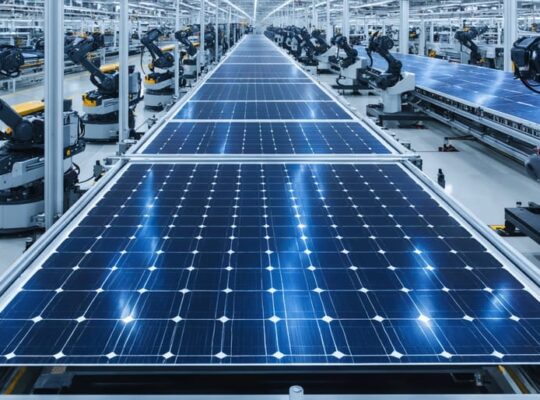
"Interior view of a solar panel manufacturing facility with gleaming photovoltaic modules on a production line and blurred machinery in the background."

Inside Modern Solar Panel Manufacturing: From Silicon to High-Efficiency PV Modules

The evolution of photovoltaic cell production represents one of modern manufacturing’s most sophisticated achievements, combining precision engineering with cutting-edge materials science. From silicon purification to module assembly, this intricate process transforms raw materials into high-efficiency solar panels that power our renewable energy future. Recent technological breakthroughs, including automated production lines and advanced quality control systems, have revolutionized …