Showing 25 Result(s)
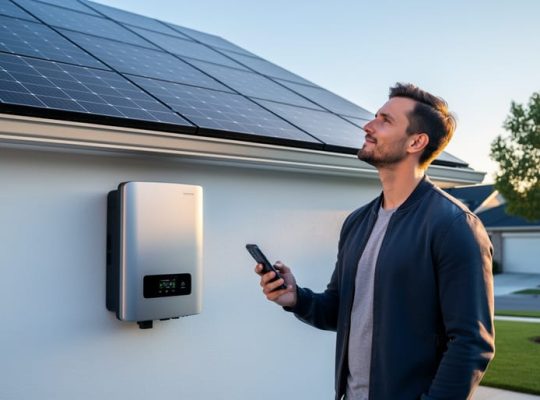
Homeowner beside wall-mounted solar inverter and battery, checking a smartphone while looking toward rooftop solar panels on a suburban house at golden hour.

How Smart Home Integration Transforms Your DIY Solar Panel System

Installing your own solar panel system requires methodical planning that begins with accurate energy consumption assessment—calculate your household’s average daily kilowatt-hour usage over the past 12 months to determine appropriate system sizing. Conduct a comprehensive structural evaluation of your roof’s load-bearing capacity, orientation, and shading patterns throughout seasonal variations, ensuring compatibility with photovoltaic array mounting requirements before purchasing any equipment.
Select components that align with your technical proficiency level and budget constraints: monocrystalline panels typically …


Technician in safety harness inspecting residential rooftop solar panels with a homeowner nearby, under soft daylight, with suburban houses and trees blurred in the background

What Your Solar Panel Warranty Actually Covers (And What It Doesn’t)

**Understand the three-tier warranty structure before signing any solar contract.** Product warranties cover manufacturing defects in panels themselves (typically 10-25 years), performance warranties guarantee minimum power output levels (usually 25-30 years at 80-90% capacity), and workmanship warranties protect installation quality (commonly 1-10 years). Each operates independently, meaning a panel producing adequate power under warranty may still have unaddressed physical defects if the product warranty has expired.
**Examine exclusion clauses that void coverage despite valid warranty periods.** Most manufacturers deny claims for…

Homeowner at kitchen table holding a calculator next to unlabeled bills, looking through a window at sunlit rooftop solar panels; soft natural light with slightly blurred suburban rooftops in the background.

Why Payday Loans Are the Wrong Way to Pay for Solar Panels

**Avoid payday loans entirely for solar panel financing—these short-term, high-interest products fundamentally contradict the long-term investment nature of photovoltaic systems.** While low apr payday loans may seem accessible when facing upfront solar costs, their typical 14-30 day repayment terms and APRs exceeding 400% create financial distress rather than solutions.
Solar installations represent capital investments spanning 25-30 years, requiring financing mechanisms aligned with their extended payback periods and energy savings trajectories. Payday loans, designed for emergency …

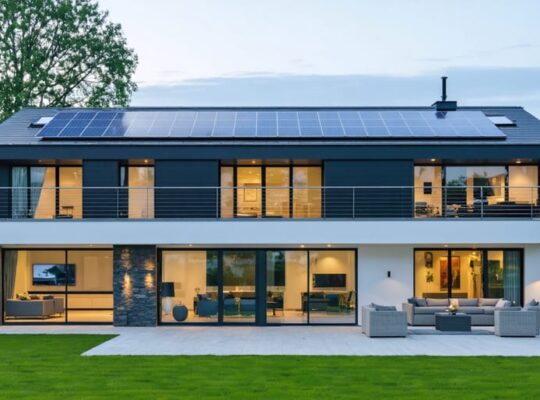
"Exterior view of a contemporary zero-energy home with solar panels on the roof and large windows showcasing eco-friendly design."

Zero Energy Homes Are Here: The Future of Smart Home Living Is Now

Zero-energy homes represent the pinnacle of sustainable architecture, combining cutting-edge technology with intelligent design to achieve net-zero energy consumption. These revolutionary dwellings produce as much energy as they consume annually through an integrated system of advanced building techniques, renewable energy generation, and smart home technologies. By leveraging solar photovoltaic systems, superior insulation, energy-efficient appliances, and sophisticated energy management systems, zero-energy homes are reshaping our approach to residential construction and environmental stewardship.
As climate change concerns …

A yacht gliding through the ocean, with flexible solar panels perfectly integrated onto its deck surface, illustrating their sleek and lightweight design for marine applications.

Flexible Solar Panels That Actually Work on Your Boat (Expert-Tested Solutions)

Choosing the right flexible solar panels for your boat demands a precise balance between power output, durability, and marine-specific design features. Today’s marine-grade flexible panels deliver up to 23% efficiency while weighing 70% less than rigid alternatives, making them ideal for curved surfaces and weight-sensitive vessel installations. Recent advances in photovoltaic technology have introduced salt-water resistant materials and enhanced UV protection, specifically engineered for the harsh marine environment. Leading models now incorporate ETFE coatings and marine-grade adhesives, ensuring reliable performance through …

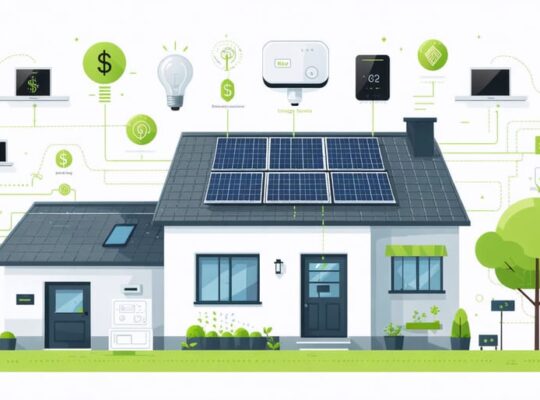
Illustration of a smart home setup with connected devices like a thermostat, smart lighting, solar panels, and a central hub, highlighted alongside elements representing energy savings and a graph showing reduced energy consumption.

Smart Home Tech Actually Saves You Money (Here’s The Real Data)

Smart home technology promises significant energy savings and enhanced convenience, but the reality demands careful cost-benefit analysis. Recent studies indicate that properly implemented smart home systems reduce energy consumption by 15-30% on average, translating to annual savings of $300-$600 for typical households. However, with initial investment costs ranging from $2,000 to $15,000 for comprehensive systems, the financial breakeven point often extends beyond five years.
The integration of smart thermostats, automated lighting, and intelligent power management systems creates a synergistic ecosystem that optimizes energy …

A modern house with rooftop solar panels and digital interface overlay showing energy efficiency and savings metrics, illustrating smart home technology.

Smart Home Upgrades That Slash Your Energy Bills Today

Transform your home into an energy-efficient powerhouse by integrating smart thermostats, automated lighting controls, and advanced HVAC systems that can cut your energy bills by up to 30%. Modern efficiency upgrades leverage IoT technology to optimize energy consumption through real-time monitoring and automated adjustments, delivering substantial returns on investment while reducing environmental impact.
Strategic implementation of home efficiency solutions combines building envelope improvements—…

Illustration of a smart home with interconnected devices like solar panels, smart thermostats, and automated lighting, showcasing energy efficiency and modern technology integration.

Smart Home Tech That Actually Cuts Your Energy Bills

Transform your living space into an intelligent ecosystem with modern smart home automation systems that revolutionize daily living. Advanced technologies like AI-powered thermostats reduce energy consumption by up to 23% annually, while integrated security systems with facial recognition and real-time monitoring provide enterprise-grade protection. Smart lighting solutions automatically adjust based on natural light levels and occupancy patterns, optimizing both comfort and efficiency. …

Conceptual image depicting a solar panel with adjustable tilt angles, surrounded by symbols of data analytics, automated cleaning systems, and smart inverter technologies, representing advanced methods to enhance solar energy output.

Proven Methods to Boost Your Solar Panel Power Output

Optimize solar panel orientation to capture maximum sunlight throughout the day by adjusting tilt angles seasonally – typically latitude plus 15 degrees in winter and latitude minus 15 degrees in summer. Install advanced monitoring systems with real-time performance analytics to detect efficiency drops and maintenance needs immediately, ensuring consistent power generation. Implement automated cleaning systems and anti-soiling coatings to maximize rooftop solar efficiency by preventing dust and debris accumulation, which can reduce output …

A split view of a residential roof displaying solar shingles on the left and traditional solar panels on the right, illustrating the aesthetic and functional differences between the two renewable energy solutions.

Solar Shingles vs Panels: Real Cost Comparison for Your Home

Solar shingles and traditional solar panels present distinctly different investment propositions for homeowners seeking renewable energy solutions. While solar shingles vs solar panels both convert sunlight into electricity, their cost structures vary significantly. Solar shingles typically command $20-25 per square foot installed, approximately 15-20% higher than conventional solar panels at $15-20 per square foot. This premium reflects their dual functionality as both roofing material and power generators.
For a 2,000-square-foot residential …