As the global shift toward renewable energy accelerates, the choice between monocrystalline and polycrystalline solar panels emerges as a critical decision for both residential and commercial installations. These two prominent photovoltaic technologies, while sharing the same fundamental purpose of converting sunlight into electricity, exhibit distinct characteristics that significantly impact their performance, cost-effectiveness, and suitability for different applications. Understanding these differences has become increasingly important as solar technology continues to evolve, with each type offering unique advantages that cater to specific installation requirements and environmental conditions. This comprehensive comparison delves into the manufacturing processes, efficiency ratings, and practical considerations that distinguish monocrystalline from polycrystalline panels, empowering readers to make informed decisions about their solar investments. With global solar capacity reaching record levels and installation costs steadily declining, knowing the nuances between these technologies has never been more relevant for sustainability-focused consumers and industry professionals alike.

Manufacturing Process: The Foundation of Performance
Monocrystalline Production
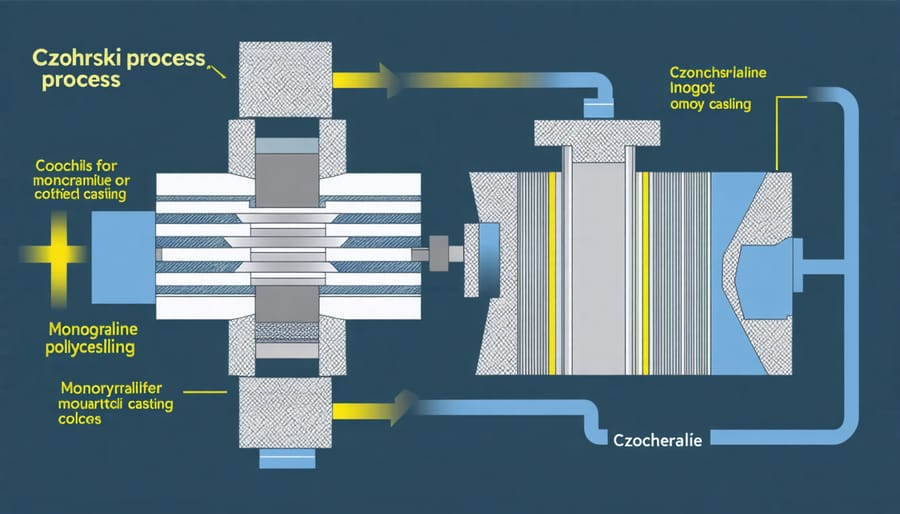
The production of monocrystalline solar panels centers on the Czochralski process, a sophisticated method that creates highly pure single-crystal silicon. This process begins with high-grade silicon that’s melted in a crucible at approximately 1,425°C. A precisely oriented seed crystal is then dipped into the molten silicon and slowly withdrawn while rotating, allowing the liquid silicon to solidify around it in a uniform crystalline structure.
As demonstrated by latest advances in solar technology, this careful extraction creates a cylindrical ingot of single-crystal silicon, characterized by its consistent molecular alignment. The ingot is subsequently trimmed and sliced into thin wafers, typically 150-180 micrometers thick, using specialized diamond wire saws.
The meticulous nature of this process contributes to higher production costs but yields silicon wafers with superior electronic properties. The uniform crystal structure minimizes internal energy losses, allowing for better electron flow and higher conversion efficiency. This crystalline perfection is what gives monocrystalline cells their characteristic deep black color and distinguished performance capabilities.
Polycrystalline Production
The production of polycrystalline solar panels begins with the melting of raw silicon at temperatures exceeding 1,500°C. Unlike monocrystalline manufacturing, multiple silicon fragments are melted together in large crucibles, allowing multiple crystal structures to form during the cooling process. This results in a distinctive speckled blue appearance due to the varied crystal orientations.
The molten silicon is carefully poured into square molds where it’s allowed to cool and solidify in a controlled environment. During solidification, multiple crystal structures develop naturally, creating boundaries between different crystal formations. These boundaries, known as grain boundaries, are characteristic of polycrystalline silicon and influence the panel’s electrical properties.
The resulting silicon ingot undergoes a similar cutting and processing procedure as monocrystalline silicon, but the manufacturing process is generally less energy-intensive and more cost-effective. The square ingots also produce less waste during the cutting process compared to cylindrical monocrystalline ingots, contributing to lower production costs.
This simplified manufacturing approach makes polycrystalline panels more economical to produce at scale, though the multiple crystal structures typically result in lower efficiency compared to their monocrystalline counterparts.
Efficiency and Performance Comparison
Energy Conversion Rates
Energy conversion efficiency represents a crucial differentiator between monocrystalline and polycrystalline solar panels. Monocrystalline panels typically achieve efficiency rates between 15-22%, with premium models reaching up to 25% in optimal conditions. This superior efficiency is attributed to their single-crystal structure, which allows for better electron flow and enhanced light absorption. Recent solar panel efficiency breakthroughs have pushed these boundaries even further.
Polycrystalline panels, by comparison, generally operate at efficiency rates between 13-17%. This lower conversion rate results from energy losses at the crystal boundaries within their multi-crystal structure. When examining power output per square meter, a typical monocrystalline panel produces 190-230 watts, while polycrystalline panels generate 180-200 watts under identical conditions.
These efficiency differences become particularly significant in space-constrained installations. For instance, to achieve a 5kW system output, you would need approximately 20 monocrystalline panels versus 25 polycrystalline panels, assuming standard panel dimensions. The higher efficiency of monocrystalline panels also translates to better performance in low-light conditions and higher temperatures, maintaining more consistent power output throughout varying environmental conditions.
Understanding these conversion rates is essential for system design and ROI calculations, as they directly impact the total area required for installation and the overall energy generation capacity of the system.
Temperature Performance
Temperature significantly impacts the performance of both monocrystalline and polycrystalline solar panels, with each type exhibiting distinct characteristics under varying thermal conditions. Monocrystalline panels typically demonstrate superior temperature coefficients, ranging from -0.3% to -0.4% per degree Celsius above standard testing conditions (25°C). This means they experience a smaller reduction in power output as temperatures rise compared to their polycrystalline counterparts.
Polycrystalline panels generally have temperature coefficients between -0.4% and -0.5% per degree Celsius, making them slightly more susceptible to efficiency losses in high-temperature environments. This difference stems from the inherent crystalline structure and manufacturing processes of each panel type. The uniform crystal arrangement in monocrystalline cells allows for better electron flow even at elevated temperatures.
In practical terms, a monocrystalline panel rated at 300W might lose approximately 0.9-1.2W per degree above 25°C, while a polycrystalline panel of similar rating could lose 1.2-1.5W. This variation becomes particularly relevant in regions with hot climates or during peak summer months. However, both panel types perform optimally in cooler conditions, with efficiency improving as temperatures drop below the standard testing temperature.
Understanding these temperature-related performance characteristics is crucial for system design and location-specific installations, as it directly affects the overall energy yield and system efficiency throughout the year.
Cost Analysis and ROI
When evaluating solar panel investments, understanding the cost implications of monocrystalline and polycrystalline options is crucial for choosing the best solar panels for your specific needs. Monocrystalline panels typically command a 10-15% higher initial cost compared to their polycrystalline counterparts, primarily due to their more refined manufacturing process and higher silicon purity levels.
The average cost per watt for monocrystalline panels ranges from $1.00 to $1.50, while polycrystalline panels generally cost between $0.90 to $1.20 per watt. However, this price differential should be considered alongside efficiency ratings and space requirements. Monocrystalline panels’ higher efficiency often means fewer panels are needed to achieve the desired power output, potentially reducing overall installation costs and space requirements.
Return on investment (ROI) calculations reveal interesting patterns. While monocrystalline panels have a higher upfront cost, their superior efficiency and performance in varying conditions often result in a faster ROI, typically reaching the break-even point in 4-6 years. Polycrystalline panels may take 5-7 years to achieve the same, depending on installation location and energy consumption patterns.
Long-term financial benefits also favor monocrystalline panels, with their degradation rate averaging 0.5% annually compared to polycrystalline’s 0.7%. This difference translates to better power output retention and increased energy savings over the panels’ 25-30 year lifespan. Additionally, monocrystalline panels often carry longer warranties, providing better value protection.
However, for installations in regions with consistent, direct sunlight and ample space availability, polycrystalline panels can offer comparable financial returns at a lower initial investment. The final decision should consider local climate conditions, available installation space, energy requirements, and budget constraints to optimize the investment return.
Physical Characteristics and Installation Considerations
Monocrystalline and polycrystalline solar panels exhibit distinct physical characteristics that influence their installation requirements and aesthetic appeal. Monocrystalline panels typically display a uniform black appearance due to their pure silicon composition, making them a preferred choice for installations where visual aesthetics are paramount. Their sleek, contemporary look integrates well with modern architectural designs and helps maximize rooftop solar performance while maintaining aesthetic appeal.
In contrast, polycrystalline panels feature a characteristic blue, speckled appearance resulting from their multiple crystal structure. The visible grain boundaries and variations in crystal orientation create a distinct pattern that some installers and property owners may find less visually appealing.
Regarding space utilization, monocrystalline panels generally require less surface area to achieve the same power output due to their higher efficiency ratings. This makes them particularly suitable for installations with limited roof space or where maximum power density is required. Polycrystalline panels typically need 15-20% more surface area to generate equivalent power output.
Installation considerations also extend to weight and mounting requirements. Both panel types utilize similar mounting systems, but the higher efficiency of monocrystalline panels often means fewer modules and mounting components are needed overall. This can reduce installation complexity and structural load requirements. Additionally, the reduced number of panels can streamline wiring configurations and minimize potential maintenance points in the system.
Environmental Impact and Longevity
The environmental impact of solar panel production and deployment varies significantly between monocrystalline and polycrystalline technologies. Monocrystalline manufacturing requires higher energy input due to the stringent purification process and precise crystal growth requirements, initially resulting in a larger carbon footprint. However, this is partially offset by their superior efficiency and longer lifespan, typically ranging from 25 to 30 years.
Polycrystalline panels, while requiring less energy during production, demonstrate slightly lower efficiency rates throughout their operational lifetime. Their manufacturing process generates more silicon waste, though much of this can be recycled into future panel production. The typical lifespan of polycrystalline panels ranges from 20 to 25 years.
Both technologies maintain similar end-of-life considerations. Current recycling technologies can recover up to 95% of the semiconductor materials and glass from either type of panel. The aluminum frames, copper wiring, and other metal components are also highly recyclable, contributing to a circular economy approach in the solar industry.
Degradation rates differ slightly between the two technologies. Monocrystalline panels typically degrade at a rate of 0.3-0.5% annually, while polycrystalline panels show slightly higher degradation rates of 0.5-0.7% per year. This difference impacts their long-term environmental benefits and energy generation capacity.
When considering the complete lifecycle assessment, both panel types demonstrate significant positive environmental impact through carbon emission reduction during their operational phase. The energy payback period – the time required to generate the energy used in production – is approximately 1-4 years for both types, depending on geographical location and installation conditions.
In comparing monocrystalline and polycrystalline solar panels, several key differences emerge that can guide your selection. Monocrystalline panels consistently demonstrate superior efficiency ratings, typically ranging from 15-22%, and perform better in limited space conditions. Their uniform black appearance and higher temperature tolerance make them ideal for residential installations in warm climates. However, this enhanced performance comes at a premium price point.
Polycrystalline panels, while slightly less efficient at 13-17%, offer excellent value for larger installations where space constraints are not a primary concern. Their lower production costs translate to more affordable pricing, making them an economically attractive option for commercial projects and budget-conscious consumers.
Your choice should ultimately depend on specific installation requirements. Consider monocrystalline panels when space is limited, aesthetic appearance is crucial, or maximum energy production is necessary. Opt for polycrystalline panels when working with larger areas and seeking optimal cost-effectiveness. Both technologies are proven reliable and can provide decades of renewable energy generation when properly installed and maintained.