
The quest to break through solar panel efficiency limits represents one of modern science’s most compelling challenges. While contemporary commercial solar cells typically achieve 15-20% efficiency, the theoretical Shockley-Queisser limit of 33% for single-junction silicon cells has long stood as a fundamental barrier in photovoltaic technology. Yet breakthrough research in multi-junction cells, quantum dot applications, and advanced material engineering continues to push these boundaries, with laboratory prototypes now reaching efficiencies above 47%.
This technological frontier isn’t merely about numbers—it represents the intersection of quantum physics, materials science, and our growing need for sustainable energy solutions. As global energy demands surge and climate challenges intensify, understanding and overcoming these efficiency limits becomes increasingly crucial. Recent innovations in perovskite materials, tandem cell architectures, and light concentration techniques are opening new pathways toward higher performance, suggesting that current limitations may be more flexible than previously thought.
The mission to maximize solar energy conversion extends beyond laboratory breakthroughs to practical implementation challenges, requiring a delicate balance between theoretical possibility and commercial viability. This exploration of solar panel efficiency limits reveals not just technical constraints, but opportunities for revolutionary advancement in renewable energy technology.
Understanding Current Solar Panel Efficiency Limits
The Shockley-Queisser Limit
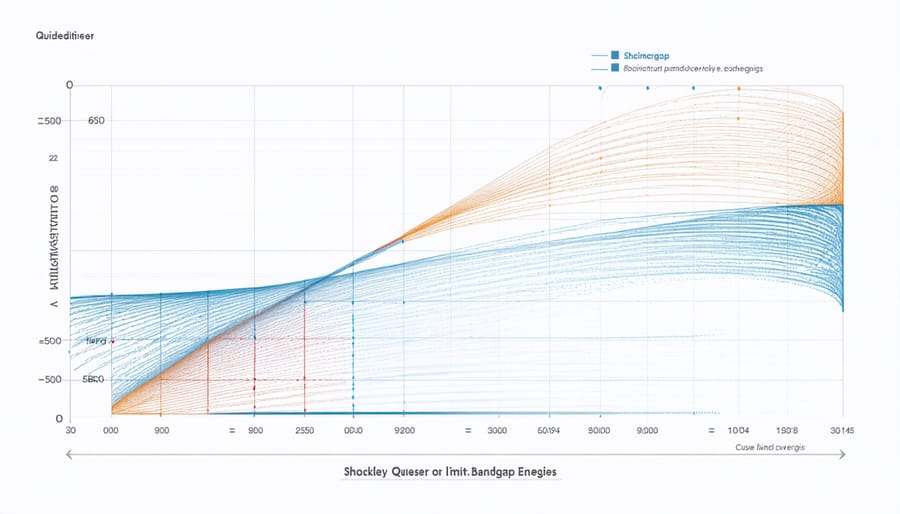
The Shockley-Queisser limit, established by William Shockley and Hans-Joachim Queisser in 1961, represents the theoretical maximum efficiency achievable by a single-junction solar cell. This fundamental limit, approximately 33.7% for a solar cell with a bandgap of 1.34 electron volts (eV), arises from inherent physical constraints in the photovoltaic conversion process.
Several factors contribute to this efficiency ceiling. First, photons with energy below the semiconductor’s bandgap cannot be absorbed, resulting in transmission losses. Second, photons with energy exceeding the bandgap generate hot carriers that quickly lose their excess energy as heat through thermalization. Additionally, radiative recombination and other unavoidable losses further reduce the maximum achievable efficiency.
For silicon solar cells, which have a bandgap of approximately 1.1 eV, the theoretical efficiency limit is slightly lower, around 32%. This explains why commercial silicon solar cells typically achieve efficiencies between 15% and 25%, despite decades of technological advancement.
Understanding the Shockley-Queisser limit is crucial for photovoltaic research and development, as it guides efforts to overcome these limitations through innovative approaches such as multi-junction cells, quantum dots, and other advanced photovoltaic technologies that can potentially surpass this theoretical boundary.
Real-World Efficiency Constraints
While theoretical solar cell efficiency limits are well-established, real-world applications face numerous constraints that significantly reduce actual performance. Environmental factors play a crucial role, with temperature being a primary concern. For every degree Celsius above optimal operating temperature, solar panel efficiency typically decreases by 0.3-0.5%. Dust, dirt, and atmospheric pollution can reduce efficiency by up to 15% through light obstruction and scattered reflection.
Manufacturing limitations also impact efficiency, as mass production techniques must balance cost-effectiveness with performance. Different types of solar cells exhibit varying levels of efficiency loss during the manufacturing process, with factors such as material impurities, surface texturing imperfections, and electrode contact resistance contributing to reduced performance.
Installation constraints further affect real-world efficiency. Factors such as roof orientation, shading from nearby structures or vegetation, and suboptimal tilt angles can significantly impact energy production. Additionally, system losses from inverters, wiring, and other balance-of-system components typically reduce overall efficiency by 5-15%.
Weather patterns and seasonal variations also influence performance, with cloud cover, precipitation, and varying sun angles throughout the year affecting energy yield. These practical limitations typically result in commercial solar panels achieving 15-20% efficiency, substantially below theoretical maximums.
Latest Technological Breakthroughs
Multi-Junction Cell Technology
Multi-junction solar cells represent a significant breakthrough in photovoltaic technology, enabling efficiency rates that surpass the theoretical Shockley-Queisser limit of single-junction cells. These advanced structures consist of multiple semiconductor layers, each optimized to capture different portions of the solar spectrum, resulting in more efficient solar energy conversion.
The most efficient multi-junction cells utilize a combination of materials such as gallium arsenide (GaAs), indium gallium phosphide (InGaP), and germanium (Ge). Each layer is carefully engineered with specific bandgaps to maximize photon absorption across the solar spectrum. Current record-holding multi-junction cells have achieved efficiencies exceeding 46% under concentrated sunlight, significantly outperforming traditional silicon-based cells.
The enhanced performance comes from the cells’ ability to minimize thermalization losses, where excess photon energy is typically lost as heat in single-junction devices. By strategically stacking semiconductors with decreasing bandgaps, multi-junction cells can capture a broader range of photon energies while maintaining high voltage output.
Despite their superior efficiency, multi-junction cells face practical challenges including complex manufacturing processes and higher production costs. These factors currently limit their widespread adoption to specialized applications such as space satellites and concentrated photovoltaic systems. However, ongoing research and development efforts continue to improve manufacturing techniques and reduce costs, potentially making this technology more accessible for broader commercial applications.

Perovskite-Silicon Tandem Cells
Perovskite-silicon tandem cells represent a groundbreaking advancement in photovoltaic technology, combining the established reliability of silicon cells with the remarkable potential of perovskite materials. These hybrid devices stack a perovskite solar cell atop a traditional silicon cell, enabling more efficient harvesting across the solar spectrum.
The primary advantage of this configuration lies in its complementary absorption characteristics. While silicon cells effectively capture red and infrared light, perovskite layers excel at absorbing blue and green wavelengths. This synergistic relationship has enabled researchers to achieve remarkable efficiency improvements, with recent prototypes exceeding 31% efficiency in laboratory conditions.
Leading research institutions and manufacturers are actively developing these tandem cells, focusing on addressing key challenges such as stability, scalability, and cost-effectiveness. The theoretical efficiency limit for perovskite-silicon tandems approaches 43%, significantly higher than single-junction silicon cells, which are limited to about 29%.
Recent developments in manufacturing techniques have improved the commercial viability of these hybrid cells. Innovations in perovskite composition and interface engineering have enhanced durability and reduced production costs. Major manufacturers are now scaling up production capabilities, suggesting that high-efficiency tandem cells could become commercially available within the next few years, potentially revolutionizing the solar energy landscape.
Surface Treatment Innovations
Recent advancements in surface treatment technologies have significantly enhanced solar panel efficiency by minimizing reflection losses and maximizing light absorption. Anti-reflection coatings (ARCs) now utilize multi-layer designs incorporating nanostructured materials that can reduce surface reflection to less than 1%, compared to the 30% reflection loss in untreated silicon surfaces.
Moth-eye texturing, inspired by nature, represents a breakthrough in light-trapping technology. This biomimetic approach creates nanoscale surface patterns that gradually match the refractive index between air and silicon, dramatically reducing reflection across a broad spectrum of wavelengths and incident angles. Similarly, hierarchical surface texturing combines micro and nano-scale features to create multiple opportunities for light absorption.
Advanced surface passivation techniques, such as atomic layer deposition (ALD) of aluminum oxide, have successfully reduced surface recombination losses while simultaneously providing anti-reflection properties. These treatments have proven particularly effective for high-efficiency solar cells, contributing to efficiency gains of 0.5-1% absolute.
Novel approaches include self-cleaning hydrophobic coatings that maintain optimal performance by preventing dust accumulation, and plasmonic structures that enhance near-field light concentration. These innovations not only improve initial efficiency but also help maintain performance over the panel’s lifetime.
Recent research focuses on cost-effective manufacturing methods for these surface treatments, aiming to bridge the gap between laboratory achievements and commercial implementation.
Practical Implementation Strategies
Optimal Panel Placement and Orientation
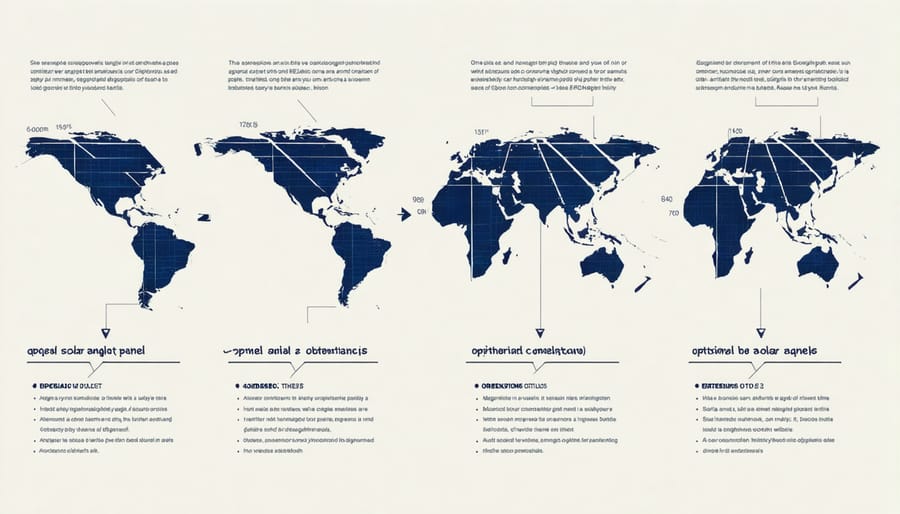
The optimal placement and orientation of solar panels play a crucial role in helping maximize solar panel efficiency and energy yield. For installations in the Northern Hemisphere, panels should face true south (not magnetic south) to capture maximum sunlight throughout the day. The optimal tilt angle typically equals the installation site’s latitude, though this can be adjusted seasonally for enhanced performance.
Shading considerations are paramount, as even partial shade on a single panel can significantly reduce the output of an entire string. Installers should conduct thorough shade analysis using solar pathfinder tools or digital modeling software to identify potential obstructions throughout the year.
Module spacing must account for self-shading, particularly in commercial installations with multiple rows. The rule of thumb for row spacing is typically 2.5 to 3 times the panel height (when tilted) to prevent inter-row shading during peak production hours.
Ventilation beneath the panels is essential for maintaining optimal operating temperatures. A minimum air gap of 4-6 inches between the roof surface and panels allows for convective cooling, which becomes particularly important in warmer climates where heat can significantly impact conversion efficiency.
For dual-axis tracking systems, sophisticated algorithms can adjust both tilt and azimuth angles throughout the day, potentially increasing energy yield by 25-35% compared to fixed installations.
Temperature Management Solutions
Temperature management plays a crucial role in maintaining optimal solar panel efficiency, as performance typically decreases by 0.3% to 0.5% for every degree Celsius rise above standard testing conditions (25°C). Several proven techniques help mitigate temperature-related efficiency losses in photovoltaic systems.
Active cooling systems, including water circulation and forced air ventilation, can effectively reduce panel temperatures. Water-based cooling systems spray or circulate water across the panel surface, achieving temperature reductions of 10-15°C and efficiency improvements of up to 15%. However, these systems require additional energy input and maintenance consideration.
Passive cooling solutions offer cost-effective alternatives without energy consumption. Enhanced natural ventilation through proper panel mounting with adequate air gaps (typically 10-15cm) enables convective cooling. Specialized heat-dissipating materials and coatings can improve thermal management, while light-colored mounting systems reflect excess heat away from panels.
Recent innovations in temperature management include phase change materials (PCMs) that absorb excess heat during peak temperatures and release it during cooler periods, maintaining more stable operating conditions. Additionally, bifacial panels with improved rear ventilation demonstrate superior thermal performance compared to traditional modules.
Proper temperature management strategy selection depends on installation location, climate conditions, and system requirements. Regular monitoring of panel temperatures through integrated sensors enables optimal performance maintenance and early detection of thermal management issues.
Maintenance Best Practices
To maintain solar panels at their peak efficiency, implementing optimal panel maintenance strategies is crucial. Regular cleaning at intervals of 3-6 months prevents dust, debris, and bird droppings from reducing light absorption capacity. Use deionized water and non-abrasive cleaning tools to protect the anti-reflective coating during maintenance procedures.
Professional inspection should be conducted annually to identify potential issues such as micro-cracks, degraded sealants, or loose connections. These inspections should include thermal imaging to detect hot spots and performance monitoring to assess efficiency degradation rates.
Monitor panel tilt angles seasonally and adjust when necessary to maximize solar exposure. In regions with heavy snowfall, implement snow removal protocols using appropriate tools to prevent damage. Maintain clear surroundings by trimming vegetation that may cast shadows on the panels.
Check electrical connections quarterly for corrosion and ensure proper torque specifications are maintained. Replace degraded components promptly to prevent system-wide efficiency losses. Document all maintenance activities and track performance metrics to establish baseline efficiency patterns and identify potential issues early.
Adhering to manufacturer-specified maintenance schedules and using certified technicians for complex repairs ensures warranty compliance and optimal system performance throughout the panel’s operational lifetime.
The pursuit of higher solar panel efficiency remains a critical frontier in renewable energy development. While current commercial solar panels typically achieve 15-22% efficiency, and the best laboratory cells approach 47%, we are still far from the theoretical Shockley-Queisser limit of 33% for single-junction cells. However, emerging technologies and research breakthroughs offer promising pathways toward higher efficiencies.
Multi-junction cells, advanced light management techniques, and novel materials like perovskites represent significant opportunities for efficiency improvements. Researchers continue to explore quantum dots, upconversion materials, and tandem cell configurations that could push practical efficiencies beyond 50% in the coming decades.
The future of solar efficiency lies in collaborative efforts between industry leaders, research institutions, and government laboratories. Ongoing developments in nanotechnology, materials science, and manufacturing processes will likely yield incremental improvements in the near term, while breakthrough technologies could potentially revolutionize solar energy conversion in the long term.
As production costs decrease and efficiency increases, solar power will become increasingly competitive with traditional energy sources. While we may never reach 100% efficiency due to fundamental physical limitations, continued innovation and research investment will help close the gap between theoretical limits and practical performance, making solar energy an increasingly viable solution for global energy needs.