
Public-private partnerships (PPPs) are transforming how essential infrastructure and services are delivered worldwide, creating powerful synergies between government resources and private sector innovation. By combining public oversight with private sector efficiency, these collaborative ventures are revolutionizing project development across sectors including transportation, healthcare, energy, and urban development.
Recent data indicates that PPP projects have grown by 30% globally over the past decade, with successful implementations demonstrating enhanced service delivery, accelerated project completion, and optimized resource allocation. These partnerships effectively distribute risks, leverage specialized expertise, and unlock new funding mechanisms that traditional procurement methods cannot match.
In an era of constrained public budgets and increasing infrastructure demands, PPPs offer a compelling solution for delivering large-scale projects while maintaining public accountability. Through carefully structured agreements, these partnerships enable governments to harness private sector capabilities while retaining strategic control over critical public services and assets.
This collaborative approach has proven particularly effective in developing sustainable infrastructure, with notable success stories ranging from modern transportation networks to renewable energy facilities. By aligning public interest with private sector innovation, PPPs are establishing new benchmarks for project delivery and operational excellence in the 21st century.
The Evolution of Public-Private Solar Partnerships
Traditional vs. Modern Partnership Models
Public-private partnership models have evolved significantly over the past decades, reflecting changing economic landscapes and societal needs. Traditional partnerships typically followed a rigid structure where public entities maintained primary control while private companies served mainly as contractors. These conventional models often featured limited risk-sharing and minimal innovation opportunities.
In contrast, modern partnership frameworks embrace a more collaborative approach, incorporating flexible funding mechanisms and shared responsibility structures. Today’s models frequently include performance-based incentives, technology transfer provisions, and integrated stakeholder engagement. This evolution has been particularly evident in renewable energy projects, where multilateral solar agreements demonstrate the sophistication of contemporary partnerships.
Contemporary models also emphasize sustainability metrics, social impact assessments, and long-term value creation. They incorporate advanced risk allocation strategies, transparent governance frameworks, and digital monitoring systems. This transformation has enabled more efficient project delivery, improved resource allocation, and enhanced community benefits, setting new standards for public-private collaboration in infrastructure development.
Key Stakeholders and Their Roles
Public-private partnership projects involve multiple stakeholders, each playing crucial roles in ensuring project success. Government entities typically serve as regulators and policy makers, establishing frameworks and incentives while often providing land access or permits. They may also contribute funding through grants or tax incentives.
Private sector partners, including solar developers and equipment manufacturers, bring technical expertise and capital investment. These companies handle project design, implementation, and ongoing maintenance while managing commercial operations and revenue generation.
Financial institutions play a vital role by providing project funding through various mechanisms such as loans, bonds, or equity investments. Their involvement often includes risk assessment and financial structuring to ensure project viability.
Local communities and utility companies are essential stakeholders who influence project acceptance and integration. Communities provide social license to operate, while utilities manage grid connection and power purchase agreements.
Academic institutions often contribute through research partnerships and workforce development programs, while environmental organizations and regulatory bodies ensure compliance with sustainability standards and environmental regulations. This diverse stakeholder ecosystem requires careful coordination and clear communication channels to achieve project objectives effectively.

Structuring Successful Solar Collaborations
Legal and Financial Frameworks
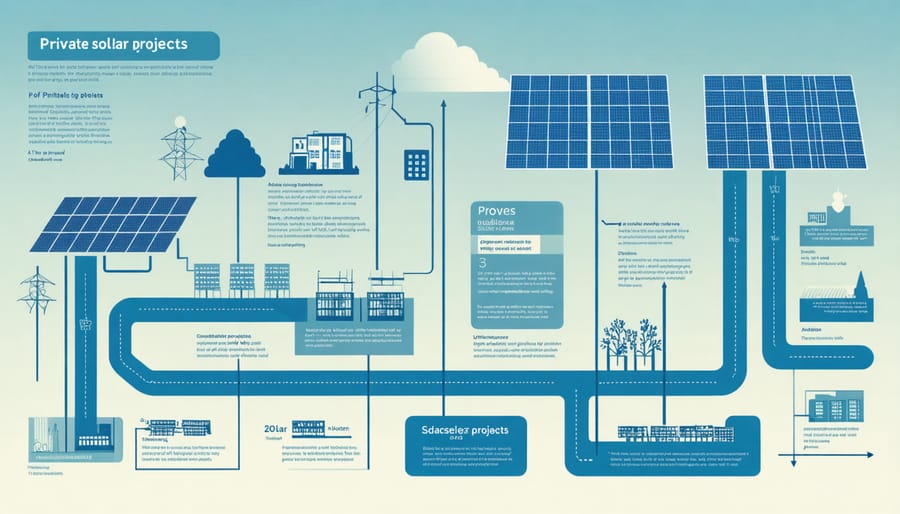
Public-private partnership (PPP) projects in the solar energy sector operate within complex legal and financial frameworks that establish rights, responsibilities, and risk allocation between parties. These frameworks typically encompass detailed contractual agreements, financing structures, and regulatory compliance mechanisms that align with global energy market trends.
Core legal components include power purchase agreements (PPAs), engineering, procurement, and construction (EPC) contracts, and operation and maintenance agreements. These documents define project scope, performance standards, and dispute resolution mechanisms. Performance guarantees and liability provisions protect stakeholders’ interests while ensuring project viability.
Financial frameworks typically incorporate multiple funding sources, including equity investments, debt financing, and government incentives. Project finance structures often utilize special purpose vehicles (SPVs) to isolate project risks and facilitate transparent financial management. Risk mitigation instruments, such as performance bonds and insurance policies, provide additional security for investors and lenders.
Regulatory compliance requirements vary by jurisdiction but generally address environmental standards, grid connection protocols, and land use permissions. Successful PPP projects maintain robust compliance monitoring systems and establish clear reporting mechanisms to satisfy stakeholder requirements and maintain regulatory compliance throughout the project lifecycle.
Risk Sharing and Management
Risk sharing and management are fundamental aspects of successful public-private partnership (PPP) projects, requiring careful allocation of responsibilities between government entities and private sector partners. The primary objective is to assign risks to the party best equipped to handle them, maximizing project efficiency while minimizing potential disruptions.
Typical risk allocation strategies involve the private sector managing commercial risks, such as construction, operation, and maintenance, while public entities handle regulatory and political risks. Financial risks are often shared between both parties through carefully structured agreements that specify contingency measures and compensation mechanisms.
Project stakeholders employ various risk mitigation tools, including performance bonds, insurance policies, and contractual guarantees. These mechanisms provide security for both parties and ensure project continuity even when challenges arise. Regular risk assessments and monitoring systems help identify potential issues early, allowing for proactive management and resolution.
Successful risk management also requires establishing clear communication channels and dispute resolution procedures. Partners should develop comprehensive contingency plans that address potential scenarios such as cost overruns, delays, or force majeure events. These plans typically include specific triggers and response protocols, ensuring swift and coordinated action when needed.
Risk sharing frameworks must remain flexible enough to adapt to changing circumstances while maintaining the project’s core objectives and financial viability. This balance is achieved through periodic reviews and adjustments to risk management strategies throughout the project lifecycle.
Benefits and Impact Assessment
Economic Advantages
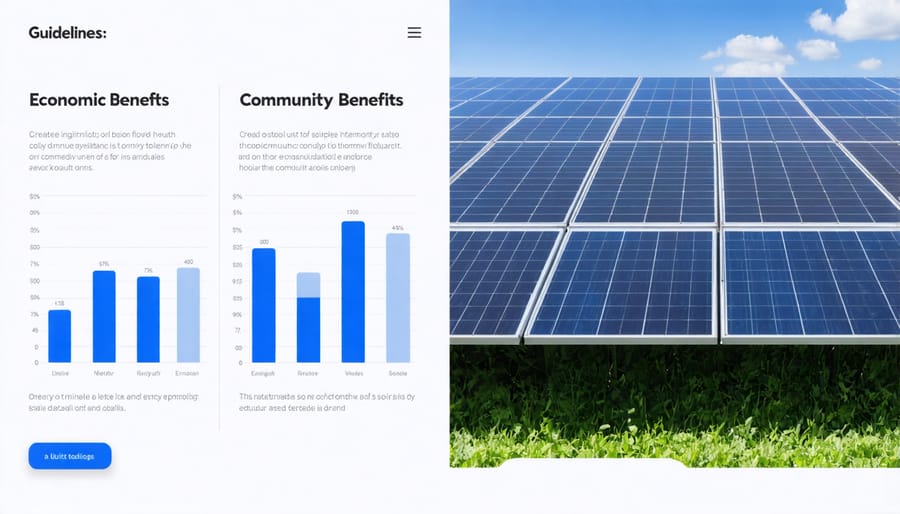
Public-private partnerships (PPPs) in solar energy projects offer substantial financial advantages for all participating entities. Government bodies benefit from reduced capital expenditure requirements, as private sector partners typically shoulder a significant portion of initial investments. This arrangement allows public funds to be allocated more efficiently across multiple renewable energy initiatives while maintaining project oversight.
Private sector participants gain access to stable, long-term revenue streams through power purchase agreements and government guarantees. These partnerships also facilitate entry into new markets and create opportunities for scaling operations through international solar partnerships. Additionally, private entities often benefit from tax incentives, subsidies, and streamlined regulatory processes.
The risk-sharing structure inherent in PPPs enhances project viability and attracts institutional investors. Public entities leverage private sector expertise and operational efficiency while maintaining quality control through performance-based contracts. This model has proven particularly effective in developing utility-scale solar installations, where high initial costs might otherwise deter public investment.
Furthermore, these partnerships often result in accelerated project completion timeframes and reduced operational costs through economies of scale. The combination of public sector stability and private sector innovation creates a sustainable framework for long-term renewable energy development.
Environmental and Social Returns
Public-private partnership projects generate significant environmental and social returns that extend beyond financial metrics. These collaborations often lead to accelerated adoption of sustainable practices and enhanced community engagement. When implemented effectively, they create a multiplier effect that benefits both the environment and local populations.
On the environmental front, these partnerships frequently result in reduced carbon emissions through the implementation of energy-efficient technologies and renewable energy solutions. Many projects incorporate green building standards, waste reduction initiatives, and sustainable resource management practices. This systematic approach to environmental stewardship helps communities meet their sustainability goals while setting new benchmarks for future developments.
The social impact is equally noteworthy, with partnerships creating local employment opportunities and fostering skill development within communities. These projects often include educational components, providing training programs and workshops that enhance local workforce capabilities. Additionally, they frequently improve public infrastructure and services, leading to better quality of life for residents.
Community engagement is typically strengthened through these initiatives, as stakeholders are involved in decision-making processes. This participatory approach ensures that projects address actual community needs while building social capital. Furthermore, successful partnerships often establish models for future collaboration, creating a foundation for sustainable development that balances economic growth with environmental protection and social progress.
Implementation Challenges and Solutions
Technical and Operational Hurdles
Public-private partnership projects often face significant technical and operational challenges during implementation. The complexity of integrating different organizational systems, processes, and technologies can lead to operational inefficiencies. Project managers must navigate disparate IT infrastructure, data management protocols, and reporting requirements between public and private entities.
Resource allocation and timeline management present persistent hurdles, particularly when public sector bureaucracy meets private sector agility expectations. Stakeholders frequently encounter difficulties in aligning project milestones with governmental approval processes and regulatory compliance requirements.
Communication barriers between partners can impede progress, especially when different organizational cultures and decision-making processes clash. Technical specifications may need continuous adjustment to meet both public sector requirements and private sector efficiency standards.
Quality control and performance monitoring also pose challenges, as establishing unified metrics acceptable to both parties requires careful negotiation. Infrastructure compatibility issues often emerge during implementation, necessitating additional investment in system integration and staff training.
Success requires robust governance frameworks, clear accountability structures, and flexible problem-solving approaches to address these technical and operational challenges effectively.
Strategic Solutions
Several proven strategies have emerged to address the challenges inherent in public-private partnership projects. Establishing clear governance frameworks and risk allocation mechanisms at the outset helps prevent misunderstandings and streamlines decision-making processes. Successful partnerships often implement staged development approaches, breaking large projects into manageable phases to reduce complexity and financial exposure.
Comprehensive stakeholder engagement programs prove essential, incorporating regular communications, transparent reporting mechanisms, and structured feedback channels. Many successful projects utilize independent monitoring committees to ensure accountability and maintain public trust. Performance-based contracts with well-defined metrics and milestones help align interests and maintain project momentum.
Financial structuring solutions, such as hybrid funding models and innovative risk-sharing arrangements, have shown effectiveness in overcoming capital constraints. Advanced project management tools and digital platforms facilitate better coordination and real-time monitoring of deliverables. Regular capacity-building initiatives for both public and private sector teams ensure consistent understanding and execution of project objectives.
These strategic approaches, when properly implemented, significantly increase the likelihood of project success while maintaining stakeholder satisfaction and public benefit delivery.
Future Outlook
The future of public-private partnerships in solar energy development shows remarkable promise, driven by technological innovations and evolving market dynamics. As governments worldwide intensify their commitment to renewable energy targets, these partnerships are expected to play an increasingly vital role in accelerating solar adoption. The emergence of cross-continental solar investments is reshaping how projects are financed and implemented across borders.
Industry analysts project a significant shift toward more sophisticated partnership models that integrate advanced data analytics and artificial intelligence for optimal project planning and execution. These smart partnerships will leverage real-time monitoring systems and predictive maintenance capabilities, ensuring maximum operational efficiency and return on investment.
Environmental, Social, and Governance (ESG) considerations are becoming increasingly central to partnership frameworks, with enhanced focus on community engagement and sustainable development goals. Future projects are likely to incorporate innovative benefit-sharing mechanisms and local workforce development programs.
Emerging trends indicate a move toward standardized partnership templates and streamlined approval processes, reducing administrative barriers and accelerating project implementation. Digital platforms for project management and stakeholder coordination are expected to become industry standard, facilitating more transparent and efficient collaboration.
The integration of energy storage solutions and smart grid technologies within partnership agreements is anticipated to create more comprehensive energy solutions. This evolution will enable projects to provide more reliable power distribution and grid stability, addressing key challenges in renewable energy adoption.
These developments suggest a future where public-private partnerships become more accessible, efficient, and impactful in driving solar energy innovation and deployment across diverse markets and regions.
Public-private partnerships in solar energy development represent a crucial framework for advancing renewable energy adoption and infrastructure development. These collaborative ventures have demonstrated significant success in bridging funding gaps, sharing risks, and leveraging diverse expertise to accomplish ambitious solar energy goals.
Key stakeholders should focus on several critical factors when pursuing PPP projects. First, establishing clear governance structures and communication channels ensures transparent decision-making and efficient project management. Second, developing comprehensive risk allocation frameworks helps protect all parties’ interests while maintaining project viability. Third, implementing robust monitoring and evaluation systems enables continuous improvement and accountability.
For maximum effectiveness, partners should prioritize community engagement, environmental sustainability, and long-term economic viability in their project planning. This includes conducting thorough feasibility studies, establishing realistic timelines, and creating flexible agreements that can adapt to changing market conditions.
Moving forward, successful public-private partnerships will increasingly depend on innovative financing mechanisms, technological advancement integration, and strategic alignment with national energy policies. Stakeholders should actively pursue capacity-building opportunities, stay informed about evolving regulatory frameworks, and maintain open dialogue with all participating entities.
By following these guidelines and learning from established best practices, organizations can develop effective partnerships that accelerate solar energy adoption while delivering value to all stakeholders involved.