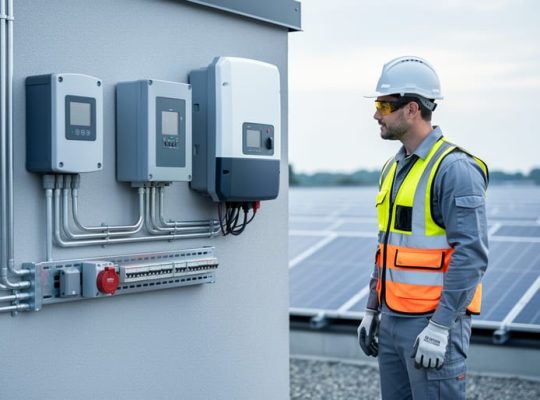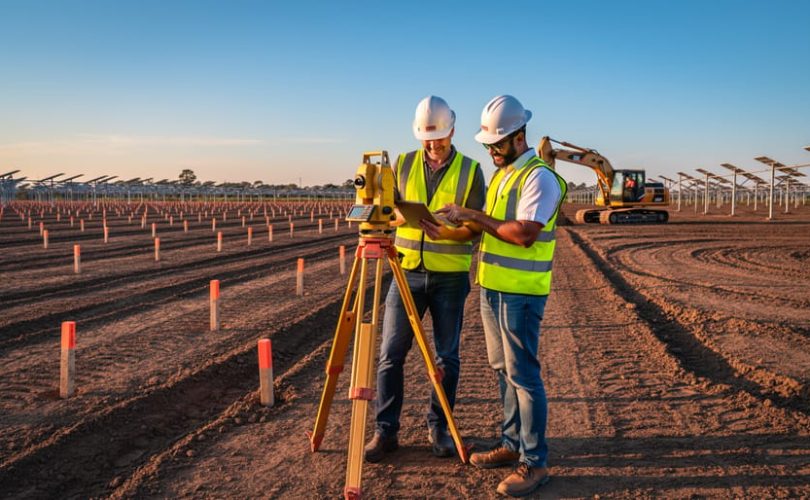
Establish comprehensive geotechnical surveys before breaking ground, measuring soil bearing capacity, water table depths, and terrain slopes to determine foundation requirements and equipment placement strategies. This foundational analysis prevents costly structural failures and ensures your solar array withstands environmental loads throughout its 25-30 year operational lifespan.
Map precise electrical routing pathways that minimize trenching distances while accounting for voltage drop calculations, conduit sizing requirements, and access road positioning. Quality PV plans integrate these civil engineering elements with electrical specifications, creating a unified blueprint that guides excavation teams, concrete contractors, and electrical installers through sequential construction phases.
Define exact grading specifications that address stormwater management, erosion control, and drainage patterns across your project site. Professional planners calculate cut-and-fill volumes, establish retention pond locations, and design permeable surfaces that comply with local environmental regulations while protecting solar equipment from water damage.
The difference between successful photovoltaic system installation and project delays often traces back to planning quality. PV plans serve as the technical bridge between conceptual solar designs and physical construction, translating megawatt capacity goals into measurable civil works specifications. These documents coordinate multiple engineering disciplines, establish construction sequencing, and provide the regulatory documentation necessary for permit approval.
For professionals entering the solar industry, understanding PV plan development represents a critical competency that distinguishes project leaders from general practitioners. This comprehensive guide examines the technical components, creation methodologies, and quality benchmarks that define professional-grade site preparation planning, equipping you with knowledge to evaluate, create, or oversee these essential project documents.
What PV Plans Actually Are (And Why They Matter)
The Core Components of Site Preparation PV Plans
Comprehensive site preparation PV plans comprise several interconnected components that work together to ensure project viability and longevity. Understanding these elements is fundamental for anyone entering the photovoltaic industry or managing solar installations.
Topographical surveys form the foundation of all site preparation plans. These detailed assessments capture existing site conditions including elevation changes, terrain characteristics, vegetation, and existing structures. Surveyors use GPS equipment and laser scanning technology to create accurate three-dimensional representations of the site, typically with contour intervals of one to two feet. This data becomes the baseline for all subsequent planning decisions.
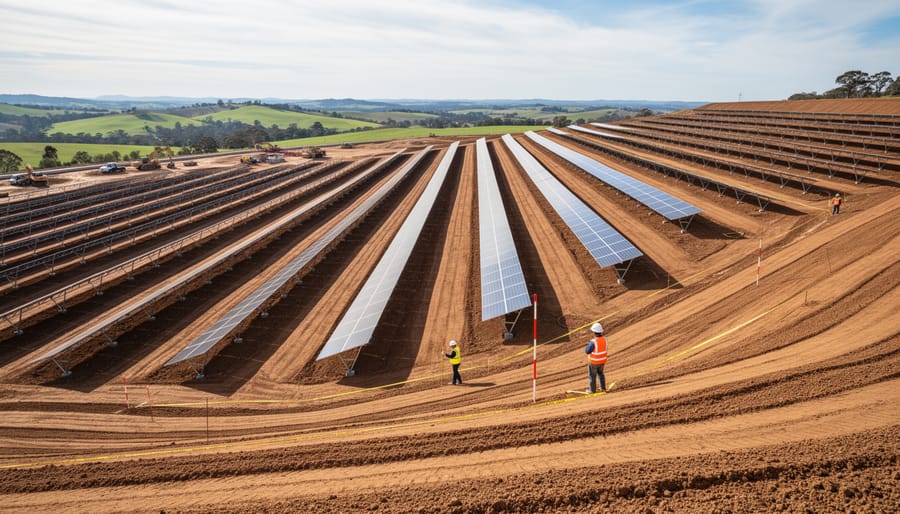
Grading plans specify how the site’s terrain will be modified to accommodate solar arrays. These documents detail cut and fill requirements, ensuring that panel rows maintain proper orientation and drainage while minimizing earthwork costs. Proper grading prevents water pooling beneath modules and ensures equipment accessibility throughout the facility’s operational life.
Drainage systems represent critical infrastructure that protects both the solar installation and surrounding properties. Engineers design swales, culverts, detention ponds, and erosion control measures based on hydrological studies and local rainfall patterns. These systems must handle both routine precipitation and extreme weather events while complying with environmental regulations.
Access roads provide essential pathways for construction equipment, maintenance vehicles, and emergency responders. Design specifications address road width, turning radii, load-bearing capacity, and surface materials suitable for the site’s soil conditions and expected traffic patterns.
Cable trenching layouts map underground pathways for electrical conductors connecting arrays to inverters and the point of interconnection. These plans coordinate with grading and drainage designs to avoid conflicts while maintaining proper depth and separation requirements.
Foundation designs vary based on mounting system selection and soil characteristics, ranging from driven piles to concrete ballast or helical anchors, each requiring specific engineering calculations and installation specifications.
How PV Plans Integrate with Civil Engineering
The successful implementation of photovoltaic systems requires seamless integration between electrical design and civil engineering fundamentals. This interdisciplinary collaboration ensures installations can withstand environmental stresses while maintaining optimal energy production throughout their operational lifespan.
Civil engineers apply structural load calculations to determine whether existing buildings or proposed ground-mounted structures can support PV array weight, wind uplift forces, and snow loads. These calculations consider both dead loads (the permanent weight of panels, racking, and mounting hardware) and live loads (temporary forces from weather events, maintenance activities, and seismic activity). For rooftop installations, engineers must verify that roof structures possess adequate load-bearing capacity, often requiring reinforcement specifications in older buildings.
Comprehensive soil analysis forms another critical component of PV plan development. Geotechnical investigations assess soil bearing capacity, determining the appropriate foundation type for ground-mounted systems. Engineers analyze soil composition, compaction characteristics, and drainage properties to prevent settlement issues that could compromise array alignment and structural integrity over time.
Environmental considerations extend beyond renewable energy benefits to encompass site-specific factors. Civil engineers evaluate drainage patterns to prevent water accumulation beneath arrays, assess grading requirements for optimal panel orientation, and determine erosion control measures necessary during construction. They also consider local climate data, including wind speed records and seismic zone classifications, to ensure designs meet regional building codes and withstand extreme weather events. This integration of civil engineering principles with PV system requirements creates resilient installations that deliver consistent performance while meeting all regulatory safety standards.
Site Assessment: Where PV Plans Begin
Geotechnical Investigation Requirements
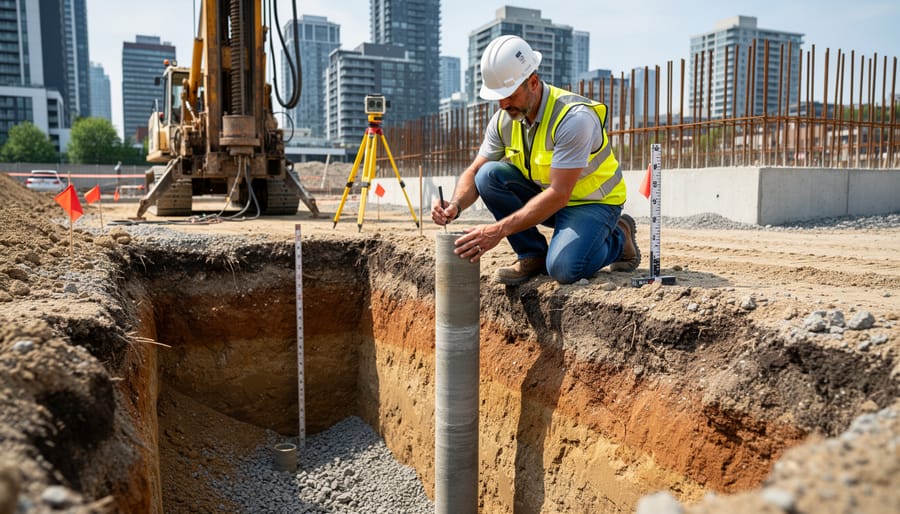
Comprehensive geotechnical investigation forms the foundation of successful PV project planning, directly influencing structural integrity and long-term system performance. Before any construction begins, soil testing protocols must assess subsurface conditions to depths extending beyond proposed foundation installations, typically reaching 10 to 30 feet depending on project scale and geological complexity.
Standard soil testing procedures include Standard Penetration Tests (SPT) to measure soil density and consistency, cone penetration testing for detailed stratigraphic profiling, and laboratory analysis of collected samples. These investigations determine soil classification, moisture content, plasticity indices, and chemical composition—particularly important for identifying corrosive conditions that could compromise foundation materials over time.
Bearing capacity analysis evaluates the soil’s ability to support structural loads without excessive settlement or failure. Engineers calculate allowable bearing pressures based on soil strength parameters, considering both short-term construction loads and long-term operational stresses. Results directly inform foundation type selection, whether driven piles for loose sandy soils, helical anchors for rocky terrain, or ballasted systems for stable ground conditions with minimal penetration.
Geological conditions profoundly shape foundation design within PV plans. Expansive clay soils require specialized foundation designs to accommodate seasonal volume changes, while sites with high groundwater tables demand drainage considerations and corrosion-resistant materials. Seismic zones necessitate additional structural reinforcement to withstand lateral forces. Universities collaborating with industry frequently conduct research on innovative foundation solutions addressing challenging geological conditions, contributing valuable data that enhances design standards and reduces project risks across diverse environmental contexts.
Topographical Analysis and Solar Array Layout
Effective topographical analysis forms the foundation of successful solar installations by identifying site-specific constraints and opportunities that directly impact system performance. Detailed terrain mapping reveals elevation changes, slope angles, and natural drainage patterns that determine optimal panel placement and orientation strategies. Surveying teams utilize GPS technology, drone imagery, and ground-based measurements to create comprehensive contour maps, typically with 1-foot elevation intervals for accurate planning.
This topographical data informs critical design decisions including row spacing calculations to minimize inter-row shading, access road placement for construction and maintenance vehicles, and drainage infrastructure requirements to prevent erosion and equipment damage. Sites with significant grade variations may require extensive grading, terracing, or specialized mounting systems that accommodate uneven terrain while maintaining optimal tilt angles. These civil works decisions directly influence project budgets and construction timelines.
Universities collaborating on PV research emphasize that thorough topographical assessment reduces costly field modifications during installation. Professional PV plans integrate terrain analysis with solar resource data to balance civil work costs against energy production gains, ensuring economically viable system designs that maximize long-term performance.
Environmental and Regulatory Constraints
Comprehensive PV plans must account for numerous environmental and regulatory constraints that directly impact site development feasibility and system design. Protected areas including wetlands, endangered species habitats, and archaeologically significant sites require careful identification through desktop studies and field surveys before construction can proceed. These designations often mandate buffer zones that effectively reduce usable project area.
Drainage patterns present critical design considerations, as solar installations must not obstruct natural water flow or increase flooding risk to adjacent properties. Civil engineers incorporate grading plans, retention basins, and culverts to maintain hydrological balance while preventing erosion beneath panel arrays. Setback requirements from property boundaries, roads, and existing structures vary by jurisdiction but typically range from 10 to 50 feet, consuming valuable space that impacts overall system capacity.
Permit obligations form the regulatory backbone of PV project approval, encompassing building permits, electrical permits, environmental assessments, and often special use permits for agricultural or residentially zoned land. Many jurisdictions now require stormwater management plans, decommissioning bonds, and glare studies as standard submission components. Compliance with interconnection standards from local utilities adds another layer of technical requirements that must be documented within comprehensive PV plans before construction authorization.
Critical Site Preparation Elements in PV Plans
Grading and Earthwork Specifications
Grading and earthwork specifications establish the foundation for long-term solar array performance by addressing terrain modification requirements. These plans detail cut and fill operations, which involve removing earth from elevated areas and depositing it in lower sections to create optimal panel placement zones. Proper specifications include volumetric calculations that balance cut and fill quantities, minimizing the need for off-site soil disposal or importation, thereby reducing project costs and environmental impact.
Slope stabilization measures are critical components that prevent soil erosion and structural failures. Specifications typically mandate maximum slope ratios, often 3:1 or gentler for vegetated areas, and include provisions for retaining walls, geotextile fabrics, and drainage systems. These measures protect panel foundations from undermining and ensure safe access for maintenance personnel throughout the installation’s operational life.
Well-designed grading plans directly optimize panel performance by establishing proper drainage patterns that prevent water pooling beneath arrays, which can cause ground settlement and electrical hazards. Strategic grading also minimizes shading between panel rows by maintaining consistent elevation profiles. Universities collaborating on solar research have demonstrated that sites with comprehensive earthwork planning experience 15-20 percent fewer maintenance issues and reduced long-term operational costs compared to installations with inadequate grading specifications.
Foundation Systems and Mounting Structures
Foundation systems form a critical component of PV plans, as they ensure structural integrity and long-term system stability. The selection of appropriate foundation types depends on multiple site-specific factors including soil conditions, wind loads, seismic requirements, and terrain characteristics.
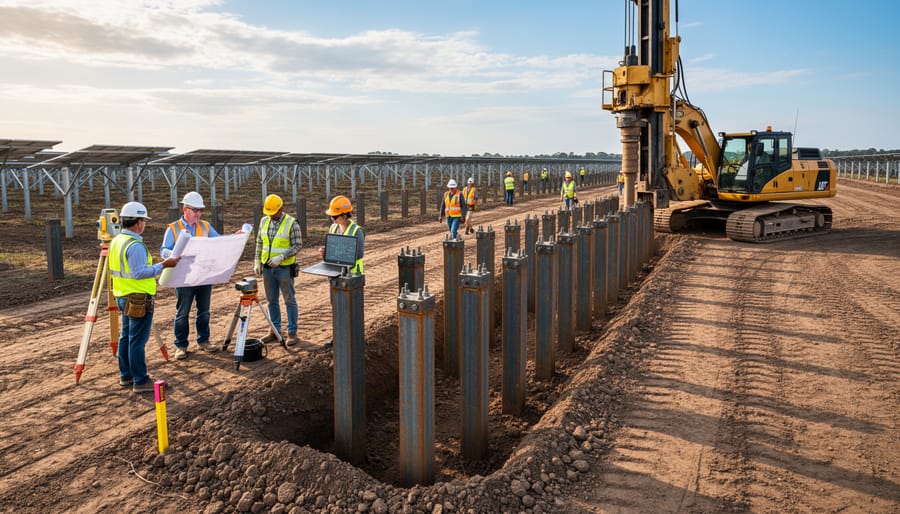
Driven piles represent a common solution for ground-mounted installations, particularly in sandy or loose soils. These steel posts are mechanically hammered into the ground to specified depths, typically ranging from 5 to 10 feet, and accommodate various installation methods. PV plans must specify pile dimensions, spacing, and embedment depths based on geotechnical data and structural load calculations.
Helical anchors offer advantages in challenging soil conditions where driven piles may prove inadequate. These screw-type foundations provide superior holding capacity in clay-heavy or unstable soils. Plans detail anchor diameter, helix configuration, and installation torque requirements to achieve specified load ratings.
Concrete footings remain prevalent for fixed-tilt systems requiring substantial stability. Ballasted systems eliminate ground penetration entirely, making them ideal for rooftop applications or sensitive sites where soil disturbance must be minimized. These utilize weighted blocks to secure racking structures through gravity alone.
Comprehensive PV plans include foundation layout drawings, soil bearing capacity requirements, frost depth considerations, and specific installation procedures. Proper foundation specification prevents costly structural failures and ensures compliance with local building codes and engineering standards.
Drainage and Stormwater Management
Effective drainage and stormwater management represents a critical component of PV site preparation that protects both solar infrastructure and the surrounding ecosystem. Comprehensive plans must address water flow patterns, erosion potential, and regulatory compliance throughout the project lifecycle.
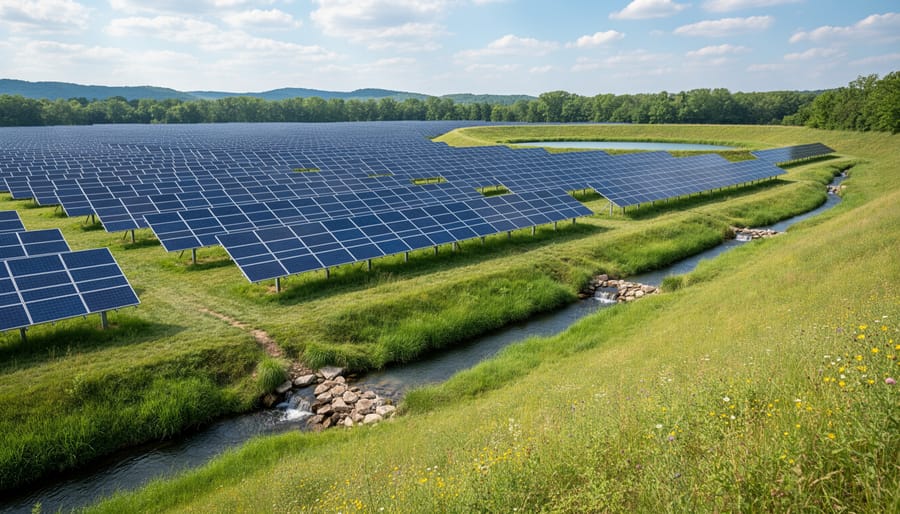
Drainage system design begins with thorough topographical analysis to identify natural water pathways and potential accumulation zones. Engineers develop grading plans that direct stormwater away from electrical equipment, inverters, and foundation structures while preventing pooling beneath panel arrays. Retention basins and swales are strategically positioned to capture runoff, allowing sediment settlement and controlled discharge that meets local watershed protection standards.
Erosion control measures during construction include silt fencing, sediment traps, and temporary vegetation to stabilize exposed soil. Post-construction strategies often incorporate permanent ground cover such as native grasses that reduce erosion while minimizing maintenance requirements. These vegetation choices also support biodiversity and habitat preservation goals.
Professional PV plans integrate stormwater Best Management Practices (BMPs) that comply with National Pollutant Discharge Elimination System (NPDES) permits where applicable. Universities collaborating on renewable energy research increasingly emphasize holistic site design that balances infrastructure protection with environmental stewardship, preparing the next generation of solar professionals to implement sustainable drainage solutions.
Access Roads and On-Site Infrastructure
Comprehensive access road planning ensures construction equipment reaches installation zones and maintenance crews can service arrays throughout the facility’s operational lifetime. PV plans must designate primary access routes capable of supporting heavy machinery during construction phases, typically requiring crushed aggregate base courses of 150-200mm depth with geotextile reinforcement. These roads generally measure 4-6 meters wide to accommodate standard construction and service vehicles.
Maintenance pathways between array rows require careful specification, balancing accessibility with cost efficiency. Many installations utilize compacted gravel or pervious surfaces that maintain ground cover while providing stable footing for personnel and light vehicles. Load-bearing calculations must account for occasional maintenance equipment, including mobile cranes for module replacement and cleaning vehicles.
Permanent service roads connect electrical infrastructure, inverter stations, and substations, requiring enhanced specifications for long-term durability. Proper drainage integration prevents erosion and maintains road integrity, while turning radii accommodate emergency response vehicles. Universities collaborating on renewable energy programs increasingly emphasize civil engineering principles in their PV system design curricula, recognizing that inadequate access infrastructure compromises both construction timelines and operational efficiency throughout a facility’s 25-30 year lifespan.
The PV Plan Development Process
Stakeholder Collaboration and Data Collection
Comprehensive PV plans require coordinated input from multiple specialized disciplines working in concert. PV system designers lead the technical configuration, determining optimal module placement, electrical routing, and equipment specifications based on site characteristics and energy production goals. Civil engineers contribute essential grading plans, drainage solutions, and structural calculations that ensure site stability and longevity throughout the project lifecycle.
Geotechnical consultants conduct subsurface investigations to assess soil bearing capacity, seismic considerations, and foundation requirements specific to mounting systems. Their data directly influences foundation design and construction methodology selection. Environmental specialists evaluate ecological impacts, regulatory compliance requirements, and mitigation strategies to protect sensitive habitats while facilitating project approval processes.
This multidisciplinary collaboration extends to developing safety protocols that protect construction teams and future maintenance personnel. Educational institutions increasingly partner with industry professionals to expose students to real-world planning scenarios, bridging theoretical knowledge with practical application. Each stakeholder contributes specialized expertise that, when integrated effectively, produces comprehensive plans addressing technical performance, regulatory compliance, environmental stewardship, and long-term operational success. This collaborative approach minimizes costly redesigns and ensures installations meet rigorous industry standards from conception through commissioning.
Software Tools and Technical Standards
Creating accurate and compliant PV plans requires specialized software tools that integrate multiple design aspects. Industry professionals typically rely on AutoCAD Civil 3D and MicroStation for comprehensive site plan development, which enable precise topographical modeling, grading design, and infrastructure layout. For solar-specific applications, platforms like PVsyst, Helioscope, and Aurora Solar facilitate array configuration, shading analysis, and energy production modeling.
Simulation tools play a critical role in validating design decisions. Finite element analysis software helps assess structural loads on racking systems, while hydraulic modeling programs ensure proper stormwater management. Geographic Information Systems (GIS) platforms assist in site selection and environmental impact assessment.
PV plan development must adhere to stringent technical standards and building codes. The International Building Code (IBC) establishes baseline structural and safety requirements, while ASCE 7 provides wind and snow load calculations essential for racking system design. Local zoning ordinances, utility interconnection standards, and environmental regulations further shape plan specifications. The National Electrical Code (NEC) governs electrical system design, ensuring safe installation practices.
Understanding these tools and standards is fundamental for aspiring professionals entering the photovoltaic industry. Educational programs increasingly incorporate hands-on training with these platforms, preparing the next generation of solar engineers to create compliant, efficient installation plans.
Permitting and Approval Documentation
Once engineering designs are complete, PV plans must be properly packaged for regulatory submission to local building departments and permitting authorities. This documentation package typically includes civil drawings, structural calculations, electrical schematics, geotechnical reports, and stormwater management plans, all stamped by licensed professional engineers. Project developers compile these documents with completed permit applications, environmental assessments, and site safety plans.
The review process varies by jurisdiction but generally follows a similar pattern. Building officials examine submitted plans for code compliance, reviewing grading designs, drainage calculations, and foundation specifications. Many authorities require corrections or clarifications before approval, initiating a revision cycle between the design team and reviewers. Timeline expectations range from two weeks for expedited commercial projects to several months for complex installations requiring environmental impact assessments or zoning variances. Understanding local permitting requirements early in the planning phase prevents costly delays and ensures smoother project execution during the construction mobilization stage.
Common Mistakes in PV Site Preparation Planning
Inadequate Geotechnical Investigation
Insufficient geotechnical investigation remains a leading cause of photovoltaic foundation failures, resulting in costly remediation and project delays. In 2019, a 50 MW solar installation in the southwestern United States experienced significant ground settlement within eighteen months of commissioning because preliminary soil analysis failed to identify expansive clay layers at depth. The facility required extensive foundation reinforcement, costing the developer $2.3 million in unplanned expenses.
Another documented case involved a European ground-mount system where inadequate bearing capacity testing led to tracker structure tilting during the first winter season. The developer had relied solely on visual soil inspection rather than conducting proper boring samples and laboratory analysis.
Comprehensive PV plans prevent these scenarios by mandating thorough geotechnical investigations before design finalization. Proper planning requires soil boring at representative locations across the site, laboratory testing for bearing capacity and expansiveness, groundwater level assessment, and corrosion potential analysis. These investigations inform appropriate foundation design, whether driven piles, helical anchors, or ballasted systems, ensuring structural integrity throughout the facility’s operational lifetime while avoiding expensive post-construction corrections.
Poor Drainage Design
Inadequate stormwater management in photovoltaic installations can lead to severe consequences that compromise both system performance and structural integrity. When drainage patterns aren’t properly analyzed during the planning phase, water accumulation around foundation elements can cause soil erosion beneath mounting structures, leading to array instability and potential collapse. Field observations have documented cases where poorly designed grading resulted in concentrated water flow that undermined tracker foundations within the first rainy season, requiring costly remediation and system downtime.
Water pooling beneath panels creates additional risks beyond structural concerns. Standing water accelerates corrosion of metal components, degrades electrical connections, and can create safety hazards for maintenance personnel. In sites with expansive clay soils, inadequate drainage exacerbates soil movement, causing misalignment of racking systems and reducing energy production efficiency. Furthermore, erosion channels can expose underground electrical conduits and compromise cable protection systems. Proper drainage design requires comprehensive topographic analysis, soil permeability testing, and integration with local watershed management requirements to ensure long-term system reliability and protect the significant capital investment in solar infrastructure.
Underestimating Site Complexity
Oversimplified photovoltaic site plans frequently underestimate critical complexities, creating cascading problems throughout project execution. When preliminary assessments fail to account for variable soil conditions, topographical challenges, or existing underground utilities, contractors encounter unexpected obstacles that halt construction and trigger costly design modifications. A common scenario involves discovering unsuitable bearing capacity during foundation excavation, requiring emergency soil stabilization measures that inflate budgets by 15-30%. Similarly, inadequate drainage planning on sites with complex water flow patterns leads to erosion issues that compromise mounting system integrity. Schedule delays compound when construction teams must pause work to address unforeseen complications that comprehensive planning would have identified. Incomplete geotechnical investigations represent another frequent pitfall, where surface-level assessments miss subsurface rock formations or high water tables that dramatically affect installation methodologies. These oversights particularly impact larger utility-scale installations where thousands of mounting points amplify the consequences of planning deficiencies. Developing robust site preparation expertise through structured educational programs helps professionals recognize potential complexities early, enabling proactive solutions rather than reactive crisis management that erodes project profitability and stakeholder confidence.
Best Practices for Professional PV Site Plans
Documentation Standards and Detail Requirements
Construction-ready PV plans require meticulous documentation to ensure seamless implementation and regulatory compliance. A comprehensive drawing set typically includes site layout plans showing array configuration, equipment locations, and access roads; grading and drainage plans detailing topographic modifications and stormwater management; foundation designs specifying mounting system anchoring; and electrical one-line diagrams illustrating interconnection pathways. Civil engineering specifications must accompany these drawings, defining material standards, construction methods, soil compaction requirements, and quality control procedures.
The documentation package should also incorporate geotechnical reports, structural calculations for mounting systems, and environmental compliance certifications. Each plan sheet requires clear dimensioning, coordinate referencing, and construction notes that eliminate ambiguity for contractors. Industry-standard CAD formats ensure compatibility across project teams, while detailed specifications prevent costly field interpretations or rework. Academic partnerships and professional training programs emphasize that thorough documentation directly correlates with project success rates, as it establishes the foundation for accurate cost estimation, efficient construction sequencing, and proper system performance. Plans must be stamped by licensed professional engineers in jurisdictions requiring such certification, demonstrating technical adequacy and legal accountability for the design’s structural and safety integrity.
Quality Assurance and Plan Review
Before construction commences, comprehensive quality assurance and plan review processes safeguard project success and regulatory compliance. The validation phase typically involves multiple stakeholders examining technical drawings, calculations, and specifications to identify potential issues that could compromise system performance or safety.
Professional peer review represents a critical checkpoint where independent engineers verify structural calculations, electrical load assessments, and compliance with local building codes. This process examines load-bearing capacity evaluations, proper equipment sizing, and adherence to National Electrical Code standards. Many jurisdictions mandate third-party engineering reviews for commercial-scale installations exceeding specific capacity thresholds.
Document control procedures ensure all team members work from current revisions, preventing costly construction errors from outdated plans. Digital plan management systems track changes, approvals, and version histories throughout the project lifecycle.
The validation sequence includes cross-referencing site survey data with design specifications, verifying utility interconnection requirements, and confirming environmental compliance measures. These quality assurance procedures establish clear construction benchmarks and acceptance criteria.
Academic institutions partnering with industry leaders often contribute expertise in emerging validation technologies, including Building Information Modeling integration and automated compliance checking software, advancing professional standards across the photovoltaic sector.
Comprehensive PV plans serve as the indispensable foundation for every successful solar installation, transforming ambitious renewable energy visions into tangible, operational reality. Throughout this exploration, we’ve examined how meticulous site preparation and civil works planning directly influence project timelines, budgets, safety outcomes, and long-term system performance. The distinction between adequate and exceptional solar projects often lies not in the panels themselves, but in the planning rigor that precedes installation.
For aspiring photovoltaic professionals, mastering PV plan development represents a significant career opportunity in the rapidly expanding renewable energy sector. As the solar industry continues its exponential growth, demand intensifies for skilled professionals who can bridge theoretical knowledge with practical application, ensuring projects progress from concept to commissioning with technical precision and regulatory compliance.
Mose Solar recognizes this critical skills gap and addresses it through specialized educational programs designed specifically for emerging PV professionals. Through strategic collaboration with universities, these programs integrate academic rigor with industry-relevant training, focusing particularly on site preparation and civil works planning. Participants gain hands-on experience developing comprehensive PV plans, learning to navigate geotechnical assessments, structural engineering requirements, environmental considerations, and regulatory frameworks that govern solar installations.
This educational approach ensures graduates enter the workforce equipped not merely with theoretical understanding but with practical competencies that employers urgently seek. By investing in proper training and developing expertise in PV plan creation, aspiring professionals position themselves at the forefront of the renewable energy transformation, contributing meaningfully to the global transition toward sustainable power generation while building rewarding careers in this dynamic field.