
Capital markets fundamentally determine whether solar projects succeed or fail financially. The cost of capital—expressed through interest rates, equity requirements, and debt terms—directly impacts every metric that photovoltaic professionals use to evaluate project viability: net present value (NPV), levelized cost of energy (LCOE), and internal rate of return (IRR). When the Federal Reserve adjusts benchmark rates by even 100 basis points, solar project economics shift dramatically, potentially transforming a viable 15-year investment into an unfeasible proposition.
Understanding this relationship requires moving beyond surface-level financial literacy. Aspiring solar professionals must grasp how capital flows through distinct market channels—from commercial banks and institutional investors to specialized green bonds and tax equity partnerships—and how each financing mechanism carries unique implications for project structuring. A residential solar installation financed through homeowner loans responds differently to interest rate changes than a utility-scale solar farm leveraging project finance structures.
The current macroeconomic environment intensifies this imperative. With central banks worldwide adjusting monetary policy in response to inflationary pressures, the cost of capital has emerged as a critical variable affecting renewable energy deployment rates. Historical data reveals that periods of rising interest rates consistently correlate with decelerated solar installations, while accommodative monetary policy accelerates market growth. For professionals entering this dynamic industry, mastering capital market fundamentals transforms from academic exercise into essential competitive advantage, enabling sophisticated financial modeling, stakeholder communication, and strategic project development that accounts for evolving financing landscapes.
Capital Markets Fundamentals for Solar Professionals

Primary vs. Secondary Capital Markets
Capital markets consist of two interconnected segments that solar companies utilize throughout their lifecycle. Understanding this distinction is essential for professionals evaluating photovoltaic project financing options.
Primary markets serve as the initial capital-raising venue where solar companies issue new securities directly to investors. When a solar manufacturer launches an initial public offering or a utility-scale project developer issues green bonds to finance a new installation, these transactions occur in the primary market. The issuing entity receives the proceeds directly, converting investor capital into tangible resources for manufacturing expansion, research and development, or project construction. For example, a solar panel manufacturer might issue $100 million in corporate bonds to build a new production facility, with the funds flowing directly from bondholders to the company’s treasury.
Secondary markets provide liquidity by enabling investors to trade previously issued securities among themselves. When an investor purchases shares of an established solar company through a stock exchange, the transaction occurs in the secondary market. The original issuing company receives no additional capital from these trades; instead, the secondary market facilitates price discovery and allows investors to adjust their portfolios based on changing risk assessments, interest rate movements, or sector performance.
For photovoltaic professionals, this distinction matters significantly. Primary market conditions determine the cost and availability of capital for new solar projects, directly impacting project feasibility and internal rate of return calculations. Secondary market dynamics affect investor confidence, influencing the pricing of future primary offerings and the overall attractiveness of solar investments in competitive capital allocation decisions.
Debt and Equity Financing in Solar Projects
Solar photovoltaic projects typically secure funding through two primary pathways: debt financing and equity financing, each offering distinct characteristics that significantly influence project economics. Understanding these mechanisms is essential for professionals developing solar financial models and assessing project viability.
Debt financing involves borrowing capital from banks, institutional lenders, or bond markets, with repayment obligations including principal and interest over specified terms. This approach typically carries lower costs of capital compared to equity, as lenders accept lower returns in exchange for priority claims on project cash flows and assets. Solar projects commonly utilize project finance structures, where loans are secured by the project’s revenue-generating capacity rather than corporate balance sheets. Interest rates directly impact debt service coverage ratios and overall project profitability.
Equity financing requires investors to provide capital in exchange for ownership stakes and profit-sharing rights. Equity investors assume higher risk but expect corresponding returns, typically ranging from 10% to 20% internal rate of return for utility-scale solar installations. These stakeholders bear losses if projects underperform but benefit fully from upside potential.
Most commercial solar projects employ blended capital structures combining both pathways. Industry-standard structures often feature debt-to-equity ratios between 70:30 and 80:20 for established markets, reflecting lender confidence in solar technology and revenue predictability. Tax equity arrangements represent specialized financing vehicles particularly relevant in jurisdictions offering investment tax credits or production tax credits, where financial institutions provide capital specifically to monetize tax benefits.
The optimal capital structure balances cost minimization with financial flexibility, considering factors including project scale, offtaker creditworthiness, regulatory environment, and prevailing market conditions that influence both debt pricing and equity return expectations.
Interest Rates: The Hidden Cost in Every Solar Project
What Determines Interest Rates
Interest rates in capital markets represent the price of borrowing money, and several interconnected factors determine these rates for solar photovoltaic projects. Understanding these determinants enables renewable energy professionals to anticipate financing costs and optimize project economics.
Central bank monetary policy serves as the primary influence on baseline interest rates. When central banks like the Federal Reserve or European Central Bank adjust their policy rates, these changes ripple through the entire financial system, affecting the cost of capital for solar developers. During periods of economic expansion, central banks typically raise rates to prevent overheating, while economic downturns prompt rate reductions to stimulate investment. Solar project developers must monitor these policy shifts, as even modest rate changes of 50-100 basis points can significantly impact project net present value and levelized cost of energy calculations.
Inflation expectations play a crucial role in rate determination. Lenders demand higher nominal interest rates when they anticipate future inflation will erode the real value of their returns. For long-term solar project financing with 20-25 year horizons, inflation projections become particularly significant. Current market expectations are reflected in the yield curve, which plots interest rates across different maturity periods.
Credit risk assessment directly affects the interest premium charged to borrowers. Solar projects with strong revenue contracts, experienced development teams, proven technology, and favorable regulatory environments receive lower rates than higher-risk ventures. Lenders evaluate factors including power purchase agreement creditworthiness, equipment warranties, construction completion guarantees, and operational track records.
Market liquidity conditions also influence rates. During periods of financial stress or uncertainty, capital becomes scarce and expensive. Conversely, abundant capital availability and competitive lending markets drive rates downward. The emergence of specialized renewable energy financing institutions and green bonds has gradually improved liquidity for solar projects, contributing to more favorable borrowing conditions for the photovoltaic industry.
The Weighted Average Cost of Capital (WACC)
The Weighted Average Cost of Capital (WACC) represents the blended rate a company pays to finance its assets through a combination of debt and equity. In solar project financing, WACC serves as a critical discount rate for evaluating project viability, directly influencing net present value calculations and investment decisions.
WACC is calculated by weighing the cost of each capital component proportionally. The formula considers the cost of equity, cost of debt (adjusted for tax benefits), and the relative proportion of each in the capital structure. For photovoltaic projects, this calculation becomes particularly nuanced due to the sector’s unique risk profile and evolving market dynamics.
Typical WACC ranges for solar projects vary significantly by market maturity and project characteristics. Utility-scale solar installations in developed markets with stable regulatory frameworks often achieve WACC values between 4 and 7 percent, reflecting lower perceived risk and favorable debt terms. Commercial and industrial solar projects typically range from 6 to 9 percent, while residential installations may see WACC values of 8 to 12 percent due to higher perceived risk and smaller project scale.
These ranges reflect several solar-specific factors. The predictable, long-term nature of solar energy generation supports lower debt costs, while government incentives and tax credits enhance project economics. However, technology risk, policy uncertainty, and interconnection challenges can elevate WACC in emerging markets or innovative applications.
Understanding WACC enables solar professionals to optimize capital structures, negotiate favorable financing terms, and accurately assess project feasibility. A one-percentage-point reduction in WACC can significantly improve project returns, making this metric essential for competitive project development in today’s dynamic renewable energy landscape.

Interest Rate Impacts on PV Project Economics
Discount Rates and Net Present Value (NPV)
Interest rates in capital markets directly influence the discount rates used in Net Present Value (NPV) calculations, fundamentally shaping investment decisions for solar photovoltaic projects. The discount rate reflects the time value of money and risk premium, determining how future cash flows are valued in present terms. For solar projects with substantial upfront costs and long-term revenue streams, even modest rate fluctuations can dramatically affect project viability.
The NPV formula discounts future cash flows back to present value: NPV equals the sum of cash flows divided by (1 + discount rate) raised to the power of each period, minus initial investment. When capital market interest rates rise, discount rates typically increase proportionally, reducing the present value of distant future revenues that solar projects depend upon.
Consider a 5 MW solar installation with $6 million upfront cost generating $800,000 annually over 25 years. At a 5 percent discount rate, the NPV calculates to approximately $5.27 million, yielding a positive $1.27 million net benefit. However, if interest rates drive the discount rate to 8 percent, the same cash flows produce an NPV of just $2.55 million, reducing net benefit to negative $3.45 million, rendering the project financially unviable.
This sensitivity analysis reveals why photovoltaic professionals must monitor capital market conditions closely. A three-percentage-point rate increase effectively eliminates project feasibility in this example. The mathematical relationship demonstrates that longer project lifespans and backend-loaded revenue structures amplify interest rate sensitivity.
For industry practitioners, understanding this dynamic proves essential when structuring financing arrangements and evaluating project timing. Academic research consistently shows that solar investments exhibit higher discount rate sensitivity compared to conventional power generation due to their capital-intensive nature and minimal ongoing fuel costs. Educational programs emphasizing financial modeling help professionals navigate these complexities, while university collaborations advance methodologies for incorporating rate volatility into project assessments. Mastering NPV calculations and recognizing discount rate implications enables informed decision-making across changing market environments.
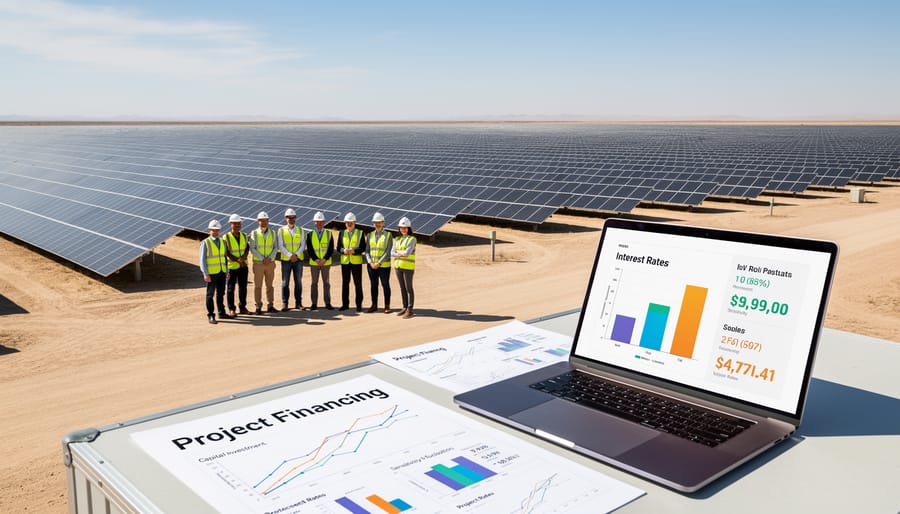
Levelized Cost of Energy (LCOE) Sensitivity
Financing costs represent one of the most influential variables in LCOE calculations, often determining whether a photovoltaic project proceeds or stalls. The weighted average cost of capital directly feeds into LCOE formulas, where even modest interest rate changes can shift project economics by 10-20%. For instance, a utility-scale solar installation financed at 3% interest might achieve an LCOE of $40 per megawatt-hour, while the same project financed at 7% could see LCOE rise to $52 per megawatt-hour, potentially exceeding power purchase agreement rates and rendering the project uncompetitive.
This sensitivity becomes particularly acute for capital-intensive renewable projects with minimal fuel costs, where upfront expenditures dominate lifetime expenses. A 100-basis-point increase in financing costs can elevate LCOE by approximately 5-8%, depending on project structure and debt-to-equity ratios. Academic research, including collaborative studies with university partners, demonstrates that financing terms influence LCOE more significantly than module efficiency improvements in mature markets.
For aspiring professionals, understanding this relationship proves essential when evaluating project feasibility. Sensitivity analyses should always model LCOE across various interest rate scenarios, incorporating potential rate fluctuations over construction and operational periods. This analytical approach enables stakeholders to identify financing thresholds where projects transition from profitable to marginal, informing strategic decisions about timing, capital structure, and risk mitigation measures that preserve project viability across varying market conditions.
Internal Rate of Return (IRR) Thresholds
Rising interest rates fundamentally reshape investor expectations for photovoltaic project returns, directly influencing which developments move forward. As central banks adjust benchmark rates to manage inflation and economic growth, investors demand higher Internal Rates of Return (IRR) to compensate for increased opportunity costs and risk-adjusted returns available in alternative investments.
When interest rates climb from 2% to 5%, for example, investors typically expect project IRRs to increase proportionally, often seeking returns 3-5 percentage points above prevailing rates. This threshold adjustment immediately impacts project feasibility assessments. Solar installations that previously achieved acceptable 8-10% IRRs may become unattractive when competing investment vehicles offer comparable returns with lower risk profiles.
For photovoltaic developers, elevated IRR thresholds necessitate strategic recalibration across multiple dimensions. Projects must demonstrate enhanced revenue certainty through long-term power purchase agreements, reduced capital expenditures via technological efficiencies, or accelerated deployment timelines. Understanding these solar investment metrics becomes essential for professionals navigating financing negotiations.
Universities collaborating with industry partners increasingly incorporate rate sensitivity analysis into renewable energy curricula, preparing graduates to model various interest rate scenarios and identify projects capable of meeting evolving return thresholds in dynamic capital markets.
Real-World Scenarios: Interest Rate Environments and Solar Deployment
Low Interest Rate Period (2010-2021)
The period from 2010 to 2021 marked a transformative era for solar photovoltaic deployment, largely driven by historically low interest rates maintained by central banks worldwide following the 2008 financial crisis. The U.S. Federal Reserve held rates near zero percent through 2015, with similar policies adopted across Europe and Asia, fundamentally reshaping the economics of capital-intensive solar projects.
This low-rate environment dramatically improved project internal rates of return and net present values. For utility-scale installations, weighted average cost of capital declined from approximately 8-10% in the late 2000s to 4-6% by the mid-2010s, translating directly to lower levelized cost of energy calculations. A typical 100 MW solar farm financed at 5% rather than 8% could see LCOE reductions of 15-20%, significantly enhancing competitive positioning against conventional generation.
Commercial and residential segments experienced parallel benefits. Distributed generation projects became financially viable across broader geographic markets as financing costs compressed. Solar lease and power purchase agreement providers leveraged inexpensive debt to expand customer bases, while property-assessed clean energy programs proliferated in jurisdictions where cheap municipal bonds enabled low-cost financing mechanisms.
The capital markets responded enthusiastically, with solar investment reaching record levels. Global photovoltaic installations grew from 17 GW in 2010 to over 140 GW by 2021, partially attributable to favorable financing conditions. Institutional investors, including pension funds and insurance companies seeking yield in a low-rate environment, increasingly allocated capital to renewable energy infrastructure, establishing solar as a mainstream asset class with predictable cash flows and acceptable risk-adjusted returns.
Rising Rate Environment Challenges (2022-Present)
The monetary policy shifts beginning in 2022 have fundamentally altered the financial landscape for photovoltaic projects. As central banks worldwide raised benchmark interest rates to combat inflation, borrowing costs increased significantly, directly impacting project financing structures and investment returns. The Federal Reserve’s rate hikes from near-zero to over 5% within eighteen months created immediate challenges for solar developers accustomed to historically low capital costs.
Higher interest rates compress project internal rates of return and extend payback periods, making marginal projects economically unviable. For example, a utility-scale solar installation financed at 7% versus 3% experiences substantially higher levelized cost of energy, potentially losing competitive advantage against fossil fuel alternatives. This pressure has forced industry participants to implement strategic adaptations.
Financial institutions have responded by developing innovative financing structures, including hybrid debt-equity models and performance-based lending that ties interest rates to energy production metrics. Project developers increasingly prioritize operational efficiency improvements and technology upgrades to offset financing cost increases. The integration of energy storage systems has become more attractive, as enhanced grid services can justify higher capital expenditures through improved revenue streams.
Educational institutions and industry organizations have strengthened collaborative programs to equip professionals with advanced financial modeling skills essential for navigating this environment. Understanding sensitivity analysis, scenario planning, and risk-adjusted returns has become critical for aspiring solar professionals. Universities now emphasize financial engineering coursework alongside technical photovoltaic training, recognizing that successful project development requires comprehensive capital markets knowledge. This challenging period has ultimately accelerated industry maturation, fostering more sophisticated financial approaches and resilient business models.
Strategic Considerations for PV Professionals

Financial Literacy as a Competitive Advantage
Understanding capital markets provides photovoltaic professionals with a distinct competitive edge in an increasingly finance-driven renewable energy sector. As solar projects require substantial upfront investment, professionals who comprehend how interest rate fluctuations, capital availability, and financing structures affect project economics can make more strategic decisions that directly impact project viability and profitability.
This financial literacy enables practitioners to effectively communicate with investors, financial institutions, and stakeholders using the language of capital markets. When presenting solar projects, professionals who can articulate how interest rate changes affect net present value calculations or how debt-to-equity ratios influence project returns demonstrate credibility that separates them from peers lacking this knowledge.
Career advancement opportunities increasingly favor candidates with interdisciplinary expertise spanning both technical solar engineering and financial analysis. Project developers, asset managers, and consultants who understand capital market dynamics can identify optimal financing windows, negotiate better terms with lenders, and structure deals that maximize returns while minimizing risk exposure. Universities now incorporate financial modeling and capital markets curriculum into renewable energy programs, recognizing this competency gap as critical for industry readiness. Professionals who proactively develop these skills position themselves as valuable assets capable of bridging the technical-financial divide that characterizes modern solar project development.
Risk Mitigation Strategies
Effective risk mitigation strategies are essential for protecting photovoltaic projects from interest rate volatility and ensuring long-term financial viability. Understanding and implementing these tools can significantly improve project economics and attract investor confidence.
Fixed-rate financing represents one of the most straightforward hedging mechanisms. By locking in interest rates at the project’s inception, developers eliminate uncertainty regarding debt service costs throughout the loan term. This approach provides predictable cash flows, simplifying financial modeling and reducing exposure to rate fluctuations that could erode profit margins. Fixed-rate loans typically carry slightly higher initial rates than variable options, but this premium often proves worthwhile for the stability gained.
Power purchase agreements serve dual purposes as both revenue stabilization and financing facilitation tools. These long-term contracts guarantee fixed electricity prices, creating predictable revenue streams that make projects more attractive to lenders. The revenue certainty often translates to better financing terms, as lenders view reduced revenue risk favorably when assessing creditworthiness.
Interest rate swaps and caps provide sophisticated hedging instruments for larger projects. Swaps allow developers to exchange variable-rate obligations for fixed payments, while caps establish maximum rate thresholds. These derivatives require careful structuring and ongoing management but offer flexibility unavailable through traditional fixed-rate loans.
Diversification across multiple projects with staggered financing timelines helps organizations manage portfolio-level interest rate risk. This strategy prevents overconcentration of rate exposure at any single point in the economic cycle.
Academic institutions and industry training programs increasingly emphasize financial risk management education, recognizing its critical role in successful project development. Aspiring professionals should prioritize understanding these mechanisms, as they directly impact project feasibility assessments and investment decisions throughout their careers in the renewable energy sector.
The intersection of technical proficiency and financial literacy represents a critical competency gap in today’s solar energy sector. While engineering expertise remains foundational, the economic viability of photovoltaic projects ultimately depends on professionals who understand how capital markets, interest rate fluctuations, and financing mechanisms influence project returns. Solar professionals equipped with this dual expertise can more effectively evaluate project feasibility, communicate with investors, and navigate the complex financial landscape that determines which renewable energy initiatives move forward.
Understanding concepts such as weighted average cost of capital, discount rates, and debt-to-equity ratios enables practitioners to make informed decisions that extend beyond technical specifications. This financial literacy becomes particularly valuable during periods of monetary policy shifts, when interest rate changes can dramatically alter project economics and investment priorities. Professionals who comprehend these dynamics position themselves as strategic assets within organizations, capable of bridging the communication gap between engineering teams and financial stakeholders.
Mose Solar recognizes that comprehensive education must address both technical and economic dimensions of solar energy development. Through strategic partnerships with universities, we deliver integrated educational programs that prepare the next generation of solar professionals for real-world challenges. These collaborative initiatives ensure that students and industry newcomers gain exposure to capital markets fundamentals alongside photovoltaic system design, creating well-rounded professionals capable of driving the renewable energy transition forward through both innovation and sound financial decision-making.