The transformation of solar energy financing has revolutionized how renewable projects move from concept to completion. Traditional funding mechanisms are giving way to innovative financial models that democratize solar investment while maximizing returns for stakeholders across the energy sector. As project costs continue to decline and environmental imperatives grow stronger, sophisticated financing structures have emerged to address the $1.3 trillion annual investment needed to achieve global renewable energy targets by 2030.
From power purchase agreements (PPAs) and solar leases to green bonds and peer-to-peer lending platforms, today’s solar financing landscape offers unprecedented flexibility for both developers and investors. These mechanisms not only reduce upfront capital requirements but also create sustainable revenue streams that attract institutional investors while making solar accessible to a broader range of consumers and businesses.
Understanding these diverse financing options has become crucial for project success. Whether you’re a utility-scale developer, commercial property owner, or residential installer, mastering the intricacies of solar project financing can mean the difference between a successful installation and a stalled initiative. This comprehensive guide explores the latest financing innovations, risk mitigation strategies, and emerging trends reshaping the solar investment landscape.
The Evolution of Solar Project Financing
Traditional Solar Financing Challenges
Despite the growing demand for solar energy installations, traditional solar financing methods present several significant challenges for both developers and potential adopters. High upfront costs remain a primary barrier, often requiring substantial capital that many businesses and homeowners cannot readily access. Commercial banks frequently impose stringent credit requirements and collateral demands, making it difficult for smaller projects to secure funding.
The lengthy approval processes associated with conventional financing can delay project implementation, potentially causing missed opportunities for tax incentives or favorable pricing agreements. Traditional lenders may also lack specialized knowledge of the solar industry, leading to conservative risk assessments and higher interest rates. Furthermore, these institutions typically prefer large-scale utility projects over distributed solar installations, creating a funding gap for medium-sized commercial and community solar initiatives.
The rigid structure of conventional loans often fails to accommodate the unique characteristics of solar projects, such as variable energy production rates and performance-based revenue streams. This misalignment between traditional financing terms and solar project economics can impact project viability and return on investment calculations.
The Rise of P2P Solar Networks
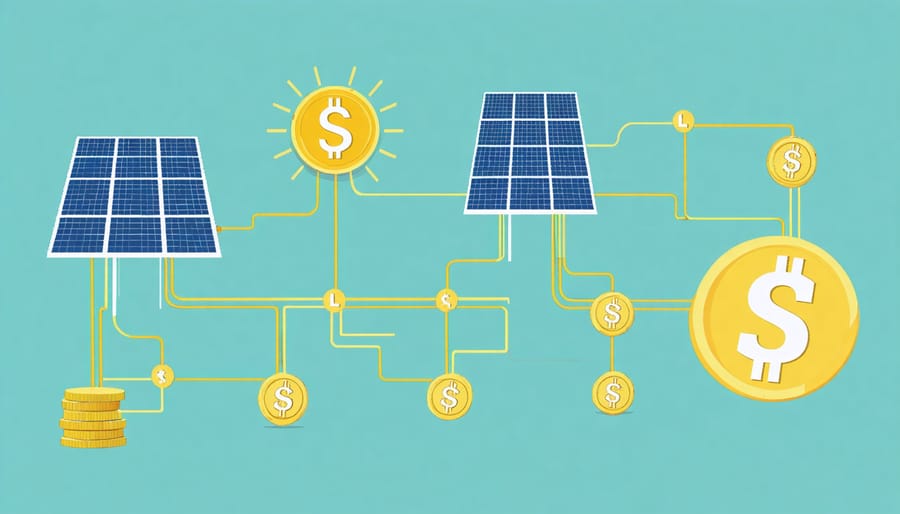
Peer-to-peer solar networks represent a transformative development in renewable energy financing, enabling direct connections between solar project developers and individual investors. These platforms leverage digital technology to democratize solar investment opportunities, allowing multiple participants to fund projects collectively while sharing the returns.
The growth of P2P solar networks has been particularly notable in developed markets, where regulatory frameworks have evolved to accommodate this innovative financing model. Investors can participate with relatively small amounts, typically starting from $100, making solar investment accessible to a broader demographic than traditional financing methods.
These networks operate through secure online platforms that handle documentation, payment processing, and project monitoring. Many platforms incorporate blockchain technology to ensure transparency and automate dividend distributions. The model has proven especially effective for community solar projects, where local residents can invest in nearby installations.
Recent market analysis indicates a compound annual growth rate of 15% in P2P solar financing platforms, with particularly strong adoption in Europe and North America. This growth is driven by increasing environmental awareness, desire for sustainable investments, and the platforms’ ability to offer competitive returns while supporting clean energy development.
How P2P Solar Financing Networks Operate
Platform Structure and Technology
Modern P2P solar financing platforms leverage advanced technology stacks to facilitate secure and efficient transactions between investors and project developers. These platforms typically operate on cloud-based infrastructures, incorporating sophisticated smart contract capabilities and blockchain integration in energy trading systems to ensure transparency and trust.
The core architecture consists of three main layers: the user interface layer, featuring responsive web applications and mobile interfaces; the middleware layer, handling authentication, data processing, and transaction management; and the backend infrastructure, managing database operations and smart contract execution.
Key technological components include:
– Distributed ledger technology for immutable transaction records
– Smart contracts for automated agreement execution
– Digital wallet integration for secure fund transfers
– API frameworks for third-party service integration
– Advanced encryption protocols for data security
– Real-time monitoring and reporting systems
These platforms employ microservices architecture to ensure scalability and maintain high performance during peak trading periods. Identity verification systems utilize multi-factor authentication and KYC (Know Your Customer) protocols to prevent fraud and ensure regulatory compliance.
The integration of artificial intelligence and machine learning algorithms helps optimize project matching, risk assessment, and portfolio management, while automated reporting tools facilitate regulatory compliance and transparent communication between stakeholders.
Investment Models and Returns
Solar project financing offers diverse investment models, each tailored to different risk appetites and return expectations. The most common approaches include direct ownership, power purchase agreements (PPAs), and community solar investments. Understanding these models is crucial for maximizing solar investment returns and project viability.
Direct ownership typically requires substantial upfront capital but offers the highest potential returns, with ROI ranging from 10-20% annually through energy savings and incentives. The payback period usually falls between 5-8 years, depending on local utility rates and available tax benefits.
PPAs present a lower-risk option, where investors receive steady returns through fixed-rate energy contracts, typically yielding 6-12% annually. This model requires minimal upfront investment and provides predictable cash flows over 15-25 years.
Community solar projects offer a middle-ground approach, enabling multiple investors to pool resources while sharing returns. These investments usually generate 7-15% annual returns through subscriber payments and renewable energy credits.
Each model’s performance varies based on factors including:
– Geographic location and solar irradiance
– Local electricity rates and rate escalators
– Available incentives and tax benefits
– Operation and maintenance costs
– Project scale and efficiency
Investors should conduct thorough due diligence, considering both financial projections and risk factors before selecting an investment model that aligns with their objectives.
Benefits and Risk Management
Advantages for Investors and Project Developers
Solar project financing offers substantial advantages for both investors and project developers, creating a mutually beneficial ecosystem that drives renewable energy adoption. For investors, these projects provide stable, long-term returns with predictable cash flows, typically ranging from 5-20 years. The investment opportunity allows for portfolio diversification while contributing to environmental sustainability, making it particularly attractive for ESG-focused investors.
Project developers benefit from increased access to capital through multiple financing channels, reducing their dependence on traditional banking institutions. This flexibility enables faster project implementation and scalability, particularly beneficial for medium-sized solar installations. The availability of diverse financing options allows developers to optimize their capital structure and potentially reduce overall project costs.
Both parties enjoy tax incentives and governmental support programs, enhancing the financial viability of solar projects. Investors can take advantage of tax credits, depreciation benefits, and other financial instruments, while developers can leverage these incentives to make projects more attractive to potential funders.
The structured nature of solar financing arrangements provides clear risk allocation and performance metrics. Investors receive detailed project documentation and regular performance reports, ensuring transparency and accountability. Developers benefit from standardized financing processes and documentation, streamlining project execution and reducing administrative burden.
Modern digital platforms have further enhanced these advantages by facilitating direct connections between investors and developers, reducing intermediary costs and improving communication efficiency. This technological integration enables better project monitoring, risk assessment, and performance tracking, providing stakeholders with real-time insights and enhanced decision-making capabilities.
Risk Assessment and Mitigation
The success of solar project financing heavily depends on accurate risk assessment and implementation of effective mitigation strategies. Key risks include technical performance issues, regulatory changes, market fluctuations, and environmental factors. Equipment failure or underperformance can significantly impact project returns, making thorough technical due diligence and quality assurance essential.
Financial risks encompass interest rate volatility, currency exchange fluctuations for international projects, and counterparty default risks. Investors protect themselves through comprehensive insurance coverage, performance guarantees, and carefully structured contracts with equipment suppliers and contractors. Power purchase agreement (PPA) terms must be meticulously reviewed to ensure stable revenue streams.
Environmental and regulatory risks require particular attention. Changes in government policies, subsidy programs, or environmental regulations can affect project viability. Developers typically conduct detailed environmental impact assessments and maintain close relationships with regulatory bodies to stay ahead of policy changes.
Construction and operational risks are mitigated through experienced engineering, procurement, and construction (EPC) contractors, detailed project timelines, and performance bonds. Regular maintenance schedules and monitoring systems help identify and address potential issues before they impact project performance.
Credit risk assessment of off-takers is crucial for project success. Thorough evaluation of their financial stability and implementation of credit enhancement measures, such as letters of credit or escrow accounts, provide additional security for investors.
Resource risk, particularly solar irradiance variability, is addressed through conservative energy production estimates and advanced monitoring systems. Long-term weather data analysis and satellite-based assessment tools help establish reliable production forecasts, ensuring realistic financial projections.
Future Outlook and Industry Impact
Market Growth Projections
The global solar project financing market continues to exhibit robust growth, with recent solar market growth trends indicating a compound annual growth rate (CAGR) of 15.3% through 2030. This expansion is driven by increasing renewable energy adoption targets, declining solar technology costs, and evolving financing mechanisms that make solar projects more accessible to diverse stakeholders.
Analysts project that the total investment in solar project financing will exceed $375 billion by 2025, representing a significant increase from $223 billion in 2020. Emerging markets, particularly in Asia-Pacific and Latin America, are expected to contribute substantially to this growth, with institutional investors showing increased interest in utility-scale solar projects.
The residential and commercial sectors are witnessing particularly strong momentum, fueled by innovative financing solutions such as green bonds, solar leasing programs, and power purchase agreements (PPAs). These financing mechanisms are projected to facilitate the deployment of over 200 GW of new solar capacity annually by 2025.
Market forecasts indicate that peer-to-peer solar financing platforms will capture approximately 8% of the total solar financing market by 2027, offering new opportunities for small to medium-scale projects. This growth is supported by advancing digital technologies, improved regulatory frameworks, and increasing investor confidence in solar assets as a stable, long-term investment vehicle.

Regulatory Developments
The regulatory landscape for peer-to-peer solar financing continues to evolve, with several key developments shaping the industry’s future. The Securities and Exchange Commission (SEC) has implemented new crowdfunding regulations that directly impact P2P solar platforms, including provisions for investment limits and disclosure requirements. These guidelines aim to protect retail investors while facilitating broader participation in solar project funding.
Recent amendments to the Investment Company Act have created more flexible frameworks for renewable energy investment vehicles, enabling P2P platforms to structure their offerings more efficiently. Additionally, state-level renewable portfolio standards (RPS) are increasingly incorporating provisions that support community-based solar financing initiatives.
The Department of Energy’s recent policy guidelines have established standardized documentation requirements for P2P solar projects, streamlining the due diligence process for both investors and project developers. Tax incentives, including the Investment Tax Credit (ITC), continue to play a crucial role in making P2P solar investments attractive, though regulations around their application in P2P structures require careful consideration.
Looking ahead, regulatory bodies are developing frameworks for blockchain-based P2P energy trading and investment platforms. These emerging regulations focus on transparency, cybersecurity, and consumer protection while promoting innovation in the sector. Project developers and investors should stay informed about these evolving requirements to ensure compliance and maximize opportunities within the P2P solar financing ecosystem.
Solar project financing represents a critical component in advancing renewable energy adoption worldwide. As we’ve explored throughout this article, various financing mechanisms exist to support solar installations across different scales and contexts. From traditional bank loans and power purchase agreements to innovative peer-to-peer platforms and green bonds, stakeholders have multiple options to fund their solar initiatives.
For those interested in pursuing solar project financing, several key action steps are recommended. First, conduct thorough due diligence on available financing options, considering factors such as interest rates, term lengths, and eligibility requirements. Second, develop a comprehensive project proposal that includes detailed financial projections, technical specifications, and risk assessment analyses. Third, engage with multiple financing providers to compare terms and identify the most advantageous arrangement for your specific circumstances.
Industry professionals should stay informed about emerging trends and regulatory changes that may impact financing opportunities. Maintaining relationships with financial institutions, attending industry conferences, and participating in professional networks can provide valuable insights and connections. Additionally, exploring innovative financing models like community solar programs and crowdfunding platforms may reveal new opportunities for project development.
Remember that successful solar project financing requires careful planning, strong documentation, and strategic partnership development. By leveraging available resources and staying current with market developments, stakeholders can effectively navigate the financing landscape and contribute to the continued growth of solar energy adoption.