
Government incentives are revolutionizing the solar power landscape, making clean energy more accessible and financially attractive than ever before. The federal Investment Tax Credit (ITC), state-level rebates, and local utility programs have been instrumental in driving solar PV adoption across the United States. These financial mechanisms can reduce installation costs by up to 50%, transforming the economics of residential and commercial solar investments.
Recent policy developments have expanded these incentives significantly, with the Inflation Reduction Act of 2022 extending the federal tax credit at 30% through 2032. This long-term commitment provides unprecedented stability for solar investments, while state-specific programs offer additional layers of financial support through performance-based incentives, property tax exemptions, and innovative financing solutions.
Understanding these diverse incentive programs is crucial for maximizing return on investment in solar technology. From direct cash rebates to net metering policies, these government initiatives create a comprehensive framework that accelerates the transition to renewable energy while generating substantial savings for property owners and businesses committed to sustainability.
Federal Solar Investment Tax Credit (ITC)
Current ITC Rates and Timeline
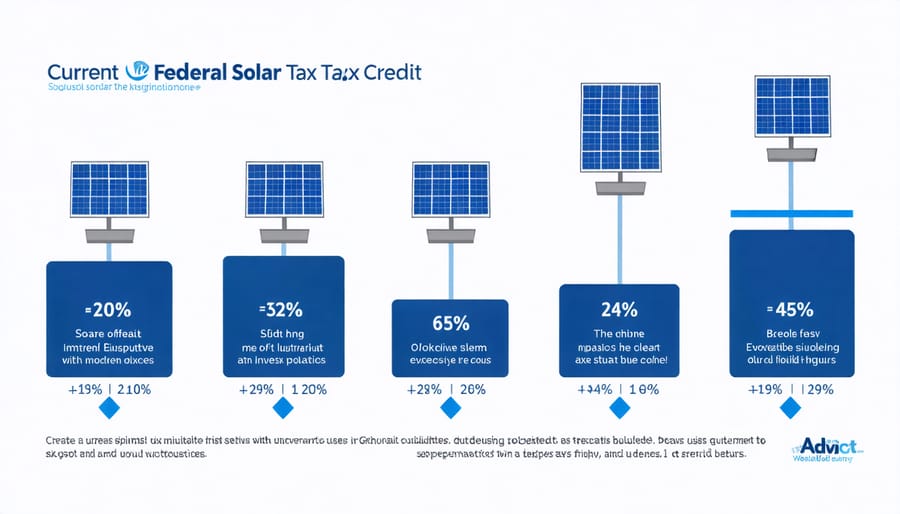
The Investment Tax Credit (ITC) remains a cornerstone of federal renewable energy policies, offering substantial financial incentives for solar power adoption. For 2024, residential and commercial solar installations qualify for a 30% tax credit, which will maintain through 2032. This percentage applies to the total cost of the system, including equipment, installation, and related expenses.
The current timeline establishes a gradual step-down structure. In 2033, the credit will decrease to 26%, followed by a further reduction to 22% in 2034. Unless Congress extends the program, the ITC will expire for residential installations and permanently settle at 10% for commercial projects beginning in 2035.
Specific provisions exist for projects that commence construction before these deadlines. The “commence construction” clause allows projects to qualify for the higher rate if they begin physical work of a significant nature or meet the Five Percent Safe Harbor test, which requires investing 5% of the total project cost.
Additional bonus credits are available for projects meeting specific criteria:
– 10% for installations in energy communities
– 10% for projects using qualified domestic content
– 20% for affordable housing projects
– 10% for projects in low-income communities
These rates are subject to annual review by the Department of Treasury and may be adjusted based on economic indicators and policy objectives.
Eligibility Requirements
The federal solar Investment Tax Credit (ITC) is available to both residential and commercial property owners who install qualifying solar energy systems. To be eligible, property owners must have sufficient tax liability and install a new solar PV system on their primary or secondary residence, or commercial property within the United States.
Qualifying expenses include solar panels, inverters, mounting equipment, and balance of system components. The credit also covers labor costs for on-site preparation, assembly, and original installation, including permitting fees, inspection costs, and developer fees. Energy storage devices that are charged exclusively by the solar PV system are also eligible when installed simultaneously.
For residential installations, homeowners must own their solar PV system rather than lease it or enter into a power purchase agreement (PPA). The system must be installed and operational during the tax year for which the credit is claimed. New construction properties and retrofits are both eligible, provided they meet technical requirements outlined by the Department of Energy.
Commercial entities must demonstrate that the solar installation is primarily for business use. The system must comply with applicable fire and electrical codes, and be certified by the Solar Rating Certification Corporation (SRCC) or comparable entity recognized by the state where the system is installed.
Properties receiving other state or local incentives generally remain eligible for the federal tax credit, though specific program requirements may vary by jurisdiction.
State-Level Solar Incentives
Solar Renewable Energy Credits (SRECs)
Solar Renewable Energy Credits (SRECs) represent a performance-based incentive that enables solar system owners to earn additional income from their installations. Each SREC represents 1 megawatt-hour (MWh) of electricity generated from solar panels. These credits can be sold to utility companies, which must meet state-mandated Renewable Portfolio Standards (RPS).
The value of SRECs varies significantly by state and market conditions. In states with robust SREC markets like New Jersey and Massachusetts, credits can range from $200 to $400 per MWh. Maryland and Washington D.C. also maintain active SREC markets, with prices fluctuating based on supply and demand dynamics.
To participate in SREC programs, system owners must first register their installation with the state’s tracking system. Once registered, the system’s generation is monitored and certified, with SRECs issued accordingly. These credits can then be sold through spot market transactions or long-term contracts with aggregators or utilities.
The income potential from SRECs can significantly impact the return on investment for solar installations. For example, a 10kW residential system generating 12 MWh annually could earn between $2,400 and $4,800 per year in high-value SREC markets. However, it’s important to note that SREC programs have finite lifespans, typically lasting 5-10 years, and prices can decrease as more solar capacity enters the market.
State Tax Credits and Rebates
Beyond federal incentives, states offer diverse tax credits and rebates to encourage solar adoption. These state-level incentives can significantly reduce the overall cost of solar installation and vary considerably by location. California’s Self-Generation Incentive Program (SGIP) provides performance-based incentives for solar systems with storage capabilities, while New York’s NY-Sun program offers direct rebates based on system size and location.
Many states provide tax credits ranging from 10% to 35% of the total system cost. For instance, Iowa offers a 15% tax credit for residential installations, while South Carolina provides up to 25% of solar system costs. Some states combine multiple incentive types – Massachusetts offers both a tax credit and a production-based incentive through its SMART program.
Property tax exemptions are another common state-level benefit. States like Florida and Arizona exclude the added value of solar installations from property tax assessments. Additionally, several states have implemented sales tax exemptions on solar equipment purchases, providing immediate savings during system acquisition.
Performance-based incentives, offered in states like Illinois and Rhode Island, provide ongoing payments based on the actual electricity generated by solar systems. These programs typically operate through renewable energy credit (REC) markets, offering long-term revenue streams for system owners.
To maximize benefits, prospective solar adopters should consult their state energy offices or qualified solar installers to understand current available incentives, as programs and funding levels may change annually.
Local Utility Incentives
Net Metering Policies
Net metering is a billing mechanism that allows solar energy system owners to receive credits for excess electricity they feed back into the grid. This policy enables consumers to offset their electricity costs by generating their own clean energy while maintaining reliable power through grid interconnection requirements.
Under net metering arrangements, your electricity meter tracks both the energy you consume from the grid and the surplus power your solar panels generate. When your system produces more electricity than you use, the excess flows back to the grid, causing your meter to run backward. This surplus is credited to your account at the retail rate, effectively reducing your future electricity bills.
The benefits of net metering are substantial. Besides lowering electricity costs, it encourages solar adoption by improving system payback periods. This policy also supports grid stability by providing distributed energy resources and reducing strain on utility infrastructure during peak demand periods. Most states have established net metering policies, though specific terms and compensation rates vary by jurisdiction. Understanding your local net metering regulations is crucial for maximizing the financial returns of your solar investment.
Performance-Based Incentives
Performance-based incentives (PBIs) offer solar system owners compensation based on their actual energy production, typically measured in kilowatt-hours (kWh). These programs, administered by utility companies and state agencies, provide ongoing payments rather than upfront rebates, ensuring long-term benefits for system owners who maintain optimal performance.
Many utilities implement tiered payment structures, offering higher rates during peak demand periods and lower rates during off-peak hours. These incentives commonly range from $0.02 to $0.06 per kWh produced, though rates vary significantly by region and program specifications. Payment periods typically extend from 3 to 5 years, with some programs offering terms up to 10 years.
Notable examples include California’s Performance Based Incentive program, which specifically targets commercial and industrial installations, and Massachusetts’ SMART program, providing fixed per-kWh payments based on system size and location. These programs often require professional installation, regular maintenance documentation, and performance monitoring systems to verify energy production.
To qualify, systems must meet minimum efficiency standards and undergo periodic inspections. Participants usually need to install approved monitoring equipment and submit regular production reports to receive payments.

Commercial Solar Incentives
Modified Accelerated Cost Recovery System (MACRS)
The Modified Accelerated Cost Recovery System (MACRS) represents a significant tax benefit for commercial solar installations, allowing businesses to depreciate their solar energy systems over an accelerated five-year period. This depreciation schedule, established by the Internal Revenue Service, enables companies to deduct the cost of their solar investment more rapidly than traditional depreciation methods would allow.
Under MACRS, businesses can depreciate their solar equipment according to a predetermined schedule: 20% in year one, 32% in year two, 19.2% in year three, 11.52% in year four, 11.52% in year five, and 5.76% in year six. This accelerated depreciation schedule significantly impacts return on investment calculations and enhances the financial viability of commercial solar projects.
To qualify for MACRS depreciation, the solar energy system must be used for business or income-producing purposes. The system’s components must also meet specific IRS requirements and be placed in service during the tax year for which the depreciation is claimed. This incentive can be combined with other federal and state solar benefits, such as the Investment Tax Credit, multiply the financial advantages of solar adoption.
For optimal tax planning, businesses should consult with qualified tax professionals to ensure proper implementation of MACRS depreciation and maximize their solar investment benefits.
Business Energy Investment Tax Credit
The Business Energy Investment Tax Credit (ITC), also known as the Section 48 tax credit, offers significant financial incentives for commercial solar installations. Under current legislation, businesses can claim a tax credit equivalent to 30% of the total solar system installation costs through 2032. This credit applies to both solar photovoltaic systems and solar thermal technologies used for commercial, industrial, and agricultural purposes.
Eligible expenses include equipment costs, installation labor, permitting fees, and interconnection expenses. The credit can be claimed in the tax year when the solar installation is placed in service, with any unused portion carrying forward for up to 20 years. Businesses must ensure their systems meet all applicable safety and performance standards to qualify.
The ITC includes bonus credit provisions for projects meeting specific criteria. Systems installed in low-income communities or incorporating domestic content can qualify for additional credit percentages, potentially increasing the total benefit to 40% or more.
To maintain eligibility, businesses must own their solar installations and use them primarily for business operations. Projects beginning construction before the end of 2032 may qualify for the full 30% rate, after which the credit percentage will gradually decrease. The credit steps down to 26% in 2033 and 22% in 2034, making early adoption more financially advantageous for businesses considering solar investments.
Government incentives play a pivotal role in making solar power adoption both accessible and economically viable. Understanding and leveraging these financial benefits can significantly reduce initial installation costs and improve long-term returns on investment. However, the landscape of solar incentives is complex and constantly evolving, with programs varying significantly across jurisdictions and timeframes. To maximize available benefits, consulting with qualified solar professionals, tax advisors, and legal experts is essential. These specialists can provide tailored guidance based on your specific situation, location, and eligibility criteria. Remember that while this overview provides a foundation, successful implementation of solar incentives requires careful planning, thorough documentation, and precise timing to ensure compliance with program requirements and deadlines. Stay informed about updates to incentive programs and consider working with certified installers who understand local regulations and available benefits.