Revolutionizing solar panel manufacturing through advanced recycling practices has become a cornerstone of sustainable energy production. As the industry grapples with the environmental impact of solar manufacturing, innovative closed-loop systems are transforming waste management and resource utilization. Modern recycling technologies now recover up to 95% of semiconductor materials and 90% of glass from end-of-life panels, significantly reducing raw material demands and manufacturing costs.
Leading manufacturers have implemented automated recycling processes that separate and purify silicon, silver, and other valuable components with unprecedented precision. These recovered materials meet the stringent quality requirements for new panel production, creating a sustainable manufacturing ecosystem that minimizes environmental footprint while maximizing resource efficiency.
The integration of artificial intelligence and machine learning in recycling operations has revolutionized material identification and sorting processes, enabling more efficient recovery of critical components. This technological advancement, coupled with stricter environmental regulations and growing consumer awareness, positions recycling as an integral component of future-proof manufacturing strategies in the photovoltaic industry.
Current State of PV Panel Recycling
Material Recovery Processes
Material recovery from end-of-life photovoltaic panels involves several sophisticated processes designed to extract valuable components efficiently. The primary method begins with mechanical separation, where panels are dismantled and crushed into manageable fragments. This is followed by thermal processing at controlled temperatures to separate the glass from the encapsulation materials.
Chemical treatment processes are then employed to recover precious metals and semiconductor materials. The most common approach uses selective etching, where specific chemical solutions target different layers of the panel. This enables the recovery of silver from contact fingers, silicon from solar cells, and aluminum from frames and conducting strips.
Advanced technologies like electrostatic separation and flotation techniques further enhance the recovery of high-purity materials. These methods achieve recovery rates of up to 95% for glass and 85% for semiconductor materials. Hydrometallurgical processes are particularly effective for recovering rare earth elements and precious metals, using specialized leaching agents and precipitation methods.
Recent innovations in automated sorting systems have significantly improved the efficiency and economic viability of these recovery processes, making material recovery an increasingly important aspect of sustainable panel manufacturing.
Industry Standards and Regulations
The photovoltaic manufacturing industry operates under stringent regulations and standards designed to ensure sustainable practices and environmental protection. The European Union’s WEEE Directive mandates that manufacturers collect and recycle a minimum of 85% of their end-of-life PV modules. Similarly, the United States Environmental Protection Agency (EPA) classifies solar panels under the Resource Conservation and Recovery Act (RCRA), requiring proper handling and disposal of potentially hazardous materials.
Major markets have established specific guidelines for recycling processes. In Japan, manufacturers must adhere to the J-Moss regulation, which restricts the use of certain hazardous substances and mandates proper recycling procedures. China, the world’s largest solar panel producer, has implemented the RoHS directive, requiring manufacturers to limit harmful substances and establish recycling programs.
Industry certification systems, such as NSF/ANSI 457, provide frameworks for sustainable production practices. These standards evaluate environmental impacts throughout the manufacturing lifecycle, from raw material sourcing to end-of-life management. Manufacturers must also comply with ISO 14001 environmental management standards, ensuring continuous improvement in their recycling and waste reduction efforts.
Innovative Manufacturing Techniques
Silicon Recovery and Reuse
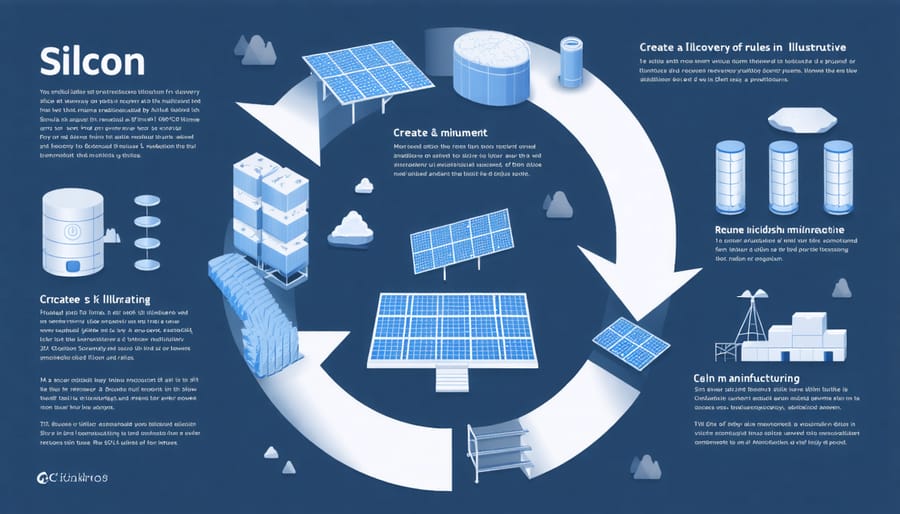
The recovery and reuse of silicon from end-of-life photovoltaic panels represents a crucial component of sustainable manufacturing practices in the solar industry. The process begins with mechanical separation, where panels are dismantled and silicon cells are isolated from other materials. Advanced thermal treatment methods are then employed to remove the ethylene vinyl acetate (EVA) encapsulant, followed by chemical processing to separate the silicon from metal contacts and anti-reflective coatings.
The recovered silicon undergoes rigorous purification processes, including acid etching and thermal treatment, to achieve the high purity levels required for solar cell manufacturing. Modern recycling facilities can recover up to 95% of semiconductor-grade silicon, which can be reprocessed into wafers for new solar cells. This recovered silicon typically maintains efficiency levels comparable to virgin materials when properly processed.
The reintegration process involves crushing and melting the recovered silicon, followed by directional solidification to create new ingots. These are then sliced into wafers using diamond wire sawing technology. Quality control measures, including resistivity testing and structural analysis, ensure the recycled silicon meets industry standards. This closed-loop approach significantly reduces the energy and raw materials needed for new panel production while minimizing environmental impact.
Metal and Glass Reclamation
Metal and glass components from decommissioned photovoltaic panels represent significant recyclable materials that can be effectively recovered and reintegrated into closed-loop manufacturing processes. The aluminum frames are typically separated first through mechanical processing, achieving recovery rates exceeding 95%. These frames can be melted down and repurposed for new solar panel frames or other aluminum products with minimal quality loss.
Glass recovery involves specialized thermal and mechanical separation techniques. The tempered glass, which comprises approximately 75% of a typical solar panel’s weight, undergoes careful processing to remove contamination and EVA coating. Advanced optical sorting technology enables the separation of different glass grades, resulting in high-purity cullet suitable for manufacturing new solar panels or other glass products.
The junction box and internal wiring contain valuable copper and other metals that are recovered through automated separation processes. Copper recovery rates typically reach 85-90%, while other metals like silver from the conducting strips can be extracted through hydrometallurgical processes.
Modern recycling facilities employ advanced technologies such as eddy current separation, optical sorting, and density separation to optimize metal and glass recovery. These methods ensure maximum material recovery while maintaining the high quality standards required for reintegration into new solar panel production.
Environmental and Economic Benefits
Carbon Footprint Reduction
The integration of recycling practices in photovoltaic manufacturing processes significantly reduces the industry’s carbon footprint through multiple pathways. Recent studies indicate that recycling solar panels can decrease CO2 emissions by approximately 1,200 kg per ton of recycled materials compared to using virgin resources. This reduction primarily stems from lower energy requirements in processing recycled materials and decreased mining activities.
Manufacturing with recycled silicon reduces energy consumption by up to 90% compared to processing raw silicon, resulting in approximately 2 metric tons of CO2 savings per kilowatt of panel capacity. Additionally, recovering and reusing metals like aluminum and copper from end-of-life panels reduces mining-related emissions by an estimated 40-50%.
Quantitative analyses demonstrate that comprehensive recycling programs can potentially prevent 60-70 million metric tons of CO2 emissions by 2050. The environmental impact extends beyond carbon reduction, as recycling one metric ton of solar panels conserves approximately 1,200 liters of water and prevents the extraction of 800 kg of raw materials.
Furthermore, implementing closed-loop manufacturing systems that incorporate recycled materials has shown to reduce transportation-related emissions by 30%, as materials remain within regional processing networks rather than requiring long-distance shipping of raw resources.
Cost Advantages
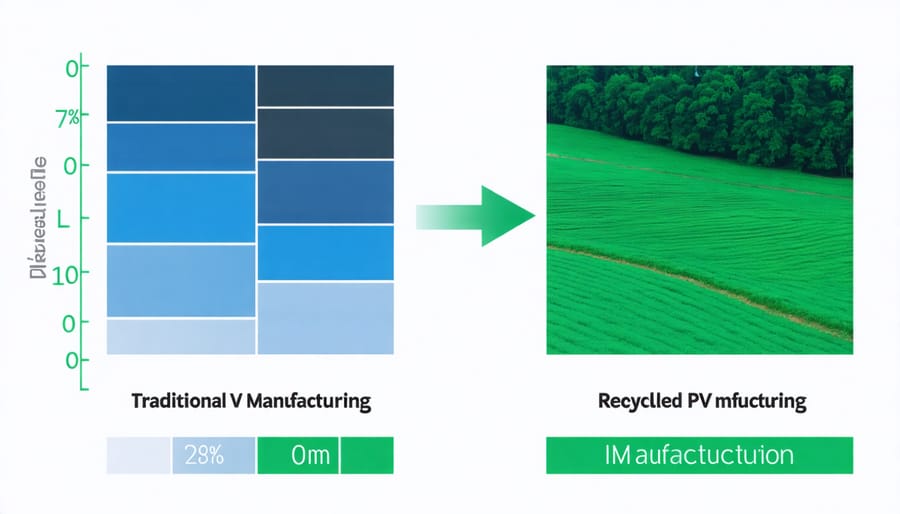
Implementing recycling programs in manufacturing processes offers significant economic advantages that extend beyond environmental benefits. Companies that integrate recycling systems typically experience a 15-25% reduction in raw material costs through the recovery and reuse of valuable components. This cost efficiency is particularly evident in photovoltaic manufacturing, where precious metals and semiconductor materials can be reclaimed and reprocessed.
The financial benefits are further amplified through reduced waste disposal costs, as recycling decreases the volume of materials sent to landfills. Manufacturing facilities report average savings of 30-40% on waste management expenses after implementing comprehensive recycling programs. Additionally, many regions offer tax incentives and grants for businesses that adopt sustainable manufacturing practices, providing immediate financial returns on recycling investments.
Energy cost savings represent another substantial advantage, as recycling typically requires less energy than processing virgin materials. For instance, recycling aluminum consumes approximately 95% less energy than primary production. These energy savings translate directly to lower operational costs and improved profit margins.
Long-term cost benefits also emerge through enhanced brand reputation and market competitiveness, as consumers increasingly prefer products from environmentally responsible manufacturers. This market advantage often results in increased sales and stronger customer loyalty, contributing to sustained financial growth.
Future Developments
The landscape of PV recycling is rapidly evolving, with several promising future solar technologies emerging to address current challenges. Advanced automated sorting systems utilizing artificial intelligence and machine learning are being developed to improve the efficiency of materials separation. These systems can identify and categorize different types of solar panels and their components with greater accuracy than traditional methods.
Innovative chemical recycling processes are showing potential for recovering high-purity silicon and other valuable materials from end-of-life panels. Researchers are developing selective extraction techniques that can separate and purify semiconductor materials while minimizing environmental impact. Additionally, new thermal recovery methods are being refined to process panels more efficiently while reducing energy consumption.
Manufacturing integration is another key area of development, with companies exploring design-for-recycling approaches. This includes the development of solar panels with easily separable components and materials that are more conducive to recycling. Some manufacturers are investigating the use of alternative materials and adhesives that maintain panel performance while facilitating end-of-life processing.
Pilot programs testing these emerging technologies are showing promising results, with improved recovery rates for critical materials and reduced processing costs. Industry collaborations between manufacturers, recyclers, and research institutions are accelerating the development of these solutions. As these technologies mature, they are expected to significantly enhance the circular economy potential of the PV industry, making solar energy an even more sustainable power source.
The integration of recycling practices into photovoltaic manufacturing represents a crucial step toward achieving true sustainability in the solar energy sector. As we’ve explored, advanced recycling technologies and circular economy principles are transforming how the industry approaches end-of-life panel management and resource recovery. The successful implementation of these practices not only addresses environmental concerns but also presents significant economic opportunities through material reclamation and waste reduction.
Looking ahead, the future of PV manufacturing appears increasingly centered on sustainable practices, with emerging technologies promising even higher recovery rates and more efficient recycling processes. The industry’s commitment to research and development, coupled with strengthening regulatory frameworks worldwide, suggests a positive trajectory toward more environmentally responsible manufacturing methods.
For continued progress, collaboration between manufacturers, researchers, and policymakers remains essential. As recycling technologies evolve and manufacturing processes become more sophisticated, the PV industry is well-positioned to demonstrate how sustainable practices can coexist with commercial viability. This transformation will be crucial in supporting the global transition to renewable energy while minimizing environmental impact.