
Energy transition companies are revolutionizing the global shift toward sustainable power through strategic integration of solar innovation hubs and advanced technological solutions. These organizations serve as critical bridges between traditional energy infrastructure and renewable futures, deploying cutting-edge photovoltaic systems while facilitating seamless grid modernization across international markets.
At the forefront of decarbonization efforts, energy transition companies leverage sophisticated engineering expertise, data analytics, and cross-border collaborations to accelerate renewable energy adoption. Their comprehensive approach encompasses everything from utility-scale solar installations to innovative energy storage solutions, creating sustainable frameworks that address both immediate power needs and long-term climate goals.
The transformation these companies enable extends beyond mere technology implementation. By establishing strategic partnerships with academic institutions, research facilities, and industry stakeholders, they create robust ecosystems that foster continuous innovation and knowledge transfer. This collaborative model ensures rapid advancement in renewable energy technologies while developing the skilled workforce needed to support global sustainability initiatives.
Through systematic integration of smart grid technologies, artificial intelligence, and advanced energy management systems, these organizations are actively reshaping the energy landscape. Their work not only facilitates the transition to clean energy but also ensures economic viability, grid reliability, and enhanced energy security for communities worldwide.
The Evolution of Energy Transition Companies
From Conventional to Renewable Energy
The evolution of traditional energy companies into renewable energy pioneers represents a significant shift in the global energy landscape. This transformation began in the late 20th century when major oil and gas corporations recognized the increasing importance of sustainable energy solutions. During the 1990s, several European energy giants initiated their first solar and wind power projects, marking the beginning of a strategic pivot toward renewables.
The transition accelerated in the early 2000s as technological advancements made renewable energy more cost-competitive. Traditional utilities and power companies began integrating solar, wind, and energy storage solutions into their portfolios. This period saw the emergence of dedicated renewable energy divisions within conventional energy corporations, accompanied by substantial investments in research and development.
By 2010, many energy companies had established comprehensive sustainability strategies, often supported by partnerships with research institutions and technology providers. This collaborative approach has facilitated knowledge transfer, technological innovation, and the development of new business models. Today, numerous former fossil fuel-focused enterprises have successfully repositioned themselves as integrated energy providers, with some achieving carbon-neutral operations and others setting ambitious renewable energy targets for the coming decades.

Strategic Transformation Frameworks
Successful energy transition requires a well-structured approach combining strategic planning, technological innovation, and stakeholder engagement. Leading energy transition companies employ comprehensive frameworks that typically encompass three key pillars: operational transformation, technological advancement, and sustainable implementation.
The operational transformation framework focuses on redesigning existing business models to accommodate renewable energy integration. This includes conducting thorough energy audits, establishing baseline measurements, and creating detailed roadmaps for transitioning from fossil fuels to clean energy sources.
Technological advancement frameworks prioritize innovation through systematic research and development processes. Companies evaluate emerging technologies, assess their viability, and develop implementation strategies that align with organizational capabilities and market demands.
The sustainable implementation framework ensures long-term success through careful change management and stakeholder coordination. This involves creating detailed timeline projections, establishing key performance indicators, and developing risk mitigation strategies.
These frameworks are supported by robust monitoring and evaluation systems that track progress, measure impact, and enable continuous improvement. Successful companies also emphasize knowledge transfer and capacity building, ensuring that transformation initiatives create lasting value while maintaining operational efficiency throughout the transition process.
Trans-National Solar Innovation Hubs: The New Ecosystem
Global Collaboration Networks
Energy transition companies thrive on robust international networks that facilitate knowledge sharing and accelerate sustainable innovation. These organizations leverage collaborative frameworks to connect research institutions, industry leaders, and policy makers across continents, creating powerful synergies in renewable energy development.
Key partnerships often include strategic alliances with universities, research centers, and technology providers worldwide. These connections enable rapid technology transfer, shared research capabilities, and coordinated responses to global energy challenges. Through structured knowledge exchange programs, companies can access diverse expertise, innovative solutions, and region-specific insights that drive technological advancement.
International collaboration networks also facilitate standardization efforts, helping establish uniform quality benchmarks and operational protocols across borders. This harmonization is crucial for scaling renewable energy solutions and ensuring consistent performance across different markets and regulatory environments.
Many energy transition companies participate in global consortiums and innovation platforms, where members pool resources for joint research initiatives and pilot projects. These platforms often incorporate digital collaboration tools, virtual training programs, and remote monitoring systems, enabling real-time knowledge sharing and project coordination regardless of geographical boundaries.
The effectiveness of these networks is further enhanced through regular international conferences, workshops, and technical symposiums, where stakeholders can exchange best practices and discuss emerging trends in renewable energy technologies.

Technology Transfer and Innovation
Energy transition companies leverage sophisticated technology transfer networks to accelerate innovation and market adoption of renewable energy solutions. These hubs serve as catalysts for technological advancement by facilitating knowledge exchange between research institutions, industry pioneers, and market implementers.
Through structured collaboration frameworks, these innovation centers enable rapid prototyping, testing, and validation of emerging technologies. They maintain specialized facilities equipped with advanced testing equipment, simulation tools, and demonstration platforms that help bridge the gap between laboratory research and commercial implementation.
The innovation process is further enhanced by cross-disciplinary teams that combine expertise in engineering, materials science, and system integration. This collaborative environment fosters the development of breakthrough solutions in areas such as solar cell efficiency, energy storage systems, and smart grid technologies.
Knowledge dissemination occurs through multiple channels, including technical workshops, research publications, and industry partnerships. These hubs also play a crucial role in standardization efforts, ensuring that new technologies meet international quality and safety requirements while maintaining compatibility across different markets.
By maintaining close relationships with academic institutions and research laboratories, energy transition companies can quickly identify and adapt promising technologies for commercial applications, significantly reducing the time-to-market for innovative solutions.
Educational Integration
Educational partnerships between energy transition companies and academic institutions serve as vital catalysts for developing expertise and driving innovation in renewable energy technologies. These collaborations typically involve joint research projects, specialized training programs, and knowledge exchange initiatives that benefit both industry professionals and students.
Leading energy transition companies establish strategic relationships with universities to create specialized curriculum tracks focusing on solar technology, energy storage systems, and smart grid integration. These programs combine theoretical knowledge with hands-on experience, preparing graduates for immediate contribution to the renewable energy sector.
Research partnerships facilitate access to cutting-edge laboratory facilities and enable companies to tap into academic expertise for solving complex technical challenges. Universities benefit from industry exposure, real-world project opportunities, and funding for advanced research initiatives. This symbiotic relationship accelerates the development of innovative solutions while ensuring a steady pipeline of skilled professionals.
Many companies also offer internship programs, giving students practical experience in solar installation, system design, and project management. These opportunities often lead to full-time employment, helping bridge the gap between academic training and industry requirements. Additionally, industry professionals frequently participate as guest lecturers, sharing real-world insights and maintaining strong connections between academic theory and practical application.
Through these educational integrations, energy transition companies play a crucial role in developing the next generation of renewable energy experts while advancing technological innovation in the field.
Impact and Future Prospects
Market Transformation Metrics
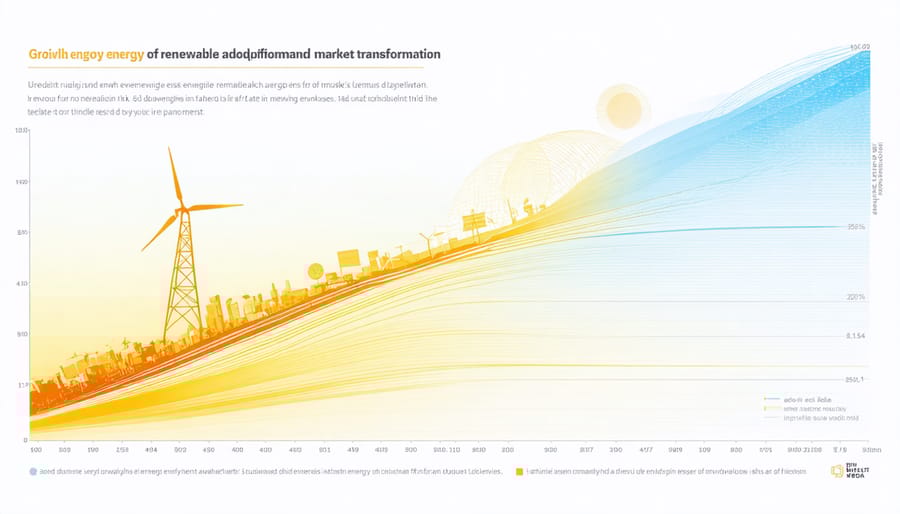
Energy transition companies employ several key metrics to measure their impact on market transformation and clean energy adoption. These indicators include the percentage increase in renewable energy installations, reduction in carbon emissions, and improvements in grid integration efficiency. Industry leaders typically track the growth rate of distributed energy resources (DERs) within their operational regions, measuring both residential and commercial adoption rates.
Successful market transformation is evidenced by decreasing levelized cost of energy (LCOE) for renewable technologies, growing investment in clean energy infrastructure, and increasing job creation in the renewable sector. Companies monitor these metrics quarterly, with many reporting annual compound growth rates exceeding 25% in solar and wind energy deployment.
Performance indicators also include the rate of fossil fuel displacement, measured in megawatt-hours (MWh) of clean energy generated, and the corresponding reduction in greenhouse gas emissions. Advanced analytics track consumer behavior changes, measuring factors such as the adoption rate of smart energy management systems and participation in demand response programs.
Market penetration metrics focus on geographic expansion, customer acquisition costs, and the diversity of energy solutions deployed. Companies assess their impact through the number of successful project implementations, customer satisfaction rates, and the scale of energy storage integration. These measurements provide quantifiable evidence of progress toward a sustainable energy future while helping identify areas requiring additional focus or investment.
Environmental and Economic Benefits
The transition to renewable energy sources yields substantial environmental and financial advantages for organizations and communities alike. Companies implementing comprehensive energy transition strategies typically report significant reductions in greenhouse gas emissions, often achieving 40-60% decreases within the first five years of implementation. These environmental benefits extend beyond carbon footprint reduction to include improved air quality and reduced water consumption in energy production processes.
From a financial perspective, energy transition initiatives demonstrate compelling returns on investment. Studies show that organizations adopting renewable energy solutions experience average energy cost reductions of 25-35% over traditional fossil fuel sources. The economic growth impact extends to job creation, with the renewable energy sector generating 3-4 times more employment opportunities compared to conventional energy industries.
Furthermore, companies undertaking energy transitions often benefit from enhanced operational resilience and improved energy security. The implementation of distributed energy systems and smart grid technologies enables better power management and reduced dependency on centralized power infrastructure. These improvements translate into decreased downtime risks and enhanced business continuity, while simultaneously supporting regional sustainability goals and compliance with evolving environmental regulations.
The measurable outcomes include reduced operational costs, improved environmental performance metrics, and strengthened stakeholder relationships, creating a robust foundation for long-term sustainable growth.
Future Growth Trajectories
Energy transition companies are poised for significant growth as global demand for renewable energy solutions continues to accelerate. Market analyses project that the renewable energy sector will expand at a compound annual growth rate of 8.4% through 2030, creating substantial opportunities for companies specializing in energy transition services.
Key growth trajectories include the expansion of integrated energy solutions, combining solar installations with energy storage systems and smart grid technologies. Companies are increasingly focusing on developing comprehensive energy management platforms that optimize resource utilization and enhance grid stability.
The emergence of green hydrogen technologies presents another promising avenue, with energy transition companies positioning themselves to facilitate the integration of hydrogen production facilities with renewable energy sources. This convergence is expected to create new revenue streams and market opportunities.
Digital transformation will play a crucial role, with companies investing in artificial intelligence and machine learning capabilities to improve operational efficiency and service delivery. Predictive maintenance systems and automated monitoring solutions are becoming standard offerings, enhancing the value proposition for clients.
Geographic expansion into emerging markets, particularly in Southeast Asia and Africa, represents a significant growth opportunity. These regions’ increasing energy demands and commitments to renewable energy adoption create favorable conditions for energy transition companies to establish new operational bases and partnerships.
Industry consolidation through strategic mergers and acquisitions is expected to continue, allowing companies to expand their service portfolios and achieve economies of scale.
The energy transition landscape continues to evolve rapidly, driven by technological innovation, policy reforms, and growing environmental consciousness. Energy transition companies have emerged as crucial catalysts in accelerating the shift toward sustainable energy systems, particularly in the solar power sector. These organizations have demonstrated their ability to bridge technological gaps, foster international collaboration, and create lasting impact through educational initiatives and practical implementation.
Looking ahead, the role of energy transition companies is expected to become even more vital as nations worldwide strive to meet their climate commitments. The integration of artificial intelligence, advanced energy storage solutions, and smart grid technologies will likely reshape how these companies operate and innovate. The trend toward establishing trans-national innovation hubs shows promising potential for accelerating knowledge transfer and technological advancement across borders.
Success in this evolving landscape will depend on several key factors: maintaining strong partnerships between industry and academia, developing workforce capabilities through specialized training programs, and ensuring continuous adaptation to emerging technologies and market demands. Companies that can effectively balance innovation with practical implementation while maintaining a strong focus on sustainability and education will be best positioned for long-term success.
As the global energy landscape continues its transformation, energy transition companies must remain agile and responsive to changing market dynamics while staying true to their core mission of facilitating sustainable energy adoption. The future outlook appears promising, with increasing opportunities for growth, innovation, and positive environmental impact through collaborative efforts and knowledge sharing across international boundaries.