
Perovskite solar cells stand at the cusp of a commercial breakthrough, promising to revolutionize renewable energy with their exceptional power conversion efficiencies and low production costs. While 2D perovskite technology has shown remarkable progress in laboratory settings, achieving efficiencies exceeding 25%, these innovative photovoltaic devices are not yet widely available for consumer purchase. Major manufacturers and research institutions are actively working to overcome key stability and scalability challenges, with several companies announcing pilot production lines and limited commercial releases expected within the next 2-3 years. This transformative technology represents the next generation of solar power, combining the potential for higher performance with significantly reduced manufacturing costs compared to traditional silicon-based panels. Understanding the current state of perovskite commercialization and its trajectory toward market availability is crucial for stakeholders across the renewable energy sector.
Current Commercial Status of Perovskite Solar Cells
Limited Commercial Products
While perovskite solar cells are not yet widely available in the consumer market, several companies have launched limited commercial products and pilot installations. Oxford PV, a leading pioneer in the field, has established a production facility in Brandenburg, Germany, with plans to manufacture perovskite-silicon tandem solar cells at scale by late 2024. Saule Technologies has deployed perovskite solar panels in commercial buildings, including a installation at the EXPO 2020 Polish Pavilion in Dubai.
Notable pilot projects include Microquanta Semiconductor’s 40kW demonstration project in Hangzhou, China, and Wonder Solar’s test installations in Japan. These implementations serve as crucial real-world validation of perovskite technology. Additionally, Hunt Perovskite Technologies has partnered with various manufacturers to integrate their perovskite solar technology into building-integrated photovoltaics (BIPV).
Several startups have also begun offering small-scale perovskite products for specialized applications, such as indoor light harvesting and IoT devices. However, these products represent early-stage commercialization efforts rather than mature market offerings, with limited availability and primarily serving as technology demonstrations.
Major Companies and Start-ups
Several prominent companies and startups are actively working to commercialize perovskite solar technology. Oxford PV, a spin-out from the University of Oxford, leads the field with its silicon-perovskite tandem cells and has secured significant investment for its commercial production facility in Germany. Saule Technologies, based in Poland, focuses on flexible perovskite modules for building-integrated photovoltaics and has partnered with major construction companies for pilot installations.
Hunt Perovskite Technologies (HPT) in the United States has made substantial progress in developing stable perovskite formulations, while Japanese manufacturer Panasonic has announced partnerships to develop perovskite-silicon tandem cells. Swift Solar, a California-based startup, specializes in lightweight, flexible perovskite modules for specialized applications.
In China, Microquanta Semiconductor and WonderSolar are scaling up their production capabilities, with pilot manufacturing lines already operational. Australian company GreatCell Solar is developing commercial-scale perovskite solutions, focusing on both standalone and tandem applications. These companies have collectively raised over $500 million in funding and are expected to begin limited commercial production within the next two to three years.
Technical Challenges Affecting Commercialization

Stability and Durability Issues
The primary challenge hindering widespread commercialization of perovskite solar cells lies in their stability and durability issues. Unlike traditional photovoltaic technology, perovskite cells currently demonstrate significant degradation when exposed to environmental factors such as moisture, heat, and prolonged sunlight.
Laboratory tests indicate that standard perovskite cells typically maintain optimal performance for only 1-2 years, compared to the 25-30 year lifespan of silicon solar panels. This degradation manifests through decreased power conversion efficiency and physical deterioration of the cell structure.
However, researchers are making substantial progress in addressing these challenges. Recent developments include enhanced encapsulation techniques, modified chemical compositions, and improved manufacturing processes. Notable breakthroughs include the development of 2D/3D hybrid structures and mixed-cation perovskite formulations that show promising stability improvements.
Several research institutions have achieved stability benchmarks exceeding 5,000 hours under accelerated testing conditions. Companies like Oxford PV and Saule Technologies are implementing these innovations in their pilot production lines, focusing on maintaining cell efficiency while improving longevity. These advancements suggest that commercial-grade stability could be achieved within the next few years, marking a crucial milestone for market viability.
Manufacturing Scale-up Challenges
Scaling up perovskite solar cell production from laboratory to industrial scale presents several significant manufacturing challenges. The primary obstacle lies in maintaining consistent quality and performance across large-area modules, as minor variations in production conditions can significantly impact cell efficiency. Current laboratory processes, which typically produce small-area cells, must be adapted for high-volume manufacturing while maintaining strict quality control.
Material stability during the manufacturing process poses another crucial challenge. Perovskite materials are sensitive to environmental conditions, requiring carefully controlled atmosphere and temperature during production. This necessitates specialized manufacturing equipment and environments, increasing production costs and complexity.
The development of reliable, high-throughput deposition techniques remains a key focus area. While methods like solution processing and vapor deposition show promise, achieving uniform film thickness and crystal formation across large areas consistently presents technical difficulties. Additionally, the integration of perovskite layers with other solar cell components requires precise control over interfaces and layer formation.
Industry stakeholders must also address the challenge of developing scalable encapsulation methods to protect perovskite materials from environmental degradation. This protection is crucial for ensuring long-term stability and meeting commercial warranty requirements, which typically extend to 25 years or more.
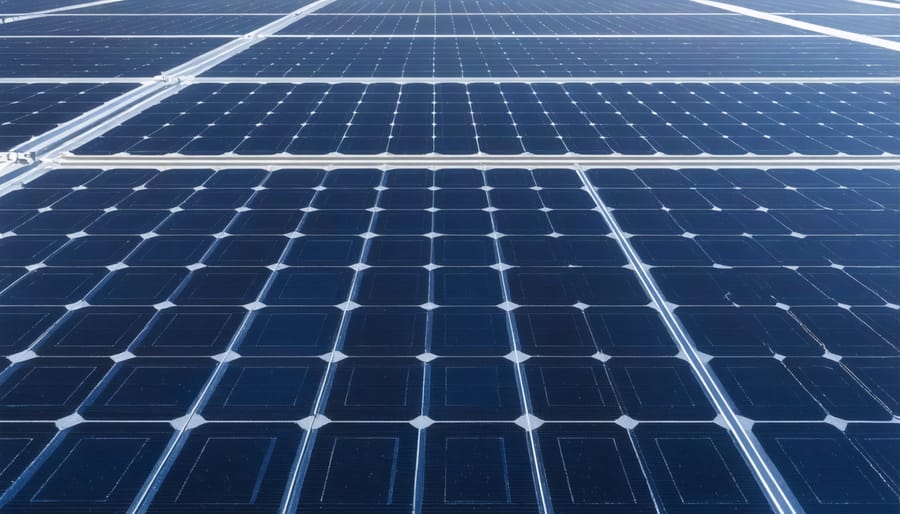
Timeline to Mass Market Availability
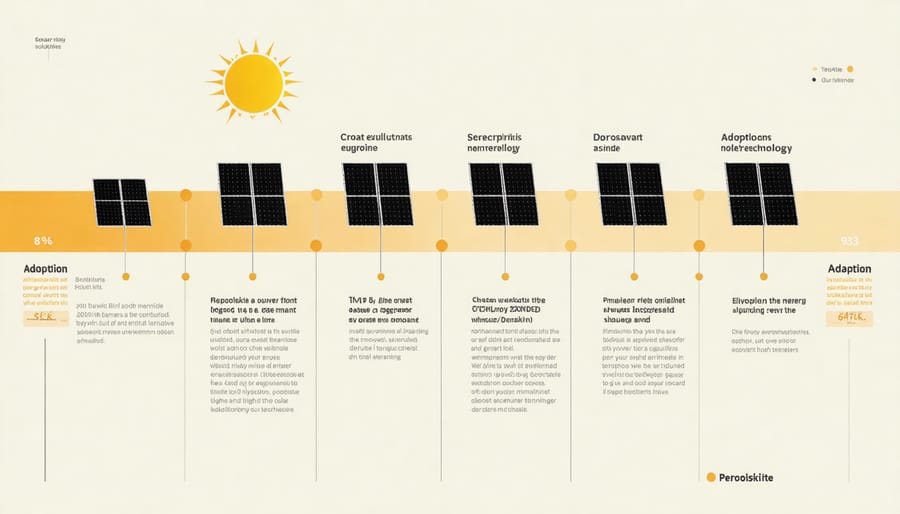
Near-term Developments (2024-2025)
The next 18-24 months are expected to bring significant advancements in perovskite solar cell commercialization. Several leading companies, including Oxford PV and Saule Technologies, have announced plans to begin limited commercial production by late 2024. These initial offerings will likely focus on specialized applications and pilot installations rather than mass-market consumer products.
Industry analysts project that the first commercial perovskite-silicon tandem cells will achieve stable efficiencies above 29% in production settings by early 2025. Manufacturing processes are being refined to increase throughput while maintaining consistent quality, with automated production lines expected to reach capacities of 100-200 MW annually.
Certification and standardization efforts are accelerating, with major testing laboratories developing specific protocols for perovskite solar cells. These standards will be crucial for industry acceptance and insurance compliance. Several countries are also updating their building codes and renewable energy regulations to accommodate these new technologies.
Research institutions and commercial partners are collaborating on solving remaining stability challenges, with promising developments in encapsulation techniques and moisture-resistant formulations. Market forecasts suggest initial commercial products will target building-integrated photovoltaics (BIPV) and specialized industrial applications, with broader consumer availability expected to follow in subsequent years.
Long-term Market Outlook
Industry analysts project that perovskite solar cells will begin meaningful commercial deployment between 2025 and 2027, with mass market adoption expected to accelerate significantly in the 2028-2030 timeframe. This timeline aligns with ongoing technological developments and manufacturing scale-up efforts by leading companies in the sector.
As one of the most promising solar innovations, perovskite technology is expected to capture 5-10% of the global solar market by 2030, potentially reaching 25% by 2035. This growth trajectory is supported by increasing investment in research and development, improvements in cell stability, and declining production costs.
Several factors will influence the pace of market adoption, including successful demonstration of long-term durability in real-world conditions, establishment of reliable mass production processes, and achievement of competitive price points compared to traditional silicon solar cells. Industry experts anticipate that initial commercial applications will focus on specialized markets and tandem cell technologies, gradually expanding to broader consumer applications.
The market outlook is particularly promising in regions with strong solar manufacturing capabilities and supportive renewable energy policies. As production scales up and efficiency continues to improve, perovskite solar cells are projected to become increasingly cost-competitive, potentially achieving manufacturing costs below $0.20 per watt by 2030.
Investment and Market Potential
The investment landscape for perovskite solar technology has seen remarkable growth, with global funding exceeding $1.5 billion in 2022. Major venture capital firms and established energy companies are increasingly backing perovskite startups, recognizing the technology’s potential to revolutionize the solar industry. Companies like Oxford PV and Saule Technologies have secured significant investments, with some funding rounds reaching hundreds of millions of dollars.
Market analysts project that the perovskite solar cell market could reach $3.9 billion by 2028, growing at a CAGR of approximately 25%. This growth potential is driven by the technology’s promise of higher efficiency rates, lower production costs, and versatile applications. Manufacturing costs for perovskite solar cells are estimated to be 50% lower than traditional silicon cells when scaled to commercial production.
Several factors contribute to investor confidence, including recent efficiency breakthroughs exceeding 29% for perovskite-silicon tandem cells and the technology’s potential integration with existing manufacturing infrastructure. However, investors remain cautious about scalability challenges and long-term stability issues that need resolution before mass commercialization.
Strategic partnerships between research institutions and industry players are accelerating commercialization efforts. Many companies are establishing pilot production lines, suggesting that initial commercial products could enter specific market segments within the next 2-3 years, particularly in building-integrated photovoltaics and specialized applications.
While perovskite solar cells show immense promise for revolutionizing the solar energy industry, they are not yet widely available for commercial purchase. Several companies and research institutions are making significant progress in addressing stability, durability, and manufacturing challenges. Industry experts anticipate commercial availability within the next 3-5 years, with initial applications likely in specialized markets and building-integrated photovoltaics. The technology continues to advance rapidly, with recent developments in efficiency and stability bringing us closer to widespread commercialization. As manufacturing processes become standardized and certification requirements are met, perovskite solar cells are expected to emerge as a competitive alternative to traditional silicon-based panels, potentially offering lower costs and improved performance characteristics for consumers and businesses alike.