Renewable energy policy stands at the forefront of global climate action, fundamentally reshaping the U.S. renewable energy landscape through strategic incentives, regulatory frameworks, and market mechanisms. Federal and state governments have implemented comprehensive policy portfolios—including investment tax credits, renewable portfolio standards, and feed-in tariffs—that collectively drive the transition toward sustainable energy systems. These policies have catalyzed unprecedented growth in solar and wind deployment, creating new economic opportunities while addressing climate change imperatives. Understanding this evolving policy framework is crucial for stakeholders across the energy sector, from utility executives to residential consumers, as it determines project viability, investment decisions, and long-term market development. Recent legislative achievements, particularly the Inflation Reduction Act of 2022, have established ambitious targets and substantial financial support mechanisms, positioning renewable energy at the center of America’s energy future and economic transformation.
Current Federal Solar PV Incentives
Investment Tax Credit (ITC)
The Investment Tax Credit (ITC) stands as one of the most significant federal solar tax incentives driving renewable energy adoption in the United States. Initially established through the Energy Policy Act of 2005, the ITC allows property owners to deduct a substantial percentage of their solar installation costs from their federal taxes.
Under the Inflation Reduction Act of 2022, the ITC was extended and enhanced, offering a base credit of 30% through 2032. This credit applies to both residential and commercial solar installations, including equipment, permitting fees, and installation costs. The percentage steps down to 26% in 2033 and 22% in 2034, making early adoption more financially advantageous.
To qualify for the maximum credit, projects must meet specific prevailing wage and apprenticeship requirements. Additional bonus credits are available for projects in low-income communities, utilizing domestic content, or being installed in energy communities. These adders can increase the total credit to up to 50% for qualifying projects.
The ITC has proven instrumental in accelerating solar deployment nationwide, reducing installation costs, and creating jobs in the renewable energy sector. For businesses, the credit can be claimed against passive income and carried forward for up to 20 years, providing significant long-term financial benefits and encouraging sustainable energy investments.
Modified Accelerated Cost Recovery System (MACRS)
The Modified Accelerated Cost Recovery System (MACRS) represents a significant tax benefit for solar photovoltaic investments, allowing businesses to depreciate solar energy equipment through an accelerated cost recovery system. Under MACRS, solar PV systems are classified as five-year property, enabling investors to deduct the system’s tax basis over a five-year schedule.
The depreciation schedule follows specific percentages: 20% in year one, 32% in year two, 19.2% in year three, 11.52% in year four, 11.52% in year five, and 5.76% in year six. This accelerated depreciation schedule provides substantial tax advantages by allowing businesses to recover their solar investment costs more quickly than through traditional depreciation methods.
For qualifying solar projects placed in service after September 27, 2017, businesses can take advantage of 100% bonus depreciation, permitting immediate first-year deduction of the entire system cost. This provision, combined with other available incentives like the Investment Tax Credit (ITC), significantly enhances the financial attractiveness of solar investments.
To qualify for MACRS benefits, the solar equipment must be used for business or income-producing purposes. The system must also meet specific technical and installation requirements as outlined by the Internal Revenue Service. Professional tax consultation is recommended to ensure proper application and maximum benefit utilization.
State-Level Solar Incentive Programs
Renewable Portfolio Standards (RPS)
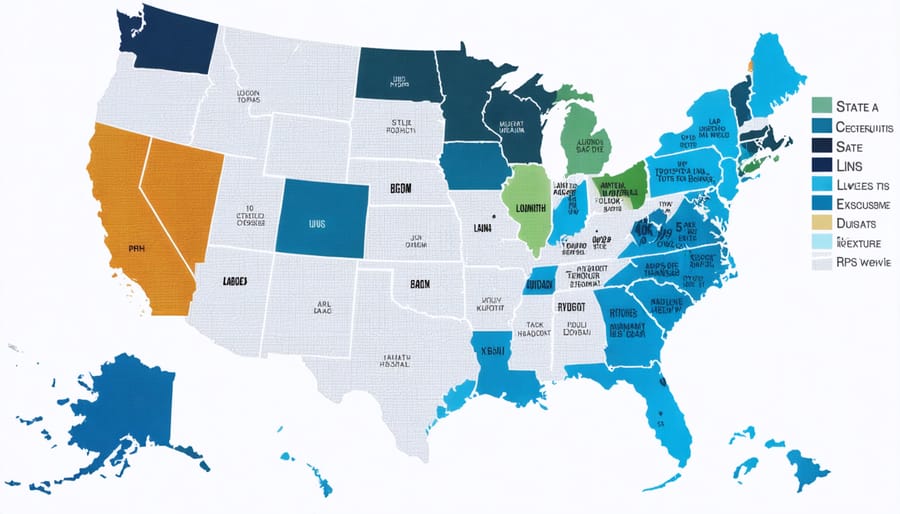
Renewable Portfolio Standards (RPS) have emerged as one of the most proven solar adoption policies at the state level, driving significant growth in renewable energy deployment across the United States. These mandatory requirements compel utilities to source a specified percentage of their electricity from renewable sources, including solar photovoltaics, within defined timeframes.
The impact of RPS policies on solar market development has been substantial, with states implementing aggressive renewable targets experiencing accelerated PV installation rates. For instance, California’s ambitious 60% RPS by 2030 has catalyzed unprecedented solar development, while New York’s 70% requirement by 2030 is spurring rapid industry growth.
RPS programs typically incorporate specific solar carve-outs or multipliers that provide additional incentives for solar PV deployment. These mechanisms ensure that utilities invest in diverse renewable technologies rather than focusing solely on the lowest-cost options. States with solar-specific provisions have demonstrated consistently higher rates of PV adoption compared to those without such requirements.
The effectiveness of RPS policies stems from their ability to create long-term market certainty for developers, investors, and utilities. By establishing clear compliance timelines and enforcement mechanisms, including alternative compliance payments, these standards help reduce investment risk and facilitate project financing. Moreover, the competitive nature of RPS compliance markets has contributed to driving down solar installation costs while promoting technological innovation.
Success metrics indicate that states with robust RPS frameworks have experienced enhanced job creation in the renewable energy sector, increased private investment, and accelerated progress toward greenhouse gas reduction goals.
Net Metering Policies
Net metering policies represent a cornerstone of renewable energy incentives across the United States, enabling solar PV system owners to receive credit for excess electricity fed back into the grid. These policies vary significantly by state, with each jurisdiction establishing its own compensation rates, system size limitations, and grid interconnection requirements.
Most states mandate utilities to offer net metering programs, though compensation structures differ. Full retail rate compensation remains common in states like California and New Jersey, where customers receive credits equal to the retail electricity rate for their excess generation. Other states have adopted modified programs, such as net billing or value-of-solar tariffs, which may compensate at wholesale rates or incorporate additional value components.
System size limitations typically range from 10 kW for residential installations to 2 MW for commercial systems, though these caps vary by jurisdiction. Some states have implemented aggregate capacity limits, restricting the total amount of net-metered systems allowed within a utility’s service territory.
The benefits of net metering extend beyond individual system owners. These policies help reduce strain on the electrical grid during peak demand periods, decrease transmission losses, and support local grid resilience. For system owners, net metering can significantly improve project economics by maximizing the value of generated electricity, often reducing payback periods by several years.
Recent policy trends indicate a shift toward more nuanced compensation mechanisms, with some states exploring time-of-use rates and location-based incentives to better align with grid needs and system values. Understanding these evolving policies remains crucial for stakeholders planning solar PV installations and managing existing systems.

Local Government Initiatives
Property Tax Exemptions
Property tax exemptions serve as powerful financial incentives for residential and commercial solar installations across various jurisdictions. These exemptions typically allow property owners to exclude the added value of solar energy systems from their property tax assessments, effectively reducing the long-term cost of renewable energy investments.
Many states offer 100% exemption on the added value of solar installations, while others provide partial relief through reduced assessment ratios. For example, Massachusetts exempts solar installations from property taxes for 20 years, while California offers exclusions until the property changes ownership. Local municipalities may also provide additional tax incentives beyond state-level programs.
To qualify for these exemptions, installations must generally meet specific criteria, including proper certification, minimum system efficiency standards, and professional installation requirements. Property owners must typically file exemption applications with their local tax assessor’s office and maintain compliance with ongoing program requirements.
The cumulative financial impact of property tax exemptions can significantly improve the return on investment for solar projects, particularly when combined with other available incentives and rebates.
Solar Rights Laws
Solar rights laws represent crucial regulatory frameworks that protect property owners’ access to sunlight for solar energy generation. These laws typically prevent neighboring structures or vegetation from obstructing solar panels’ exposure to sunlight, ensuring optimal system performance and investment protection. Many states and municipalities have enacted specific ordinances that establish solar easements, which are legal agreements guaranteeing unobstructed solar access.
California’s Solar Rights Act serves as a pioneering example, prohibiting homeowners’ associations from unreasonably restricting solar system installations and establishing clear guidelines for solar access protection. Similar legislation exists in states like New Mexico and Wisconsin, where solar rights laws mandate consideration of solar access in urban planning and development decisions.
These regulations often include provisions for height restrictions on adjacent buildings, setback requirements, and vegetation management guidelines. Some jurisdictions have implemented solar fence height calculations and shading analysis requirements for new construction projects to ensure existing solar installations maintain their effectiveness. Property owners seeking to install solar systems should consult their local zoning codes and solar rights ordinances to understand their legal protections and responsibilities regarding solar access.
Maximizing Policy Benefits
Incentive Stacking Strategies
Maximizing renewable energy benefits often requires strategic combination of multiple incentives, a practice known as incentive stacking. Understanding how to effectively layer various financial mechanisms can significantly enhance project viability and return on investment. When developing solar PV financing strategies, stakeholders should carefully evaluate federal, state, and local incentives to create optimal funding structures.
Key strategies include combining investment tax credits (ITC) with production-based incentives, leveraging accelerated depreciation alongside grant programs, and utilizing renewable energy certificates (RECs) in conjunction with performance-based incentives. However, it’s crucial to verify that specific incentive combinations are permissible under applicable regulations, as some programs may have restrictions on concurrent participation.
Successful incentive stacking requires thorough documentation, precise timing of applications, and careful consideration of program requirements. Organizations should maintain detailed records of all incentive applications and approvals, ensuring compliance with reporting obligations and deadlines. Working with qualified financial advisors and legal counsel can help navigate complex eligibility criteria and maximize available benefits while maintaining regulatory compliance.
For optimal results, develop a comprehensive incentive matrix that outlines all available programs, their requirements, and potential interactions. This systematic approach helps identify the most advantageous combinations while avoiding conflicts between different incentive mechanisms.

Application Processes and Timeline
The process of securing renewable energy incentives typically follows a structured timeline that requires careful planning and attention to detail. Begin by conducting a preliminary assessment of your project’s eligibility for various incentive programs at federal, state, and local levels. This initial evaluation should occur at least 6-12 months before project implementation.
Once eligibility is confirmed, gather all required documentation, including property ownership records, system specifications, and contractor credentials. Submit pre-approval applications where necessary, particularly for performance-based incentives or tax credit programs. Many jurisdictions require this step 3-4 months before installation begins.
During the application phase, ensure compliance with specific program requirements:
– Complete all necessary environmental impact assessments
– Obtain required permits and inspections
– Submit detailed project plans and cost estimates
– Provide proof of financial capability
– Secure interconnection agreements with utility providers
After installation, schedule final inspections and submit completion documentation within specified timeframes, typically 30-60 days post-completion. For tax incentives, maintain records for submission during the appropriate tax filing period.
Monitor deadlines carefully, as many programs operate on first-come, first-served bases or have annual caps. Consider working with qualified renewable energy consultants to navigate complex application processes and maximize available incentives. Regular review of program guidelines is essential, as requirements and deadlines may change annually.
The evolving landscape of renewable energy policy continues to shape the future of sustainable power generation and consumption. As we’ve explored throughout this analysis, effective policy frameworks have proven instrumental in accelerating the adoption of renewable technologies, particularly in the solar PV sector. The combination of financial incentives, regulatory support, and market mechanisms has created a robust foundation for industry growth and technological advancement.
Looking ahead, several key trends are likely to influence future policy development. Grid modernization initiatives, energy storage integration, and enhanced interconnection standards will require careful policy consideration to ensure system reliability and efficiency. The increasing focus on environmental justice and equitable access to clean energy benefits suggests that future policies may incorporate more comprehensive social impact assessments and community-based programs.
International cooperation and policy harmonization will become increasingly important as renewable energy markets become more interconnected. The success of feed-in tariffs, renewable portfolio standards, and carbon pricing mechanisms in various jurisdictions provides valuable lessons for policymakers worldwide. These experiences can inform the development of more effective and efficient policy frameworks.
The transition to renewable energy will continue to require careful balancing of economic, environmental, and social objectives. Future policies must remain flexible enough to accommodate technological innovations while providing the stability needed for long-term investment decisions. As costs continue to decline and efficiency improves, policy emphasis may shift from direct subsidies toward market-based mechanisms and grid integration solutions.
For industry stakeholders and professionals, staying informed about policy developments and actively participating in consultation processes will be crucial for successful navigation of this dynamic landscape.