
The United States stands at a pivotal moment in solar manufacturing, with domestic production capacity poised to triple from 7.5 GW to 22.5 GW by 2024. This unprecedented expansion, driven by the Inflation Reduction Act’s manufacturing incentives and growing demand for clean energy solutions, marks a transformative shift in America’s renewable energy landscape. Sustainable manufacturing practices are revolutionizing production methods across the solar value chain, from polysilicon processing to final module assembly.
The resurgence of U.S. solar manufacturing represents more than just increased production numbers—it signifies a strategic move toward energy independence, job creation, and technological innovation. With over $4 billion in private sector investments announced since 2022, domestic manufacturers are establishing robust supply chains that reduce dependence on foreign imports while advancing state-of-the-art production techniques. This renaissance in American solar manufacturing combines cutting-edge automation, advanced quality control systems, and circular economy principles to create a more resilient and sustainable energy future.
Current U.S. Solar Manufacturing Landscape
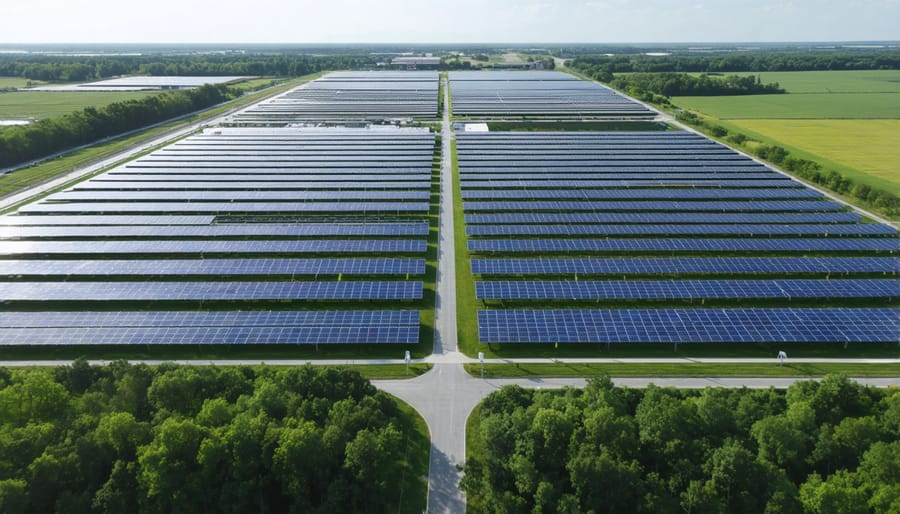
Manufacturing Capacity Statistics
As of 2023, U.S. solar manufacturing capacity has experienced significant growth, with total module production reaching approximately 8.5 GW annually. Major manufacturing hubs are concentrated in states like Georgia, Ohio, and Texas, collectively accounting for over 60% of domestic production. The Southeastern United States has emerged as a particularly robust region for solar manufacturing, hosting several state-of-the-art facilities.
Currently, domestic manufacturers supply about 20% of U.S. solar module demand, with key players including First Solar, Q CELLS, and JinkoSolar maintaining large-scale operations. First Solar’s Ohio facility leads domestic production with a 3.3 GW annual capacity. The average facility size ranges from 500 MW to 2 GW of annual production capacity, with newer facilities trending toward larger scales.
Employment in solar manufacturing has reached approximately 34,000 jobs across the country. Recent investments, spurred by the Inflation Reduction Act, are expected to add another 15 GW of domestic manufacturing capacity by 2025. These expansions include both new facility construction and existing plant upgrades, particularly in polysilicon production and cell manufacturing capabilities.
Recent Industry Investments
Recent investments in U.S. solar manufacturing have surged significantly, driven by the Inflation Reduction Act’s manufacturing tax credits. First Solar announced a $1.1 billion investment in a new Ohio facility, expanding domestic production capacity by 3.5 GW annually. Similarly, Meyer Burger committed $400 million to establish a heterojunction solar cell manufacturing plant in Colorado, creating 350 new jobs.
The Department of Energy’s Solar Energy Technologies Office has allocated $20 billion in federal grants to support domestic manufacturing initiatives. These investments focus on advancing automated production lines and enhancing supply chain resilience. Notable expansions include Qcells’ $2.5 billion Georgia facilities, which will produce both solar cells and modules.
State-level incentives have also catalyzed growth, with Texas offering tax abatements for new solar manufacturing facilities. California’s Clean Energy Manufacturing Initiative provides matching grants for facilities incorporating advanced manufacturing technologies. These combined federal and state efforts aim to strengthen America’s position in the global solar supply chain while fostering sustainable manufacturing practices.
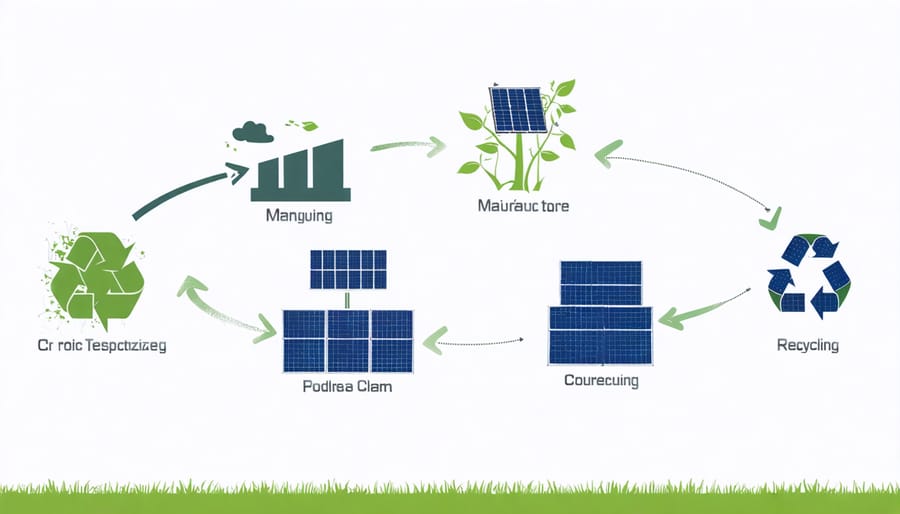
Circular Economy Integration in Solar Manufacturing
Material Recovery and Recycling
As the U.S. solar manufacturing sector grows, material recovery and recycling have become increasingly critical components of the industry’s sustainability efforts. Modern solar panel recycling technologies have evolved to efficiently recover valuable materials, including silicon, silver, aluminum, and glass, from end-of-life panels.
Leading manufacturers are implementing comprehensive recycling programs that utilize mechanical and thermal processing methods. These processes typically begin with the removal of aluminum frames and junction boxes, followed by specialized treatment to separate glass from the semiconductor materials. Advanced thermal techniques are employed to recover high-purity silicon, while chemical processes extract precious metals and other valuable components.
Several U.S. facilities now operate dedicated solar panel recycling lines, with recovery rates reaching up to 95% of materials by weight. These operations not only reduce environmental impact but also create a sustainable supply chain for raw materials, helping to decrease dependence on imported resources.
The industry has established partnerships with research institutions to develop more efficient recycling methods and explore innovative materials recovery techniques. These collaborations focus on reducing processing costs while maximizing material yield and purity. Additionally, manufacturers are incorporating design-for-recycling principles into new panel development, making future recycling efforts more efficient and cost-effective.
Looking ahead, the expansion of recycling infrastructure remains a priority as the industry prepares for the increasing volume of panels reaching end-of-life in the coming decades. This growth in recycling capacity supports both environmental sustainability goals and the long-term economic viability of domestic solar manufacturing.
Waste Reduction Strategies
In modern solar manufacturing facilities across the United States, waste reduction has become a cornerstone of operational efficiency and environmental responsibility. Leading manufacturers implement comprehensive material recovery systems that capture and recycle silicon wafer fragments, metal contacts, and glass components throughout the production process. These systems typically achieve recovery rates exceeding 90% for valuable materials like silver and silicon.
Advanced automation and precision cutting technologies have significantly reduced kerf loss – the material wasted during the silicon wafer slicing process. Many facilities now employ diamond wire sawing techniques that minimize material loss while improving wafer quality. Additionally, manufacturers utilize sophisticated quality control systems with machine learning capabilities to detect defects early in the production process, preventing waste from defective products moving further down the line.
Water conservation plays a crucial role in waste reduction strategies. Modern facilities incorporate closed-loop water recycling systems that treat and reuse process water, reducing consumption by up to 80% compared to traditional manufacturing methods. Chemical recovery systems extract and purify chemicals used in cell processing, enabling their reuse while minimizing environmental impact.
Packaging optimization has emerged as another key focus area. Manufacturers are transitioning to recyclable and biodegradable packaging materials while implementing efficient design strategies that reduce packaging volume. Some facilities have established partnerships with local recycling companies to ensure proper handling of unavoidable waste materials.
These waste reduction initiatives not only support environmental sustainability but also contribute to cost reduction and improved operational efficiency. Many manufacturers report significant cost savings through material recovery and reduced waste disposal expenses, demonstrating that environmental responsibility and economic viability can work hand in hand.
Innovation and Technology Advancement
Advanced Manufacturing Processes
Recent advancements in U.S. solar manufacturing have focused on reducing environmental impact while maintaining high production efficiency. The integration of automated manufacturing processes has significantly decreased waste generation and energy consumption during production. Leading manufacturers have implemented closed-loop water recycling systems, reducing freshwater usage by up to 90% compared to traditional methods.
Innovation in silicon wafer production has led to the development of diamond wire sawing technology, which minimizes kerf loss and reduces silicon waste. This technique, combined with advanced material recovery systems, enables manufacturers to recycle up to 85% of silicon waste back into the production process.
Manufacturers are also adopting low-temperature processing methods for cell metallization, reducing energy consumption and associated carbon emissions. The implementation of smart factory systems and AI-driven quality control has improved production yields while minimizing material waste.
New encapsulation techniques using bio-based materials and lead-free soldering processes demonstrate the industry’s commitment to environmental stewardship. These innovations have reduced the use of harmful chemicals by 40% compared to previous manufacturing methods.
The integration of renewable energy sources to power manufacturing facilities further enhances the sustainability profile of U.S. solar production, with several major facilities now operating on 100% renewable energy.

Sustainable Material Development
The U.S. solar manufacturing sector is making significant strides in developing eco-friendly solar materials through innovative research partnerships and sustainable manufacturing practices. Leading manufacturers are investing in alternatives to traditional silicon-based panels, exploring materials like perovskites and organic photovoltaics that promise reduced environmental impact during production and end-of-life disposal.
Research initiatives at major universities and national laboratories focus on developing lead-free solar cells, reducing rare earth mineral dependencies, and creating more recyclable panel components. These efforts align with circular economy principles while maintaining high performance standards. Manufacturers are also implementing water-based processing methods and non-toxic alternatives to traditional solvents, significantly reducing the environmental footprint of production processes.
Recent breakthroughs include the development of bio-based encapsulants, recycled silicon feedstock processing, and advanced recycling technologies that enable more efficient material recovery from decommissioned panels. These innovations support both environmental sustainability and supply chain resilience. Industry leaders are also exploring biodegradable substrates and conducting lifecycle assessments to optimize material selection and manufacturing processes.
The integration of these sustainable materials and practices is strengthening the U.S. solar industry’s competitive position while addressing environmental concerns and meeting increasingly stringent regulatory requirements. This commitment to sustainability extends beyond material selection to encompass entire production processes and end-of-life management strategies.
Future Outlook and Challenges
Market Growth Projections
Market analysts project substantial growth in U.S. solar manufacturing capacity over the next decade, driven by favorable policies, technological advancements, and increasing demand for renewable energy solutions. The Inflation Reduction Act’s manufacturing incentives are expected to catalyze significant expansion, potentially tripling domestic manufacturing capacity by 2025.
Industry forecasts indicate that U.S. solar module production could reach 50 GW annually by 2030, representing a substantial increase from current levels. This growth trajectory is supported by multiple factors, including supply chain reorganization, increased automation in manufacturing processes, and strategic investments in research and development.
Several major manufacturers have announced plans to establish or expand facilities across various states, particularly in regions with existing industrial infrastructure and skilled workforce availability. These expansions are expected to create thousands of new jobs while strengthening domestic supply chains.
The market outlook suggests a shift toward higher-efficiency modules and advanced manufacturing techniques, with particular emphasis on n-type cell technology and heterojunction solutions. Investment in manufacturing capacity for raw materials and components is also projected to increase, reducing dependence on international suppliers.
Experts anticipate that enhanced domestic manufacturing capabilities will lead to more competitive pricing structures and improved supply chain resilience, ultimately benefiting both industrial and residential solar installations throughout the United States.
Implementation Challenges
The transition to a circular economy in U.S. solar manufacturing faces several significant challenges. Supply chain dependencies remain a primary concern, with many essential raw materials and components still sourced from overseas markets. This reliance creates vulnerabilities in the domestic manufacturing ecosystem and complicates efforts to implement closed-loop systems.
Infrastructure limitations pose another substantial barrier. Many existing facilities require extensive retrofitting to accommodate circular manufacturing processes, while the development of recycling facilities specifically designed for solar panels lags behind production capacity. The high initial capital investment required for these upgrades often deters manufacturers from implementing comprehensive circular solutions.
Technological barriers also impact implementation. Current solar panel designs, while efficient, often make component separation and material recovery difficult. This challenge is compounded by the long lifespan of solar panels, which creates a significant time gap between production and potential recycling.
Regulatory uncertainties and varying state-level policies create additional complexities. The lack of standardized guidelines for end-of-life management and recycling procedures hampers coordinated efforts across state lines. However, emerging solutions include innovative design approaches that prioritize easier disassembly, advanced recycling technologies, and collaborative initiatives between manufacturers and research institutions.
Industry stakeholders are actively working to address these challenges through increased investment in research and development, establishment of reverse logistics networks, and advocacy for consistent regulatory frameworks. Success in overcoming these barriers will be crucial for establishing a truly sustainable domestic solar manufacturing sector.
The U.S. solar manufacturing capacity stands at a pivotal point in its evolution, with significant growth potential and increasing technological capabilities reshaping the industry landscape. Recent investments in domestic manufacturing facilities, coupled with supportive policy frameworks and technological innovations, have positioned the United States to become a major player in global solar production.
Key developments in manufacturing processes, particularly in automated production lines and quality control systems, have enhanced efficiency while reducing costs. The integration of sustainable practices and circular economy principles throughout the manufacturing chain demonstrates the industry’s commitment to environmental stewardship and resource optimization.
Looking ahead, the U.S. solar manufacturing sector is expected to experience substantial growth, driven by increasing demand for renewable energy solutions and ongoing technological advancements. The expansion of manufacturing facilities across different states creates new employment opportunities while strengthening the domestic supply chain.
Challenges remain, including international competition and supply chain dependencies, but strategic investments in research and development, workforce training, and infrastructure development are addressing these concerns. The collaboration between industry stakeholders, research institutions, and government agencies continues to foster innovation and sustainable growth.
As the industry moves forward, maintaining focus on quality, efficiency, and sustainability will be crucial for securing America’s position in the global solar market while contributing to climate change mitigation efforts and energy independence goals.