
Mono PERC (Passivated Emitter and Rear Cell) solar panels represent a groundbreaking advancement in photovoltaic technology, delivering up to 25% higher efficiency than conventional solar cells. By incorporating an additional dielectric passivation layer on the rear side of the cell, these panels significantly reduce electron recombination and enhance light capture, revolutionizing solar energy production. As the global solar industry rapidly evolves, Mono PERC technology has emerged as the new standard for commercial and utility-scale installations, commanding over 80% of the market share in 2023. This innovative technology addresses the critical challenges of space efficiency and energy yield that have historically limited solar adoption, making it particularly valuable for both urban installations and large-scale solar farms where maximizing power output per square meter is paramount. With continued technological refinements and declining production costs, Mono PERC panels exemplify the decisive shift toward more efficient, sustainable energy solutions in our collective pursuit of carbon neutrality.
Understanding Mono PERC Technology
The PERC Cell Structure
Monocrystalline PERC solar cells feature a sophisticated multi-layer structure that significantly enhances their power conversion efficiency. The foundation consists of a high-quality monocrystalline silicon wafer, which serves as the primary light-absorbing material. Above this base layer, manufacturers deposit a carefully engineered anti-reflection coating to minimize light loss through reflection.
The distinguishing characteristic of PERC technology lies in its rear surface design. Unlike traditional cells, PERC cells incorporate a dielectric passivation layer between the silicon wafer and the aluminum back contact. This passivation layer serves two crucial functions: it reduces electron recombination at the rear surface and reflects unabsorbed light back into the silicon wafer for a second absorption opportunity.
The front surface features precisely engineered metal contacts, typically arranged in a grid pattern, which collect and transport the generated electrical current. These contacts are optimized to balance conductivity with minimal shading loss. The rear surface includes local contact points through the passivation layer, allowing for selective metal contact while maintaining the benefits of surface passivation.
This advanced structure enables PERC cells to capture and convert a broader spectrum of solar radiation into electrical energy, resulting in higher efficiency ratings compared to conventional cell designs. The enhanced rear-side passivation and reflection capabilities particularly improve performance in real-world conditions, including low-light and high-temperature environments.

Efficiency Advantages
PERC (Passivated Emitter and Rear Cell) technology represents a significant advancement in monocrystalline technology advantages, offering substantial efficiency improvements over conventional solar cells. Traditional solar panels typically achieve conversion efficiencies between 15-17%, while mono PERC panels consistently demonstrate efficiencies of 20-22% under standard testing conditions.
This enhanced performance is attributed to the additional passivation layer on the rear surface, which serves two crucial functions. First, it reduces electron recombination at the back surface, allowing more electrons to contribute to the electrical current. Second, it reflects unabsorbed light back through the solar cell, providing a second opportunity for photon absorption and energy conversion.
The efficiency gains are particularly notable in real-world conditions. Mono PERC panels maintain higher performance levels in low-light conditions and demonstrate superior temperature coefficients, resulting in better energy yield in hot climates. Quantitative analysis shows that PERC technology can increase power output by 6-12% compared to standard mono cells of the same size.
These improvements translate to practical benefits: fewer panels needed for equivalent power output, reduced installation space requirements, and lower balance-of-system costs. The technology’s enhanced low-light performance also extends the effective daily power generation window, contributing to improved overall energy yield.
Commercial Benefits and Applications
Cost-Performance Analysis
Mono PERC solar panels demonstrate compelling economic advantages when analyzed from a cost-performance perspective. Initial investment costs are typically 10-15% higher than traditional mono-crystalline panels, but this premium is offset by superior energy conversion efficiency and enhanced long-term performance.
The cost per watt for Mono PERC panels has decreased significantly, averaging $0.25-0.30/W in 2023, representing a 70% reduction from 2010 prices. When evaluating return on investment (ROI), these panels typically achieve payback periods of 4-6 years in residential installations, depending on local solar irradiance and electricity rates.
Performance analysis reveals that Mono PERC panels generate 5-10% more energy per square meter compared to standard panels. This increased energy yield translates to improved revenue generation in commercial installations and greater energy savings for residential users. The technology’s superior low-light performance and reduced light-induced degradation (LID) contribute to consistent energy production throughout the panel’s 25-30 year lifespan.
Financial modeling indicates that Mono PERC installations can achieve levelized cost of electricity (LCOE) values between $0.04-0.08 per kWh, making them increasingly competitive with conventional power sources. The technology’s enhanced temperature coefficient also results in better performance in high-temperature conditions, maintaining efficiency levels that positively impact the overall cost-benefit ratio.
When factoring in government incentives, tax credits, and potential carbon offset revenues, Mono PERC systems present an attractive investment opportunity with internal rates of return (IRR) typically ranging from 10-15% for commercial installations.
Installation Flexibility
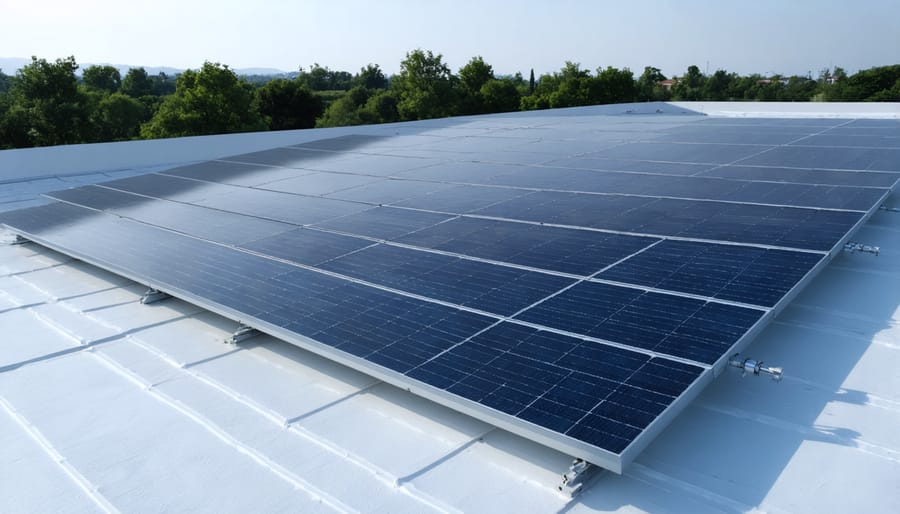
Mono PERC solar panels offer exceptional installation flexibility, making them suitable for diverse deployment scenarios across residential, commercial, and utility-scale applications. Their higher power density allows for more efficient use of available space, generating greater power output per square meter compared to conventional solar panels.
These panels demonstrate remarkable adaptability in both rooftop and ground-mounted installations. Their enhanced efficiency means fewer panels are required to achieve desired power outputs, reducing the overall installation footprint and associated mounting hardware costs. This space efficiency is particularly valuable in urban environments where usable area is limited.
The panels’ robust construction enables installation at various angles and orientations, accommodating different roof pitches and geographical locations. Their superior low-light performance ensures optimal energy generation even when mounted in less-than-ideal orientations or in regions with variable weather conditions.
For large-scale installations, mono PERC panels’ higher power rating translates to reduced balance of system (BOS) costs. Fewer panels mean fewer mounting structures, less wiring, and reduced labor requirements during installation. This efficiency extends to maintenance considerations, as fewer panels require less frequent cleaning and inspection routines.
The technology’s bifacial variants further expand installation possibilities by capturing reflected light from surrounding surfaces, making them particularly effective in snow-covered regions or when installed over light-colored surfaces. This dual-sided generation capability can increase overall system yield without requiring additional installation space.
Modern mounting solutions specifically designed for mono PERC panels ensure secure installation while maintaining optimal ventilation, crucial for maintaining the panels’ high-performance characteristics across their operational lifetime.
Market Adoption and Future Trends
Global Market Penetration
Mono PERC solar panels have experienced remarkable market penetration globally, with adoption rates showing consistent growth since 2018. As of 2023, these panels account for approximately 80% of the global solar cell production capacity, demonstrating their dominance in the photovoltaic industry.
Asia-Pacific leads the manufacturing and implementation of Mono PERC technology, with China maintaining its position as the primary producer, hosting over 90% of global manufacturing capacity. Major Chinese manufacturers have significantly expanded their production lines, driving economies of scale and reducing costs.
European markets have shown strong adoption rates, particularly in Germany, Spain, and the Netherlands, where high electricity prices and favorable renewable energy policies have accelerated PERC technology integration. The region’s commitment to carbon neutrality has further stimulated market growth, with installation rates increasing by 25% annually since 2020.
North America has also witnessed substantial growth in Mono PERC adoption, driven by utility-scale solar projects and residential installations. The United States market share has expanded significantly, supported by federal tax incentives and state-level renewable portfolio standards.
Emerging markets in Latin America and Africa are showing increasing interest in Mono PERC technology, primarily due to its superior performance in high-temperature conditions and improved cost-effectiveness. Countries like Brazil, Chile, and South Africa have initiated large-scale solar projects utilizing Mono PERC panels.
Market analysts project continued growth in global adoption, with particular emphasis on developing regions where grid parity has been achieved. The technology’s proven reliability and consistent performance improvements continue to drive its market penetration across diverse geographical and economic contexts.
Manufacturing Innovations
Recent advancements in the solar PV cell manufacturing process have revolutionized mono PERC panel production, significantly improving both efficiency and cost-effectiveness. The introduction of automated production lines equipped with artificial intelligence and machine learning capabilities has reduced manufacturing defects while increasing throughput rates by up to 30%.
Key innovations include the implementation of advanced laser ablation techniques for more precise rear contact opening, resulting in better electrical contact formation and reduced recombination losses. Manufacturers have also adopted sophisticated passivation layer deposition methods, utilizing atomic layer deposition (ALD) technology to create uniformly thin aluminum oxide layers that enhance cell efficiency.
The integration of selective emitter technology has improved front surface passivation, while advanced metallization processes using fine-line printing techniques have reduced shadowing losses and improved light absorption. These improvements have enabled manufacturers to achieve cell efficiencies exceeding 23% in mass production.
Another significant breakthrough is the development of multi-busbar technology, which has reduced silver paste consumption while improving current collection efficiency. The implementation of half-cut cell technology has also become standard in manufacturing, reducing resistive losses and improving overall module performance.
Quality control systems have evolved to incorporate real-time monitoring and artificial intelligence-based inspection systems, ensuring consistent product quality while minimizing material waste. These manufacturing innovations have collectively contributed to reducing production costs by approximately 40% over the past five years while simultaneously improving product performance and reliability.
Future Development Roadmap
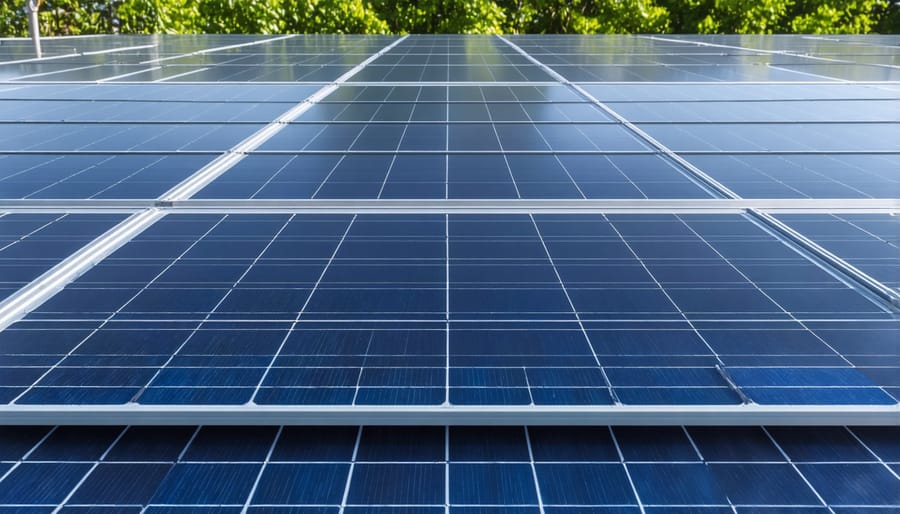
The future of mono PERC solar panels shows promising developments as manufacturers continue to push efficiency boundaries. Industry experts project that future solar panel technologies will achieve conversion efficiencies exceeding 24% through advanced passivation techniques and improved cell architectures.
Key technological advancements on the horizon include the integration of selective emitter structures, multi-busbar designs, and enhanced anti-reflection coatings. These innovations are expected to reduce production costs while maximizing power output. Research institutions are currently exploring novel passivation materials and advanced metallization processes to minimize electrical losses.
Market analysts forecast substantial growth in mono PERC adoption, with global manufacturing capacity projected to double by 2025. The technology is anticipated to maintain its market dominance as manufacturers transition from traditional BSF cells. Production automation and economies of scale will likely drive down costs further, making mono PERC panels increasingly accessible to both utility-scale projects and residential installations.
Emerging trends indicate a shift toward larger wafer sizes and higher power ratings, with modules potentially reaching outputs of 600W or more. Environmental considerations are also shaping development, with manufacturers focusing on reducing silver consumption and implementing lead-free metallization solutions. These advancements will contribute to both improved performance and sustainability metrics, solidifying mono PERC’s position in the solar energy landscape.
Mono PERC solar panels represent a significant advancement in photovoltaic technology, offering enhanced efficiency and improved performance compared to conventional solar cells. Throughout this comprehensive examination, we’ve explored how PERC technology’s innovative rear passivation layer and local contact structure contribute to higher energy yields and better low-light performance.
The commercial success of mono PERC panels is evidenced by their rapid market adoption, with global manufacturing capacity continuing to expand. Their superior temperature coefficient and bifacial capabilities make them particularly attractive for both residential and utility-scale installations, while declining production costs have improved their economic viability.
Looking ahead, the future of mono PERC technology remains promising, with ongoing research focused on pushing efficiency boundaries beyond 24%. Manufacturers are investing in advanced automation and quality control processes to further reduce costs while maintaining high performance standards. The technology is expected to maintain its market dominance in the medium term, though emerging technologies like TOPCon and heterojunction cells may eventually provide strong competition.
As the solar industry continues to evolve, mono PERC panels will play a crucial role in the global transition to renewable energy. Their combination of proven reliability, cost-effectiveness, and superior performance characteristics positions them as a cornerstone technology in the sustainable energy landscape. For stakeholders across the solar value chain, understanding and leveraging mono PERC technology remains essential for success in the renewable energy sector.