
Tax equity financing has emerged as a cornerstone of solar project development, enabling renewable energy initiatives to capitalize on valuable federal tax incentives while optimizing return on investment. By leveraging the Investment Tax Credit (ITC) and accelerated depreciation benefits, this sophisticated financing mechanism allows solar developers to partner with tax-motivated investors who can efficiently monetize these tax advantages. The structure has proven instrumental in driving the exponential growth of utility-scale and commercial solar installations across the United States, with tax equity investments exceeding $20 billion in recent years.
For project developers and investors alike, understanding the intricacies of tax equity financing is crucial for successfully navigating the complex intersection of renewable energy policy, tax law, and project finance. Whether through partnership flip structures, sale-leasebacks, or inverted leases, these arrangements facilitate the efficient allocation of tax benefits while providing the necessary capital for project development. This financing approach has become particularly relevant as the solar industry continues to mature and stakeholders seek innovative ways to maximize project economics while advancing clean energy goals.
The strategic importance of tax equity financing extends beyond mere financial engineering – it represents a critical bridge between policy incentives and practical project implementation in the renewable energy sector.
How Tax Equity Financing Works in Solar Projects
Partnership Flip Structures
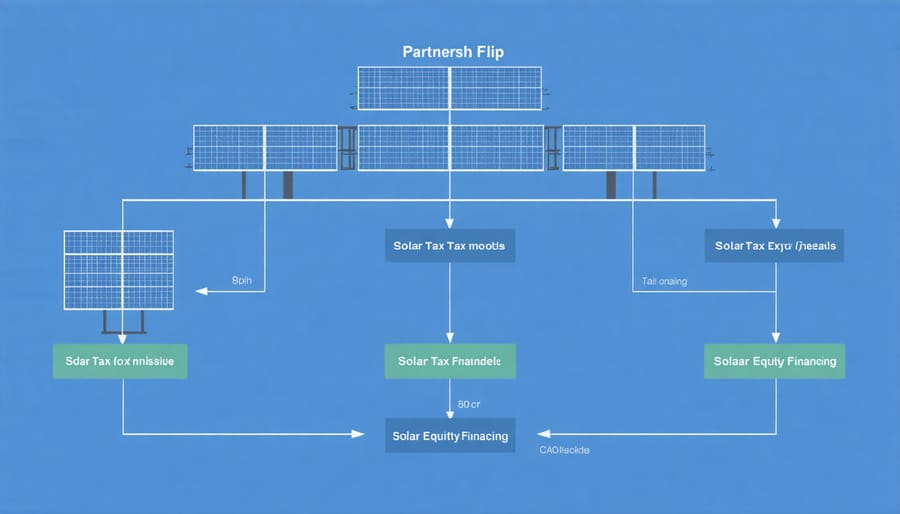
Partnership flip structures represent the most prevalent tax equity arrangement in solar project financing, accounting for approximately 80% of all tax equity transactions. In this structure, the tax equity investor and project sponsor form a partnership where ownership percentages “flip” at a predetermined point, typically after the investor achieves their target internal rate of return (IRR).
Initially, the tax equity investor receives the majority of tax benefits and cash distributions, usually maintaining a 99% ownership stake. This arrangement allows them to efficiently utilize the Investment Tax Credit (ITC) and accelerated depreciation benefits. The project sponsor, meanwhile, retains a minimal ownership percentage but maintains operational control of the solar facility.
The flip point occurs when the tax equity investor reaches their expected return threshold, usually 5-7 years after project completion. At this juncture, the ownership allocations shift dramatically, with the project sponsor typically receiving 95% of cash flows and tax benefits, while the investor’s share reduces to 5%.
This structure proves particularly attractive because it aligns the interests of both parties: investors receive their desired tax benefits and returns early in the project lifecycle, while developers maintain long-term control and eventually receive the majority of project benefits. The arrangement also provides flexibility in structuring cash distributions and can accommodate various investor preferences regarding risk and return profiles.
Sale-Leaseback and Inverted Lease Models
Sale-leaseback and inverted lease structures represent alternative tax equity financing models that offer unique advantages for solar project development. In a sale-leaseback arrangement, the developer sells the solar assets to a tax equity investor and immediately leases them back for operation. This structure allows developers to monetize tax benefits while maintaining operational control of the system.
The sale-leaseback model typically provides higher upfront capital compared to partnership flip structures, making it particularly attractive for developers seeking immediate liquidity. The lease payments are structured to provide the tax equity investor with a predetermined return while allowing the developer to benefit from system operation and revenue generation.
Inverted leases, also known as lease pass-through structures, involve the developer leasing the solar system to the tax equity investor, who then subleases it back to the developer or end-user. This arrangement enables the transfer of the Investment Tax Credit (ITC) to the tax equity investor while allowing the developer to retain accelerated depreciation benefits. The structure is particularly popular in residential and commercial solar installations.
Both models require careful consideration of accounting implications, tax regulations, and legal requirements. The choice between these structures often depends on factors such as project size, developer capital needs, and investor preferences. Successful implementation requires collaboration with experienced legal counsel and tax advisors to ensure compliance and optimal benefit allocation.
Key Tax Benefits and Incentives
Investment Tax Credit (ITC)
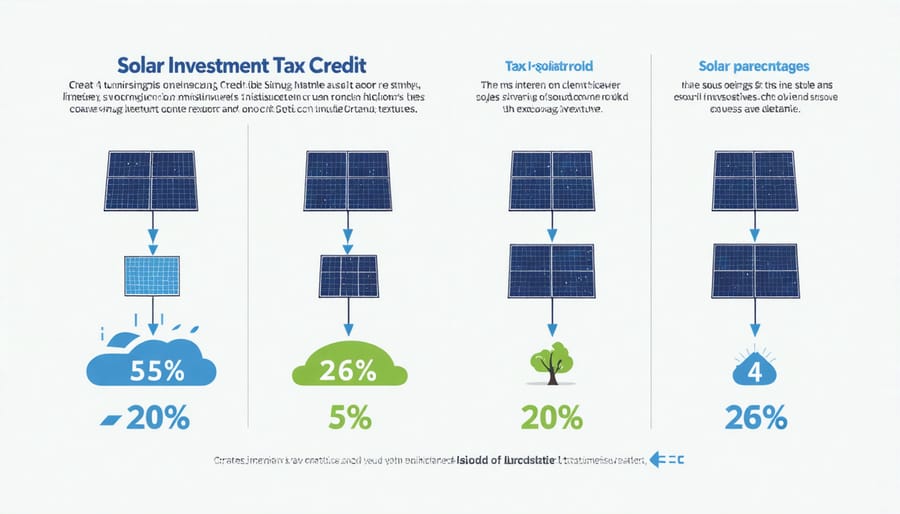
The Investment Tax Credit (ITC) stands as one of the most significant government solar tax incentives driving the growth of photovoltaic installations across the United States. This federal tax credit allows project owners to deduct a substantial percentage of their solar system costs from their federal taxes, effectively reducing the overall investment burden.
Currently, the ITC enables qualifying solar projects to receive a 30% tax credit of the total system cost, including equipment, installation, and related expenses. This credit applies to both residential and commercial installations, though the specific application process and requirements differ between sectors. The Inflation Reduction Act of 2022 extended and enhanced the ITC, providing long-term market stability through 2032.
To qualify for the ITC, projects must meet specific criteria regarding equipment standards, installation timing, and system ownership structure. The credit can be claimed in the year the system becomes operational, with any unused portion potentially carried forward to subsequent tax years. For tax equity investors, the ITC represents a powerful incentive that can significantly enhance project returns while supporting renewable energy deployment.
Depreciation Benefits
Depreciation benefits represent a significant advantage in solar tax equity financing, primarily through the Modified Accelerated Cost Recovery System (MACRS) and bonus depreciation provisions. Under MACRS, solar equipment qualifies for accelerated depreciation over a five-year period, allowing investors to deduct the cost of their solar assets more quickly than traditional straight-line depreciation would permit.
The current tax code also enables bonus depreciation, which allows investors to immediately deduct a substantial portion of their capital investments in the first year. As of 2023, qualifying solar projects can benefit from 80% bonus depreciation, with this percentage gradually stepping down in subsequent years according to federal schedules.
The combination of MACRS and bonus depreciation creates powerful tax savings opportunities for investors. For example, a $10 million solar installation might generate several million dollars in depreciation deductions within the first year alone, significantly reducing the investor’s tax liability. This accelerated cost recovery helps improve project economics and attracts capital to the solar sector.
These depreciation benefits work in conjunction with other solar incentives, such as the Investment Tax Credit (ITC), to enhance overall returns and make solar projects more financially attractive to tax equity investors. Understanding and properly structuring these depreciation benefits is crucial for maximizing the value of solar investments.
Economic Impact on Solar PV Projects

Cost Reduction Analysis
Tax equity financing significantly reduces the overall cost burden of solar project development through strategic allocation of tax benefits and financial responsibilities. By partnering with tax equity investors, project developers can monetize federal Investment Tax Credit (ITC) and accelerated depreciation benefits, which typically account for 30-40% of a project’s total value. This optimization directly enhances solar investment returns while minimizing upfront capital requirements.
The cost reduction mechanism operates through multiple channels. First, the immediate monetization of tax credits provides substantial upfront capital, reducing the need for expensive debt financing. Second, accelerated depreciation benefits create valuable tax deductions that offset investor tax liabilities, generating additional project value. Third, the partnership structure allows for optimal allocation of risks and rewards, reducing the developer’s financial exposure.
Consider a typical 10MW utility-scale solar project with $20 million in total costs. Through tax equity financing, developers might only need to contribute 20-25% of the project cost upfront, while tax equity investors provide the remainder in exchange for tax benefits. This arrangement can reduce the developer’s initial capital requirement by up to 75%, significantly improving project feasibility and financial metrics.
The cost advantages become particularly apparent when comparing traditional financing approaches to tax equity structures, especially for large-scale installations where tax benefits can reach millions of dollars.
Project Viability Enhancement
Tax equity financing significantly enhances solar project viability by addressing two critical challenges: capital intensity and tax benefit utilization. By bringing in investors with substantial tax appetites, projects can effectively monetize federal tax incentives, including the Investment Tax Credit (ITC) and accelerated depreciation benefits, which might otherwise go unused by the original project developer.
This financing mechanism typically reduces the overall cost of capital for solar installations by 200-300 basis points compared to traditional financing methods. The improved economics translate into more competitive power purchase agreement (PPA) rates, making solar projects more attractive to potential off-takers and increasing the likelihood of project success.
The enhanced financial structure also enables developers to undertake larger portfolios of projects simultaneously. Instead of being constrained by their own tax capacity, developers can partner with multiple tax equity investors to scale their operations effectively. This multiplication effect accelerates market penetration and industry growth.
Furthermore, tax equity arrangements often include provisions for operation and maintenance funding, ensuring long-term project sustainability. The involvement of sophisticated institutional investors also adds credibility to projects, making it easier to secure additional debt financing and attract other stakeholders.
By optimizing the capital stack and maximizing tax benefit utilization, tax equity financing transforms marginally viable solar projects into attractive investment opportunities, contributing to the broader adoption of renewable energy solutions.
Future Outlook and Industry Trends
The future of solar financing appears increasingly dynamic, with several emerging trends shaping the landscape. The Investment Tax Credit (ITC) extension through the Inflation Reduction Act has created a stable foundation for long-term industry growth, while new financing models are evolving to accommodate diverse investor needs.
Direct pay provisions and transferability options introduced by recent legislation are expected to expand the pool of potential investors, reducing dependency on traditional tax equity partners. This democratization of solar financing could lead to more competitive pricing and innovative structuring options.
Environmental, Social, and Governance (ESG) considerations are becoming increasingly crucial in investment decisions, driving more corporations to participate in solar tax equity deals. This trend is expected to continue as companies aim to meet their sustainability goals while optimizing tax positions.
Technology advancements in solar efficiency and energy storage are improving project economics, making tax equity investments more attractive. The integration of artificial intelligence and blockchain technology is streamlining due diligence processes and reducing transaction costs.
Market analysts predict continued growth in community solar projects and virtual power purchase agreements, creating new opportunities for tax equity deployment. Additionally, the emergence of specialized financial intermediaries is expected to facilitate easier access to tax equity markets for medium-sized developers.
Nevertheless, challenges remain, including potential policy changes, grid integration issues, and market volatility. Industry stakeholders must stay informed about regulatory updates and market dynamics to optimize their tax equity strategies in this evolving landscape.
Tax equity financing has emerged as a crucial mechanism for advancing solar energy projects, offering significant advantages for both investors and developers. Throughout this exploration, we’ve seen how this financing structure effectively leverages tax incentives while providing essential capital for renewable energy initiatives.
The key benefits of tax equity financing include optimized tax efficiency, reduced upfront capital requirements, and enhanced project viability. For developers, this financing method offers access to necessary funding while maintaining operational control. Investors benefit from substantial tax advantages while contributing to sustainable energy development.
To implement tax equity financing successfully, consider these practical steps:
1. Conduct thorough due diligence on potential partners and project feasibility
2. Engage qualified legal and tax advisors familiar with renewable energy financing
3. Develop comprehensive financial models that account for all tax benefits and cash flows
4. Establish clear partnership agreements outlining roles, responsibilities, and exit strategies
5. Maintain detailed documentation of all tax equity transactions and compliance requirements
Moving forward, organizations interested in solar project development should begin by assessing their tax appetite and financial capabilities. Building relationships with potential tax equity investors and staying informed about regulatory changes affecting renewable energy incentives will position projects for success.
Remember that while tax equity financing can be complex, its benefits for solar project development make it worth pursuing with the right preparation and partners.