
Nature’s 3.8 billion years of evolutionary innovation offers groundbreaking solutions for modern engineering challenges. Bio-inspired design – the practice of emulating biological systems in technological development – has revolutionized fields from photovoltaic technology basics to advanced materials science.
Consider how lotus leaves inspired self-cleaning surfaces, butterfly wings informed more efficient solar cells, and gecko feet led to revolutionary adhesives. These natural adaptations, refined over millions of generations, provide elegant solutions to complex engineering problems that conventional approaches haven’t solved.
In photovoltaic applications specifically, bio-inspired design has yielded remarkable advances. Light-harvesting systems modeled after photosynthetic organisms have improved solar cell efficiency by up to 25%. Surface patterns derived from moth eyes reduce reflection and enhance absorption across the solar spectrum. Even the branching patterns of leaves have influenced solar panel array configurations for optimal energy collection.
This systematic approach to innovation – studying, understanding, and adapting nature’s time-tested strategies – represents the future of sustainable technology development. By bridging the gap between biological principles and engineering solutions, bio-inspired design is transforming how we approach renewable energy challenges.
Learning from Nature’s Light-Harvesting Systems
Photosynthetic Principles
Nature’s photosynthetic systems demonstrate remarkable efficiency in capturing and converting light energy into chemical energy, providing valuable insights for solar technology development. These biological processes have evolved over millions of years to achieve optimal light harvesting through sophisticated molecular arrangements and energy transfer mechanisms.
At the core of natural photosynthesis lies the light-harvesting complex, a precisely organized network of chlorophyll molecules and proteins. These complexes feature hierarchical structures that maximize light absorption across the visible spectrum while minimizing energy loss. The arrangement of chlorophyll molecules enables quantum coherence effects, allowing for nearly instantaneous energy transfer with minimal dissipation.
The photosynthetic process employs multiple strategies to enhance efficiency, including:
– Broadband light absorption through various pigment molecules
– Spatial organization optimizing energy transfer pathways
– Self-repair mechanisms maintaining system functionality
– Adaptive responses to changing light conditions
– Protection against photodamage through regulatory mechanisms
Understanding these principles has led to significant breakthroughs in artificial photosynthetic systems and solar cell design. Scientists have particularly focused on mimicking the spatial organization of light-harvesting complexes and their energy transfer mechanisms. This has resulted in the development of bio-inspired light-harvesting materials that demonstrate improved absorption characteristics and enhanced energy conversion efficiency.
The study of photosynthetic principles continues to reveal new insights, driving innovation in photovoltaic technology and sustainable energy solutions.
Biomimetic Applications
The translation of biological principles into photovoltaic technology has led to several groundbreaking innovations in solar cell design and efficiency. Scientists and engineers have successfully adapted various natural phenomena to enhance solar energy capture and conversion processes.
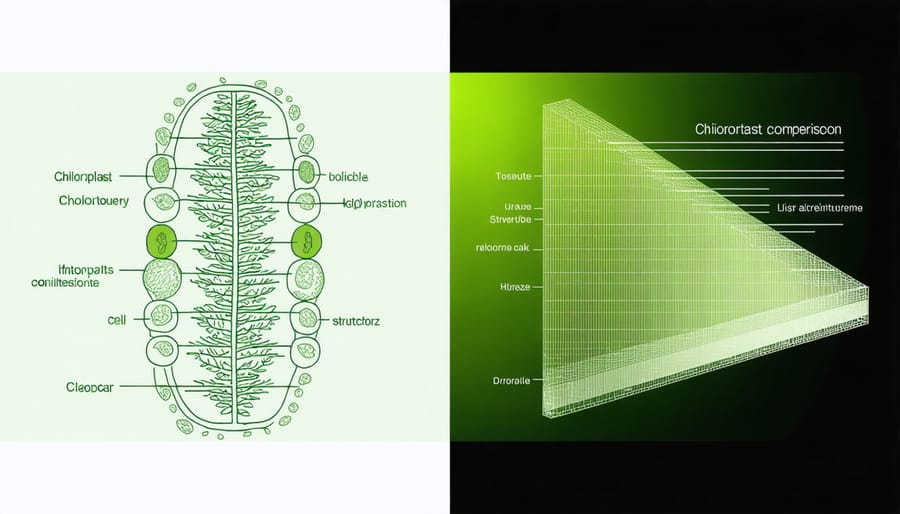
Light-harvesting mechanisms found in photosynthetic organisms have inspired the development of hierarchical structures in solar cells. For instance, the arrangement of chloroplasts in leaves has influenced the design of multi-layered photovoltaic systems that maximize light absorption across different wavelengths. The natural antenna complexes of plants have also inspired the creation of artificial light-harvesting arrays that improve energy transfer efficiency.
Surface texturing in solar cells often mimics the microscopic patterns found on butterfly wings and moth eyes. These natural anti-reflective surfaces have led to the development of biomimetic coatings that significantly reduce light reflection and increase photon absorption. Similarly, the self-cleaning properties of lotus leaves have inspired hydrophobic surface treatments that help maintain solar panel efficiency by preventing dust accumulation.
The branching patterns of leaf venation systems have influenced the design of electrode networks in solar cells, optimizing charge collection and reducing electrical resistance. Additionally, the spiral arrangements found in sunflowers have inspired solar field layouts that maximize energy collection while minimizing land use.
These biomimetic applications continue to drive innovation in photovoltaic technology, leading to more efficient and sustainable solar energy solutions that closely mirror nature’s time-tested designs.
Bio-Inspired Materials Transforming Solar Cells
Butterfly Wing-Inspired Light Management
Butterfly wings have emerged as a remarkable source of inspiration for innovative solar cell materials, particularly due to their intricate nanostructures that efficiently manage light. The Morpho butterfly’s wings, known for their brilliant blue iridescence, demonstrate exceptional light-harvesting capabilities through their complex arrangement of microscopic scales and ridges.
These natural structures consist of alternating layers of air and chitin that create what scientists call photonic crystals. This architectural arrangement enables the wings to capture and manipulate light waves with remarkable efficiency, achieving both high absorption and selective reflection of specific wavelengths. Engineers have successfully replicated these principles in solar cell design, developing nanostructured surfaces that enhance light absorption and reduce reflection losses.
Research has shown that solar cells incorporating butterfly wing-inspired nanostructures can achieve up to 200% greater light absorption compared to conventional designs. The biomimetic approach has led to the development of thin-film solar cells with enhanced efficiency through improved light trapping and reduced material usage. These advancements are particularly significant for next-generation photovoltaic technologies, where maximizing light capture while minimizing material costs is crucial.
Implementation methods include nanoimprint lithography and self-assembly techniques that create precise, repeating patterns mimicking the natural structures found in butterfly wings. This biological inspiration continues to drive innovation in photovoltaic design, offering promising pathways for improving solar cell performance and cost-effectiveness.

Plant-Based Surface Patterns
Plants have evolved sophisticated surface patterns over millions of years to optimize light capture and energy conversion efficiency. These natural adaptations are providing valuable insights for photovoltaic technology development. The epidermal cell patterns found on leaf surfaces, particularly those in shade-dwelling plants, demonstrate remarkable light-trapping capabilities through their specialized microscopic structures.
Research has shown that the hierarchical arrangement of surface patterns on leaves can increase light absorption by up to 20% compared to flat surfaces. These patterns typically consist of microscale ridges and valleys that create multiple opportunities for light to interact with the surface, reducing reflection and enhancing photon capture. Of particular interest are the wrinkle patterns found in species like the Begonia rex, which exhibits highly efficient light-harvesting properties even in low-light conditions.
Scientists are now replicating these biological surface patterns in solar cell design through various manufacturing techniques, including nanoimprint lithography and laser texturing. The resulting biomimetic surfaces have demonstrated improved light absorption across broader angles of incidence and enhanced overall conversion efficiency. For example, solar cells incorporating leaf-inspired surface patterns have shown up to 15% increased efficiency in laboratory testing.
This bio-inspired approach to surface engineering represents a significant advancement in photovoltaic design, offering potential solutions for improving solar cell performance while maintaining cost-effectiveness in manufacturing processes.
Self-Cleaning Surfaces
Nature’s remarkable self-cleaning abilities have inspired innovative solutions for maintaining solar panel efficiency. The lotus leaf, with its microscopic surface structures and waxy coating, demonstrates remarkable water-repellent and self-cleaning properties – a phenomenon known as the “lotus effect.” This natural mechanism has led to the development of advanced surface treatments for photovoltaic panels that significantly reduce maintenance requirements and enhance energy production.
Modern self-cleaning solar surfaces incorporate nano-structured coatings that mimic the lotus leaf’s hierarchical surface patterns. These bio-inspired coatings create a superhydrophobic surface where water droplets form nearly perfect spheres, rolling off and carrying dust and debris with them. This passive cleaning mechanism is particularly valuable in arid regions where dust accumulation can reduce solar panel efficiency by up to 40%.
Recent technological advances have produced transparent, durable coatings that combine hydrophobic properties with anti-reflective characteristics. These dual-function surfaces not only maintain cleanliness but also improve light absorption, resulting in higher energy conversion efficiency. Some manufacturers have successfully implemented electrostatically charged surfaces inspired by gecko feet, which actively repel dust particles through electromagnetic forces.
Field studies demonstrate that bio-inspired self-cleaning surfaces can maintain optimal panel performance while reducing water consumption and maintenance costs. This technology represents a sustainable solution for large-scale solar installations, particularly in desert environments where regular cleaning poses significant logistical challenges.

Commercial Applications and Future Prospects
Current Market Solutions
The market for bio-inspired photovoltaic solutions has experienced significant growth in recent years, with several innovative products now available commercially. Leading manufacturers have successfully translated nature’s principles into practical solar technologies, offering enhanced efficiency and durability compared to conventional designs.
One notable example is the Sundrop Solar system, which incorporates moth-eye-inspired antireflective coatings to maximize light absorption. These surfaces feature nanoscale patterns that reduce reflection losses by up to 35% compared to traditional solar panels, resulting in improved energy conversion efficiency across a broader spectrum of light conditions.
Similarly, the LeafTech Solar series implements a hierarchical branching structure inspired by natural leaf venation patterns. This design optimizes electron transport and reduces internal resistance, leading to a 12% increase in power output under standard testing conditions. The system also demonstrates superior performance in partial shading scenarios, addressing a common limitation of conventional solar arrays.
Several companies have commercialized butterfly wing-inspired photonic crystal structures in their solar products. These include the ChromaSol panels, which utilize iridescent nanostructures to enhance light trapping and increase the optical path length within the solar cell. Initial field tests show up to 18% higher energy yield in low-light conditions compared to standard panels.
In the building-integrated photovoltaics (BIPV) sector, products like BioSolar Tiles incorporate lotus leaf-inspired self-cleaning surfaces. These surfaces maintain higher efficiency over time by preventing dust and debris accumulation, reducing maintenance requirements and associated costs. Performance data indicates these systems retain 95% of their initial efficiency after one year of deployment without cleaning.
The market also features tracking systems based on heliotropic plant movements, such as the SunFlow system, which adjusts panel orientation throughout the day to optimize solar exposure. These systems have demonstrated energy yield improvements of up to 25% compared to fixed-tilt installations in certain geographical locations.
Research Frontiers
Bio-inspired design continues to push the boundaries of solar technology innovation, with researchers exploring groundbreaking approaches inspired by nature’s most efficient energy-harvesting systems. Recent developments in biomimetic photovoltaics are reshaping the future of solar technology, particularly in areas of light absorption and energy conversion efficiency.
One of the most promising frontiers involves the development of artificial photosynthesis systems that mimic the sophisticated light-harvesting complexes found in plants. Scientists are creating synthetic antenna molecules that can capture and channel light energy with unprecedented precision, potentially revolutionizing solar cell efficiency.
Another emerging area focuses on replicating the hierarchical structures found in butterfly wings and moth eyes. These natural architectures demonstrate remarkable anti-reflective properties and enhanced light absorption capabilities. Researchers are developing nanostructured surfaces that incorporate these principles, resulting in solar panels that can capture light from multiple angles while reducing surface reflection losses.
Biomimetic self-cleaning surfaces, inspired by lotus leaves, are being integrated into solar panel designs to maintain optimal performance in challenging environmental conditions. These surfaces utilize microscopic patterns that prevent dust accumulation and facilitate water-droplet movement, significantly reducing maintenance requirements and ensuring consistent energy generation.
Advanced materials research is exploring the potential of bio-inspired semiconductors that can self-assemble at the molecular level, similar to natural photosynthetic systems. This approach promises more efficient manufacturing processes and improved material performance. Additionally, scientists are investigating natural light-concentrating mechanisms found in certain marine organisms to develop new optical systems for concentrated photovoltaic applications.
These innovations represent significant steps toward more sustainable and efficient solar energy solutions, with potential applications extending beyond traditional photovoltaic systems to include building-integrated solar materials and flexible energy-harvesting devices.
Bio-inspired design has emerged as a transformative force in revolutionizing solar energy technologies. By studying and adapting nature’s time-tested solutions, researchers and engineers have developed more efficient, durable, and sustainable photovoltaic systems. These innovations demonstrate the remarkable potential of biomimicry in addressing current technological limitations and advancing renewable energy solutions.
The integration of biological principles into PV design has yielded significant improvements in light absorption, energy conversion efficiency, and structural durability. From moth-eye-inspired anti-reflective coatings to leaf-like solar cell arrangements, nature’s solutions have provided invaluable insights for enhancing solar technology performance. These advancements not only improve energy generation capabilities but also contribute to more cost-effective and environmentally sustainable solar solutions.
Looking ahead, bio-inspired design will continue to play a crucial role in shaping the future of photovoltaic technology. As our understanding of natural systems deepens and manufacturing capabilities advance, we can expect to see even more innovative applications of biomimicry in solar energy development. This approach not only drives technological progress but also promotes a more harmonious relationship between human innovation and natural systems, ultimately supporting the global transition to renewable energy sources.