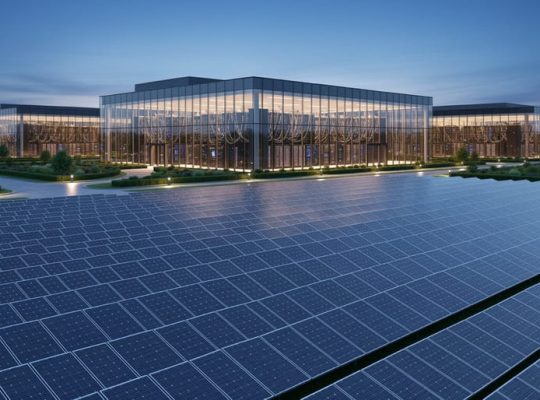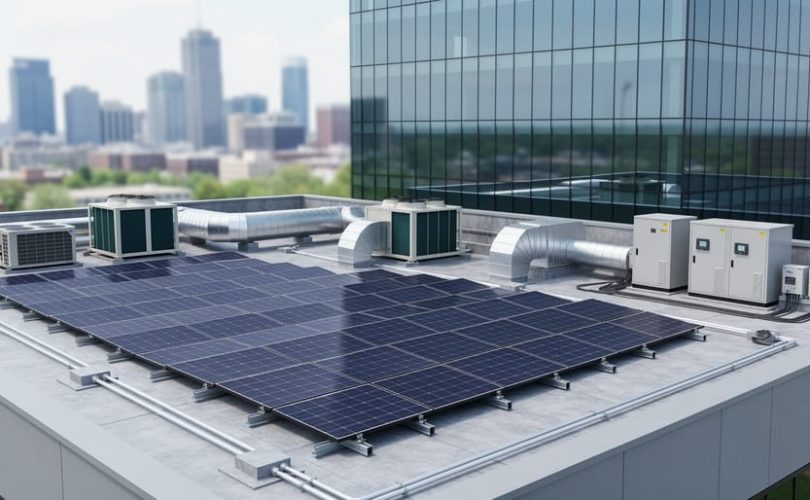
Solar-powered HVAC systems represent the convergence of two critical building technologies, offering facility managers and energy professionals a pathway to reduce operational costs by 40-60% while achieving substantial carbon footprint reductions. As commercial buildings account for nearly 40% of global energy consumption—with HVAC systems comprising up to 50% of that demand—integrating photovoltaic arrays with heating, ventilation, and air conditioning infrastructure has transitioned from experimental to essential.
The integration operates through three primary configurations: direct DC coupling where solar panels power variable-speed HVAC components without inverter losses, AC coupling through standard grid-tied inverters for conventional systems, and hybrid arrangements incorporating battery storage for load shifting during peak demand periods. Modern building management systems enable sophisticated control algorithms that optimize solar generation timing with HVAC thermal loads, precooling spaces during peak solar production hours and reducing compressor operation during expensive utility rate periods.
Economic viability hinges on accurate load analysis, proper system sizing, and strategic equipment selection. Commercial installations typically achieve 4-8 year payback periods depending on regional electricity rates, available incentives, and building thermal characteristics. The technology selection process requires evaluating inverter efficiency ratings, panel degradation warranties, and HVAC equipment compatibility with variable power inputs—factors that directly impact long-term return on investment and system reliability in real-world operating conditions.
The Energy Challenge: Why HVAC Systems Need Solar Integration
HVAC Energy Consumption Patterns in Modern Buildings
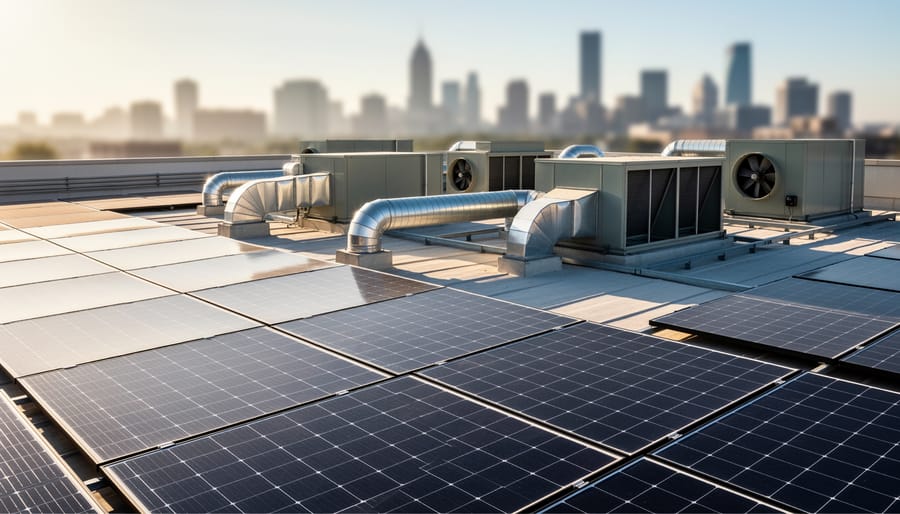
Understanding HVAC energy consumption patterns is fundamental to optimizing solar integration strategies in commercial and residential buildings. Research conducted in partnership with leading universities demonstrates that HVAC systems typically account for 40-60% of total building energy consumption, with distinct temporal characteristics that influence solar system design.
Commercial buildings exhibit pronounced daytime cooling loads, particularly during summer months when solar irradiance peaks between 10 AM and 4 PM. This natural alignment between cooling demand and solar generation creates an ideal synergy for direct solar-to-HVAC integration. Facility managers can leverage this coincidence to reduce grid dependence by up to 70% during peak hours, significantly lowering demand charges that often constitute 30-50% of commercial electricity costs.
Seasonal variations present both opportunities and challenges for HVAC solar systems. Cooling loads in temperate climates may increase energy consumption by 200-300% during summer compared to winter months, while heating demands follow inverse patterns in colder regions. Comprehensive load profiling reveals that solar generation curves align most favorably with cooling-dominated buildings, though advanced battery storage systems can address temporal mismatches in heating-focused applications.
Peak demand periods typically coincide with afternoon temperatures reaching maximum levels, creating critical pressure on electrical grids. Solar PV systems sized appropriately for HVAC loads can effectively shave these peaks, delivering both economic benefits through reduced utility costs and environmental advantages by minimizing reliance on fossil fuel peaker plants. Educational programs in renewable energy engineering emphasize these load-matching principles as essential competencies for aspiring photovoltaic professionals designing integrated building energy systems.
The Cost Implications of Conventional HVAC Operations
HVAC systems represent one of the most significant operational expenses for commercial and institutional buildings, typically accounting for 40-60% of total electricity consumption. Commercial facilities commonly face electricity costs ranging from $0.10 to $0.25 per kilowatt-hour, with HVAC operations generating monthly expenses between $5,000 and $50,000 depending on building size and climate zone. Beyond basic consumption charges, building operators encounter substantial demand charges that penalize peak power usage, often adding 30-70% to monthly utility bills.
Peak demand periods frequently coincide with maximum HVAC loads during summer afternoons when cooling requirements intensify. These coincident peaks trigger time-of-use rates that can exceed $0.40 per kilowatt-hour in certain jurisdictions, creating compounding financial burdens. Demand charges alone can constitute $2 to $15 per kilowatt of peak demand monthly, making a 100-kilowatt HVAC system’s demand component worth $200 to $1,500 beyond energy consumption costs.
For educational institutions and research facilities collaborating on renewable energy initiatives, understanding these cost structures becomes essential for evaluating solar integration strategies. Universities participating in photovoltaic educational programs benefit from analyzing actual consumption data to quantify potential savings through solar-HVAC integration, establishing baseline metrics for system performance evaluation.
How Solar PV-HVAC Integration Works in Smart Buildings
System Components and Architecture
A comprehensive solar-HVAC integration system comprises several critical components working in harmony to deliver efficient climate control powered by renewable energy. Understanding these elements is essential for effective system design and implementation.
Solar arrays form the foundation of any photovoltaic installation. Modern systems typically employ one of three primary module technologies. Monocrystalline panels, manufactured from single-crystal silicon, offer the highest efficiency rates (19-22%) and superior performance in limited space applications. Multi-crystalline modules, produced from multiple silicon fragments, provide a cost-effective alternative with slightly lower efficiency (15-17%) but remain viable for installations with adequate roof area. Mono PERC (Passivated Emitter and Rear Cell) modules represent an advanced iteration of monocrystalline technology, incorporating a reflective layer on the rear surface to capture previously lost light, achieving efficiency rates exceeding 22% while demonstrating enhanced low-light performance.
Inverters serve as the critical bridge between DC solar generation and AC HVAC equipment, converting direct current from panels into usable alternating current. String inverters offer economical solutions for uniform installations, while microinverters optimize individual panel performance, particularly valuable in partially shaded conditions.
Charge controllers regulate power flow to battery storage systems, preventing overcharging and deep discharge scenarios that compromise battery longevity. Maximum Power Point Tracking (MPPT) controllers extract optimal energy from solar arrays across varying environmental conditions.
Battery storage options enable load shifting and backup power capabilities. Lithium-ion technologies dominate contemporary installations due to superior energy density, extended cycle life, and minimal maintenance requirements compared to traditional lead-acid alternatives.
Smart control systems integrate monitoring, predictive analytics, and automated optimization algorithms, coordinating solar generation with HVAC demand patterns. These platforms provide real-time performance data and enable remote system management, maximizing energy independence while reducing operational costs.
Direct DC Coupling vs. AC Integration Approaches
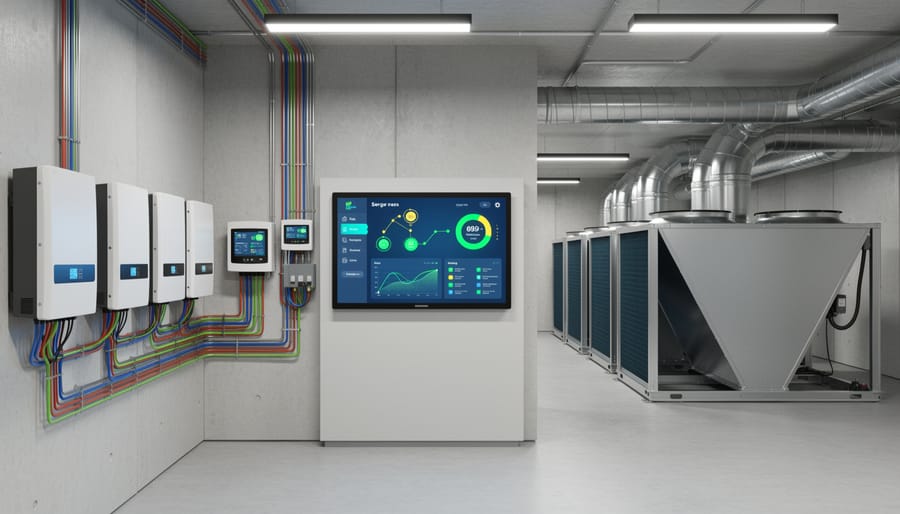
When integrating solar power with HVAC systems, two primary approaches exist: direct DC coupling and AC integration. Understanding the fundamental differences between these methodologies is essential for optimizing system performance and energy efficiency.
Direct DC coupling connects solar panels directly to DC-powered HVAC equipment, eliminating the need for inverters to convert DC electricity to AC. This approach minimizes conversion losses, which typically range from 3-8% in standard inverter operations. By maintaining power in its native DC form, direct coupling can achieve system efficiencies of 92-96%, representing a significant advantage in overall energy utilization. However, this method requires specialized HVAC equipment designed to operate on variable DC voltage, which may limit equipment options and increase initial capital costs.
AC integration represents the conventional approach, where solar-generated DC power passes through inverters to match standard AC building electrical systems. This method offers greater flexibility in equipment selection, as virtually all commercial HVAC systems operate on AC power. The primary disadvantage involves inherent conversion losses during the DC-to-AC transformation process. Modern high-efficiency inverters have substantially reduced these losses, with premium models achieving conversion efficiencies exceeding 98%.
Practical implementation considerations extend beyond efficiency metrics. AC integration simplifies maintenance procedures, as technicians possess greater familiarity with standard AC equipment. Direct DC systems, while more efficient, may require specialized training programs to ensure proper installation and ongoing service. Grid integration also differs significantly between approaches, with AC systems offering straightforward net metering capabilities, while DC coupling typically necessitates battery storage systems for optimal performance. System scalability, local electrical codes, and available technical expertise should guide selection between these integration strategies.
Smart Control and Energy Management Integration
Modern building management systems (BMS) have evolved to orchestrate solar generation with HVAC demand through sophisticated coordination mechanisms. These intelligent energy systems leverage real-time data analytics to optimize energy flows, ensuring that photovoltaic output aligns with heating, ventilation, and air conditioning requirements throughout daily operational cycles.
Predictive algorithms form the foundation of this integration, utilizing weather forecasting data, historical consumption patterns, and occupancy schedules to anticipate both solar generation capacity and HVAC load profiles. Machine learning models continuously refine these predictions, enabling systems to precondition spaces during peak solar production hours while minimizing grid dependency during expensive rate periods.
Load shifting strategies represent a key optimization technique, where thermal mass in buildings serves as energy storage. Systems can overcool or overheat spaces within acceptable comfort ranges during periods of abundant solar generation, reducing HVAC operation when solar availability decreases or utility rates increase. This approach capitalizes on the building’s inherent thermal inertia.
Real-time optimization algorithms constantly balance multiple variables including solar irradiance levels, battery state of charge, grid electricity pricing, indoor environmental conditions, and predicted occupancy. Advanced controllers make millisecond decisions about whether to direct solar energy toward immediate HVAC loads, battery storage, or grid export, maximizing both economic returns and sustainability metrics. Integration with utility demand response programs further enhances system value, allowing facilities to participate in grid stabilization efforts while maintaining occupant comfort.
Advanced Applications in Smart Building Energy Management
Demand Response and Grid Services
Solar-integrated HVAC systems represent strategic assets for grid operators seeking demand flexibility and stability. These systems can participate in demand response programs by modulating cooling loads during peak demand periods, effectively serving as distributed energy resources. Advanced building management systems enable HVAC equipment to shift operation to off-peak hours or reduce capacity temporarily without compromising occupant comfort, utilizing thermal mass as energy storage.
Through smart inverters and control algorithms, solar-HVAC installations provide ancillary grid services including frequency regulation and voltage support. When solar generation exceeds immediate HVAC demand, excess capacity can be curtailed or redirected according to grid needs, earning facility operators revenue through market participation. Research partnerships with universities have demonstrated that aggregated solar-HVAC systems can deliver predictable demand reduction equivalent to conventional generation resources.
Virtual power plant platforms increasingly aggregate commercial solar-HVAC systems into coordinated networks that respond to grid signals in real-time. Facility managers receive financial incentives based on their capacity availability and response reliability, creating additional revenue streams beyond energy cost savings. These programs typically require controllable loads exceeding 50 kW and compatible communication infrastructure. Educational programs now train photovoltaic professionals in demand response optimization, ensuring the industry develops expertise in maximizing both building performance and grid service value from integrated solar-HVAC investments.
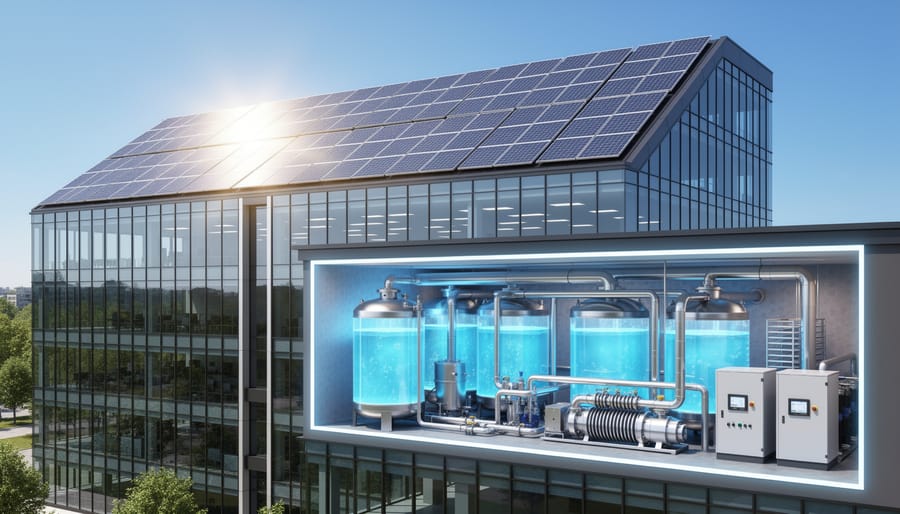
Thermal Energy Storage Integration
Converting solar excess into thermal energy storage presents a practical alternative to conventional battery systems in solar-powered HVAC applications. This approach leverages periods of peak solar generation to produce and store cooling capacity for later use, effectively time-shifting energy consumption without expensive electrochemical storage.
Ice storage systems represent one of the most established thermal storage methods. During high-irradiance periods, solar-powered chillers freeze water in insulated tanks, creating a reservoir of cooling capacity deployable during evening hours or cloudy conditions. This strategy reduces peak electrical demand and minimizes reliance on grid power during expensive rate periods.
Chilled water storage operates similarly but maintains water at temperatures above freezing, typically between 4-7°C. While requiring larger tank volumes than ice storage, these systems offer simpler operation and lower capital costs, making them attractive for medium-sized commercial installations where space permits.
Phase-change materials (PCMs) provide high energy density storage in compact configurations. These substances absorb or release substantial thermal energy during state transitions at specific temperatures, enabling efficient cooling storage matched to building load profiles. Integration with hybrid power systems further optimizes performance by coordinating thermal and electrical storage.
Research collaborations with universities continue advancing thermal storage integration, developing control algorithms that maximize solar utilization while maintaining occupant comfort across diverse building typologies and climatic conditions.
Predictive Maintenance and Performance Optimization
Modern HVAC solar systems leverage Internet of Things (IoT) sensors and artificial intelligence algorithms to revolutionize maintenance protocols and system efficiency. IoT devices continuously monitor critical parameters including solar panel output, inverter performance, temperature differentials, refrigerant pressures, and energy consumption patterns across both subsystems. This real-time data streams into AI-powered analytics platforms that identify anomalies, predict component failures, and recommend preventive interventions before breakdowns occur.
Machine learning algorithms analyze historical performance data to establish baseline operational parameters, detecting deviations that signal potential issues such as panel degradation, soiling accumulation, or HVAC compressor inefficiencies. These predictive capabilities reduce unplanned downtime by approximately 30-40 percent while extending equipment lifespan through timely maintenance interventions.
The optimization component continuously adjusts system operation based on weather forecasts, occupancy patterns, and real-time energy pricing. Algorithms determine optimal battery charging schedules, load distribution between grid and solar power, and HVAC setpoint adjustments that minimize energy costs without compromising comfort. Universities collaborating with industry leaders are advancing these technologies through research programs, creating opportunities for aspiring photovoltaic professionals to develop expertise in smart building energy management systems that represent the future of sustainable infrastructure.
Selecting the Right Solar PV Technology for HVAC Applications
Monocrystalline vs. Multi-Crystalline Modules for Commercial HVAC
When selecting solar modules for commercial HVAC applications, understanding the distinctions between monocrystalline and multi-crystalline technologies is essential for optimizing system performance and return on investment.
Monocrystalline modules typically achieve efficiency ratings between 19-22%, making them ideal for space-constrained commercial rooftops where maximum power generation per square meter is critical. Their uniform black appearance and single-crystal silicon structure enable superior electron movement, translating to higher output under identical conditions. Multi-crystalline modules, with efficiency ranges of 15-17%, require approximately 20% more installation area to generate equivalent power output, which may challenge buildings with limited roof space or complex architectural features.
Temperature coefficients present another crucial consideration for HVAC integration. Monocrystalline panels demonstrate superior performance in high-temperature environments, with typical coefficients around -0.35% per degree Celsius compared to -0.40% for multi-crystalline variants. Since HVAC systems operate continuously during peak cooling seasons when ambient temperatures are elevated, this difference can impact annual energy production by 3-5% in hot climates.
Cost-effectiveness analysis reveals that multi-crystalline modules offer lower upfront investment, typically 10-15% less expensive per watt than monocrystalline options. However, facility managers must evaluate total lifecycle economics, including installation costs, maintenance requirements, and long-term degradation rates. Both technologies support solar panel sustainability initiatives through recycling programs. For commercial HVAC applications prioritizing maximum efficiency and longevity, monocrystalline modules generally provide superior value despite higher initial costs, while multi-crystalline solutions suit budget-conscious projects with adequate installation space.
Building-Integrated Photovoltaics: Solar Tiles and Roof Shingles
Building-integrated photovoltaics (BIPV) represent a transformative approach to solar adoption, seamlessly merging energy generation with architectural design. Solar tiles and roof shingles offer compelling alternatives to traditional rack-mounted panels, particularly for residential and commercial buildings where aesthetic considerations align with functional HVAC integration requirements.
These integrated products serve dual purposes: weather protection and electricity generation. Unlike conventional solar installations that sit atop existing roofing materials, BIPV components replace traditional building elements, reducing material costs and installation complexity. Solar shingles typically measure similar dimensions to standard asphalt shingles, facilitating straightforward installation by qualified roofing contractors with photovoltaic training. Solar tiles present larger formats with interlocking mechanisms that ensure weather-tight performance while maintaining electrical connectivity.
For HVAC system integration, BIPV installations offer strategic advantages. The distributed nature of roof coverage provides consistent power generation throughout daylight hours, matching typical building cooling loads. Installation considerations include ensuring adequate ventilation beneath BIPV components to prevent thermal degradation, maintaining proper electrical grounding, and coordinating with building management systems for optimal load matching.
Academic research collaborations have demonstrated that BIPV systems reduce urban heat island effects while offsetting HVAC energy consumption by 30-50 percent in residential applications. Professional training programs increasingly emphasize BIPV installation techniques, recognizing their growing market relevance. When selecting BIPV products, evaluate efficiency ratings, warranty terms, and compatibility with existing electrical infrastructure to maximize long-term performance and economic returns.
Sizing and Configuration Best Practices
Properly sizing a solar-HVAC integration requires systematic analysis of multiple interdependent factors. The foundational system sizing methodology begins with quantifying annual HVAC energy consumption through detailed load profiling, accounting for seasonal variations and peak demand periods. Engineers should analyze hourly consumption data to identify correlation between cooling loads and solar irradiance patterns.
Calculate photovoltaic array capacity by dividing total HVAC energy requirements by the site-specific solar capacity factor, typically ranging from 15-25% depending on geographic location. Factor in system losses including inverter efficiency (95-98%), wiring losses (2-3%), and temperature derating coefficients. For grid-tied configurations, determine optimal array-to-inverter sizing ratio, generally between 1.2:1 and 1.3:1, maximizing energy harvest without excessive clipping.
Battery storage sizing for hybrid systems requires calculating the autonomy period needed during peak HVAC demand when solar generation is insufficient. Size battery banks to handle 2-4 hours of critical cooling loads while maintaining depth-of-discharge below 80% for lithium-ion technologies.
Grid interaction capabilities must accommodate bidirectional power flow, with inverters rated for both solar generation capacity and potential HVAC surge currents. Conduct utility interconnection studies to verify grid compliance and export limitations.
Real-World Performance and Economic Benefits

Commercial Building Case Studies
Real-world implementations demonstrate the substantial benefits of integrating solar photovoltaic systems with HVAC infrastructure across diverse commercial applications. A 45,000-square-foot office building in California installed a 150 kW rooftop solar array connected to a variable refrigerant flow HVAC system, achieving a 68% reduction in cooling-related energy costs. The facility documented a payback period of 5.8 years, with annual operational savings exceeding $42,000. Advanced monitoring systems revealed that strategic battery storage deployment allowed the building to shift 73% of cooling loads to solar-powered operation during peak demand hours.
A retail center in Arizona implemented a 280 kW solar installation integrated with a smart HVAC controller managing 22 rooftop units across 85,000 square feet. Post-installation analysis showed a 61% decrease in grid electricity consumption for climate control, with the system achieving full return on investment within 6.2 years. The facility manager reported improved temperature consistency and reduced maintenance requirements due to optimized equipment cycling.
Industrial facilities present unique opportunities for solar-HVAC integration. A manufacturing plant in Texas deployed 400 kW of solar capacity with direct-coupled variable frequency drives controlling air handling units. This configuration eliminated conversion losses and delivered annual energy savings of $67,000, demonstrating particular effectiveness in high-ventilation environments. These case studies provide valuable benchmarks for organizations evaluating similar implementations, with collaboration between universities and industry partners producing comprehensive performance datasets that inform best practices for system design and operation.
ROI Analysis and Financial Incentives
The financial viability of HVAC solar systems depends on several interconnected factors, including initial capital expenditure, operational savings, and available financial incentives. For commercial installations, upfront costs typically range from $150,000 to $500,000 for a 100-kilowatt system capable of offsetting a significant portion of HVAC energy consumption. However, these investments benefit substantially from federal and state-level incentives.
The federal Investment Tax Credit currently provides a 30 percent tax credit for solar installations, representing immediate savings of $45,000 to $150,000 on the example system. Additionally, the Modified Accelerated Cost Recovery System allows businesses to depreciate solar assets over five years, further reducing tax liability. Many states offer additional rebates, performance-based incentives, and sales tax exemptions that can reduce net costs by an additional 10 to 20 percent.
Operational savings derive from reduced grid electricity purchases and demand charge reductions during peak cooling periods. Commercial facilities typically achieve annual savings between $15,000 and $40,000, depending on local utility rates and HVAC load profiles. Net metering policies in many jurisdictions enable excess generation credits, maximizing return on investment.
Payback periods vary considerably across scenarios. Commercial installations with strong solar resources and high electricity rates commonly achieve payback in 5 to 8 years, while residential applications range from 8 to 12 years. Industrial facilities with continuous HVAC demands and access to accelerated depreciation often realize the shortest payback timelines, occasionally reaching full return within 4 to 6 years when combining all available incentives.
Implementation Considerations and Best Practices
Regulatory Compliance and Interconnection Standards
Integrating solar photovoltaic systems with HVAC infrastructure requires navigating a comprehensive regulatory landscape that ensures safety, grid stability, and building code compliance. Professionals must familiarize themselves with the National Electrical Code (NEC), particularly Articles 690 and 705, which govern photovoltaic system installations and interconnection to electrical power sources. The International Building Code (IBC) and International Energy Conservation Code (IECC) establish structural and energy efficiency requirements that directly impact solar-HVAC system design.
Grid interconnection standards, primarily IEEE 1547, define technical specifications for connecting distributed generation resources to utility systems, including voltage regulation, frequency response, and anti-islanding protection. State-specific variations in these standards necessitate thorough research during project planning phases. The permitting process typically involves multiple agencies, including building departments, electrical inspectors, and utility companies, each requiring detailed documentation of system specifications, structural calculations, and electrical schematics.
Many universities now incorporate regulatory compliance modules into renewable energy curricula, preparing future professionals to navigate these requirements effectively. Aspiring photovoltaic professionals should pursue educational opportunities that emphasize practical permitting experience alongside technical training, as regulatory knowledge significantly impacts project timelines and success rates. Additionally, staying current with evolving interconnection standards and local amendments ensures continued professional competency in this dynamic field.
Professional Training and Certification Pathways
The integration of photovoltaic systems with HVAC technology requires specialized knowledge that extends beyond traditional electrical or mechanical training. Professional training pathways are emerging through collaborative university programs that combine renewable energy engineering with building systems management. Leading institutions now offer certificate programs and advanced degrees specifically focused on solar-HVAC integration, covering topics such as load calculations, energy storage optimization, and building management system protocols.
Industry professionals can access professional development resources through organizations like NABCEP, which offers specialized certifications for PV installation professionals working with complex building systems. These programs emphasize hands-on training with integrated systems, ensuring practitioners understand both the electrical characteristics of solar arrays and the thermal dynamics of HVAC equipment. Continuing education workshops, often developed in partnership with manufacturers and research institutions, provide updates on emerging technologies, code requirements, and best practices for system commissioning and maintenance. This comprehensive educational approach prepares PV professionals to design, install, and optimize solar-HVAC systems that deliver maximum energy efficiency and economic returns.
The convergence of solar photovoltaic technology and HVAC systems represents a transformative approach to smart building energy management, offering substantial operational cost reductions while advancing environmental sustainability goals. As this article has demonstrated, successful integration requires comprehensive understanding of both photovoltaic principles and HVAC system dynamics, from proper sizing and inverter selection to energy storage optimization and grid interaction protocols.
The professional landscape for solar-HVAC integration specialists continues to expand rapidly as building codes evolve and energy efficiency mandates strengthen worldwide. This growth trajectory creates exceptional opportunities for aspiring photovoltaic professionals who invest in specialized education and hands-on training. Collaboration between industry leaders and academic institutions has become instrumental in developing curriculum that addresses real-world implementation challenges, ensuring graduates possess both theoretical knowledge and practical competencies demanded by employers.
For facility managers and industry stakeholders evaluating solar-HVAC solutions, the economic case has strengthened considerably through declining equipment costs, improved system efficiencies, and favorable financing mechanisms. However, achieving optimal performance requires rigorous site assessment, accurate load modeling, and ongoing commissioning practices that verify design assumptions translate into operational reality.
The path forward demands continued innovation in component technologies, control algorithms, and integration methodologies. Research institutions and manufacturers must maintain collaborative partnerships that accelerate development cycles while ensuring solutions remain commercially viable and technically robust. As the renewable energy sector matures, professionals equipped with interdisciplinary expertise in solar technology, building systems, and energy management will drive the industry toward widespread adoption, fundamentally reshaping how commercial and residential buildings consume and generate power in an increasingly decarbonized energy landscape.