
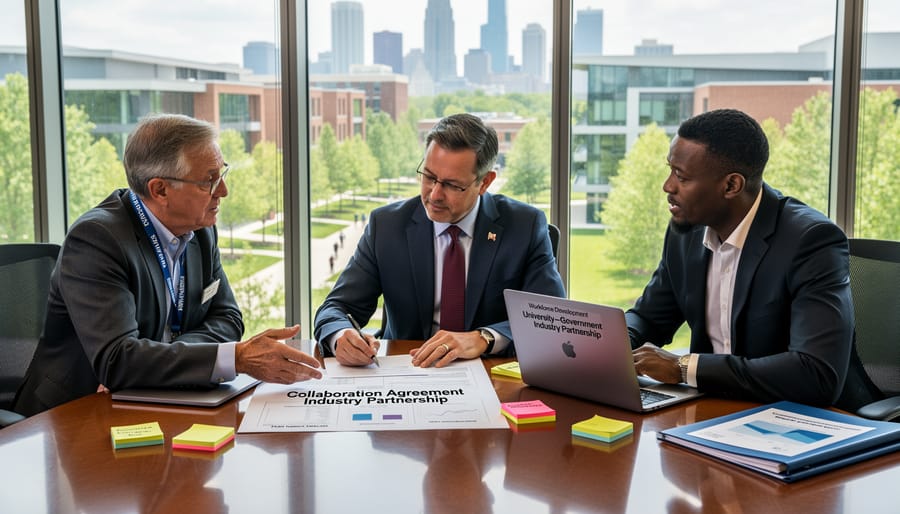
University-community partnerships transform abstract academic knowledge into tangible workforce solutions by aligning curriculum development with real-world industry demands. Establish formal agreements between educational institutions and local governments that define shared objectives, resource allocation, and success metrics—specifically targeting emerging sectors like renewable energy where skilled labor shortages impede regional economic growth. Deploy tri-sector collaboration models connecting universities, municipalities, and industry partners to create pathways from classroom to career, ensuring students gain both theoretical foundations and hands-on experience through internships, apprenticeships, and capstone projects. Structure partnerships around measurable community outcomes rather than symbolic gestures, such as quantifiable increases in certified professionals entering the solar industry or documented reductions in local unemployment rates within specific technical fields.
Effective university-community partnerships in renewable energy education require dedicated coordination mechanisms, including joint steering committees, shared funding streams, and co-designed programs that respond to documented labor market needs. These collaborative frameworks prove particularly vital in photovoltaic workforce development, where rapid technological advancement demands continuous curriculum updates and industry-validated competencies. By integrating educational solar programs within broader community development strategies, municipalities address sustainability goals while universities fulfill their public service missions, creating ecosystems where academic research directly informs policy implementation and workforce training scales to meet documented industry demand.
The Skills Crisis Threatening Solar Energy Expansion
The photovoltaic industry faces a significant workforce challenge that threatens to slow the transition to renewable energy. According to the Interstate Renewable Energy Council, the solar sector will need to fill approximately 900,000 new positions by 2030 to meet deployment targets established under current climate policies. However, current training pipelines are producing only a fraction of the qualified candidates required to fill these roles.
Recent analysis from the Solar Energy Industries Association reveals that 63% of solar employers report difficulty finding qualified applicants for technical positions, including installers, system designers, and maintenance technicians. This shortage extends beyond entry-level positions, with project managers, electrical engineers specializing in photovoltaic systems, and quality assurance specialists also in critically short supply. The gap between available jobs and qualified workers has widened by 28% since 2020, creating bottlenecks in project completion timelines.
The workforce deficit directly impacts local clean energy goals and deployment schedules. Communities that have committed to renewable energy targets often face delays of six to eighteen months on solar installations due to contractor shortages. In California alone, an estimated 2.4 gigawatts of approved solar capacity remains unbuilt primarily due to workforce constraints, representing enough generating capacity to power approximately 450,000 homes.
The skills crisis extends beyond installation expertise. The industry requires professionals trained in emerging technologies such as battery storage integration, smart grid connectivity, and advanced monitoring systems. Traditional trade schools and community colleges have struggled to update curricula quickly enough to match technological advancement, while many potential workers remain unaware of career opportunities in the solar sector.
This workforce shortage poses particular challenges for rural and underserved communities seeking to develop local solar capacity. Without accessible training programs and clear pathways to employment, these areas face extended timelines for achieving energy independence and realizing the economic benefits of clean energy development. Addressing this gap requires coordinated efforts between educational institutions, industry partners, and local governments to create robust training ecosystems that can scale rapidly to meet demand.
What Makes University-Community-Government Partnerships Effective
The University’s Role: Academic Rigor and Research Infrastructure
Universities serve as the academic backbone of effective community partnerships by establishing rigorous educational standards and providing essential research infrastructure. Their primary contribution lies in developing comprehensive curricula that align with industry requirements while maintaining academic integrity. Through collaboration with industry partners and local governments, universities design degree programs, certificate courses, and continuing education opportunities that address evolving workforce needs in the photovoltaic sector.
Accreditation processes managed by universities ensure that training programs meet nationally recognized standards, lending credibility to workforce development initiatives. This academic validation proves particularly valuable for aspiring professionals seeking recognized credentials that enhance employment prospects. Universities also contribute state-of-the-art laboratory facilities and testing equipment that would otherwise be financially prohibitive for community organizations or small municipalities to maintain independently.
The research infrastructure universities provide extends beyond physical facilities. Faculty members bring evidence-based training methodologies grounded in pedagogical research, ensuring that educational programs incorporate effective learning strategies. Universities conduct applied research that addresses real-world challenges in solar installation, system design, and maintenance, translating findings into practical training modules.
Additionally, academic institutions offer assessment frameworks to measure program effectiveness and student learning outcomes. This data-driven approach enables continuous improvement of partnership initiatives while demonstrating tangible results to stakeholders and funding agencies. Through these multifaceted contributions, universities transform community partnerships into sustainable, high-quality educational ecosystems.
Local Government’s Contribution: Policy Support and Community Access
Municipal governments play a pivotal role in enabling effective university-community partnerships through strategic policy frameworks and resource allocation. Successful local government partnerships typically involve dedicated funding mechanisms such as workforce development grants, tax incentives for renewable energy education initiatives, and capital investment in shared training facilities. These financial supports reduce barriers to program implementation while demonstrating municipal commitment to clean energy workforce expansion.
Regulatory frameworks also facilitate collaboration by streamlining facility-sharing agreements, establishing clear intellectual property guidelines, and creating expedited permitting processes for educational solar installations. Many municipalities provide universities with access to public buildings, unused land parcels, or existing renewable energy infrastructure for hands-on training purposes. This access proves invaluable for developing practical photovoltaic installation skills among students and community members.
Furthermore, forward-thinking local governments align partnership initiatives with broader economic development strategies, recognizing that investing in solar workforce education strengthens regional competitiveness in the renewable energy sector. By establishing clear procurement preferences for locally-trained solar professionals and supporting apprenticeship programs, municipalities create sustainable pathways from education to employment. This coordinated approach ensures partnerships deliver measurable outcomes including job creation, reduced unemployment, and accelerated clean energy adoption within communities.
Industry Partners: Real-World Application and Career Pathways
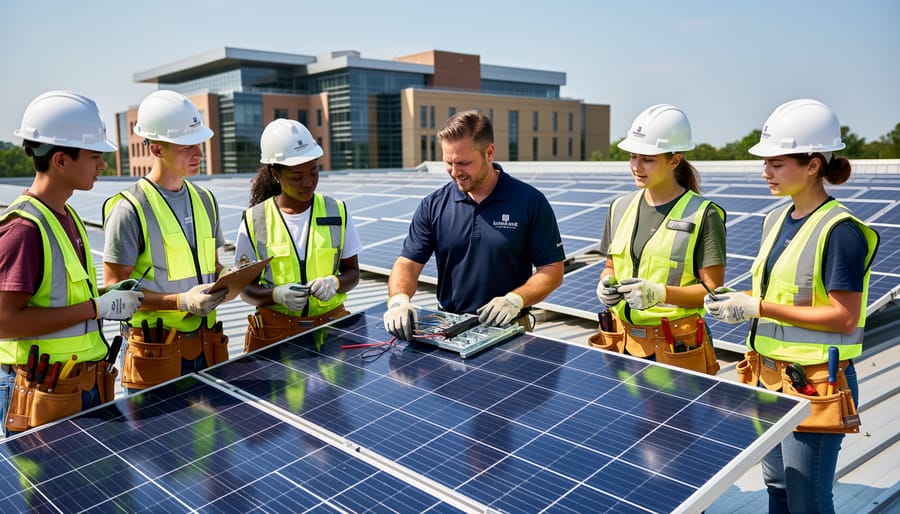
Industry partners serve as critical bridges between academic learning and professional practice in university-community partnerships. Solar installation companies like Mose Solar exemplify this collaborative model by providing essential resources that enhance educational outcomes while building robust talent pipelines. These partnerships typically encompass several key components that benefit students, universities, and industry stakeholders alike.
Technical expertise represents a foundational contribution, with experienced professionals delivering guest lectures, participating in curriculum development, and providing mentorship to students navigating career decisions. This real-world perspective ensures academic programs remain aligned with current industry standards and emerging technologies in photovoltaic systems.
Equipment access addresses a significant barrier in renewable energy education, as solar hardware and installation materials require substantial investment. Industry partners often supply or subsidize training equipment, enabling hands-on learning experiences that translate theoretical knowledge into practical competencies.
Internship opportunities create structured pathways for students to gain field experience while companies evaluate potential future employees. These programs typically involve supervised project work, exposure to various aspects of solar operations, and skill development in installation, system design, and customer relations.
Direct hiring pipelines emerge naturally from successful internship programs, with many participants transitioning into full-time positions. This streamlined recruitment process benefits employers by reducing training costs while providing graduates with immediate career placement in the growing renewable energy sector.
Successful Partnership Models Already Transforming Communities
The Community College Hub Model
Community colleges serve as particularly effective hubs for university-community partnerships due to their accessibility, affordability, and established connections with local populations. These institutions typically maintain strong relationships with regional industries and government entities, positioning them as natural bridges between academic knowledge and community workforce needs.
The community college hub model operates through tri-sector collaboration, connecting educational institutions with municipal governments and private industry partners. In renewable energy workforce development, this approach has proven especially valuable. Community colleges offer certificate programs and associate degrees in photovoltaic installation and maintenance, while university partners provide advanced curriculum development, research support, and pathways for students seeking bachelor’s degrees in solar engineering or sustainable energy management.
Local governments contribute through workforce development grants, facility upgrades, and policy alignment that ensures training programs meet regional employment demands. Industry stakeholders participate by offering internships, donating equipment, and providing input on skill requirements. This creates a responsive educational ecosystem where curriculum evolves alongside technological advancements in solar panel efficiency and installation techniques.
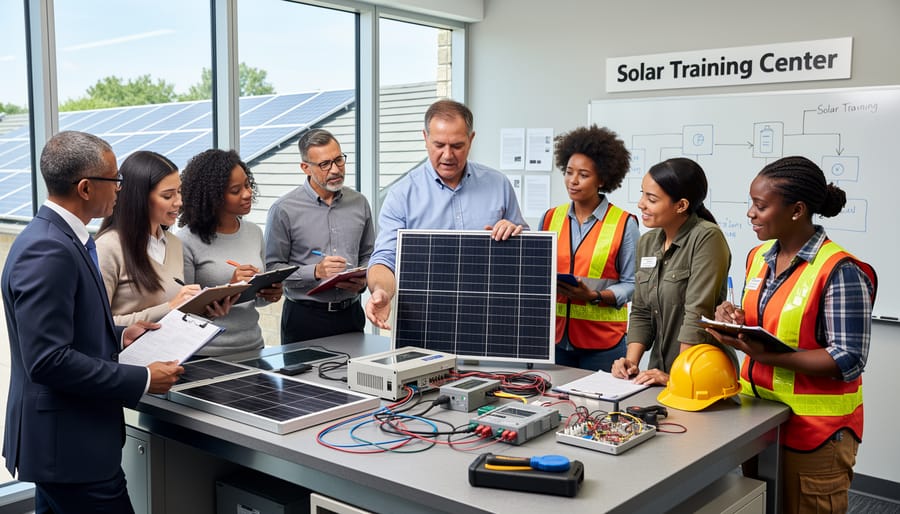
Successful examples include partnerships where community colleges host hands-on training facilities equipped with photovoltaic arrays for student practice, while universities supply faculty expertise and certification frameworks. The model’s accessibility makes it particularly effective for serving underrepresented populations and career changers entering the renewable energy sector, addressing both educational equity and clean energy workforce shortages simultaneously.
Online-Hybrid Programs Expanding Geographic Reach
The integration of online-hybrid programs represents a transformative approach to expanding photovoltaic education beyond traditional university campuses. Universities are partnering with local governments and community organizations to establish distributed learning networks that combine rigorous online coursework with hands-on training at regional practicum sites. This model enables aspiring PV professionals in rural and underserved communities to access world-class instruction without relocating to urban educational centers.
These partnerships leverage digital training platforms to deliver theoretical content, virtual laboratories, and interactive simulations, while community-based sites provide essential practical experience with solar installations, maintenance procedures, and system troubleshooting. Local governments often contribute by designating public facilities as training locations and connecting students with municipal solar projects for real-world application.
Geographic barriers that historically limited workforce development in renewable energy are diminishing as universities establish memoranda of understanding with community colleges, workforce development boards, and regional utilities across multiple states. Students can complete certification requirements while remaining in their home communities, addressing the critical shortage of qualified PV technicians in areas where solar adoption is rapidly expanding. This democratization of access ensures that the clean energy transition includes diverse populations and strengthens local economies through skilled workforce development. The model also allows universities to scale their impact cost-effectively while maintaining educational quality and industry relevance through standardized curricula and unified assessment protocols.
Building Blocks: Essential Components of Sustainable Partnerships
Funding Structures and Revenue Sustainability
Successful university-community partnerships in photovoltaic education require diverse, stable funding structures to ensure long-term viability. Government grants from federal and state renewable energy initiatives provide foundational support, particularly through Department of Energy programs and workforce development funds targeting clean energy sectors. Municipal investment represents another critical revenue stream, as local governments increasingly recognize the economic benefits of developing skilled solar workforces within their jurisdictions.
Tuition-sharing arrangements between educational institutions and community organizations can expand access while distributing financial responsibility. In this model, universities contribute instructional resources and facilities, while community partners may subsidize student costs or provide equipment. Industry sponsorship has emerged as particularly valuable, with solar manufacturers and installation companies investing in curriculum development and hands-on training facilities in exchange for pipeline access to qualified professionals.
Hybrid funding models combining these elements demonstrate superior sustainability compared to single-source approaches. Partnership agreements should establish clear revenue commitments, cost-sharing formulas, and contingency plans. Additionally, performance-based funding tied to student outcomes and workforce placement metrics can attract continued investment from stakeholders seeking measurable returns on their educational contributions to the renewable energy sector.
Curriculum Alignment with Industry Certification Standards
Successful university-community partnerships in photovoltaic education require deliberate curriculum alignment with recognized industry certification standards, particularly those administered by the North American Board of Certified Energy Practitioners (NABCEP). This alignment ensures graduates possess competencies directly valued by employers while preserving the academic rigor expected from higher education institutions.
NABCEP certifications serve as the solar industry’s gold standard, establishing clear benchmarks for installer, designer, and technical sales professional competencies. When universities map their program learning outcomes to these certification requirements, they create transparent pathways for students to achieve both academic credentials and professional certifications. This dual achievement significantly enhances employability while demonstrating to local government partners and industry stakeholders that educational investments yield job-ready graduates.
However, maintaining academic integrity remains paramount. Universities must balance certification-specific training with broader educational objectives including critical thinking, research methodology, and theoretical foundations. Effective partnerships incorporate industry advisory boards comprising local employers and certification holders who regularly review curricula to ensure relevance without compromising academic standards. This collaborative approach yields programs that produce technically proficient professionals capable of advancing the field through innovation and leadership, addressing both immediate workforce needs and long-term industry development goals that benefit the entire community.
Equity and Community Access Considerations
University-community partnerships in photovoltaic workforce development must prioritize equitable access to ensure diverse participation. Effective programs establish dedicated pathways for veterans transitioning to civilian careers, leveraging their technical aptitude and discipline. Partnerships can offer bridge programs for career-changers from declining industries, providing accelerated training that recognizes transferable skills while addressing clean energy fundamentals.
Scholarship programs funded through industry partners and local government grants reduce financial barriers for economically disadvantaged participants. Successful models include income-based tuition scales, equipment lending libraries, and stipend programs that offset lost wages during training periods. Geographic accessibility matters equally—offering courses at community centers, workforce development offices, and mobile training facilities reaches populations without reliable transportation.
Recruitment strategies should extend beyond traditional channels, engaging community organizations, faith-based groups, and social service agencies that serve underrepresented populations. Partnerships implementing inclusive access strategies demonstrate measurably higher diversity outcomes. Language-accessible materials, flexible scheduling accommodating multiple job holders, and childcare support during training sessions further remove participation barriers. These deliberate equity measures strengthen workforce pipelines while addressing historical underrepresentation in renewable energy sectors, creating sustainable pathways for communities most impacted by energy transition.
Overcoming Common Barriers to Partnership Formation
Establishing effective university-community partnerships requires acknowledging and addressing several structural challenges that commonly impede collaboration. Understanding these barriers and implementing targeted solutions enables institutions to build sustainable, productive relationships.
Bureaucratic misalignment represents a primary obstacle, as universities and community organizations operate under fundamentally different administrative frameworks. Academic institutions typically follow semester-based timelines and extensive approval processes, while community partners require flexible, responsive engagement. To bridge this gap, establish dedicated liaison positions with authority to expedite decisions and create streamlined approval pathways for partnership activities. Developing standardized partnership agreements that can be adapted for various collaborators reduces administrative burden while maintaining institutional compliance.
Funding inconsistencies frequently derail promising collaborations. Universities and community organizations compete for limited grant resources, creating potential conflicts rather than cooperation. Address this challenge by pursuing joint funding applications that demonstrate combined impact, particularly for workforce development initiatives in emerging sectors like photovoltaic technology. Establishing cost-sharing models where each partner contributes distinct resources—such as universities providing research expertise and facilities while community organizations offer industry connections and practical training sites—creates sustainable financial foundations without duplicative costs.
Competing institutional priorities often result in misaligned objectives and expectations. Universities prioritize research output and student learning outcomes, while community partners focus on immediate workforce needs and economic development. Regular stakeholder meetings that explicitly map shared goals and individual benefits ensure all parties maintain commitment throughout the partnership lifecycle. Creating formal memoranda of understanding that specify deliverables, timelines, and success metrics provides accountability while respecting each organization’s unique mission.
Stakeholder coordination complexity increases with partnership scale. Implement coordinating committees with clearly defined roles, decision-making authority, and communication protocols. Designating project managers from each organization ensures consistent information flow and rapid problem resolution. Utilizing collaborative digital platforms enables transparent progress tracking and facilitates engagement among geographically dispersed partners. These structural solutions transform potential barriers into opportunities for innovation and meaningful community impact.
Measuring Impact: How to Evaluate Partnership Success
Establishing clear evaluation frameworks ensures university-community partnerships deliver measurable value to all stakeholders. Effective assessment requires both quantitative metrics and qualitative indicators that capture the multifaceted impact of collaborative solar workforce development initiatives.
Student outcome metrics form the foundation of partnership evaluation. Track enrollment numbers, program completion rates, and certification achievement percentages to gauge educational effectiveness. Post-graduation employment statistics prove particularly valuable, with successful partnerships typically achieving 70-85% placement rates within six months of program completion. Monitor average starting salaries and career progression trajectories to assess long-term student success.
Community impact extends beyond individual outcomes. Measure local solar capacity growth through megawatts installed annually, number of residential and commercial installations completed, and greenhouse gas emission reductions achieved. Document the economic multiplier effect by tracking new businesses established, local jobs created, and investment dollars retained within the community. For comprehensive assessment, calculate the ratio of local versus external hiring in solar projects.
Partnership sustainability indicators include stakeholder satisfaction surveys, renewal rates of collaborative agreements, and continued funding commitments from participating organizations. Evaluate knowledge transfer effectiveness through the number of joint research publications, patent applications filed, and technology innovations commercialized.
Implement regular assessment cycles using balanced scorecards that weight academic, economic, environmental, and social outcomes according to partnership priorities. Consider establishing third-party evaluation processes to maintain objectivity and credibility. Successful partnerships typically conduct quarterly internal reviews and annual comprehensive evaluations, adjusting strategies based on data-driven insights. This systematic approach ensures accountability while demonstrating tangible returns on investment for universities, local governments, industry partners, and the communities they collectively serve.
The successful transition to renewable energy fundamentally depends on collaborative workforce development models that bridge the gap between academic knowledge and practical industry application. University-community partnerships represent a proven, scalable approach to cultivating the skilled professionals needed to meet ambitious climate goals and energy infrastructure demands. These collaborative frameworks deliver measurable benefits across multiple dimensions: students gain career-ready competencies through hands-on training, communities access clean energy solutions while building local economic capacity, and industries secure a pipeline of qualified workers prepared to address sector-specific challenges.
For stakeholders considering partnership development, the evidence is clear. Educational institutions possess research capabilities and training infrastructure, local governments understand community needs and regulatory environments, and industry partners provide real-world project opportunities and employment pathways. When these entities align their resources and expertise, they create sustainable ecosystems that multiply individual contributions exponentially.
The call to action is straightforward: initiate conversations, identify shared objectives, and commit resources toward partnership formation. Academic administrators should reach out to local government officials and regional employers. Industry leaders must engage with educational program developers to articulate workforce requirements. Community organizations should advocate for accessible training opportunities that serve diverse populations.
Scalability remains a critical advantage of these models. Successful partnerships can be replicated across different geographic regions and adapted to various renewable energy technologies beyond photovoltaics. The renewable energy workforce challenge is too substantial for any single sector to address alone. Collaborative action, starting today, will determine whether we meet tomorrow’s clean energy targets with adequate human capital.