Gravity energy storage systems represent a transformative solution in the renewable energy landscape, offering a powerful complement to building-integrated photovoltaics and other clean energy technologies. By harnessing the fundamental force of gravity, these systems store excess energy by lifting heavy weights during peak production periods and generate electricity by lowering them when demand increases.
Unlike conventional battery storage, gravity-based systems offer exceptional longevity, minimal environmental impact, and significantly lower maintenance requirements. Their integration with existing building infrastructure provides a sustainable solution for urban energy management, particularly in high-rise structures where vertical space can be efficiently utilized for energy storage.
Recent technological advancements have enhanced the efficiency and scalability of gravity storage systems, making them increasingly viable for commercial applications. With energy conversion efficiencies reaching up to 85% and operational lifespans exceeding 25 years, these systems present a compelling alternative to chemical battery storage solutions. Their ability to provide stable, long-duration energy storage addresses one of the primary challenges in renewable energy adoption: intermittency management.
How Gravity Energy Storage Works in Buildings
Core Components and Mechanisms
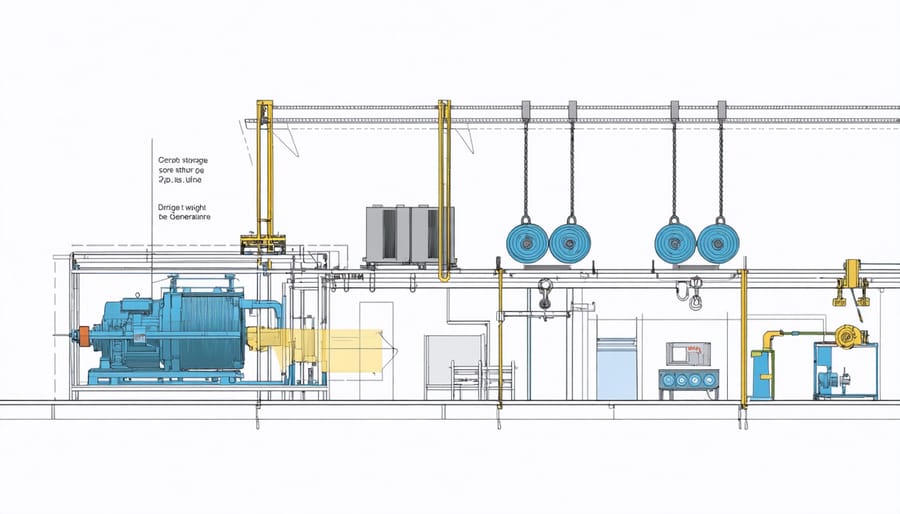
Gravity energy storage systems comprise several fundamental components that work together to harness gravitational potential energy as one of the emerging energy storage solutions. The primary element is the mass system, typically consisting of heavy weights made from dense materials like concrete or steel, which are elevated to store potential energy.
The lifting mechanism includes high-strength cables or chains connected to an electric motor-generator assembly. This bidirectional system operates as a motor during the charging phase, lifting the weights to store energy, and functions as a generator during discharge, converting the gravitational potential energy back into electricity as the weights descend.
A sophisticated pulley system facilitates smooth weight movement while minimizing friction losses. The system incorporates safety mechanisms, including emergency brakes and mechanical stops, to prevent uncontrolled descent and ensure safe operation.
The control system forms the brain of the installation, managing charging and discharging cycles based on energy demand and supply. It monitors parameters such as weight position, system speed, and power output while optimizing performance through advanced algorithms.
Additional components include structural support frameworks, guide rails for weight movement, and power conversion equipment to ensure grid compatibility. These systems also feature sensors and monitoring devices that provide real-time operational data and enable predictive maintenance.
Energy Conversion and Efficiency
Gravity energy storage systems operate on a fundamental principle of energy conversion between potential and kinetic energy. During the charging phase, electrical energy from renewable sources, such as solar panels, powers motors that lift heavy weights or pump water to elevated reservoirs. This process converts electrical energy into gravitational potential energy, which can be stored for extended periods with minimal losses.
The discharge process reverses this conversion, allowing the weights to descend or water to flow downward through turbines, transforming gravitational potential energy back into electrical energy. Modern gravity storage systems achieve overall round-trip efficiency rates between 70% and 85%, depending on the specific technology implementation and scale of operation.
Several factors influence system efficiency, including mechanical friction, motor-generator efficiency, and parasitic losses in the control systems. Advanced designs incorporate regenerative braking systems and high-efficiency components to maximize energy recovery. The use of smart control algorithms and precision engineering helps minimize energy losses during both storage and retrieval phases.
Notable advantages of gravity storage include minimal degradation over time, unlike chemical batteries that experience capacity fade. The system’s efficiency remains relatively stable throughout its operational lifetime, typically exceeding 25 years. Additionally, the conversion process produces no harmful emissions or chemical byproducts, making it environmentally sustainable and cost-effective for long-term energy storage applications.
Integration with Building PV Systems
Architectural Considerations
The implementation of gravity energy storage systems requires careful consideration of building structural integrity and architectural adaptations. Buildings must be designed or modified to accommodate the significant weight loads associated with the storage mechanism, whether utilizing concrete blocks, water tanks, or other mass-based systems.
Foundation reinforcement is typically necessary to support the additional static and dynamic loads. Engineers must calculate the total weight capacity needed, including both the storage mass and the mechanical systems required for operation. Load-bearing walls and support columns may need strengthening to ensure safe distribution of forces throughout the structure.
The mechanical room housing the lifting and lowering mechanisms requires dedicated space, typically in the basement or ground floor. Vertical shafts or channels must be incorporated into the building design to accommodate the movement of weights or fluid systems. These pathways need proper reinforcement and safety mechanisms to prevent structural damage during operation.
Seismic considerations play a crucial role, particularly in active geological regions. The storage system must be designed to maintain stability during seismic events, with appropriate dampening mechanisms and safety features. Building codes and local regulations often require specific structural modifications and safety measures for such installations.
Architectural integration should consider aesthetic impacts, particularly in commercial or residential settings. The system components can be concealed within the building envelope or designed as visible architectural elements, depending on the project requirements and local planning regulations. Access points for maintenance and emergency situations must be strategically placed throughout the structure.

System Synchronization
Gravity energy storage systems require sophisticated synchronization mechanisms to effectively integrate with photovoltaic generation and building power management systems. This integration operates through a multi-layered control architecture that monitors real-time power generation, consumption patterns, and grid conditions.
The synchronization process begins with the building’s energy management system (BEMS) collecting data from various sources, including PV production metrics, current power demand, and weather forecasts. This information feeds into an advanced algorithm that determines optimal charging and discharging cycles for the gravity storage system.
During peak solar generation, excess energy is used to power the lifting mechanism, raising weights or masses to their maximum potential energy state. The system’s controllers maintain constant communication with the PV inverters to ensure smooth power flow and prevent any sudden fluctuations that could affect building operations.
When power demand exceeds solar generation or during non-productive hours, the synchronization system initiates a controlled descent of the weights, converting potential energy back into electrical power. This process is precisely timed to complement the building’s power requirements and maximize energy efficiency.
The system also interfaces with smart grid infrastructure, enabling demand response capabilities and participation in grid services. Advanced monitoring systems provide real-time performance data, allowing facility managers to optimize energy storage operations and maintain system efficiency. Regular calibration and adjustment of synchronization parameters ensure optimal performance as seasonal variations and building usage patterns change over time.
Benefits and Performance Metrics
Energy Storage Capacity
The storage capacity of gravity energy storage systems varies significantly based on the installation scale and design parameters. These systems typically offer capacities ranging from 10 kWh for small-scale installations to several MWh for utility-grade implementations. When integrated with building power management systems, gravity storage can provide 4-12 hours of continuous discharge at rated power.
The discharge rate is highly controllable, offering flexibility in power output from 100kW to multiple megawatts. This adaptability makes gravity storage particularly suitable for grid-balancing applications and peak demand management. The systems maintain consistent performance throughout their operational lifetime, with minimal capacity degradation compared to chemical batteries.
A key advantage is the rapid response time, typically under 1 second from standby to full power output. The storage duration can be extended by increasing the mass of the weighted components or the height differential, though practical considerations often limit building installations to 24-hour cycles.
Most commercial gravity storage installations achieve round-trip efficiencies between 70% and 85%, depending on system design and operating conditions. The energy density typically ranges from 50-150 Wh/m³, making spatial efficiency an important consideration for building integration projects.
Cost-Effectiveness and ROI
Gravity energy storage systems demonstrate compelling cost-effectiveness when evaluated against traditional energy storage solutions. Initial installation costs typically range from $1,500 to $4,000 per kilowatt-hour (kWh), positioning them competitively against lithium-ion batteries, which average $2,000 to $5,000 per kWh. The primary advantage lies in their significantly longer operational lifespan of 30-50 years, compared to 10-15 years for chemical batteries.
The return on investment (ROI) calculations reveal favorable economics, particularly in regions with variable electricity pricing. A typical gravity storage system can achieve payback periods of 8-12 years through energy arbitrage alone, with shorter periods possible when combined with additional revenue streams such as grid services and demand response programs.
Maintenance costs remain notably low, averaging 1-2% of initial capital expenditure annually, substantially less than chemical battery alternatives requiring regular cell replacement. The systems’ mechanical simplicity contributes to reduced operational expenses and minimal performance degradation over time.
Analysis of levelized cost of storage (LCOS) shows gravity storage systems achieving $0.15-0.25 per kWh cycle, comparing favorably with pumped hydro storage and becoming increasingly competitive as technology matures and economies of scale improve. This cost-effectiveness is further enhanced in urban environments where space constraints make traditional storage solutions impractical.

Implementation Challenges and Solutions
The implementation of gravity energy storage systems presents several significant challenges that require careful consideration and innovative solutions. One primary challenge is the substantial initial infrastructure requirements, particularly in urban environments where space is limited. Engineers have addressed this by developing compact vertical systems that maximize height rather than footprint, and by repurposing existing structures such as decommissioned mine shafts.
Material selection poses another crucial challenge, as the weights used must balance durability with cost-effectiveness. Advanced composite materials and recycled construction waste are emerging as viable solutions, offering optimal weight-to-volume ratios while maintaining structural integrity. These materials also help reduce the environmental impact of system installation.
System efficiency losses through friction and mechanical wear represent a persistent challenge. Implementation of magnetic levitation technology and advanced bearing systems has shown promising results in minimizing these losses. Additionally, sophisticated control systems utilizing machine learning algorithms help optimize the raising and lowering of weights, maximizing energy conversion efficiency.
Grid integration and response time present technical hurdles, particularly in maintaining stable frequency regulation. Modern gravity storage systems incorporate advanced power electronics and smart controllers to ensure seamless grid interaction and rapid response to demand fluctuations. These solutions enable systems to provide ancillary services while maintaining their primary storage function.
Safety considerations require robust fail-safe mechanisms and redundant braking systems. Engineers have developed multiple independent safety systems, including mechanical stops, emergency brakes, and computerized monitoring systems that continuously assess structural integrity and operational parameters.
Cost remains a significant challenge, particularly for smaller-scale implementations. However, innovative financing models, including power purchase agreements and energy-as-a-service contracts, are making these systems more accessible. Additionally, standardization of components and modular design approaches are helping reduce installation and maintenance costs while improving system reliability.
Gravity energy storage systems integrated with building-mounted photovoltaic installations represent a promising solution for addressing the intermittency challenges of solar power generation. The technology’s potential to provide reliable, long-duration energy storage while utilizing existing building infrastructure makes it particularly attractive for urban environments where space is limited.
As the renewable energy sector continues to evolve, gravity storage systems are expected to play an increasingly important role in building energy management. Research indicates that these systems can achieve round-trip efficiencies of up to 85% when properly integrated with PV systems, offering a viable alternative to traditional battery storage solutions. The scalability and minimal environmental impact of gravity-based storage further enhance its appeal for sustainable building designs.
Looking ahead, ongoing technological advancements and cost reductions in both PV and gravity storage components are likely to accelerate adoption rates. Industry experts project significant growth in building-integrated gravity storage implementations over the next decade, particularly in commercial and industrial applications. The development of smart control systems and improved power electronics will further optimize the integration of these technologies.
However, successful implementation will require continued collaboration between architects, engineers, and energy specialists to overcome current technical and regulatory challenges. As more pilot projects demonstrate the feasibility and benefits of integrated gravity storage systems, we can expect to see broader acceptance and implementation across the built environment.