
Zero-interest solar loans represent a breakthrough in solar financing options, enabling homeowners to install photovoltaic systems without incurring interest charges or upfront capital expenses. These specialized financing instruments, typically offered through partnerships between solar installers, financial institutions, and government programs, eliminate the traditional cost barriers associated with renewable energy adoption.
By combining federal tax incentives, state-level rebates, and innovative loan structures, zero-interest solar financing creates an immediate positive cash flow for property owners. The monthly loan payments often remain lower than existing utility bills, while the elimination of interest charges accelerates the return on investment timeline significantly. This financing mechanism has emerged as a crucial catalyst in accelerating residential solar adoption across diverse economic demographics.
For qualified homeowners, these programs typically offer terms ranging from 5 to 20 years, with loan amounts covering the complete system cost, including installation. The zero-interest structure, combined with energy savings and increased property value, presents a compelling financial proposition that transforms solar installation from a long-term investment into an immediate economic advantage.
How Zero Interest Solar Loans Work
Qualifying for Zero Interest Solar Financing
Qualifying for zero interest solar financing typically requires meeting specific credit, income, and property criteria established by lending institutions and program administrators. Most lenders require a minimum FICO credit score of 640, though some premium programs may demand scores of 680 or higher to secure the most favorable terms.
Income requirements generally follow debt-to-income (DTI) ratio guidelines, with most lenders requiring a DTI below 45%. Applicants must demonstrate stable employment history and sufficient monthly income to cover both existing obligations and the new solar loan payments. Annual household income thresholds vary by region and program but typically start at $45,000.
Property eligibility focuses on both structural and ownership factors. The installation site must be owner-occupied, with clear property titles and no significant liens. Roof condition and orientation are crucial considerations, as the solar system must meet minimum energy production requirements to qualify for zero interest financing. Most programs require professional site assessments to verify structural integrity and solar potential.
Additional qualifying factors may include:
– Current utility bill history
– Property insurance coverage
– Home equity percentage
– Length of homeownership
– Previous bankruptcy declarations
– Solar system size and cost
Programs may also require participation in energy efficiency audits or completion of solar education workshops before final loan approval.
Loan Terms and Conditions
Zero interest solar loans typically offer repayment periods ranging from 5 to 20 years, with loan amounts varying between $10,000 and $100,000 depending on the project scope and lender policies. These loans are structured specifically for solar PV system installations, including equipment costs, installation labor, and necessary electrical upgrades.
Most lenders require a minimum credit score of 640 and a debt-to-income ratio below 45% for approval. While the loans carry no interest, borrowers should be aware of origination fees, which typically range from 1.5% to 3% of the total loan amount. These fees are often rolled into the loan balance to minimize upfront costs.
The loan agreement generally includes provisions for system maintenance requirements, insurance coverage, and property sale conditions. Many contracts stipulate that the loan must be paid in full if the property is sold, unless the new owner assumes the loan obligations.
Monthly payments are calculated by dividing the total loan amount (including fees) by the number of months in the repayment term. Some lenders offer flexible payment schedules, allowing borrowers to make larger payments during months with higher solar production and smaller payments during lower-production periods.
Important contractual details often include prepayment privileges without penalties, default consequences, and requirements for maintaining the solar system’s operational status throughout the loan term. Most agreements also specify the process for handling warranty claims and system repairs.
Financial Benefits and Savings Analysis
Monthly Payment Comparisons
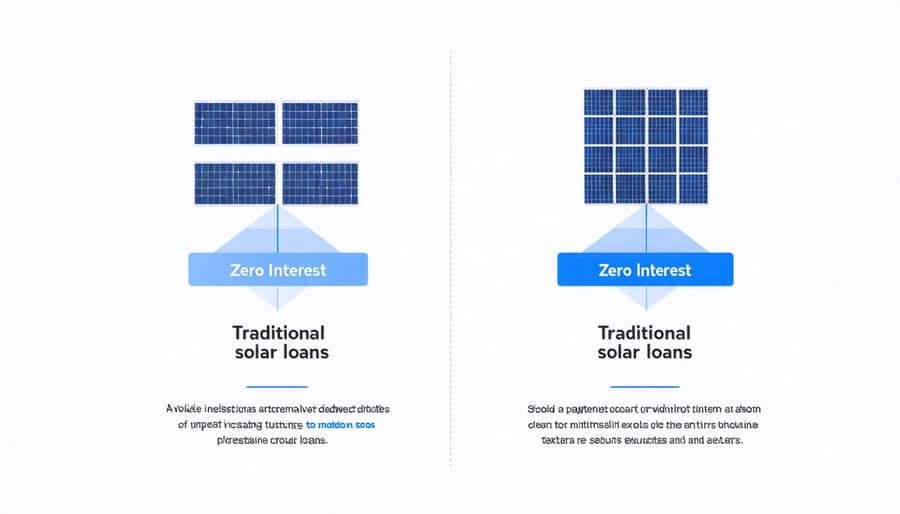
Understanding the financial implications of different solar loan options is crucial when evaluating cost savings from solar energy. Let’s examine a typical scenario for a $20,000 solar installation to illustrate the difference between zero-interest and traditional financing options.
With a zero-interest solar loan:
– Monthly payment: $333 (based on 60-month term)
– Total interest paid: $0
– Total amount paid: $20,000
– No additional fees or charges
With a traditional solar loan (6% APR):
– Monthly payment: $387
– Total interest paid: $3,220
– Total amount paid: $23,220
– Potential origination fees: $200-600
With a home equity loan (4.5% APR):
– Monthly payment: $373
– Total interest paid: $2,380
– Total amount paid: $22,380
– Closing costs: $500-1,000
These comparisons demonstrate that zero-interest financing can result in significant savings over the loan term. For the same solar installation, borrowers save approximately $3,220 compared to traditional solar loans and $2,380 compared to home equity options. Additionally, zero-interest loans typically require minimal documentation and have faster approval processes, making them an efficient financing solution for qualified borrowers.
Long-term Financial Impact
The long-term financial impact of zero-interest solar loans presents a compelling case for property owners considering photovoltaic installations. When analyzing solar investment returns, homeowners typically achieve complete system payback within 5-7 years, significantly accelerated by the absence of interest charges.
A comprehensive financial analysis reveals that a standard 6kW residential solar system, which typically costs between $15,000 and $18,000 before incentives, can generate lifetime savings of $40,000 to $55,000 over 25 years when financed through a zero-interest loan. This calculation factors in reduced electricity bills, federal tax incentives, and state-specific renewable energy credits.
The elimination of interest charges through these specialized loans directly enhances the return on investment (ROI) metrics. For instance, on a $16,000 system with a 10-year zero-interest term, homeowners save approximately $4,800 to $6,400 in interest charges compared to conventional solar loans with 5-6% interest rates. These savings contribute directly to accelerating the system’s payback period.
Moreover, the combination of zero-interest financing and rising utility rates strengthens the investment case. With average electricity rates increasing by 2-3% annually, the fixed monthly loan payments coupled with eliminated interest charges create a predictable financial pathway. Property owners can expect their monthly energy savings to exceed loan payments within the first few years, generating positive cash flow while building equity in their solar asset.
Government and Utility Support Programs
Tax Credits and Rebates
Solar installations qualify for significant financial incentives that can substantially reduce the overall system cost. The federal Investment Tax Credit (ITC) currently allows property owners to claim 30% of their solar installation costs as a tax credit. This incentive remains available through 2032, making zero-interest solar loans even more attractive when combined with tax savings.
Many states offer additional tax credits and incentives. For instance, some jurisdictions provide property tax exemptions for the added home value from solar installations or sales tax exemptions on solar equipment purchases. These state-level benefits can range from hundreds to thousands of dollars in additional savings.
Local utility companies frequently provide rebate programs to encourage solar adoption. These programs may offer performance-based incentives, paying homeowners for the solar energy their systems produce, or upfront rebates based on system size. Some utilities also provide net metering arrangements, allowing customers to earn credits for excess energy production.
Smart solar loan applicants typically combine these various incentives with their zero-interest financing to maximize savings. It’s essential to research available programs in your area and confirm eligibility requirements, as incentive structures and availability can vary significantly by location and may change periodically.
Special Programs and Partnerships
Many local governments and utility companies have established innovative programs to facilitate zero-interest solar financing for their residents. These initiatives often combine federal incentives with local resources to maximize affordability. Notable examples include the Property Assessed Clean Energy (PACE) programs, which allow property owners to finance solar installations through their property tax assessments.
Utility companies frequently partner with financial institutions to offer on-bill financing programs, enabling customers to repay their solar loans through their monthly utility bills. These arrangements typically feature zero-interest terms and extended repayment periods, making solar adoption more accessible to a broader demographic.
Several states have implemented Green Banks, public-private partnerships that leverage public funds to attract private investment in renewable energy projects. These institutions often provide zero-interest loans and technical assistance to homeowners and businesses pursuing solar installations.
Municipal governments may also offer solar group purchase programs, where communities collectively negotiate better rates with installers and secure favorable financing terms. Some utilities provide additional incentives, such as performance-based rebates or renewable energy credits, which can be combined with zero-interest financing to further reduce the overall cost of solar installation.
Application Process and Timeline
Required Documentation
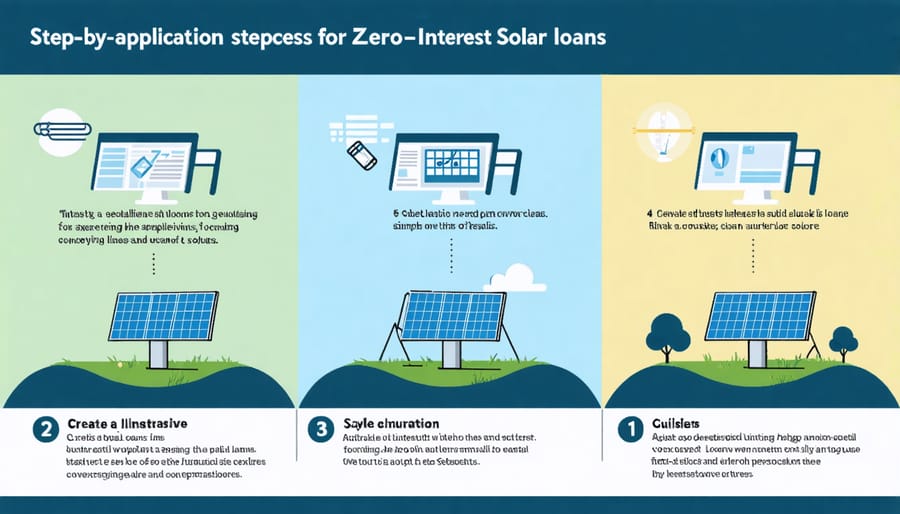
To qualify for a zero interest solar loan, applicants must provide comprehensive documentation that verifies their financial status and property ownership. The following documents are typically required:
Financial Documentation:
– Two most recent pay stubs
– Previous two years of tax returns
– Bank statements from the last three months
– Current credit report (minimum credit score requirements vary by lender)
– List of current debts and monthly obligations
– Proof of employment or income verification letter
Property-Related Documents:
– Proof of homeownership (deed or mortgage statement)
– Recent property tax assessment
– Current homeowner’s insurance declaration page
– Utility bills from the previous 12 months
– HOA approval letter (if applicable)
Solar Project Documentation:
– Detailed solar system proposal from certified installer
– Engineering plans and specifications
– Local building permits and approvals
– Utility interconnection agreement
– Solar contractor’s license and insurance certificates
Additional Requirements:
– Government-issued photo identification
– Social Security number verification
– Signed loan application
– Authorization for credit check
– Property appraisal (may be required by some lenders)
Most lenders require digital submission of these documents through their online portal, though some may accept physical copies. All documents should be current within 60 days of the application date.
Approval and Installation Timeline
The timeline from initial application to complete solar system installation typically spans 45-90 days, depending on various factors including loan approval processing, permitting requirements, and installation scheduling. The initial loan application review usually takes 2-5 business days, during which lenders verify credit history, income documentation, and property ownership.
Once approved, the project enters the system design phase, lasting approximately 1-2 weeks. During this period, engineers conduct site assessments and create customized solar array layouts. Local permitting follows, typically requiring 2-4 weeks for municipal review and approval, though timeframes vary by jurisdiction.
Equipment procurement and scheduling typically take 2-3 weeks, as suppliers coordinate delivery of panels, inverters, and mounting hardware. The physical installation process generally requires 1-3 days for residential systems, though larger installations may take longer. Following installation, final inspections and utility interconnection approval typically require an additional 2-3 weeks.
Factors that may extend timelines include adverse weather conditions, permitting delays, or high seasonal demand for installations. Working with experienced installers who maintain strong relationships with lenders and local authorities can help streamline the process. Some lenders offer expedited approval processes for qualified borrowers, potentially reducing the overall timeline by 15-20%.
Zero interest solar loans represent a transformative financing solution that makes sustainable energy accessible to a broader range of property owners. As the growing solar PV market continues to expand, these financing options have emerged as a crucial catalyst for widespread solar adoption. By eliminating interest charges while preserving the financial benefits of solar installation, these loans offer an unparalleled opportunity to transition to clean energy without the burden of additional costs.
The combination of federal tax incentives, state rebates, and zero interest financing creates a compelling economic case for solar installation. Property owners can significantly reduce their upfront costs while maintaining predictable monthly payments, often offset by immediate energy savings. This arrangement effectively transforms what might otherwise be a substantial financial hurdle into a manageable investment in long-term energy independence.
We encourage readers to thoroughly evaluate their solar financing options, paying particular attention to zero interest programs available through certified installers and financial institutions. By carefully reviewing qualification requirements, terms, and conditions, property owners can make informed decisions that align with their financial goals and environmental values. The path to solar adoption has never been more accessible, and zero interest financing stands ready to help bridge the gap between aspiration and implementation.