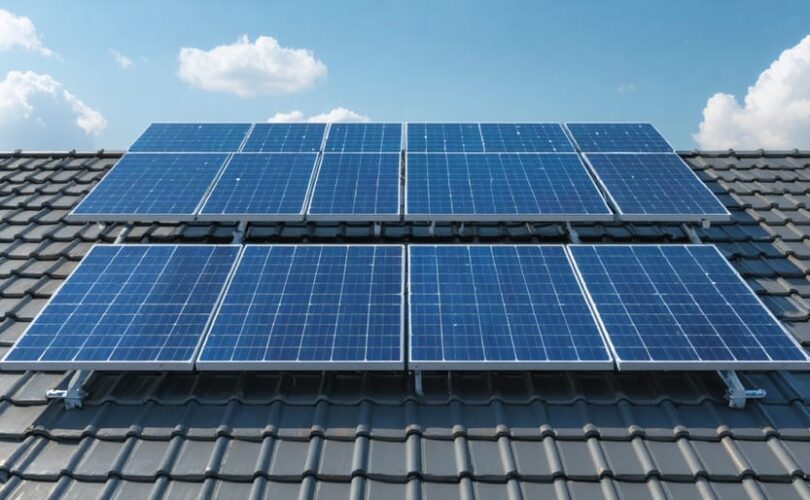
Maximize power output and system reliability by configuring four solar panels in a series-parallel arrangement – a critical setup that combines higher voltage capabilities with enhanced current production. As solar technology advancements continue to evolve, this configuration delivers optimal performance across diverse operating conditions while maintaining compliance with grid interconnection requirements. Two parallel strings, each containing two series-connected panels, create an electrical architecture that balances system voltage requirements with current capacity, enabling more efficient power conversion and reduced transmission losses. This arrangement proves particularly valuable for residential and small commercial installations where space optimization and voltage management are paramount, offering enhanced reliability through redundancy while simplifying maintenance procedures and fault isolation capabilities.
Understanding Series-Parallel Solar Panel Configurations
Series Connection Basics
In a series connection, solar panels are wired sequentially, with the positive terminal of one panel connected to the negative terminal of the next. This configuration results in voltage addition while maintaining a constant current flow throughout the string. When connecting solar panels in series, the total voltage becomes the sum of individual panel voltages, while the current remains equal to that of a single panel.
For example, if each solar panel produces 24V, four panels connected in series will generate a total of 96V. This voltage increase is particularly beneficial for grid-tied systems and long-distance power transmission, as it helps minimize power losses and reduce wire size requirements.
However, series connections present certain considerations. All panels in the string must have matching current ratings to prevent bottlenecking, and shading on even one panel can significantly impact the entire string’s performance. Modern solar installations often incorporate bypass diodes to mitigate these effects, allowing current to flow around underperforming panels.
Temperature variations also affect series-connected panels more prominently, as voltage changes with temperature fluctuations. System designers must account for both cold-weather voltage increases and hot-weather voltage decreases when sizing equipment and ensuring compliance with inverter specifications.
Understanding these fundamental principles of series connections is crucial for optimizing system performance and ensuring safe, efficient operation of solar arrays.

Parallel Connection Fundamentals
In a parallel connection configuration, solar panels are arranged by connecting all positive terminals together and all negative terminals together. This arrangement maintains the same voltage across each panel while combining their current outputs. When solar panels are connected in parallel, the total system voltage remains equal to that of a single panel, while the current (amperage) adds up cumulatively.
For instance, if each solar panel produces 8 amps at 24 volts, four panels connected in parallel will generate a total of 32 amps while maintaining the 24-volt output. This configuration is particularly advantageous when higher current output is required or when dealing with partial shading conditions, as each panel operates independently in terms of voltage.
Parallel connections offer enhanced system reliability since a malfunction in one panel doesn’t significantly impact the performance of the others. However, this configuration requires heavier gauge wiring to handle the increased current flow safely. It’s essential to ensure all panels in the parallel arrangement have matching voltage ratings to prevent unwanted current flow between panels and maintain optimal system efficiency.
When implementing parallel connections, installers must also consider the charge controller’s current handling capabilities and ensure proper overcurrent protection devices are installed to safeguard the system components.
Grid Interconnection Standards for 4-Panel Systems

Voltage and Current Requirements
When configuring four solar panels in a series-parallel arrangement, meeting specific voltage and current requirements is crucial for grid-ready PV systems. The typical grid interconnection standards mandate that the system’s output voltage must fall within 85% to 110% of nominal grid voltage. For a 240V AC system, this translates to an acceptable range of 204V to 264V AC after inverter conversion.
In a series-parallel configuration with four panels, the voltage and current characteristics are determined by the specific arrangement. When two panels are connected in series, their voltages add while maintaining the same current. These two series strings, when connected in parallel, maintain the series voltage while combining their currents.
For example, with typical 60-cell solar panels rated at 30V and 8A:
– Each series string produces 60V (30V × 2)
– The parallel combination maintains 60V
– Total current becomes 16A (8A × 2)
This configuration must account for temperature coefficients and voltage drops across conductors. Voltage typically decreases as temperature increases (-0.3% per °C), while current remains relatively stable. System designers must ensure that:
– Maximum voltage remains below inverter limits
– Minimum voltage stays above MPPT threshold
– Total current doesn’t exceed conductor ratings
– Combined power output matches inverter specifications
These requirements ensure stable grid integration, optimal power production, and safe system operation throughout varying environmental conditions.
Safety and Protection Measures
When installing four solar panels in a series-parallel configuration, implementing proper safety measures is crucial for system reliability and personnel protection. The installation must include appropriately rated circuit breakers and fuses to prevent overcurrent situations that could damage equipment or create fire hazards. Each parallel string should have dedicated overcurrent protection devices sized according to the maximum system current.
Bypass diodes must be properly installed across each panel to prevent hot-spot formation during partial shading conditions. These diodes allow current to flow around shaded cells, protecting them from potential thermal damage. Additionally, blocking diodes should be installed at the end of each series string to prevent reverse current flow during nighttime or low-light conditions.
Ground-fault protection devices are essential to detect and interrupt current leakage paths, protecting both equipment and personnel. The system should incorporate properly sized surge protection devices to guard against voltage spikes from lightning strikes or grid disturbances.
All wiring connections must be made using appropriate weatherproof junction boxes and MC4 connectors rated for DC solar applications. Regular inspection of these connections helps prevent arc faults and ensures system longevity. Emergency disconnect switches should be installed at easily accessible locations, allowing rapid system shutdown when necessary.
It’s imperative to use proper personal protective equipment (PPE) during installation and maintenance, including insulated gloves and tools rated for the system’s maximum voltage.
Optimal Configuration Strategies
Performance Optimization
To maximize the performance of a four-panel series-parallel configuration, several optimization strategies can be implemented. The primary focus should be on enhancing solar panel efficiency through careful system design and maintenance protocols.
Proper panel matching is crucial for optimal performance. When selecting panels for series-parallel configurations, ensure all four panels have identical specifications, including voltage ratings, current capabilities, and power outputs. Even minor variations can lead to significant efficiency losses due to the mismatch effect.
Strategic panel positioning plays a vital role in system optimization. Install panels at the optimal tilt angle for your geographical location, typically between 30-45 degrees in most regions. Maintain consistent orientation across all panels to prevent shading disparities that could trigger bypass diodes and reduce overall system output.
Implementation of Maximum Power Point Tracking (MPPT) technology is essential for series-parallel configurations. MPPT controllers continuously adjust the system’s operating parameters to extract maximum available power under varying environmental conditions. For four-panel systems, select an MPPT controller rated appropriately for the combined system voltage and current.
Regular maintenance procedures significantly impact long-term performance. Establish a routine cleaning schedule to remove dust, debris, and other accumulations that can reduce light absorption. Monitor panel temperatures and ensure adequate ventilation to prevent heat-related efficiency losses. Inspect electrical connections periodically to identify and address potential points of resistance.
Temperature compensation mechanisms should be incorporated into the system design. Install temperature sensors and utilize controllers with temperature compensation features to adjust charging parameters automatically. This helps maintain optimal performance across varying weather conditions and seasons.
Consider implementing panel-level monitoring systems to track individual panel performance within the series-parallel configuration. This enables quick identification of underperforming panels and allows for prompt corrective action, ensuring the system maintains peak efficiency throughout its operational lifetime.
Common Configuration Challenges
When implementing a series-parallel configuration with four solar panels, several common challenges can affect system performance and reliability. Understanding these issues and their solutions is crucial for optimal system operation.
Voltage mismatch between parallel strings represents one of the most significant challenges. When two series strings are connected in parallel, any voltage difference between them can lead to circulating currents, reducing overall system efficiency. This typically occurs due to panel manufacturing tolerances, shading conditions, or varying degrees of panel degradation. Installing blocking diodes between strings helps prevent reverse current flow and protects panels from potential damage.
Panel compatibility issues frequently arise when replacing or expanding existing configurations. Using panels with different specifications in the same series-parallel arrangement can create performance bottlenecks. To avoid this, ensure all panels have matching voltage and current ratings, ideally from the same manufacturer and production batch.
Temperature variations across panels can lead to inconsistent performance. Panels exposed to different ambient temperatures or cooling conditions may operate at varying efficiencies, affecting the entire array’s output. Proper panel spacing and adequate ventilation help maintain uniform operating temperatures across all modules.
Shading presents another critical challenge, particularly in residential installations. Even partial shading on one panel can significantly impact the performance of its entire series string. Implementing power optimizers or microinverters can help mitigate these effects by allowing each panel to operate at its maximum power point independently.
Wiring complexity increases with series-parallel configurations, raising the risk of installation errors. Incorrect connections can lead to reduced system efficiency or safety hazards. Using clearly labeled cables, maintaining detailed wiring diagrams, and performing thorough testing during installation helps prevent these issues. Regular maintenance inspections should include checking for loose connections and signs of wire degradation.
The configuration of four solar panels in a series-parallel arrangement offers a versatile and efficient solution for various photovoltaic applications. Throughout this discussion, we have explored the fundamental principles, benefits, and practical considerations of implementing this configuration. By connecting two pairs of panels in series and then combining these pairs in parallel, system designers can achieve an optimal balance between voltage and current outputs while maintaining system reliability.
Key advantages of this configuration include enhanced system flexibility, improved shade tolerance, and more efficient power production under varying environmental conditions. The series-parallel arrangement also provides redundancy, ensuring continued operation even if one panel experiences reduced performance or failure. This configuration is particularly beneficial for residential and small commercial installations where space and efficiency optimization are crucial considerations.
When implementing a four-panel series-parallel system, practitioners should carefully consider several factors for optimal performance. These include matching panel specifications, using appropriate cable sizing, installing proper overcurrent protection devices, and ensuring compatibility with the selected inverter specifications. Regular maintenance and monitoring are essential to maintain system efficiency and longevity.
For best results, we recommend:
– Conducting thorough site assessments before installation
– Using panels with identical specifications to prevent mismatch losses
– Installing high-quality bypass diodes and junction boxes
– Implementing proper grounding and protection measures
– Following manufacturer guidelines for mounting and connections
– Maintaining detailed documentation of system configuration and performance
As the renewable energy sector continues to evolve, understanding and properly implementing series-parallel configurations remains crucial for maximizing solar energy system performance. This knowledge enables practitioners to design more resilient and efficient photovoltaic systems while ensuring compliance with current industry standards and safety regulations.
Looking ahead, advances in solar technology and power electronics will likely introduce new opportunities to optimize series-parallel configurations further, making this fundamental knowledge increasingly valuable for industry professionals and system designers.