Solar-powered water production systems are revolutionizing manufacturing sustainability by combining photovoltaic technology with advanced water extraction methods. This integration enables facilities to generate clean water from atmospheric moisture or purify existing water sources while operating entirely on renewable energy. As global water scarcity intensifies and environmental regulations tighten, solar-powered water systems offer manufacturers a dual advantage: reducing operational costs while meeting sustainability targets.
Recent technological breakthroughs in solar-thermal desalination and atmospheric water generation have achieved efficiency rates exceeding 85%, making these systems increasingly viable for large-scale industrial applications. Leading manufacturers implementing these solutions report up to 60% reduction in water-related expenses while maintaining consistent production output. The convergence of high-efficiency solar panels, advanced water extraction technologies, and smart monitoring systems has created a new paradigm in sustainable manufacturing processes.
This comprehensive analysis explores cutting-edge solar water production technologies, implementation strategies, and economic implications for manufacturing facilities. We’ll examine real-world case studies, ROI calculations, and best practices for integrating these systems into existing industrial operations, providing decision-makers with actionable insights for sustainable water management solutions.
Water Demands in Solar PV Manufacturing
Manufacturing Process Water Requirements
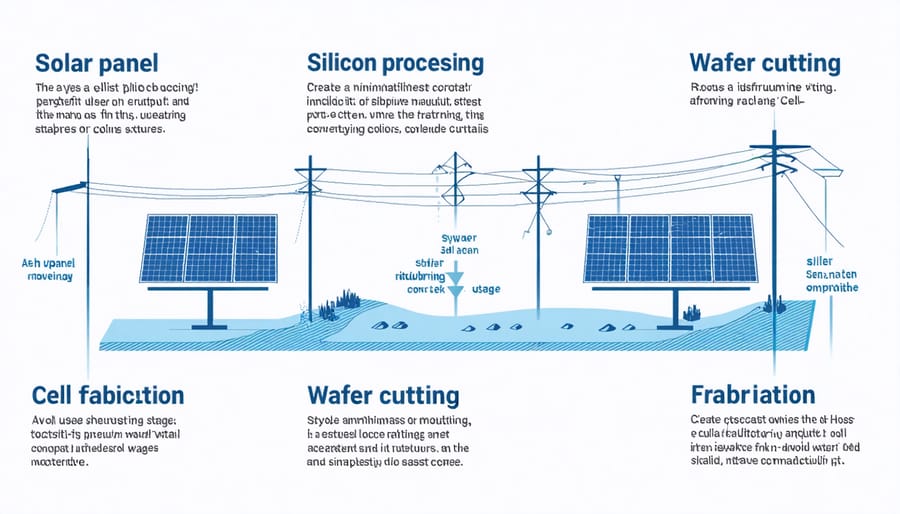
Water plays a crucial role in the solar PV cell manufacturing process, with significant quantities required across multiple production stages. During silicon processing, ultra-pure water is essential for cleaning and removing impurities, consuming approximately 1,500 liters per square meter of solar cells produced. Wafer cutting operations demand roughly 600 liters per square meter, primarily for cooling and lubricating diamond wire saws while slicing silicon ingots into wafers.
Cell fabrication requires an additional 1,000 liters per square meter, used in texturing, etching, and surface cleaning processes. This stage demands the highest water purity levels, often requiring multiple deionization and filtration steps. Cooling systems throughout the manufacturing facility account for approximately 400 liters per square meter of production capacity.
These requirements highlight the importance of implementing efficient water management systems and recycling technologies to reduce consumption while maintaining product quality. Modern facilities increasingly incorporate closed-loop systems that can reclaim up to 85% of process water, significantly reducing environmental impact and operational costs.
Quality Standards and Purification Needs
Water produced through solar-powered systems must meet stringent quality standards to ensure safety and usability in various applications. The World Health Organization (WHO) guidelines specify that drinking water should contain less than 1,000 total dissolved solids (TDS) per million and be free from harmful microorganisms. Industrial applications often require even stricter standards, particularly in semiconductor manufacturing where ultra-pure water is essential.
Common purification processes in solar-powered systems include multi-stage filtration, reverse osmosis (RO), and ultraviolet (UV) disinfection. The initial filtration removes suspended particles and sediments, while RO membranes eliminate dissolved solids, ions, and contaminants. UV treatment provides additional protection against biological contamination.
Regular monitoring and maintenance of purification systems are crucial for consistent water quality. This includes periodic testing of key parameters such as pH levels, conductivity, turbidity, and microbiological content. Advanced monitoring systems with real-time sensors can automatically adjust treatment processes to maintain optimal water quality, ensuring compliance with regulatory requirements and specific industry standards.
Quality certification from recognized bodies such as NSF International or ISO may be required depending on the intended use of the produced water.
Solar-Powered Water Production Technologies
Solar Desalination Systems
Solar desalination systems represent a significant advancement in sustainable water production, combining solar energy technology with water purification processes. These systems utilize solar thermal or photovoltaic energy to remove salt and impurities from seawater or brackish water, making it suitable for manufacturing applications.
The two primary approaches to solar desalination include direct and indirect methods. Direct solar desalination employs solar stills, where sunlight directly evaporates water, leaving behind salt and contaminants. This process mimics the natural water cycle, producing high-purity water through condensation. Indirect methods utilize solar energy to power conventional desalination processes such as reverse osmosis or multi-effect distillation.
Modern solar desalination facilities often incorporate advanced membrane technology and energy recovery systems to maximize efficiency. Membrane distillation, a promising technology, uses temperature differences created by solar heating to drive water vapor through specialized membranes. This process requires less energy compared to traditional thermal desalination methods.
Industrial implementations typically feature large-scale solar collector arrays coupled with desalination units. These systems can be optimized for specific manufacturing requirements, with some facilities achieving production capacities of several thousand cubic meters per day. Energy storage solutions, such as thermal storage tanks or battery systems, ensure continuous operation during non-sunny periods.
The integration of smart monitoring systems and automated controls helps maintain optimal performance while reducing operational costs. These systems continuously adjust parameters based on solar availability, water quality requirements, and production demands. Recent innovations in materials science have led to the development of more durable and efficient components, further enhancing system reliability and longevity.

Atmospheric Water Generation
Atmospheric water generation (AWG) represents a promising solar-powered solution for water production, particularly in regions with limited access to traditional water sources. This technology harnesses solar energy to extract moisture from ambient air through a condensation process, offering a sustainable approach to water generation.
The process begins with solar panels powering an air handling system that draws ambient air through specialized moisture-absorbing materials. These materials, typically featuring advanced desiccants or hydrophilic surfaces, capture water vapor from the air. The system then uses solar thermal energy or photovoltaic-powered cooling systems to reduce the temperature below the dew point, causing water vapor to condense into liquid form.
Modern AWG systems incorporate intelligent controls that optimize performance based on environmental conditions. These systems monitor relative humidity, temperature, and solar availability to maximize water production efficiency. Advanced units can generate between 3-10 liters of water per day per square meter of solar panel area, depending on atmospheric conditions.
Implementation challenges include maintaining consistent production during periods of low humidity or limited solar exposure. To address these limitations, hybrid systems often combine AWG with energy storage solutions, ensuring continuous operation. Some installations integrate thermal storage materials that retain solar heat for nighttime operation.
The effectiveness of solar-powered AWG systems varies significantly with geographic location and climate conditions. Optimal performance typically occurs in coastal areas or regions with relative humidity above 60%. Recent technological advances have improved system efficiency in arid environments, though production rates remain lower compared to humid conditions.
For manufacturing facilities, AWG systems can supplement existing water supplies while reducing dependence on municipal sources. These systems demonstrate particular value in remote locations where traditional water infrastructure is unavailable or cost-prohibitive.
Integration and Optimization Strategies
System Design and Integration
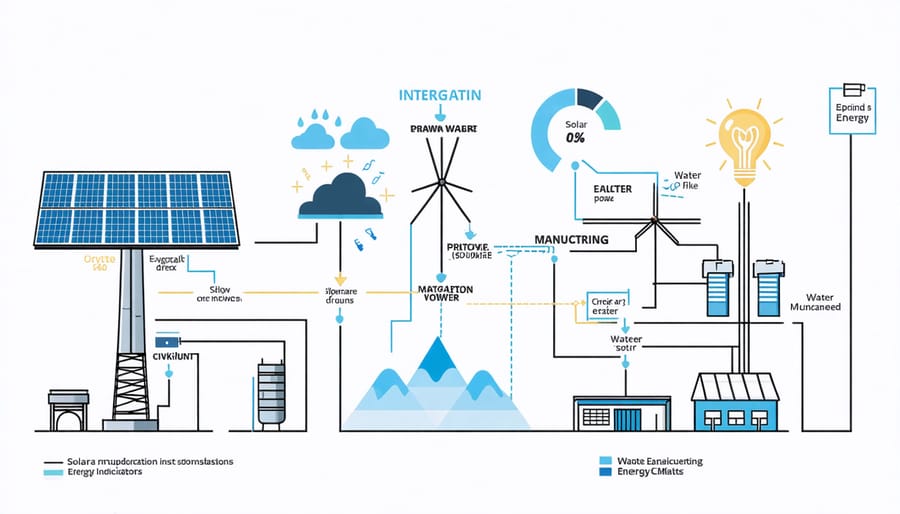
The successful implementation of solar-powered water production systems requires careful consideration of multiple components and their integration. The design process begins with a comprehensive site assessment to determine solar resource availability, water demand patterns, and local environmental conditions. Engineers must calculate the required photovoltaic array capacity based on daily water production targets and system efficiency factors.
System integration involves coordinating three primary subsystems: the solar power generation unit, water treatment equipment, and control systems. The photovoltaic array must be properly sized to power both the water extraction mechanism (typically pumps or atmospheric water generators) and treatment processes. Energy storage solutions, such as batteries, should be incorporated to ensure consistent operation during periods of low solar radiation.
Water treatment components must be selected based on source water quality and intended use. This may include filtration systems, reverse osmosis units, or distillation equipment. The control system serves as the brain of the operation, monitoring power generation, water production rates, and system parameters while optimizing performance through automated adjustments.
Special attention must be paid to system redundancy and fail-safes to prevent interruptions in water production. This includes implementing backup power systems and establishing maintenance protocols. The design should also incorporate monitoring capabilities for remote operation and diagnostics, enabling efficient system management and troubleshooting.
For optimal performance, all components must be carefully matched in terms of capacity and operational characteristics, ensuring seamless integration and maximum efficiency.
Energy Management
Effective energy management is crucial for maximizing the efficiency of solar-powered water production systems. By implementing advanced manufacturing optimization technologies, facilities can achieve optimal balance between power generation and water production demands.
Key strategies include implementing smart load management systems that prioritize water production during peak solar generation hours and utilize excess energy for storage. Advanced monitoring systems track real-time energy availability and water demand, automatically adjusting production rates to maintain system efficiency.
Energy storage solutions, such as battery banks or thermal storage systems, play a vital role in maintaining continuous operation during periods of low solar irradiance. These systems ensure stable power supply for critical processes while reducing dependence on grid electricity.
Variable frequency drives (VFDs) in pumping systems help optimize energy consumption by adjusting motor speeds based on demand and available power. Additionally, heat recovery systems capture and utilize waste heat from various processes, further improving overall system efficiency.
Regular performance analysis and predictive maintenance schedules ensure optimal energy utilization while minimizing unexpected downtime. This comprehensive approach to energy management results in reduced operational costs and increased system reliability, making solar-powered water production increasingly viable for industrial applications.
Cost-Benefit Analysis
The implementation of solar-powered water production systems requires careful economic analysis to determine long-term viability and return on investment. Initial capital costs typically range from $50,000 to $500,000, depending on system capacity and complexity. These costs encompass solar panel arrays, water treatment equipment, storage facilities, and installation expenses.
Operating costs are significantly lower compared to conventional water production methods, with energy expenses reduced by 60-80%. Annual maintenance costs average 2-3% of the initial investment, primarily covering panel cleaning, filter replacement, and routine system checks. The expected system lifespan of 20-25 years ensures sustained cost benefits.
ROI calculations indicate that most installations achieve breakeven within 5-8 years, depending on local water costs, solar irradiance levels, and utility rates. Facilities operating in water-stressed regions or areas with high electricity costs typically see faster returns. Government incentives and environmental credits can further improve financial outcomes, reducing payback periods by 1-2 years.
Performance metrics show that a well-designed 100kW system can produce 2,000-3,000 liters of water daily, with production costs averaging $0.02-0.04 per liter. This represents a 40-60% reduction compared to traditional grid-powered systems. Additionally, carbon emission reductions contribute to environmental compliance targets and potential carbon credit benefits.
When factoring in rising utility costs and increasing water scarcity, solar-powered water production demonstrates strong long-term economic viability for manufacturing operations.
Future Developments and Industry Impact
The landscape of solar-powered water production is rapidly evolving, with emerging solar technologies promising significant advancements in efficiency and scalability. Advanced photovoltaic materials and improved thermal management systems are expected to increase water production yields by up to 40% within the next decade. These developments are particularly crucial for regions facing severe water scarcity and limited grid connectivity.
Integration of artificial intelligence and IoT sensors is revolutionizing system monitoring and optimization, enabling predictive maintenance and real-time performance adjustments. Smart control systems can now automatically adjust production parameters based on weather conditions and water demand, maximizing operational efficiency while minimizing energy consumption.
Innovative membrane technologies and advanced filtration systems are reducing energy requirements while improving water quality. Research indicates that next-generation graphene-based membranes could reduce energy consumption by up to 20% compared to conventional systems. Additionally, hybrid systems combining solar thermal and photovoltaic technologies are showing promise in achieving higher overall system efficiency.
The industry impact extends beyond technological improvements. Manufacturing facilities implementing solar-powered water production systems are reporting significant reductions in operational costs and carbon emissions. This trend is driving increased investment in research and development, with major manufacturers allocating substantial resources to advance these technologies.
As costs continue to decrease and efficiency improves, widespread adoption of solar-powered water production systems is expected to reshape water management strategies across various industries, particularly in manufacturing and agricultural sectors. This transformation will likely create new opportunities for sustainable water production while supporting global efforts to combat climate change.
Solar-powered water production represents a transformative solution at the intersection of renewable energy and sustainable water management. Through this comprehensive analysis, we’ve explored how photovoltaic technology enables efficient water generation through various methods, including atmospheric water generation, desalination, and purification systems. The economic viability of these systems continues to improve as solar technology advances and implementation costs decrease.
Looking ahead, the future of solar-powered water production appears promising. Emerging technologies, such as enhanced photovoltaic materials and improved water capture mechanisms, are poised to increase system efficiency and reduce operational costs further. Industry collaboration with research institutions is driving innovation in this field, leading to more sophisticated and cost-effective solutions.
As water scarcity becomes an increasingly pressing global challenge, the role of solar-powered water production systems will become more crucial. Their ability to operate in remote locations, minimal environmental impact, and decreasing installation costs make them an attractive solution for both industrial applications and community water needs. Continued investment in research and development, coupled with supportive policies, will be essential in advancing this technology and ensuring its widespread adoption.