
Solar energy stands at the forefront of our transition to sustainable power generation, revolutionizing how we harness and deploy renewable resources in modern energy systems. As solar PV components become increasingly sophisticated, the industry has achieved remarkable advances in both efficiency and sustainability. Recent technological breakthroughs have pushed solar conversion efficiency beyond 25% in commercial applications, while simultaneously reducing the environmental impact of manufacturing processes.
The integration of renewable materials in solar technology represents a crucial evolution in photovoltaic development, addressing both environmental concerns and long-term sustainability goals. From recycled silicon in cell production to bio-based encapsulation materials, manufacturers are pioneering innovative solutions that minimize resource depletion while maintaining optimal performance standards. This strategic shift towards renewable resources in solar manufacturing not only enhances the technology’s environmental credentials but also establishes a more resilient and sustainable supply chain for the growing global solar industry.
These advancements signal a transformative period in renewable energy, where the very components that harness solar power are themselves becoming more sustainable and environmentally responsible.
The Evolution of Renewable Materials in Solar PV Technology
Traditional vs. Renewable Materials
Solar photovoltaic technology has traditionally relied on materials like silicon, silver, and aluminum, which often involve resource-intensive extraction and processing methods. Silicon-based solar cells, while efficient, require significant energy during manufacturing and purification processes. In contrast, emerging renewable materials offer more sustainable alternatives without compromising performance.
Recent innovations include bio-based encapsulants derived from plant materials, replacing conventional petroleum-based EVA films. Recycled silicon from electronic waste now serves as a viable alternative to virgin silicon in cell production. Organic photovoltaic materials, synthesized from abundant carbon-based compounds, present promising opportunities for sustainable manufacturing.
Perovskite solar cells, utilizing earth-abundant materials, demonstrate remarkable potential in reducing material costs and environmental impact. These cells can be manufactured at lower temperatures, consuming less energy than traditional silicon processing. Additionally, transparent wood composites are emerging as renewable alternatives to glass substrates, offering improved durability and reduced weight.
The transition to renewable materials in solar technology not only addresses resource scarcity but also supports circular economy principles, ensuring long-term sustainability in photovoltaic manufacturing.

Environmental Impact Assessment
The adoption of renewable materials in photovoltaic manufacturing represents a significant advancement in reducing the environmental impact of solar manufacturing. Modern manufacturing processes increasingly incorporate bio-based polymers, recycled silicon, and sustainable encapsulation materials, resulting in a substantially lower carbon footprint compared to traditional methods. Life cycle assessments indicate that renewable materials can reduce manufacturing emissions by up to 30% while maintaining panel efficiency and durability.
Key environmental benefits include decreased reliance on fossil fuel-derived materials, reduced water consumption during production, and minimized toxic waste generation. Manufacturers utilizing renewable resources typically achieve a 25% reduction in energy consumption during production, while implementing closed-loop recycling systems ensures that end-of-life panels contribute to a circular economy rather than becoming environmental hazards.
Research indicates that panels manufactured with renewable materials demonstrate comparable or superior performance metrics while significantly reducing ecological impact throughout their lifecycle. This advancement aligns with global sustainability goals and strengthens the solar industry’s position as a leader in clean energy technology.
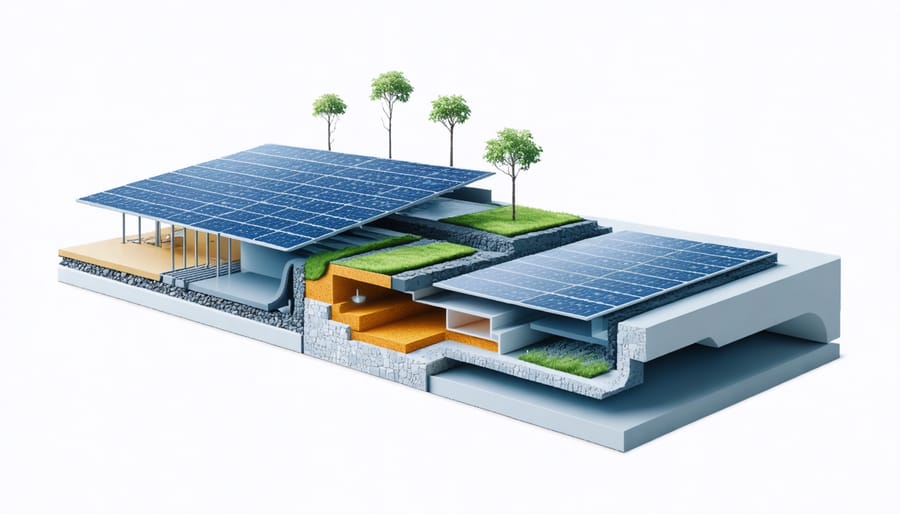
Key Renewable Components in Modern Solar PV Systems
Bio-based Encapsulation Materials
Bio-based encapsulation materials represent a significant advancement in developing sustainable materials in solar panels. These renewable alternatives to traditional petroleum-based encapsulants are derived from natural sources such as plant oils, cellulose, and other biological materials.
The most promising bio-based encapsulants include modified vegetable oils, which demonstrate excellent UV stability and moisture resistance. Epoxidized soybean oil (ESO) and linseed oil derivatives have shown particular potential, offering comparable performance to conventional EVA (ethylene-vinyl acetate) while reducing environmental impact.
Cellulose-based materials, processed into transparent films, provide another innovative solution. These materials exhibit strong adhesion properties and thermal stability, essential characteristics for protecting solar cells. Recent developments in bio-based polyurethanes and polyesters have also yielded encapsulants with improved durability and weather resistance.
Research indicates that these materials can maintain cell efficiency while biodegrading naturally at end-of-life, addressing both performance and environmental concerns. Laboratory tests demonstrate that some bio-based encapsulants achieve transmission rates above 90% across the solar spectrum, matching or exceeding traditional materials.
The integration of these materials into commercial production requires careful consideration of scalability and cost-effectiveness, but their potential to reduce carbon footprint makes them increasingly attractive to manufacturers committed to sustainability.
Sustainable Frame Materials
The sustainable evolution of solar panel frames has led to significant innovations in eco-friendly materials that enhance both environmental compatibility and performance. Traditional aluminum frames, while durable, carry a substantial carbon footprint during production. Modern alternatives include recycled aluminum composites, which reduce primary material demand by up to 95% while maintaining structural integrity.
Biocomposite frames, developed through collaboration with materials science laboratories, incorporate renewable resources such as bamboo fibers and recycled plastics. These hybrid materials offer comparable strength-to-weight ratios to conventional frames while significantly reducing environmental impact. Recent advancements in thermoplastic polymers derived from agricultural waste have shown promising results in durability testing, withstanding diverse weather conditions and maintaining structural stability over extended periods.
Carbon fiber reinforced bio-resins represent another breakthrough in sustainable frame technology. These materials combine lightweight properties with exceptional strength, reducing transportation costs and installation complexity. The manufacturing process for these advanced composites generates 60% fewer emissions compared to traditional aluminum frame production.
Certification programs now recognize the importance of sustainable framing materials, with several manufacturers achieving cradle-to-cradle certification for their eco-friendly frame designs. This holistic approach considers the entire lifecycle of frame materials, from sourcing through end-of-life recycling, ensuring a truly sustainable product that aligns with renewable energy principles.
Renewable Backsheet Technologies
Renewable backsheet technologies represent a significant advancement in sustainable solar panel manufacturing, offering environmentally conscious alternatives to traditional petroleum-based materials. These innovative materials serve as the protective outer layer of photovoltaic modules while reducing the carbon footprint of solar panel production.
Bio-based polymers derived from renewable resources are increasingly being utilized as sustainable backsheet components. These materials, often manufactured from plant-based sources such as cellulose and corn starch, provide comparable durability and weather resistance to conventional backsheets while minimizing environmental impact.
Recent developments include recyclable backsheet materials that facilitate end-of-life panel management. These advanced composites maintain essential properties such as moisture barrier protection and electrical insulation while enabling easier separation and recovery of components during the recycling process.
Several manufacturers have successfully implemented bio-based polyethylene terephthalate (PET) and polyolefin compositions, which demonstrate excellent UV stability and mechanical strength. These materials undergo rigorous testing to ensure they meet industry standards for reliability and performance, including accelerated aging tests and thermal cycling evaluations.
The adoption of renewable backsheet technologies contributes to the circular economy within the solar industry. By incorporating these sustainable materials, manufacturers can reduce dependence on fossil fuel-derived components while maintaining the high performance and longevity expected from modern solar panels. This advancement aligns with broader industry goals of minimizing environmental impact throughout the entire solar panel lifecycle.
Future Innovations and Research Directions
Breakthrough Technologies
Recent advancements in breakthrough solar technologies have revolutionized the materials used in photovoltaic systems. Perovskite solar cells represent a significant innovation, offering enhanced efficiency and lower production costs compared to traditional silicon-based panels. These materials demonstrate remarkable potential with conversion efficiencies exceeding 25% in laboratory settings.
Multi-junction solar cells utilizing organic materials have shown promise in maximizing sunlight absorption across different wavelengths. Research collaborations between leading universities and industry partners have yielded new composite materials that significantly reduce the environmental impact of solar panel manufacturing while maintaining high performance standards.
Emerging thin-film technologies incorporating renewable and abundant materials like copper, zinc, tin, and sulfur (CZTS) present a sustainable alternative to rare earth elements. These materials not only reduce dependency on scarce resources but also facilitate easier end-of-life recycling processes.
Transparent solar cells, developed using sustainable polymers, are transforming building-integrated photovoltaics. These innovative materials enable windows and surfaces to generate electricity while maintaining optical transparency, expanding solar energy applications in urban environments.
Bio-based encapsulation materials and recycled components are increasingly being integrated into solar panel manufacturing, creating a more circular economy approach to renewable energy production.

Industry Adoption Challenges
Despite the growing momentum in renewable solar energy adoption, several significant challenges continue to impact industry-wide implementation. Cost remains a primary barrier, with initial investment requirements for sustainable materials often exceeding traditional alternatives. Manufacturing processes for eco-friendly components typically demand specialized equipment and expertise, contributing to higher production expenses.
Supply chain constraints present another substantial challenge. The limited availability of certain renewable materials and dependency on specific geographical regions for raw materials can create bottlenecks in production and increase market volatility. This situation is further complicated by varying international regulations and trade policies affecting material sourcing and distribution.
Technical performance considerations also influence adoption rates. While renewable materials show promising results, some still need to match the efficiency and durability of conventional options. Research and development efforts focus on bridging this gap, but the process requires significant time and resource investment.
Infrastructure adaptation poses additional challenges. Existing manufacturing facilities often require substantial modifications to accommodate new materials and processes. This transition demands careful planning, workforce training, and potential production interruptions.
Solutions to these challenges include increased research funding, government incentives for sustainable material adoption, and industry collaboration to standardize processes. Educational initiatives and workforce development programs are essential for building expertise in renewable material handling and implementation. As technology advances and economies of scale improve, these barriers are expected to diminish, facilitating broader industry adoption.
Implementation Strategies and Best Practices
The successful implementation of renewable materials in photovoltaic manufacturing requires a systematic approach combining strategic planning, quality control, and sustainable practices. Manufacturing facilities should begin by conducting a comprehensive assessment of their current material usage and identifying opportunities for incorporating renewable alternatives.
Key implementation strategies include establishing partnerships with sustainable material suppliers, developing robust quality assurance protocols, and investing in specialized equipment designed for handling renewable materials. Manufacturers should prioritize materials that offer both environmental benefits and maintain high performance standards in solar panel production.
Best practices for renewable material integration encompass several critical areas. First, implement a staged approach to material substitution, starting with components that have proven renewable alternatives. This allows for proper testing and validation before full-scale implementation. Second, establish clear procurement guidelines that prioritize suppliers with verified sustainable practices and certification.
Quality control measures are essential when working with renewable materials. Regular testing protocols should verify that renewable components meet or exceed traditional material specifications. This includes accelerated aging tests, durability assessments, and performance evaluations under various environmental conditions.
Employee training programs play a crucial role in successful implementation. Staff should receive comprehensive instruction on handling new materials, understanding their properties, and maintaining quality standards throughout the manufacturing process. Regular updates to training materials ensure alignment with evolving industry standards and technological advances.
Documentation and tracking systems must be implemented to monitor the performance and impact of renewable materials. This includes maintaining detailed records of material sources, processing parameters, and performance metrics. Such data helps optimize manufacturing processes and supports continuous improvement initiatives.
Lastly, manufacturers should develop contingency plans to address potential supply chain disruptions or quality issues. This includes maintaining relationships with multiple suppliers and having alternative materials approved for use when necessary. Regular review and updating of these strategies ensure long-term sustainability and success in renewable material implementation.
The integration of renewable resources in solar PV manufacturing represents a crucial step toward creating a truly sustainable energy ecosystem. As the solar industry continues to expand, the emphasis on utilizing renewable materials and implementing circular economy principles becomes increasingly important for long-term sustainability. Recent technological advances have demonstrated that incorporating renewable resources not only reduces environmental impact but also contributes to improved panel efficiency and durability.
Looking ahead, the solar industry is poised for significant transformation through innovative material solutions. Research indicates that bio-based polymers, recycled silicon, and sustainable encapsulation materials will play pivotal roles in next-generation solar technologies. The development of these alternatives, coupled with improved manufacturing processes, promises to further reduce the carbon footprint of solar panel production while maintaining or enhancing performance standards.
Industry collaboration between manufacturers, research institutions, and environmental organizations continues to drive progress in sustainable material development. As regulations evolving around environmental protection become more stringent, manufacturers are increasingly incentivized to adopt renewable resources in their production processes. This shift not only ensures compliance but also meets growing consumer demand for environmentally responsible products.
The future success of solar energy depends significantly on our ability to balance technological advancement with environmental stewardship. By prioritizing renewable resources in manufacturing, the solar industry can maximize its positive impact on global sustainability while maintaining its position as a leading clean energy solution.